The art of François Schuiten

schuiten1.jpg

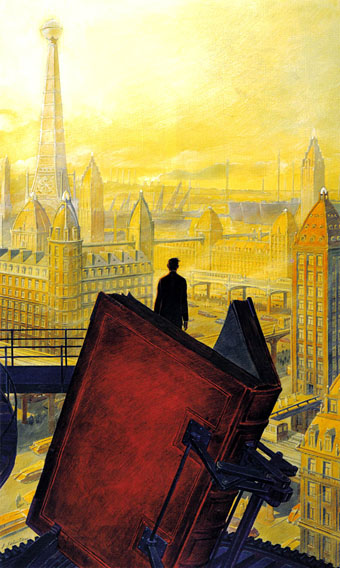
Paris au XXieme Siecle by Jules Verne (1994).

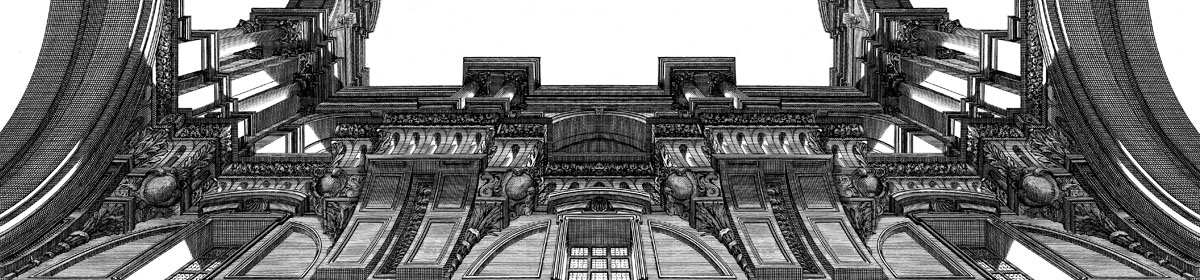
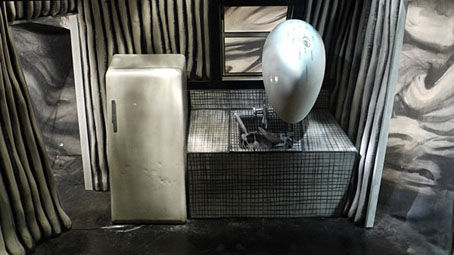
Following a comment I made last week in the post about the Temples of Future Religions by François Garas I’ve decided it’s time to give some proper attention to one of my favourite comic artists, François Schuiten, a Belgian whose obsession with imaginary architecture resembles the earlier endeavours of Garas and others. Schuiten’s parents were both architects which perhaps explains his predilection. In addition to a large body of comics work, he’s produced designs for film—notably Taxandria by Raoul Servais—Belgian stamps, and a steampunk makeover for the Arts et Métiers station of the Paris Métro. In 1994 he created cover designs and a series of illustrations for the publication of Jules Verne’s rediscovered manuscript, Paris au XXieme Siecle.
schuiten2.jpg

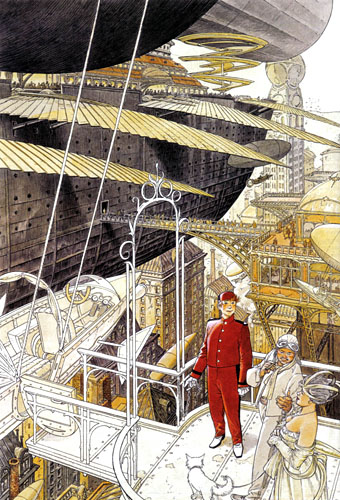
Cover for Spirou (2000).

I first encountered Schuiten’s work in a 1980 issue of Heavy Metal magazine which was reprinting translated stories from the French Métal Hurlant along with original work. Schuiten’s story, The Cutter of the Fog, was an erotic and futuristic tale of a small community and the obsession of the local “fog-cutter”. François’s brother Luc wrote the piece and it bears some similarity with JG Ballard’s Vermilion Sands story, The Cloud Sculptors of Coral D. Unusually for Schuiten, the architecture was downplayed in this one although the small homes with their geodesic roofs are like extrapolations of architectural plans from one of the Whole Earth Catalogues.

The next time I saw his work was several years later when artist Bryan Talbot showed me some of the comic albums he’d brought back from a European convention. Among these there were several of the Cités Obscures books that Schuiten had been creating during the Eighties and Nineties with writer Benoît Peeters. These knocked me out with their apparently effortless creation of an imaginary world comprised of several city states, each with their own unique architectural style, and a wealth of retro-future technology, from dirigibles of all shapes and sizes to ornithopters and huge motorised unicycles. One of the many things I liked about European comic artists, and something which made me favour their work over their American counterparts, was the creation of richly detailed imaginary universes with inhabitants one could expect to meet in our world, not facile superheroes or vigilantes. Schuiten went further than his contemporaries by making the architecture meticulously believable and foregrounding its design to an extent that in some of the Cités Obscures stories architecture itself is the subject.
Continue reading “The art of François Schuiten”

David Lynch window displays

lynch1.jpg

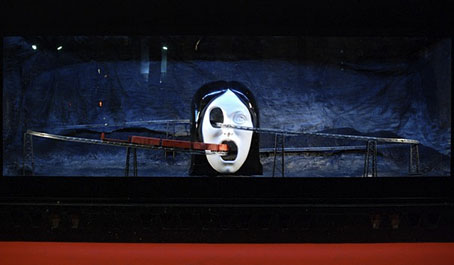
Two of the stunning displays created from sketches by David Lynch for the Galeries Lafayette department store, Paris. The series is entitled Machine-Abstraction-Women, and I don’t think Mr Lynch would mind too much having his description of the works translated in an extruded manner from French to English:

I was always fascinated by the spectacle of the women in front of the windows of the department stores. By designing the fronts of the Lafayette Galleries, I wanted to show all the identities which coexist at the woman of the 21st century. With the reflection of glass which returns the floutée image of the passers by, this set of parallel universes approaches my films, where the same actress interprets several characters. I drew very abstract decorations. Landscapes cubists populated of sculptures, wheels, pieces of furniture, of vidéos, sounds. I see these windows like a labyrinth, a street museum where to move through indices. A window, it is a transparent door on the unknown. (More.)

Much as I like Lynch’s films, I’ve never been very taken with his paintings, they always seem to lack the powerful quality he achieves in other media. But I like these a great deal and it’s a shame this is a one-off commission for a store. He’s also produced an attendant series of lithograph works, I See Myself.

David Lynch aux Galeries
David Lynch en vitrine

lynch2.jpg

Previously on { feuilleton }
David Lynch in Paris
Inland Empire

Maruyama Okyo’s peacocks

okyo1.jpg

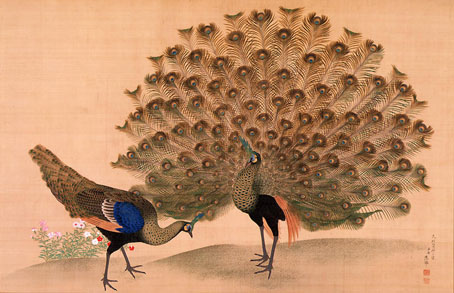
Peacock and Peahen (18th c.).

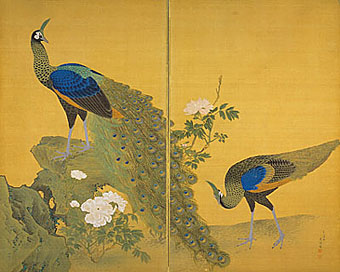
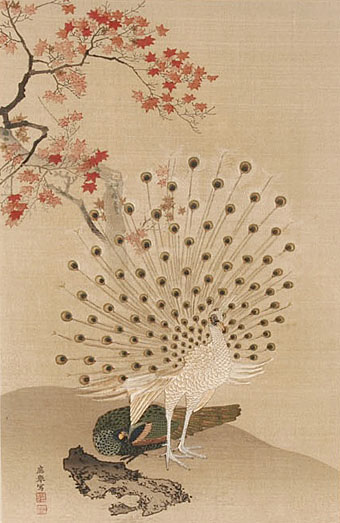
I’ve had an untitled Japanese painting of a peacock as a desktop image for a while now, its origin forgotten, and I’ve wondered a few times who the artist was. A recent posting about Maruyama Okyo (1733–1795) at Bajo el Signo de Libra made me think that Okyo might be the artist responsible. As it turns out, he wasn’t, my bird is by one of his pupils, Nagasawa Rosetsu (1754–1799), and looks like a copy of the picture below. Mystery solved anyway, and the search gives me a good excuse to link to some of Okyo paintings. These differed from the prevailing style of the period, Okyo having studied Western artists and their methods in order to produce work which was more realistic than that of his contemporaries.

okyo2.jpg

Peony and Peacocks (1781).

A realist and an eccentric | Okyo and Rosetsu profiled.

okyo3.jpg

Peacock (no date).

Previously on { feuilleton }
Louis Rhead’s peacocks
The White Peacock
Peacocks
Whistler’s Peacock Room
Beardsley’s Salomé

The art of Bertha Lum, 1869–1954

lum1.jpg

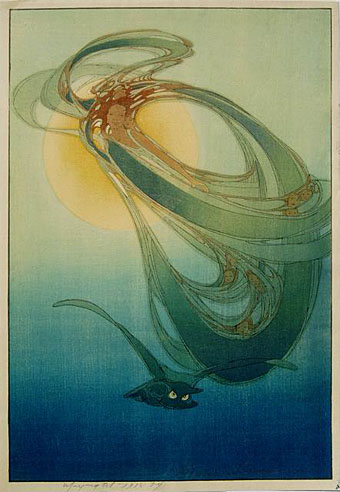
Mother West Wind (1918).

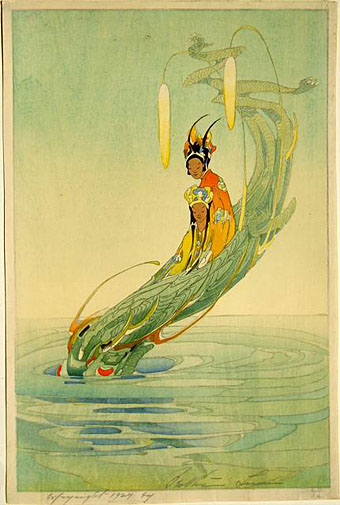
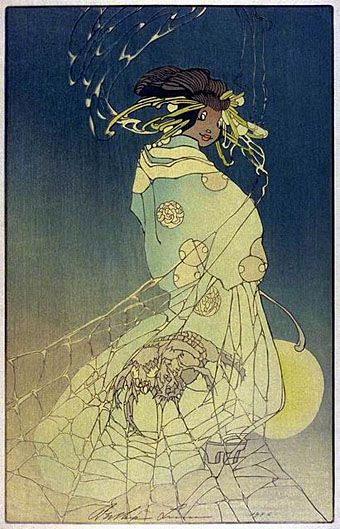
The first thought which comes to mind when looking at these beautiful prints is to wonder why American artist Bertha Lum isn’t more well-known, she had a particularly fondness for fluid lines and swirling arabesques as in the example above. There is at least a wealth of detail about her career online, and her biography shows her to be far more than a careful pasticheur like Edmund Dulac and others. She travelled to Japan specially to learn printmaking, and her later works were produced in collaboration with Japanese artisans. No surprise to see she was attracted to the works of Lafcadio Hearn (1850–1904), another Westerner who did much to introduce the rest of the world to Japanese folklore—especially the ghost stories—during the late Victorian era.

lum2.jpg

The Dragon King and his Bride (1924).

Four pages of catalogued works at Bertha-lum.org
Biography page in English and a reference gallery

lum3.jpg

Spider Woman (1936).

Elsewhere on { feuilleton }
The illustrators archive

Previously on { feuilleton }
The Boy Who Drew Cats
More Arabian Nights

Eduardo Paolozzi’s Jet Age Compendium

paolozzi.jpg

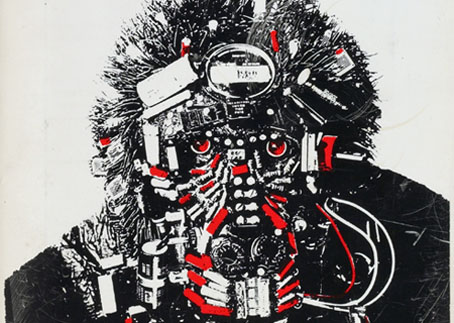
Detail from the cover of Ambit # 40, 1969.

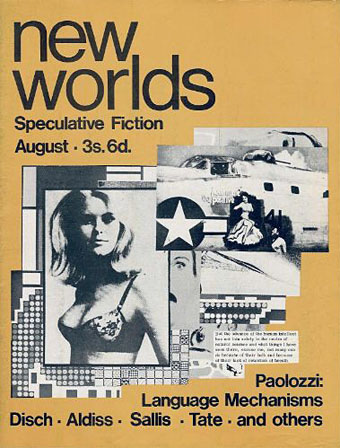
A teenage enthusiasm for Pop Art meant I was familiar with the paintings and collages of Eduardo Paolozzi (1924–2005) long before I became aware of his association with sf magazine New Worlds, and his friendship with JG Ballard. Paolozzi was famously credited on the masthead of New Worlds as “Aeronautics Advisor”, a listing which impressed the relevant authorities when Brian Aldiss petitioned for an Arts Council grant and saved the magazine from collapse. Paolozzi’s work was featured in New Worlds now and then, and he provided a cover for issue 174, but it was to Ambit magazine one had to turn to see regular work by the artist.

paolozzi2.jpg

New Worlds #174, Aug 1967.

My favouritism towards New Worlds has always led me to see Ambit as NW-lite; frequent NW contributor JG Ballard was Ambit‘s fiction editor, and both stood to the side of the British literary scene, although Ambit editor Martin Bax didn’t share Michael Moorcock’s preference for pursuing generic or experimental means to Romantic or visionary ends. Quibbles aside, it’s good to see Paolozzi’s work for the magazine is now the subject of an exhibition, The Jet Age Compendium, at Raven Row, London, and also a book, The Jet Age Compendium: Paolozzi at Ambit from Four Corners Books. If you can’t see the former, the latter is priced £12.95 which strikes me as very reasonable.

The Jet Age Compendium runs until 1 November 2009. For an insight into the artist’s interests and attitudes, there’s a great Studio International interview here from 1971 with Paolozzi and Ballard talking to art critic Frank Whitford.

Previously on { feuilleton }
Sculptural collage: Eduardo Paolozzi
Revenant volumes: Bob Haberfield, New Worlds and others