Weekend links 32

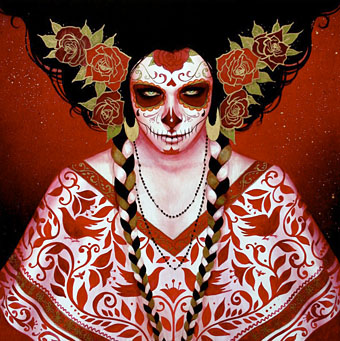
ji1.jpg

Red Quechquemitls (2010) by Sylvia Ji.

• The Blackout Mix, a pay-what-thou-wilt 49-minute mixtape, “specially designed to accompany (or simulate) a human-plant interaction”. Art by Arik Roper, music selection by Jay Babcock.

An ode to the many evolved virtues of human semen: “the penis is capable of dispensing a sort of natural Prozac” says Jesse Bering.

• The new John Foxx CD & DVD release, D.N.A., has a Jonathan Barnbrook cover, a new collaboration with Harold Budd and a disc of short films.

• “I have been copying Margaret Hamilton my whole life, and I am proud to admit it. The Wicked Witch of the West, the jolie laide heroine of every bad little boy’s and girl’s dream of notoriety and style, whose twelve minutes of screen time in The Wizard of Oz can never be topped … I’m a big butch-lesbian hag. I love the ones with chips on their shoulders and heavy attitude. They’re my real favorites.” John Waters always gives great interviews.

• Listen to a track from the forthcoming Brian Eno album while you’re reading Kristine McKenna’s interview with the man himself at Arthur mag. Includes an appreciation by Alan Moore.
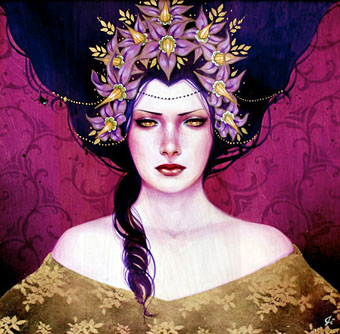
ji2.jpg

Atropa Bella Donna (2009) by Sylvia Ji.

• Steven Severin is touring the UK this month, performing a live accompaniment to screenings of Jean Cocteau’s The Blood of a Poet. He’s at the Tyneside Cinema this Tuesday. Other dates can be found on his website.

• “I know it’s a very emotive subject and you’re either for it or against it but for a jobbing self-employed musician such as me – bootlegging (CD copying) is just killing us.” Finding The Spaces Between: musician Chris Carter (Throbbing Gristle, Chris & Cosey, et al) interviewed.

Mile End Pugatorio (1991), a one-minute film-poem by Guy Sherwin and Martin Doyle. Related: four one-minute movies by The Residents.

• Gijs Van Vaerenbergh installed an Upside Dome at the St. Michiel Church in Leuven, Belgium.

• Sidney Sime illustrates Lord Dunsany at Golden Age Comic Book Stories.

Europe according to gay men. There’s more at Mapping Stereotypes.

• There’s never a dull moment in the High Desert.

• Generative art by Leonardo Solas.
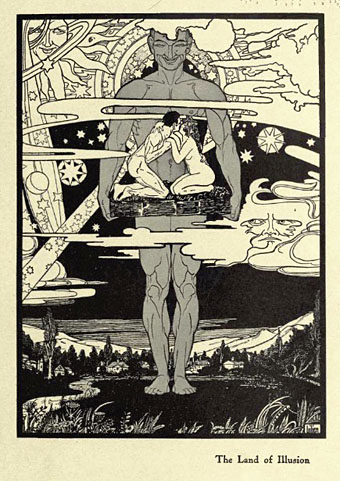
The art of Ephraim Moses Lilien, 1874–1925

lilien1.jpg

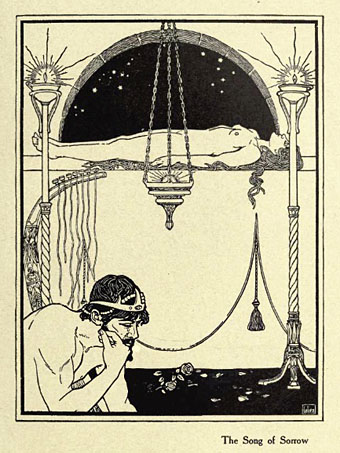
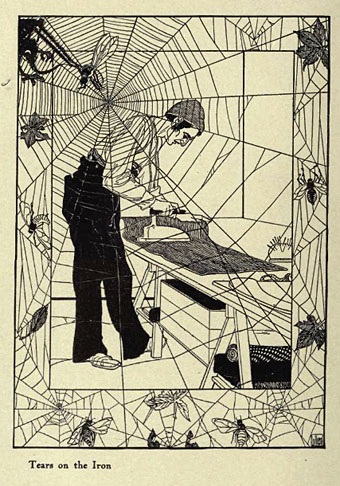
Marvellous black-and-white work from a Galician artist whose drawings were predominately concerned with Jewish and Zionist themes. These are from a small monograph about the artist, The New Art of an Ancient People; The Work of Ephraim Mose Lilien (1906) which can be downloaded at the Internet Archive. Elsewhere there’s a page here about the artist with further examples and links, a gallery site with a catalogue of his drawings of Palestine, and some of his illustrations can also be found in back issues of Jugend magazine.

lilien2.jpg

lilien3.jpg

Elsewhere on { feuilleton }
The illustrators archive

Previously on { feuilleton }
Jugend, 1900

Wildeana 3

teleny.jpg

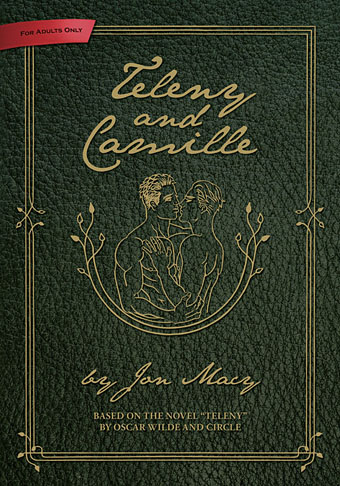
Some recent pieces of Wilde news. The cover above is for a new edition of Teleny and Camille, Jon Macy‘s comic strip adaptation of the erotic novel attributed to Oscar Wilde and members of his Uranian circle:

Teleny is the haunted musical genius that everyone desires but no one has truly touched… until the fateful night that he senses Camille’s presence in the audience. The wealthy young man is instantly seduced by Teleny’s dark beauty and smoldering melancholy. This groundbreaking and powerful early gay novel, written in secret by Oscar Wilde and his anonymous circle of writers, is now re-interpreted as a graphic novel, in all its lush, pansexual excess.

I wrote something about the novel last year. I’m not convinced that Wilde penned the whole thing but I can see places where he may have contributed. There’s a marvellous scene in an all-white room, for example, which seems inspired by the obsessive decor in Des Esseintes’ house from À rebours, the novel which had a great influence on Dorian Gray (both book and character). I’d been intending on writing something substantial about Macy’s adaptation all summer but failed dismally due to a deluge of deadlines. Suffice to say it’s a very accomplished and (most important) erotic work, doing full justice to a story that makes many later erotic novels seem timid and evasive. The drawings are black-and-white throughout which gives a Beardsley-like quality in places, and Macy conveys a period feel without fretting over details as I’m afraid I’d be tempted to do. Northwest Press have published the new edition and have a selection of reviews here.

For the other Wildeana, Lambda Literary had a review of a new book by Matthew Hofer and Gary Scharnhorst, Oscar Wilde in America: The Interviews which sounds like another essential purchase. And the Independent had this story about a sale of Wilde letters which included one to a magazine editor that may be read as a proposition. Readers of Neil McKenna’s The Secret Life of Oscar Wilde will be familiar with the form and know that there’s no “maybe” about it; Priapus was calling.

Elsewhere on { feuilleton }
The gay artists archive
The Oscar Wilde archive

Diaghilev’s World of Art

miriskusstva1.jpg

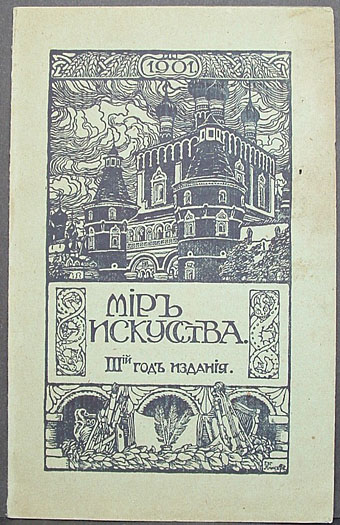
Cover by Evgeny Lanceray for Prospectus of the Magazine, 1901.

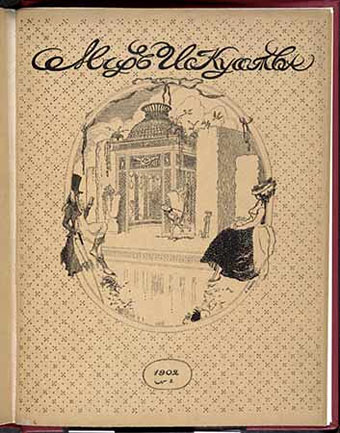
Previous posts here have concerned fin de siècle art magazines like The Savoy, Pan and Jugend; yesterday we had Sergei Diaghilev so it seems fitting to mention Diaghilev’s own magazine, Mir Iskusstva (World of Art), founded in 1899 with similar intentions to the European magazines which were highlighting developments in art beyond the academic sphere. Mir Iskusstva was also the name of the Russian art group who used the magazine as their forum, and a number of the artists involved in the movement, notably Léon Bakst, Ivan Bilibin and Nicholas Roerich, went on to work for Diaghilev at the Ballets Russes.

miriskusstva2.jpg

Cover by Léon Bakst for Mir iskusstva #8 (1902).

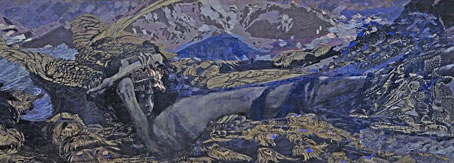
I find this later development especially fascinating since it positions the magazine as a precursor to the groundbreaking works which followed rather than being—as so many periodicals were and still are—a publication which had its moment of glory then faded from view. Of the works shown here, Vrubel’s Symbolist Demon, one of several painted by the artist, was featured in a 1903 edition of the magazine, whilst the Bakst painting, depicting the destruction of Atlantis, shows a Symbolist side to an artist who later became far better known for his Ballets Russes costume designs.

vrubel.jpg

Demon (1902) by Mikhail Vrubel.

Unlike the other magazines mentioned above, I’ve yet to come across a cache of whole editions of Mir Iskusstva (and I’m still waiting for Ver Sacrum to turn up somewhere). This page has an overview of the Russian art movement and its journal, while this page has a selection of works by the artists involved. For more of Vrubel’s work, Wikimedia Commons has the best collection of the artist’s paintings and sculpture.

bakst.jpg

Terror Antiquus (1908) by Léon Bakst.

Previously on { feuilleton }
Diaghilev and the Ballets Russes
Pamela Colman Smith’s Russian Ballet
The art of Ivan Bilibin, 1876–1942
Magic carpet ride
Le Sacre du Printemps
Images of Nijinsky

Diaghilev and the Ballets Russes

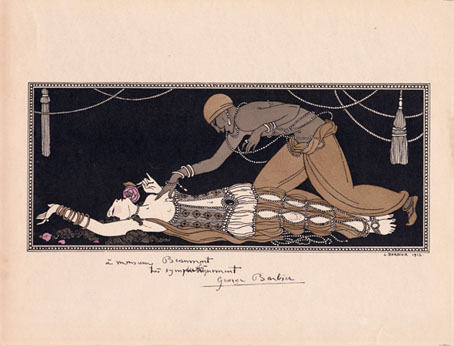
diaghilev1.jpg

Ida Rubinstein as Zobeide and Vaslav Nijinsky as the Golden Slave in Schéhérazade (1913) by George Barbier.

Another great exhibition at the V&A, London, Diaghilev and the Ballets Russes gathers a wealth of costumes, stage designs, photographs and ephemera—including some of Stravinsky’s manuscripts—to present a history of the legendary ballet company and their visionary impresario. For those who can’t get to London the museum website shows some of the items which will be on display, and there’s also a blog about the installing of the exhibition. The enormous frontcloth from 1924 based on Picasso’s Two Women Running on the Beach received a flurry of attention in the press here but my own attention was caught by the picture of Natalia Goncharova‘s even more enormous backcloth for The Firebird. The exhibition runs to January 9, 2011.

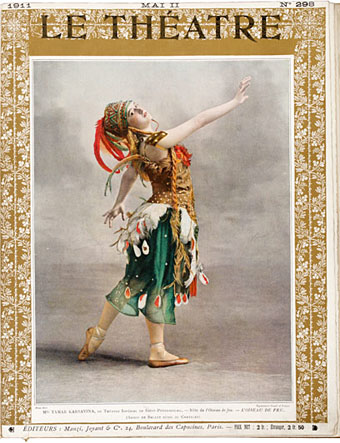
diaghilev2.jpg

Cover of Le Théatre showing Tamara Karsavina in costume as the Firebird, May 1911.

While we’re on the subject, a new biography of the impresario, Diaghilev: A Life by Sjeng Scheijen, was reviewed last week in the New York Times:

Diaghilev loved beautiful young men, and at a time when the fashion in ballet was to exchange patronage for sex, his company provided a bounty. Scheijen dexterously plays his sources against one another to examine the erotic and professional dynamics between Diaghilev and his stars.

For a fictional (and necessarily heterosexual) account of those erotic and professional dynamics, I recommend Michael Powell & Emeric Pressburger’s The Red Shoes (1948) which not only has a central character based on Diaghilev but includes among the cast of real dancers Léonide Massine, dancer and principal choreographer of the Ballets Russes from 1915 to 1921.

See also:
Russian Ballet History | An archive and documentary site.

Previously on { feuilleton }
Pamela Colman Smith’s Russian Ballet
The art of Ivan Bilibin, 1876–1942
Jack Cardiff, 1914–2009
Magic carpet ride
Le Sacre du Printemps
Images of Nijinsky