Will Bradley posters

bradley01.jpg

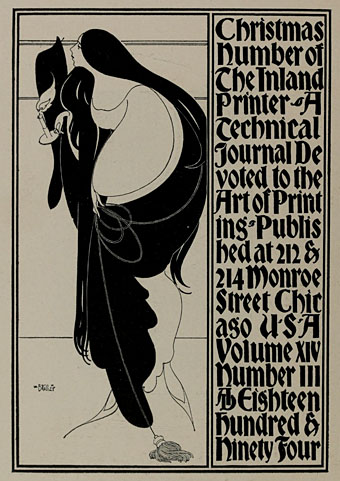
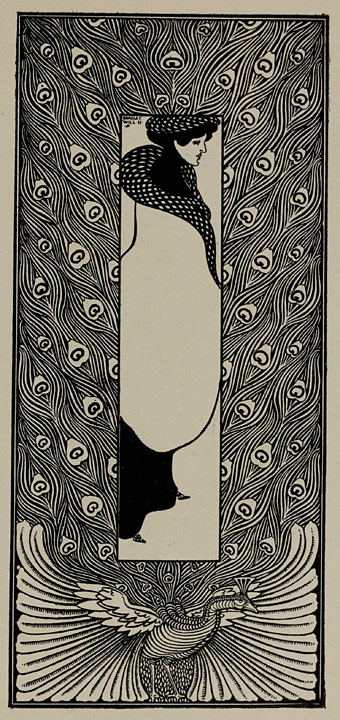
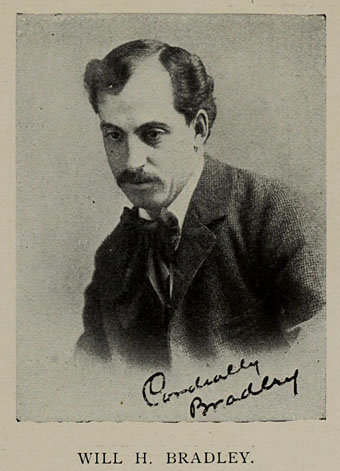
More from American illustrator and designer Will Bradley (1868–1962) from the height of his Beardsley period circa 1894–95. These are from a collection by Edward Penfield entitled Posters in Miniature (1897) in which Bradley’s work receives more attention than some of his better-known contemporaries. Half of these designs are familiar, the rest I hadn’t seen before, including the peacock piece below. Even though Bradley was trying out various Beardsley moves at this stage, his work was always a lot more versatile than the lesser imitators. More of Bradley’s designs, and work by other artists, can be found in the scanned edition of Penfield’s book at the Internet Archive.

bradley02.jpg

bradley03.jpg

Continue reading “Will Bradley posters”

Burroughs in Paris

wsb-paris1.jpg

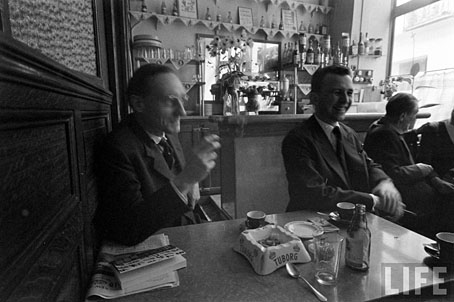
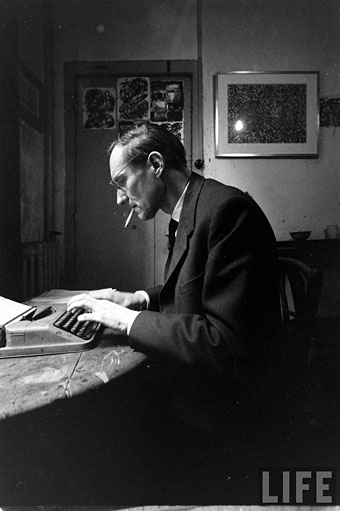
William Burroughs and Maurice Gerodias.

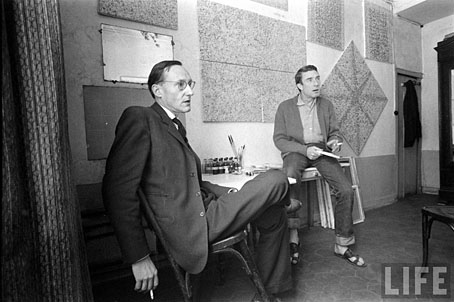
More specifically, William Burroughs photographed in 1959 for Life magazine by Loomis Dean. This was no doubt a story based around the publication of The Naked Lunch by Olympia Press: in the full set there’s shots of Burroughs with Olympia boss Maurice Gerodias, some pictures of the author signing copies of his novel (which can also be seen resting on the newspaper above), and many shots of the shabby interior of the Beat Hotel where the walls of Burroughs’ and Brion Gysin’s rooms are decorated with Gysin’s calligraphic paintings.

wsb-paris2.jpg

Burroughs and Gysin.

Over at the Time archives there’s an amusingly snotty review from 1962 of the first US publication of The Naked Lunch. The reviewer isn’t credited but they trot out details of Burroughs’ history with the implication that nasty people can’t possibly be good or worthwhile writers. In 1962 the Pulitzer Prize for Fiction was won by something called The Edge of Sadness by Edwin O’Connor. What? Who? Exactly.

wsb-paris3.jpg

Elsewhere on { feuilleton }
The William Burroughs archive

The recurrent pose 44

flandrin.jpg

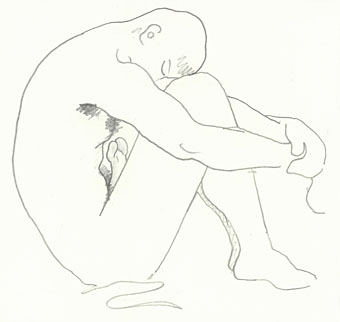
An item found in a collection of erotic drawings of dubious provenance, this piece is credited to Jean Cocteau. While I can’t be 100% certain it is Cocteau’s work it does closely resemble his other erotic drawings, and the rendering of the ear and hands is typical. Cocteau (or whoever) here does the obvious jokey thing with the Flandrin pose, something I’m surprised I haven’t seen already.

Elsewhere, Nathalie spotted a feature about the photography of Yannis Bournias which features another close variation as well as being gorgeous pictures in their own right.

Elsewhere on { feuilleton }
The recurrent pose archive

Previously on { feuilleton }
The writhing on the wall
Le livre blanc by Jean Cocteau
Cocteau’s sword
Cristalophonics: searching for the Cocteau sound
Cocteau at the Louvre des Antiquaires
La Villa Santo Sospir by Jean Cocteau

Weekend links 77

farmer.jpg

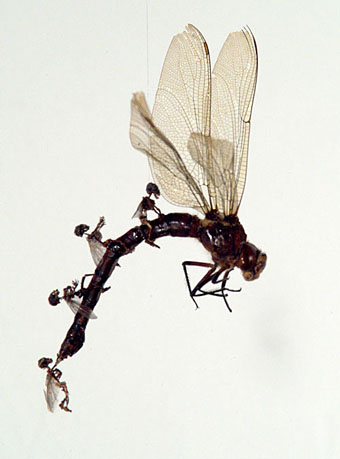
Art by Tessa Farmer.

• An exhibition of Tessa Farmer’s art is running at Viktor Wynd Fine Art, London, until October 30th. On Saturday, October 1st, Strange Attractor hosts Good Neighbours: Faeries, Folklore and the Art of Tessa Farmer also at Viktor Wynd.

Unearthing The Psychedelic Harp: “David Moats talks to harpist and songwriter Serafina Steer about her work with John Foxx and Patrick Wolf, being classically trained, the difficulties of doing live soundtracks and psychedelia.”

• And speaking of psychedelia, Arkhonia is still blogging up a storm here, here and here about the lost Beach Boys album, Smile, the farthest Brian and co. ventured into the tripped-out weirdness of 1967. The complete original recordings will finally be released in November.

• “‘We’ve arrived at a level of commodification that may have negated the concept of counterculture,’ Gibson says in the Paris Review.” William Gibson profiled by Thomas Jones.

One of the qualities I always stress when talking about this design work influenced by Surrealism is its enormous boldness and creative freedom, which is something of a paradox in many cases, since the Czech and Polish designs were created under communist regimes. So, while Uncanny documents a significant current in the history of 20th-century visual culture, the show also has a polemical intention aimed, quite deliberately, at our circumstances now. Students who encounter these images in lectures sometimes feel constrained by their conception of what they — or their teachers — regard as acceptable in today’s marketplace. At times, this has struck me as being a form of insidious self-censorship. (more)

Rick Poynor: Jan Švankmajer and the Graphic Uncanny.

• The exhibition curated by Mr Poynor last year, Uncanny: Surrealism and Graphic Design, is now showing at the Kunsthal in Rotterdam until early December. Related: MizEnScen’s somber, surrealist collages.

Howard Pyle’s Book of Pirates (1921) at Golden Age Comic Book Stories, the Urtext of buccaneer imagery.
bonnat.jpg

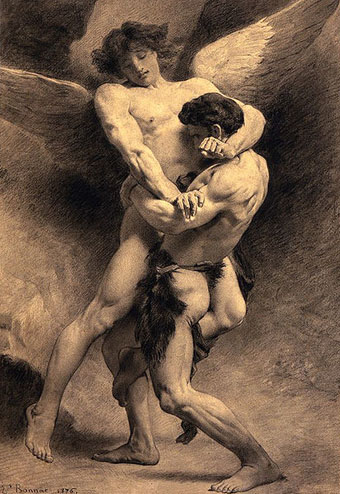
Another of those homoerotic religious pictures: Jacob Wrestling with the Angel (1876) by Léon Bonnat. Via Babylon Baroque.

• Celebrating the 250th anniversary of Laurence Sterne’s marbled page: Emblem of My Work.

John Martin’s Pompeii painting finally restored after 1928 Tate flood damage.

The Spectral Dimension: “where the paranormal and popular culture collide”.

The Writing of Stones (1970) by Roger Caillois at 50 Watts.

Mercury Arc Rectifiers.

• When silliness was an avant garde strategy: video from 1974 of Brian Eno performing China My China and (in better quality) The Seven Deadly Finns. (Go here for lyrics of the latter.)

Labyrinths

labyrinth.jpg

The Breamore Miz-Maze, Hampshire. Photo by Jim Champion.

As part of the work-related research this week I was looking for designs of old turf labyrinths. It turns out I have two pages of the things in a book I’d earlier considered dropping into Oxfam so that particular volume may have gained a reprieve. Before I went to the bookshelves I’d been browsing the rather wonderful Labyrinthos site which is just the kind of detailed resource you hope to find in these circumstances. There we find an explanation for the difference between a maze and a labyrinth (the general rule being that a maze has more than one choice of route), and a wealth of examples from ancient history to the present day. I’ve long been fascinated by the labyrinths found in churches and cathedrals, of which the most famous example is the one in Chartres Cathedral. They’re a rare incidence of a symbolic device in Christian architecture which is near-universal, and which has clear antecedents in the labyrinths and mazes found in ancient temples. Labyrinthos has a guide to some of the surviving examples to be found in England. As to England’s turf labyrinths, there’s a page devoted to those here with a number of photos.

Previously on { feuilleton }
Jeppe Hein’s mirror labyrinth