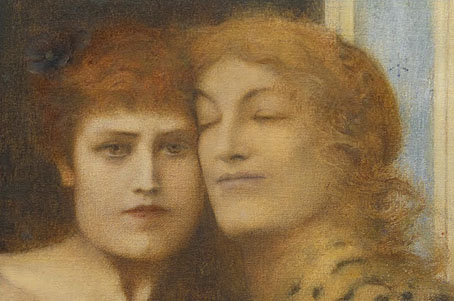
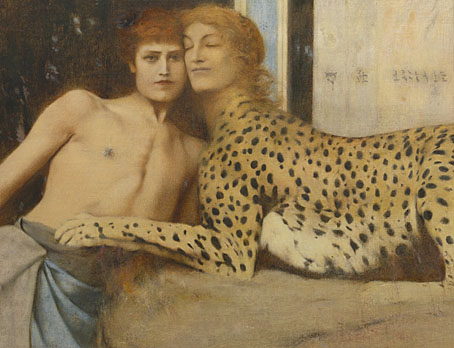
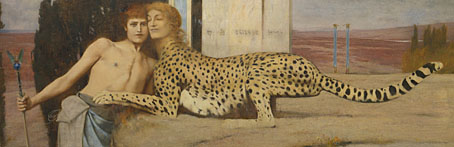
Caresses by Fernand Khnopff

khnopff1.jpg

khnopff2.jpg

khnopff3.jpg

Details from Caresses aka The Caress (1896), the most famous painting by Belgian Symbolist Fernand Khnopff which can now be explored in detail at the Google Art Project. Caresses was one of Khnopff’s more enigmatic works although the term is a relative one when it comes to an oeuvre in which enigma is the default position. The combination of a young male, a feline female and the trappings of antiquity suggests Oedipus and the Sphinx although the Sphinx of mythology is a far more threatening presence. Adding to the enigma is the fact that Khnopff’s sister, Marguerite, was his model in most of his paintings which means we can recognise her heavily-jawed features in the male figure as well as the female. The essence of Symbolism for me has always been an atmosphere of unresolved pictorial mystery, a quality which this painting exemplifies.
khnopff4.jpg

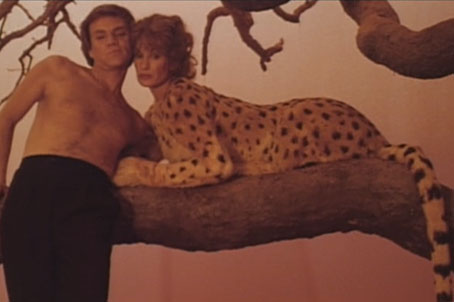
Malcolm McDowell and Ruth Brigitte Tocki in a deleted scene from Cat People (1982).

The mystery would have been carried over to the cinematic world in 1982 if the producers of Cat People had kept their nerve. The “Leopard Tree” dream sequence was to have featured a moment when Irena (Nastassia Kinski) meets her dead brother and mother in a pose which recapitulates Khnopff’s painting. The painting itself also appeared earlier in the film although it’s so long since I watched it I forget now whether that moment was also excised. The dream sequence may have been stretching audience credulity too far but the symbolism is fitting not least for the incestuous nature of the story. Here’s the scene in the final cut set to Giorgio Moroder’s fantastic score.
khnopff5.jpg

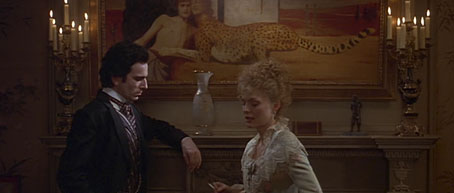
Daniel Day-Lewis and Michelle Pfeiffer.

The painting definitely did appear on-screen in 1993 where it overshadows a crucial conversation in Martin Scorsese’s adaptation of The Age of Innocence. Given that the setting is New York in the 1870s the usage is slightly anachronistic but once again the symbolism works for a scene which concerns unacceptable and unrequited passions.

Previously on { feuilleton }
Symbolist cinema
Bruges-la-Morte

Gekko Hayashi revisited

hayashi02.jpg

It remains a fact that the most popular posts here are the sex-related ones. The post about Clayton Cubitt’s Hysterical Literature project continues to rack up views despite having been written about at greater length on far more popular sites; this weekend Facebook users were flocking to see the phallic plaster casts (why now?).

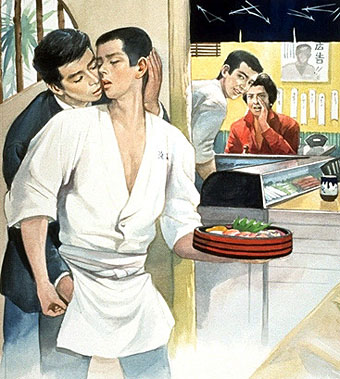
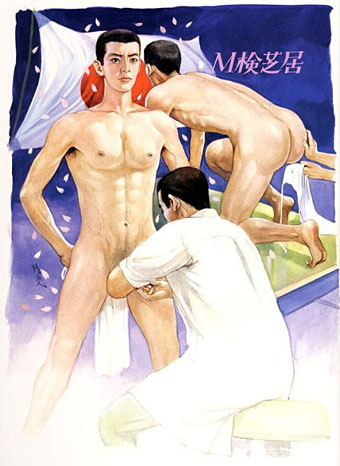
One of the perennial favourites from the gay artists archive is the post I made two years ago about the homoerotic art of Gekko Hayashi, the pseudonymous alter ego of Goji Ishihara (1923–1997). This has managed to become an almost universal point of reference despite all my knowledge about the artist being gleaned from other websites. The popularity would appear to be due to a generally high level of visibility in Google rankings combined with a tendency to write about recherché subjects which don’t receive high-profile attention elsewhere. Talking to Anne Billson yesterday about Ishihara’s monster art had me searching around for more of the Hayashi material. There’s still little to be seen outside some Japanese reprints. Given the language barrier when searching the Japanese book world it’s difficult to say whether any of these are still in print.

hayashi05.jpg

After turning up a few more examples of Hayashi’s work I’m increasingly struck by the strangeness of some of his art as well as the rare disjunction of seeing a commercial illustration style serving semi-pornographic ends. The latter effect is like seeing the libido of an artist such as Look and Learn painter Ron Embleton suddenly laid bare. A similar disjunction can be found in Oliver Frey’s work where a polished illustration and comic strip technique is applied to raw sexual scenarios. (I should note that Ron Embleton’s libido was on display in his comic strips for Penthouse magazine while—going in the opposite direction—Oliver Frey worked for a while at Look and Learn.)

hayashi07.jpg

You can find a polished style elsewhere but few artists get quite as weird with their erotic fantasies as the picture below showing a pair of penis-headed males embracing, and the one of a boy in what may be a bath full of blood being menaced (?) by an ambulatory midget phallus. Weirdness is familiar in the fetish world—everyone’s fetish is inherently weird to those who don’t share it—but always within strict limits, and besides, these aren’t fetishes. What’s odd about the pictures (especially the first) is the way they overburden the eros with a peculiarity you’d think would defeat the purpose of the painting. Hayashi/Ishihara worked as a comic artist as well as an illustrator so perhaps they’re part of a larger narrative; they may also be illustrating a text piece like some of the other pictures. For the moment they appear caught between the gay work and the monster illustration from the 1970s. This isn’t a complaint, it makes the art all the more intriguing and worth searching for.

hayashi09.jpg

Continue reading “Gekko Hayashi revisited”

Weekend links 138

durette.jpg

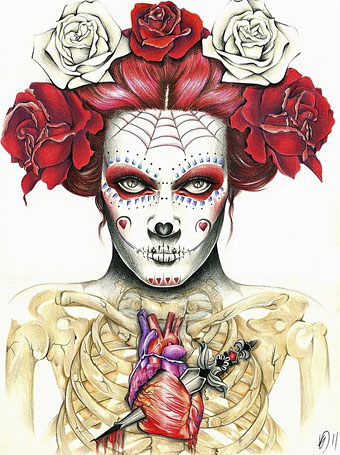
Heartsick (2011) by Kelly Durette.

• Now that Scott Walker’s Bish Bosch album is out and causing the usual consternation, the spotlight-shy singer/composer has been doing a surprising amount of promotional interviews. Simon Hattenstone talked to him for the Guardian at the end of last month; this week it was John Doran’s turn at The Quietus. One quote from the latter piece stood out in the light of this week’s posts: “…the music we’re making is meant to be an aural version of the HR Giger drawings for Alien. It always sounds to me like those look.”

Satanica is a limited-edition publication curated by Gio Black Peter & Christopher Stoddard “for anyone who rejects societal norms, for those dedicated to a life of pleasure, excess and self-reflection”.

• Sci-Fi-O-Rama has put five years’ worth of blog pictures onto Pinterest. I don’t really need to do that, there’s already a diverse crowd of Pinterest users compiling their own selection of things posted here.

As Susan Sontag once observed, pornography is practical. It was designed as a marital aid, and its vocabulary should follow natural biological rhythms and stick with hot-button words in order to produce a predictable climax. It is not about sex but is sex. Whereas the great sex writers (Harold Brodkey, DH Lawrence, Robert Gluck, David Plante, the Australian Frank Moorhouse) have a quirky, phenomenological, realistic approach to sex. They are doing what the Russian formalists said was the secret of all good fiction – making the familiar strange, writing from the Martian’s point of view.

Edmund White on writing about sex in fiction

• When pirate DVDs of films by Cocteau, Bresson and Pasolini are on sale in a Mexican market, life in the 21st century increasingly resembles a William Gibson novel. Joanne McNeil investigates.

• Copies of City Fun, Manchester’s premier music fanzine/alt culture mag (founded 1978), can now be read online at the Manchester District Music Archive.

• Linked everywhere during the past few days, the astonishing map of bomb hits on London during the Blitz (October 1940 to June 1941).

• At 50 Watts: 30 Vintage Magazine Covers from Japan and Alfred Kubin’s illustrations for Lesabéndio: An Asteroid Novel (1913) by Paul Scheerbart.

• Earlier this year for Frieze Magazine Geeta Dayal talked to musical collaborators of the great German producer Conny Plank.

Invisible Ink by Christopher Fowler, “the extraordinary stories of over one hundred forgotten authors”.

Cynthia Carr talks about Fire in the Belly, her biography of American artist David Wojnarowicz.

• “Blasphemy, Filth, And Nonsense” More Aleister Crowley ephemera at Front Free Endpaper.

• At Strange Flowers: Surrealist art by Jindrich Heisler (1914–1953).

Vladimir Nabokov wrote to Alfred Hitchcock in 1964.

• Scott Walker’s four tracks from the Nite Flights album (1978): Shutout | Fat Mama Kick | Nite Flights | The Electrician.

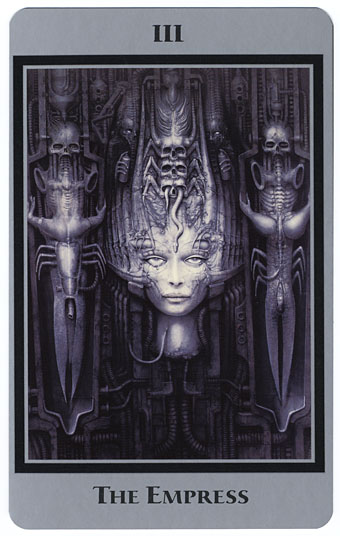
Giger’s Tarot

giger13.jpg

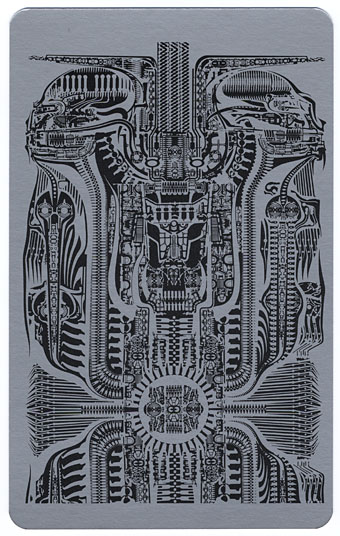
This week’s posts reminded me that I have a copy of the HR Giger Tarot set published by Taschen under their Evergreen imprint in 2000. The set is Taschen’s reworking of Giger & Akron’s Baphomet Tarot der Unterwelt set from 1994, and I recall this being one of the last things Taschen created with Giger after spending the previous decade producing a run of books, diaries and posters featuring his paintings. Inside a box you find a set of 22 oversize Tarot trumps presenting some of Giger’s works against metallic silver surrounds. There’s also a poster-size sheet for card readings printed with his pentagram design plus a 224-page paperback book by Swiss Tarot scholar Akron, aka CF Frey, which interprets the paintings as they relate to the Major Arcana. (The Baphomet set had a hardback book and the pentagram design printed on the back of each card.)

giger12.jpg

The design on the back of the cards, printed in black on metallic silver.

If you’re familiar with Tarot symbolism you don’t have to use these cards to find the correspondences intriguing. The trump ordering is an odd mix of the Crowley scheme with the more traditional designations. Two of the trumps have also been given new names: The Hanged Man is now The Hanged Woman while Crowley’s Art (formerly Temperance) has become Alchemy, an association which works since the card in the Crowley deck depicts the Androgyne of alchemical symbolism. I can imagine some Tarot collectors finding these cards far too dark and nasty, but when so many Tarot designs today are various degrees of garish or twee there’s plenty of room for a Giger or two to harsh the New Age mellow.

The card set has been out of print for years but Abebooks still carries copies at reasonable prices. A few examples of the cards follow.

giger14.jpg

Continue reading “Giger’s Tarot”

HR Giger album covers

giger4.jpg

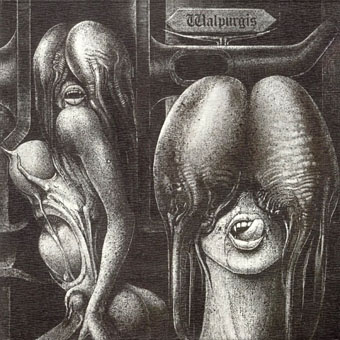
Walpurgis (1969) by The Shiver.

An inevitable follow-up to yesterday’s post, this continues an occasional look at album cover art by people better known for their work elsewhere. Giger’s album covers fall into two categories: those with some direct involvement from the artist and those which are merely reuses of pre-existing paintings. The former category is the one that’s of concern here.

The Shiver were a German Swiss group who Discogs label as “Krautrock”, a term with an unfortunate tendency these days to get attached to any German music that isn’t James Last. From what I’ve heard the group are a lot more ordinary than that, doing the kind of late psychedelic/early progressive rock common to many European bands in 1969.

Update: Further research reveals that The Shiver were Swiss, not German as they’re listed at Discogs. They evolved later into Island (see below) which explains why both groups released albums bearing Giger cover art.

giger5.jpg

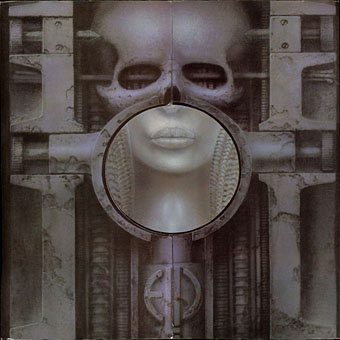
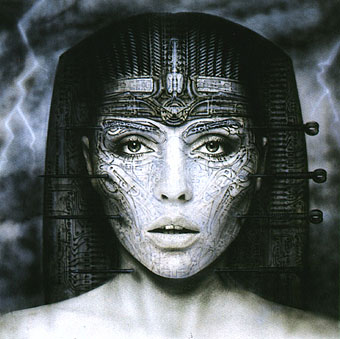
Brain Salad Surgery (1973) by Emerson, Lake & Palmer.

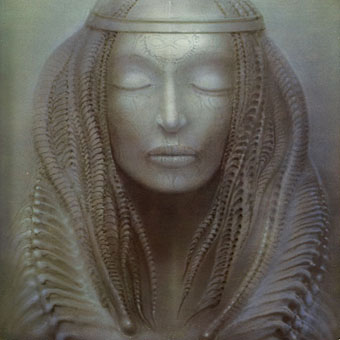
And speaking of prog… I’ve always loved the cover for this album which in its vinyl edition opens out to reveal the spectral woman beneath. The female face is named Isis on a poster I still have somewhere. Despite liking the cover I never really liked ELP so this is one album of the period I’ve yet to hear.

giger6.jpg

Brain Salad Surgery interior.

giger7.jpg

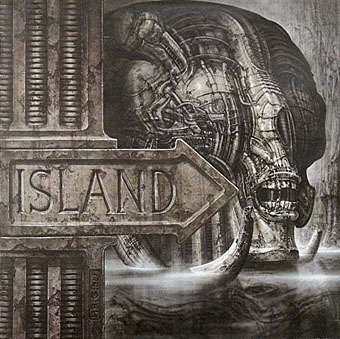
Pictures (1977) by Island.

And yet more prog… Island were a Swiss group. The cover painting is Necronom IIIa (1976) with some Giger lettering added.

giger8.jpg

Attahk (1978) by Magma.

Magma are (of course) Christian Vander’s ongoing jazz/prog/opera/Zeuhl/sf/freakout music project. Giger declares a taste for jazz and jazz rock in one of his books so I imagine this commission would have appealed more than others, Magma’s approach to jazz having an apocalyptic tendency. Track titles like Liriïk Necronomicus Kanht (In Which Our Heroes Ourgon & Gorgo Meet) wouldn’t have done much harm either. The safety-pin sunglasses were inspired by the safety-pin fashions of punk.

giger9.jpg

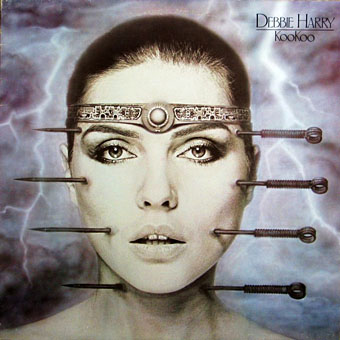
KooKoo (1981) by Debbie Harry.

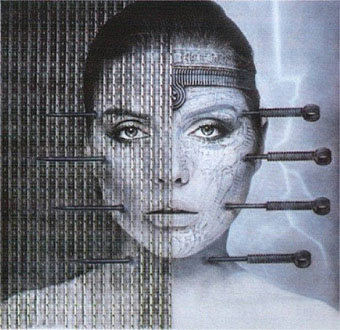
And speaking of punk… Giger considered Debbie Harry to be “the Queen of the Punks” so he decided to pierce her face accordingly. The album isn’t punk, however, it’s a collection of smart and funky pop songs produced by Nile Rodgers & Bernard Edwards. Two singles from the album have Giger-directed videos, Backfired (which HRG also appears in), and Now I Know You Know which has Ms Harry posing against the Passagen paintings in a black wig and a biomechanical body stocking. There’s more about the KooKoo album at the Giger site.

giger10.jpg

gige11.jpg

Elsewhere on { feuilleton }
The album covers archive

Previously on { feuilleton }
Giger’s Necronomicon
Dan O’Bannon, 1946–2009
Alejandro Jodorowsky’s Dune
The monstrous tome