The art of Shinji Horimura

horimura1.jpg

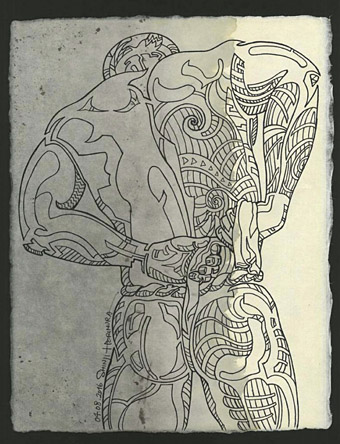
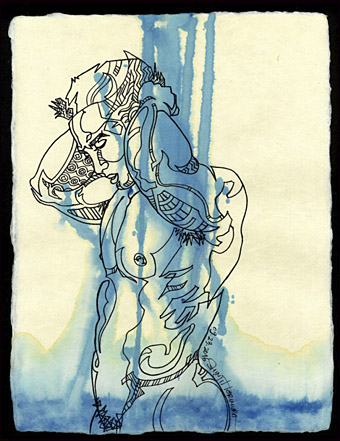
Lagrimas del Mar (2016).

The gay artists archive continues to be the most popular destination on these pages which makes me feel I ought to add to it more often than I do. Not all of Shinji Horimura’s art is homoerotic but these drawings from his WAH series certainly are. In these and other works Horimura renders the male body with broken outlines that fragment into abstract patterns. In the black-and-white drawings these might be read as tattoos but in his colour art they suggest the hallucinatory revelations of Alex Grey’s paintings. There’s more to see on the artist’s Coroflot pages.

horimura2.jpg

Loosen (2016).

Continue reading “The art of Shinji Horimura”

Weekend links 543

cliffhouse.jpg

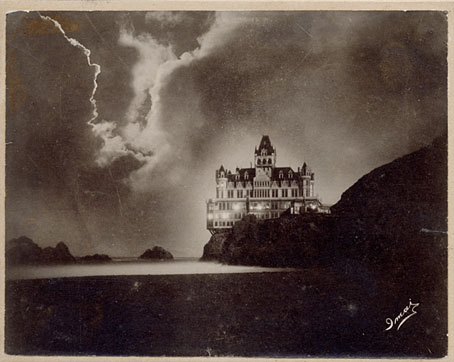
Adolph Sutro’s Cliff House in a Storm (c. 1900) by Tsunekichi Imai.

• Good to see a profile of Wendy Carlos, and to hear that she’s still working even though all her albums (to which she owns the rights) have been unavailable for the past two decades. I’d be wary of praising Switched-On Bach too much to avoid giving new listeners a wrong impression. The album was a breakthrough in 1968 but was quickly improved upon by The Well-Tempered Synthesizer (1969) and Switched-On Bach II (1973). And my two favourites, A Clockwork Orange – The Complete Original Score (1972) and the double-disc ambient album, Sonic Seasonings (1972), are superior to both.

• “[Sandy Pearlman] told me that one of the main inspirations was HP Lovecraft. I said, ‘Oh, which of his books?’ He said, ‘You know, the Cthulhu Mythos stories or At The Mountains Of Madness, any of those.'” Albert Bouchard, formerly of Blue Öyster Cult, talks to Edwin Pouncey about BÖC’s occult-themed concept album, Imaginos (1988), and his affiliated opus, Re Imaginos.

• More electronica: Jo Hutton talks to Caroline Catz, director of the “experimental documentary” Delia Derbyshire: The Myths and Legendary Tapes.

• At the V&A blog Clive Hicks-Jenkins talks to Rebecca Law about his award-winning illustrations for Hansel and Gretel: A Nightmare in Eight Scenes.

• New music: Archaeopteryx is a new album by Monolake; What’s Goin’ On is a further preview of the forthcoming Cabaret Voltaire album, Shadow Of Fear.

Celebrating A Voyage to Arcturus: details of two online events to mark the centenary year of David Lindsay’s novel.

• “Streaming platforms aren’t helping musicians – and things are only getting worse,” says Evet Jean.

• At Spoon & Tamago: the cyberpunk, Showa retro aesthetic of anime Akudama Drive.

• At A Year In The Country: a deep dive into the world of Bagpuss.

Sinister Sounds of the Solar System by NASA on SoundCloud.

• At Dennis Cooper’s: Shirley Clarke Day.

Mary Lattimore‘s favourite albums.

• Solaris, Part I: Bach (1972) by Edward Artemiev | Bach Is Dead (1978) by The Residents | Switch On Bach (1981) by Moderne

Weekend links 542

gysbrechts.jpg

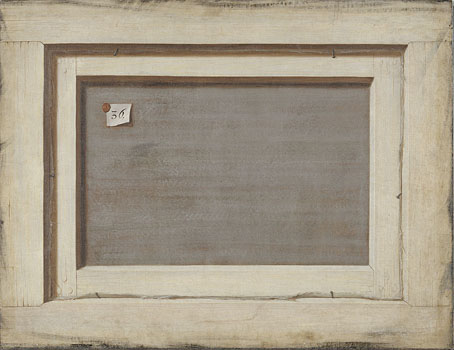
The Reverse of a Framed Painting (between 1668 and 1672) by Cornelis Norbertus Gysbrechts.

• New music with a cinematic flavour: Disciples Of The Scorpion (Main Theme) Heavy Mix by The Rowan Amber Mill is a taster for the group’s forthcoming imaginary soundtrack, Disciples Of The Scorpion (also a sequel of sorts to The Book Of The Lost); The Quietened Dream Palace is this year’s final themed compilation from A Year In The Country. The subject this time is abandoned cinemas, past and present.

San Francisco Moog: 1968–72 by Doug McKechnie, a collection of early synthesizer music using a modular instrument that was later bought by Tangerine Dream. “The quiescent, meditative pulse of the music has much more in common with what would come to be known as the Berlin school of German electronic music than anything coming out of the US at the time,” says Geeta Dayal.

• Sarah Davachi released a new album recently, Cantus, Descant, so The Quietus asked her to discuss her favourite albums. Related: XLR8R has a mix of the music that Davachi regards as influences. Kudos for the choice of Why Do I Still Sleep by Popol Vuh, an overlooked piece from the end of the group’s career.

When I use relevance as a filter for determining what books to read, I’m failing to make myself available for an authentic encounter with otherness, something genuine art always offers. I’m presuming that I can guess, from the barest plot summary, whether a book will be useful in my life. But how can I know what I will find relevant about a work before I have submitted myself to the experience? I don’t think we are likely to be transformed by art if we try to determine that encounter in advance. Part of the vulnerability necessary for transformation is the recognition that I am, to a great extent, a mystery to myself. How could I know what I need?

Garth Greenwell on the idea that a novel is only worthwhile if it is somehow “relevant”

• “For a long time I had been encouraged by the world of fine art to remove references to the spiritual from my work,” says Penny Slinger in a piece by Hettie Judah exploring the resurgence of interest in occult art. Good to see S. Elizabeth and her book on the subject receiving a mention.

• Arriving on Region B blu-ray later this month is Spring (2014) by Justin Benson & Aaron Moorhead, which 101 Films describes as Richard Linklater channeling HP Lovecraft. I enjoyed Benson & Moorhead’s Resolution (2012) and The Endless (2017) so this one is on pre-order.

• Topical books dept: The Man in the High Chair and Other Tyrannies by Kurt Fawver, a benefit publication for the California Coalition for Women Prisoners.

• We never know exactly where we’re going in outer space: Caleb Scharf on the difficulties of aiming for distant objects in an ever-changing universe.

• Submissions open soon for the contemporary Dada journal Maintenant 15, with a theme of “Humanity: The Reboot”. Details here.

• At Dennis Cooper’s: Harry Smith, Filmmaker Day.

Pandemonium – Spring (1985) by Peter Principle | Silent Spring (2006) by Massive Attack feat. Elizabeth Fraser | Spring Stars (2009) by Simon Scott

Weekend links 541

finlay.jpg

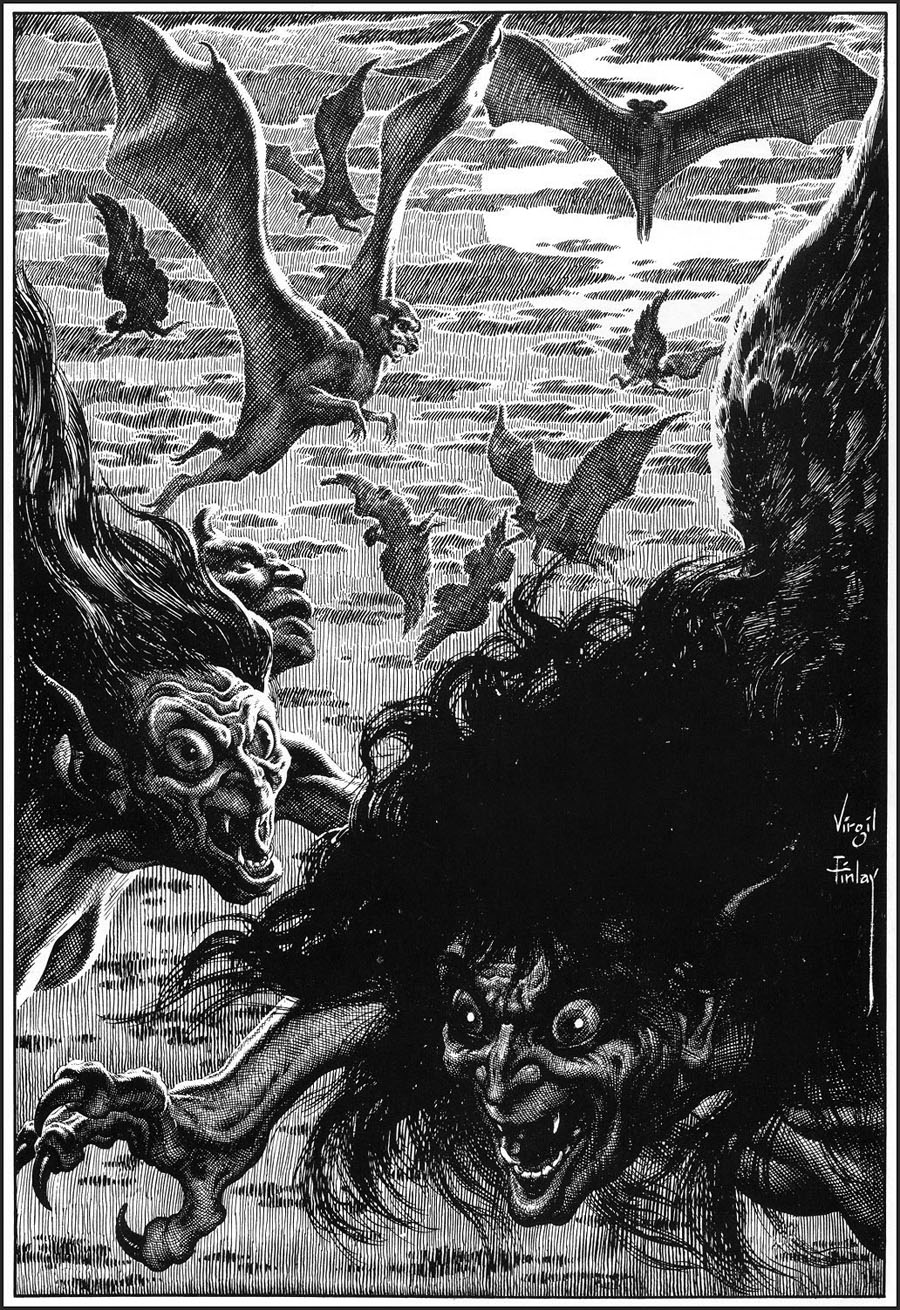
Virgil Finlay illustrates Hallowe’en in a Suburb by HP Lovecraft for Weird Tales, September 1952.

• Literary Hub does Halloween with an abundance with Draculas, a lazy option but the pieces are good ones nonetheless: Olivia Rutigliano attempts to rank the 50 best (screen) Draculas, and also recalls the Broadway production designed by Edward Gorey. At the same site, Katie Yee discovers that The Addams Family (1991) is really about the importance of books.

• The inevitable film lists: the always reliable Anne Billson selects the scariest ghosts in cinema; at Dennis Cooper’s, TheNeanderthalSkull curates…DC’s Weirdo Halloween Horror Movie Marathon, a list featuring a couple of oddities which have appeared in previous weekend links.

• More books bound with human skin: Megan Rosenbloom, author of Dark Archives: A Librarian’s Investigation into the Science and History of Books Bound in Human Skin discusses the subject with S. Elizabeth.

Beyond all this, however, readers are most likely to read De Quincey for his compellingly strange writing on opium and its effect on the mind. For it is opium, rather than the opium-eater, he writes in Confessions, who “is the true hero of the tale”. He explains the drug cannot of itself create imaginative visions—the man “whose talk is of oxen” will probably dream about oxen. But for De Quincey, with his love for reverie, it gives “an inner eye and power of intuition for the vision and the mysteries of our human nature”. Wine “robs a man of his self-possession: opium greatly invigorates it”. It “gives an expansion to the heart and the benevolent affections”. “This”, he claims, “is the doctrine of the true church on the subject of opium: of which church I acknowledge myself to be the only member.”

“Thomas De Quincey’s revelatory writing deserves greater attention,” says Jane Darcy

• New music: Weeping Ghost by John Carpenter is a preview of the forthcoming Lost Themes III; Moments Of Clarity is a new album of psychedelic(ish) songs from Professor Yaffle.

• “How now, you secret, black, and midnight hags!” Sean Connery (RIP) was often playing kings in later life but he started early with this performance as Macbeth in 1961. (Ta to TjZ for the link!)

• Mixes of the week: a (non-Halloween) guest mix by Paul Schütze for Toneshift, and the by-now traditional Samhain Séance Mix from The Ephemeral Man.

Clive Hicks-Jenkins’ big new adventure: an illustrated “reinvention” of Jean Cocteau’s La Belle et la Bête.

Drew McDowall (of Coil, et al) talks Musick, magick and sacred materiality.

• “No one loves the smell of a Kindle,” says Thomas O’Dwyer.

Brüder des Schattens (1979) by Popol Vuh | Nosferatu (1988) by Art Zoyd | Vampires At Large (2012) by John Zorn

Ghosts of the Chit-Chat

chitchat1.jpg

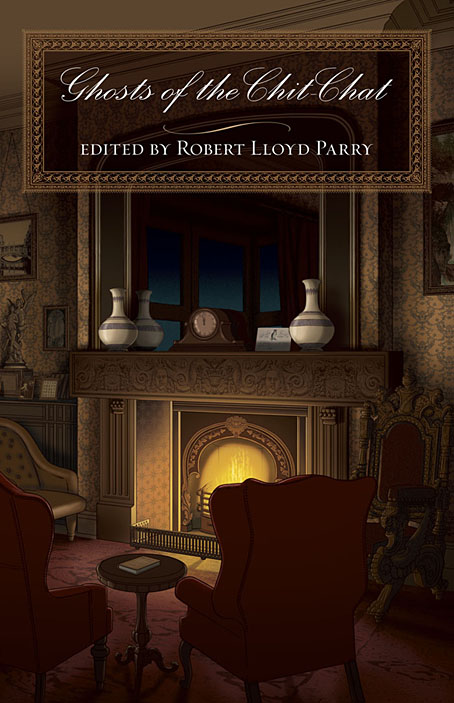
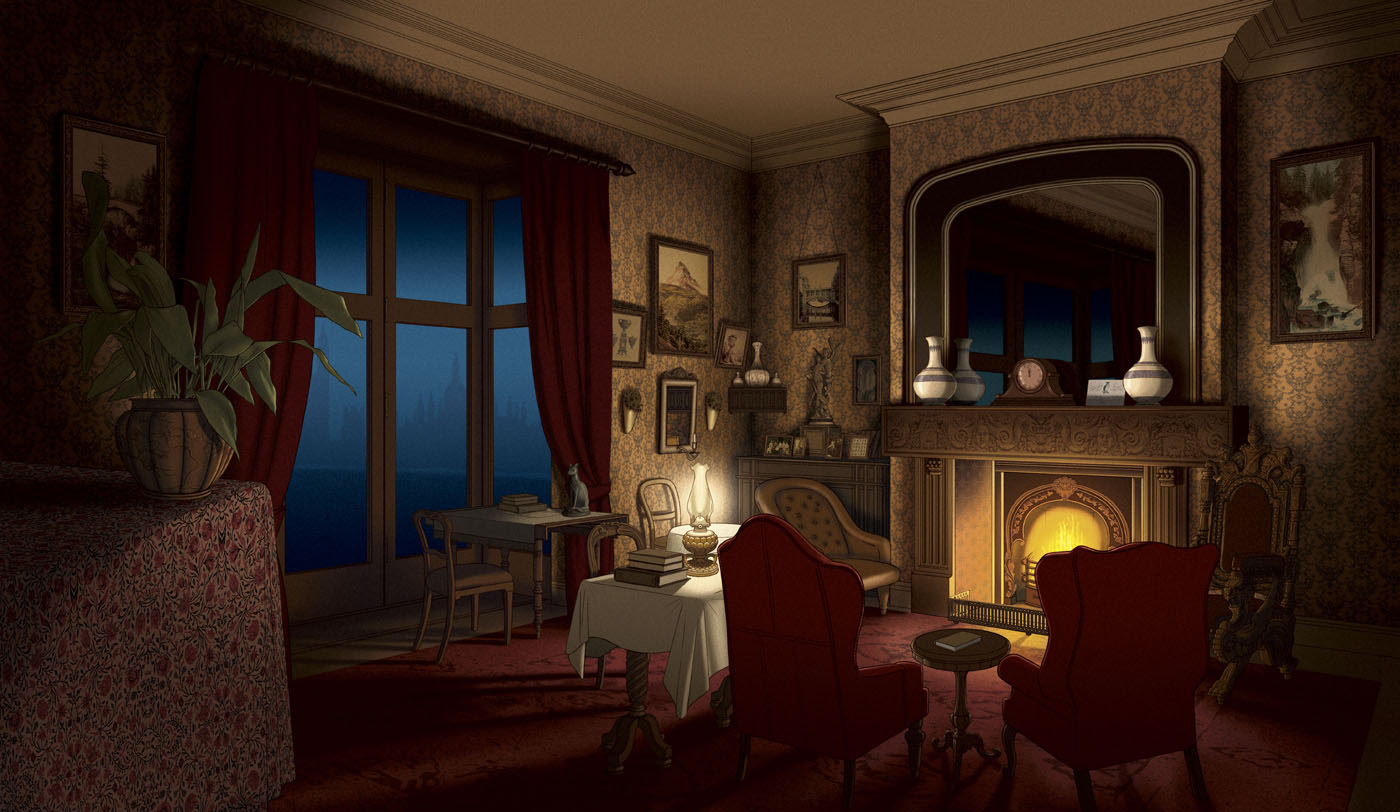
My latest cover for Swan River Press is very suitable for the season, It’s also a good example of the “window” type of cover design, where you show a view into a scene rather than a flat design. Window covers are common in fantasy and science fiction, less so in the horror genre where you often want to avoid giving too much away. The “Chit-Chat” of the title was The Chit-Chat Club, a group of students and tutors at King’s College, Cambridge:

On the evening of Saturday, 28 October 1893, Cambridge University’s Chit-Chat Club convened its 601st meeting. Ten members and one guest gathered in the rooms of Montague Rhodes James, the Junior Dean of King’s College, and listened — with increasing absorption one suspects — as their host read “Two Ghost Stories”.

Ghosts of the Chit-Chat celebrates this momentous event in the history of supernatural literature, the earliest dated record we have of M. R. James reading his ghost stories out loud. And it revives the contributions that other members made to the genre; men of imagination who invoked the ghostly in their work, and who are now themselves shades. In a series of essays, stories, and poems Robert Lloyd Parry looks at the history and culture of the Club.

In addition to tales and poems never before reprinted, Ghosts of the Chit-Chat features earlier, slightly different versions of two of M. R. James’s best-known ghost stories; Robert Lloyd Parry’s profiles and commentaries on each featured Chit-Chat member sheds new light on this supernatural tradition, making Ghosts of the Chit-Chat a valuable resource for casual readers and long-time Jamesians alike. (more)

chitchat2.jpg

The full picture which will be a little cropped on the print version. Here you get to see more aspidistra.

The brief for the cover was to show a view of an empty room in a manner similar to the covers drawn by “Ionicus” (Joshua Charles Armitage) in the 1970s and 80s for a series of supernatural story collections. After looking at a number of these covers I took Tune in for Fear as a template; I liked the angle of the picture which offered a view of a welcoming fireplace to contrast with the night sky seen on the back of the book, and the two-point perspective makes a change from my tendency to create symmetrical pictures. The inhabitants of the Ionicus room seem to have either fled or been abducted whereas mine have either just left or are soon to arrive. The clock on the mantelpiece is almost at midnight, and there’s a Chit-Chat invitation next to it so I’d suggest the latter. The picture contains a number of references to the stories and poems in the book, although not as many as I’d originally intended when several of the pieces proved resistant to having their contents reduced to a single detail. I won’t list everything here since I’d prefer readers to try and match the details themselves.

Ghosts of the Chit-Chat will be published in December, and is available for pre-order here.

Previously on { feuilleton }
The Far Tower: Stories for WB Yeats
The Scarlet Soul: Stories for Dorian Gray