A Book of Old English Ballads

ballads01.jpg

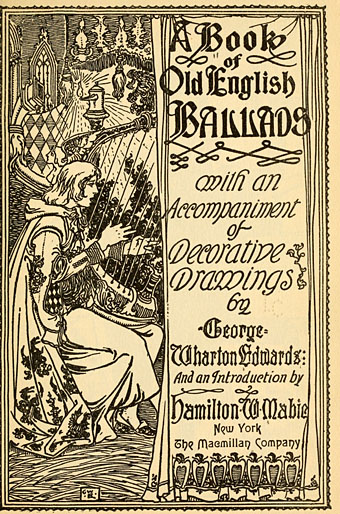
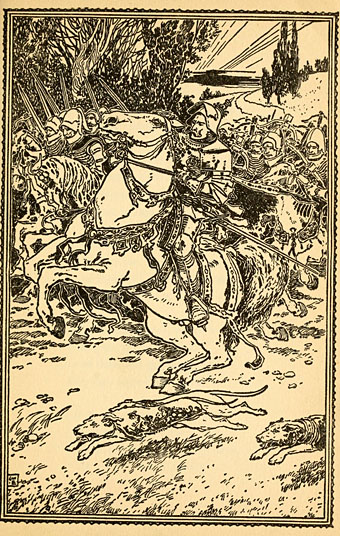
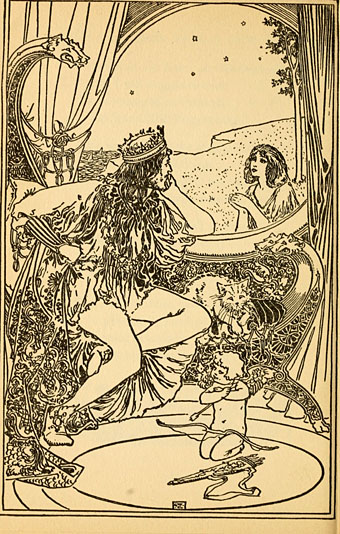
More illustration from George Wharton Edwards (1859–1950) with a collection of ballads from 1910. These being for the American market, the emphasis is on the picturesque England of kings and queens, duelling knights, and Robin Hood. A couple of exceptions, such as The Twa Corbies, point to the darker world of the Child Ballads where love and virtue aren’t always rewarded, and unnatural death is often the order of the day. Browse A Book of Old English Ballads here or download it here.

ballads02.jpg

ballads03.jpg

Continue reading “A Book of Old English Ballads”

Bird Gods

birdgods01.jpg

Why, I asked myself, should certain birds have been allotted to certain gods and goddesses in the Greek and Roman mythology? Why should the eagle go with Zeus, the peacock with Hera, the dove with Venus, the swan with Apollo, the woodpecker with Ares, the owl with Pallas Athene? It could not be mere chance that so many gods and goddesses had each their attendant bird; the attribution was too regular; it was done too much on a system. What was the original meaning of it all?

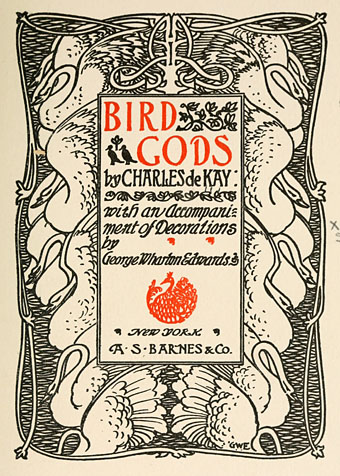
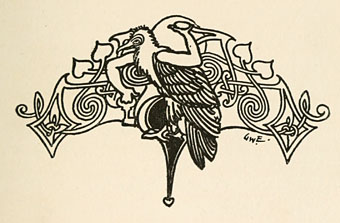
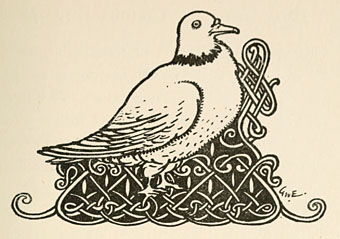
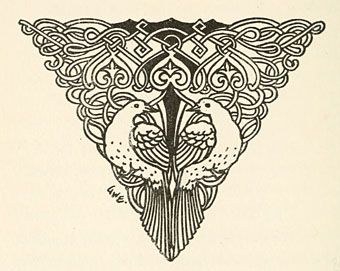
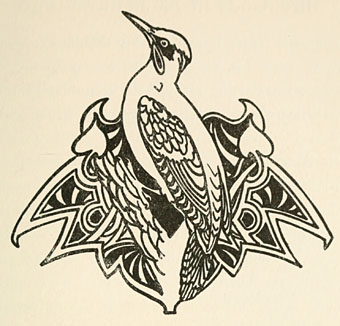
Charles de Kay attempts to answer his question in Bird Gods (1898), a study of the mythological and religious import of birds through the ages. Illustrator George Wharton Edwards was an American artist who worked in the Impressionist style when painting but here deliveries a range of bird portraits embellished with bits of imitation Celtic knotwork. The interlacings of Celtic art underwent a resurgence of interest with the development of Art Nouveau. Edwards’ illustrations aren’t the best examples of this (Mucha’s Hamlet poster is much better) but they give an idea of the trend. Browse the rest of De Kay’s book here or download it here.

birdgods02.jpg

birdgods03.jpg

birdgods04.jpg

birdgods05.jpg

Continue reading “Bird Gods”

Wildeana 10

wilde.jpg

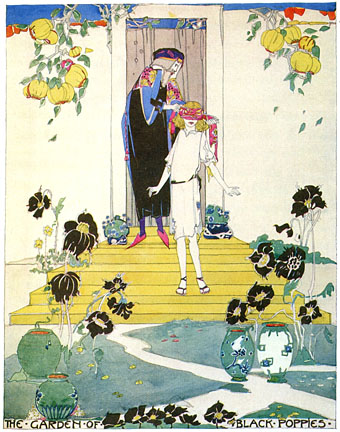
Illustration from The House of Pomegranates (1914) by Jessie M. King.

Continuing an occasional series. Recent Wildean links.

• It’s a measure of a writer’s success if the characters or stories they create resonate sufficiently with future generations to be subject to new interpretations. Among Oscar Wilde’s contemporaries this has happened to Arthur Conan Doyle and Bram Stoker, both of whom Wilde knew. Increasingly it’s been happening to Wilde’s own fiction, especially in the case of Dorian Gray whose tragedy assumes the status of a modern myth. At Cannes this year, Clio Barnard premiered a contemporary retelling of Wilde’s The Selfish Giant. Bleeding Cool has some clips. The social realism is a long way from Wilde’s tale but that shows how flexible these fables can be.

• Jessie M. King’s illustrations for Wilde’s The House of Pomegranates have appeared here before but the copies posted at The Golden Age are the usual quality scans.

• Rick Gekoski: “Visiting the US, I am reminded of Oscar Wilde’s tour there in 1881, which allowed him to become an orator and a celebrity.”

• Paper Dolls by David Claudon based on the characters from The Importance of Being Earnest. (Thanks to Gabe for the tip.)

Elsewhere on { feuilleton }
• The Oscar Wilde archive

Tom Adams book covers

adams01.jpg

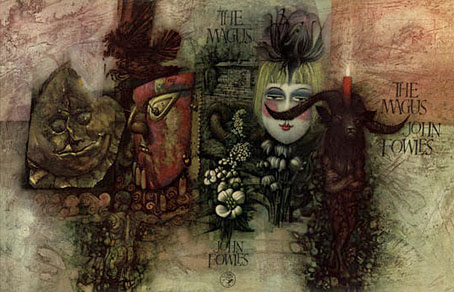
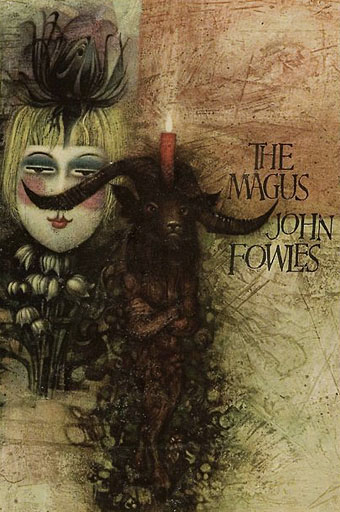
Dust jacket for The Magus (1966) by John Fowles.

I pulled my 1982 paperback of John Fowles’ The Magus from the bookshelf recently. After flicking through the pages I decided to start re-reading it, having realised that in the thirty years which have elapsed since I first read it I couldn’t remember much at all about it. One thing I did remember, however, was the cover of the first edition, a painting and design I’d admired in the past without knowing the name of the artist responsible.

adams02.jpg

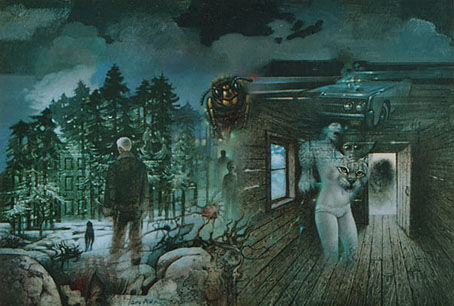
American illustrator Tom Adams is the artist in question, and looking at his painting again it further occurred to me that his cover deployed an evocative but not wholly specific assemblage of figures and objects that I’d often seen elsewhere, notably on the first edition cover of Peter Straub’s Ghost Story. So it was no great surprise to discover that Tom Adams was also responsible for that cover painting. The Fowles and Straub novels are big books which slowly reveal their layered mysteries. Adams’ approach to illustrating them strikes me as an ideal solution when neither of the novels can be easily reduced to a single image. (This hasn’t prevented subsequent designers from trying.) Fowles approved wholeheartedly of the painting but this isn’t a particularly fashionable technique at the moment, the trend being to try and condense complex narratives into a single motif.

adams03.jpg

Cover painting for Ghost Story (1979) by Peter Straub.

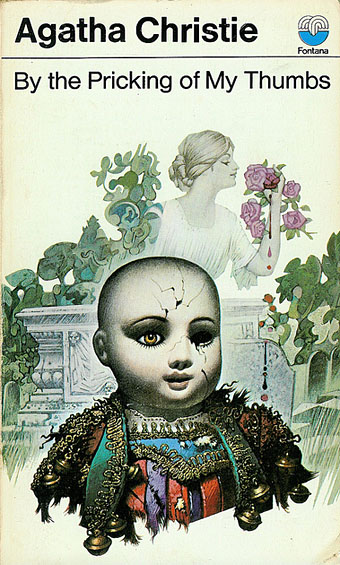
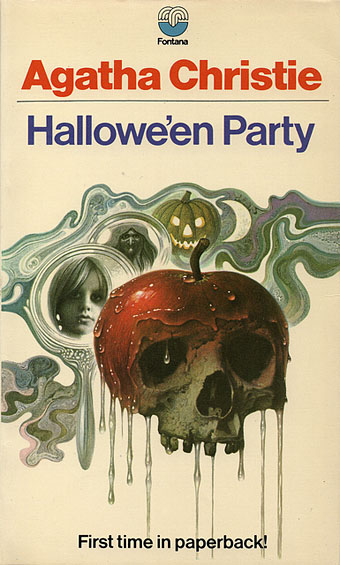
Looking for more of Adams’ art tipped me into an entire world of Agatha Christie book covers which were the artist’s main body of work for many years. Adams is understandably celebrated by Christie-philes (Paper Tiger published a book of his Christie covers in 1981) but outside Sherlock Holmes and Father Brown I’ve never had much of a taste for the classic detective story so this was a previously undiscovered niche. Here Adams sidesteps the chore of painting Christie’s meddlesome sleuths in favour of a remarkable display of grotesque Surrealism which—for a sceptic such as myself—makes the books seem potentially interesting. As with The Magus and Ghost Story there’s the same assemblage of evocative figures or objects but with an additional macabre twist. Many of these covers are so grotesque they could easily function as horror illustrations so it’s no wonder he was asked to illustrate the Straub. This Flickr page has many more examples (warning: wretched user-unfriendly Flickr layout in operation) as does this site. The artist has a website where prints of The Magus painting may be purchased.

adams04.jpg

adams05.jpg

Continue reading “Tom Adams book covers”

Elric 1: Le trône de rubis

elric1.jpg

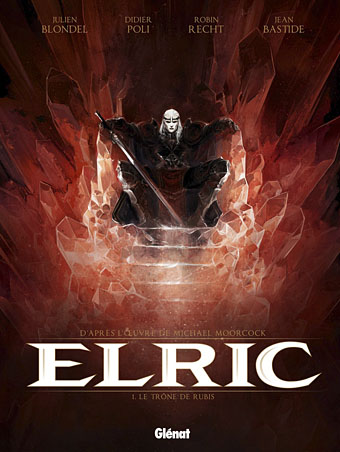
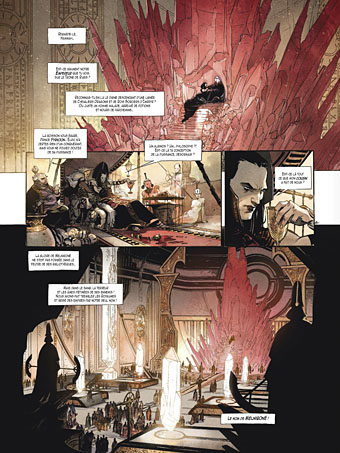
The closest I ever got to illustrating Michael Moorcock’s Elric character was the sleeve for The Chronicle of the Black Sword in 1985, a Hawkwind concept album based on the first couple of Elric books. That design favoured a decorative approach over anything illustrative, however. At the time I felt too intimidated by the renderings of Elric’s first illustrator, James Cawthorn, and subsequent depictions by book cover artists such as Michael Whelan, to attempt my own version of the character. These days I pay little attention to heroic fantasy of any kind but I do look out for new depictions of Moorcock’s anti-hero. Earlier this year the French bande dessinée publisher, Glénat, released the first album in a planned series of five comic-strip adaptations of the Elric books. Many creditable Elric comics have appeared since the 1970s, not least the Cawthorn version of Stormbringer, one of the earliest and best, and Philippe Druillet’s own somewhat eccentric production. Mike Moorcock very generously sent me a copy of the Glénat volume this week, and I’d say this is now the one to beat.
elric2.jpg

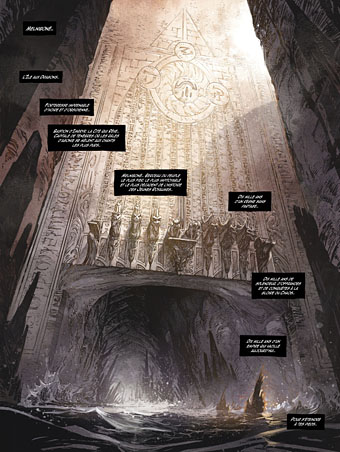
Writer Julien Blondel has adapted the books with the art duties being taken by Didier Poli and Robin Recht. Jean Bastide is the colourist. I’ve always preferred the French and Belgian approach to comic art over the American style so I’m naturally biased towards a book such as this. That said, the art is marvellous, and so many of the details feel just right. Moorcock portrays the Melnibonéans as decadent and cruel, something that Poli and Recht portray with scenes of naked slaves being bled, butchered, and even used as human torches for the blithe amusement of their masters. The general atmosphere in the opening pages is like something from Flaubert’s Salammbô with its combination of antique depravity and the massing of great armies prior to battle. They don’t slouch with the monstrosities, either, there’s a spot of Lovecraftian weirdness when Elric is rescued by Straasha, the Sea King. I look forward to seeing how they deal with Arioch (who puts in an appearance at the end) and the other Chaos Lords. The dialogue is all in French, of course, but if you know the books it’s easy to follow even with French as limited as mine.
elric3.jpg

The Glénat site has a few more page samples. Moorcock has been watching these books being adapated and re-adapted for decades, and he says this is among the very best. For anyone with more than a passing interest in the brooding albino prince it’s well worth seeking out.

Previously on { feuilleton }
• Salammbô illustrated
• Jim Cawthorn, 1929–2008