Jo Daemen’s The Sacred Flame

daemen00.jpg

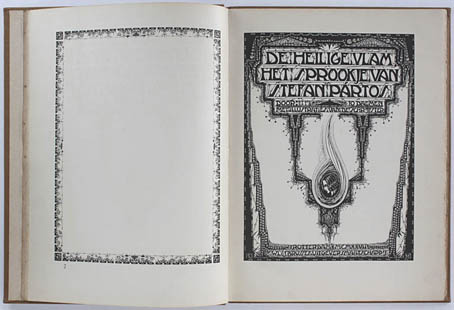
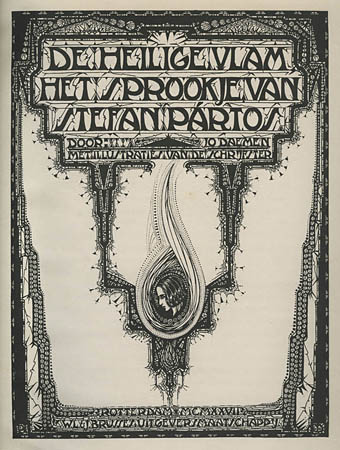
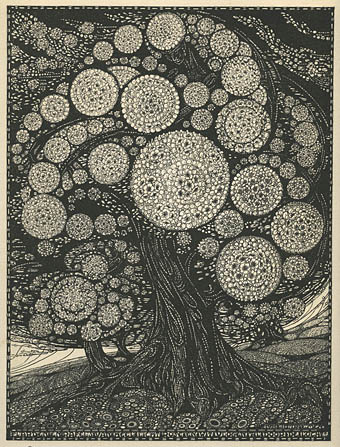
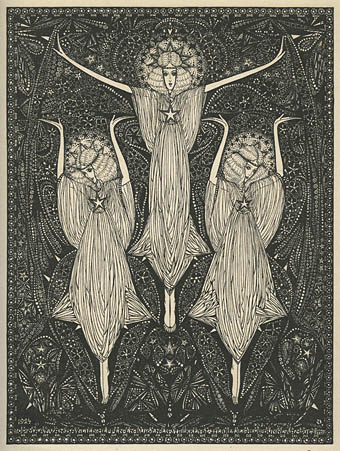
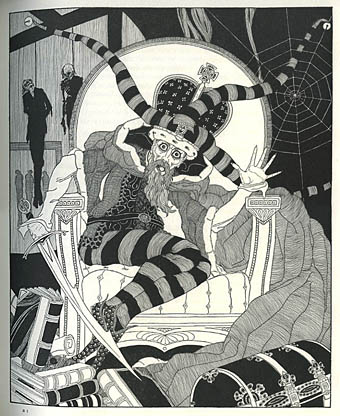
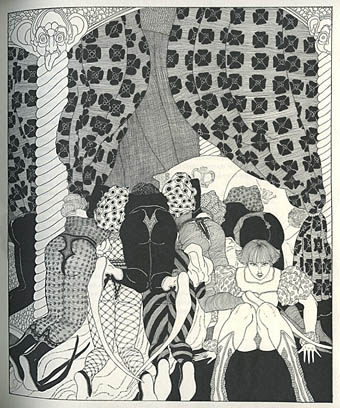
Johanna Maria Hendrika Daemen (1891–1944), credited here as “Jo”, wrote and illustrated The Sacred Flame: The Fairy-Tale of Stefan Pártos (1927), a tribute to a Hungarian violinist who died young. Daemen was a Dutch illustrator, graphic designer and glass artist who one suspects would be better known if she’d been British or American. The detail and composition of these illustrations is exceptional, falling somewhere between Kay Nielsen’s meticulous detailing and Harry Clarke’s stained-glass designs. This is another volume currently for sale at silver-gryph’s eBay pages where larger views of the drawings may be seen. (Thanks again to Nick for the tip!)

daemen12.jpg

daemen01.jpg

daemen02.jpg

Continue reading “Jo Daemen’s The Sacred Flame”

John Yunge-Bateman’s King Lear

yunge01.jpg

When Majesty turns to folly!

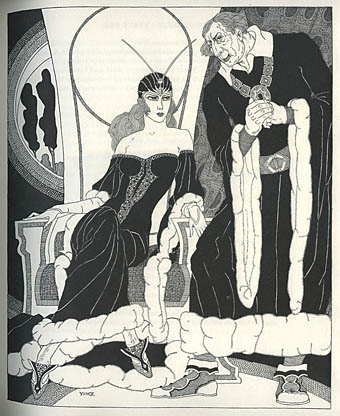
John Yunge-Bateman (1897–1971), aka “Yunge”, is another British illustrator whose work I’d not noticed until now, possibly because this 1930 edition of King Lear is an early creation in a derivative style the artist abandoned. The ten black-and-white drawings are closer to Harry Clarke than Aubrey Beardsley, and a couple of them even try to match Clarke’s more grotesque inventions albeit with variable results. Some of the faces are rather dopey for my taste but I like the use of solid blacks. These samples are taken from a scarce copy currently up for auction at silver-gryph’s eBay pages should anyone be interested. (Thanks again to Nick for the tip!)

yunge02.jpg

Than doth, within a dull, stale, tired bed, go to the creating a whole tribe of fops.

yunge03.jpg

If you come slack of former services you shall do well.

Continue reading “John Yunge-Bateman’s King Lear”

Weekend links 250

gebbie.jpg

Untitled artwork by Melinda Gebbie.

• “Johnny Rocket is like a Chaucerian epic retold by David Peace with music by Bruce Haack and The Focus Group for a music hall located in Hell.” John Doran talks to Maxine Peake and the Eccentronic Research Council about their “psychedelic ouija pop”.

Allison Meier looks at a new exhibition of Victor Moscoso’s psychedelic drawings. Related: Julia Bigham writing in Eye magazine in 2001 about London’s psychedelic poster scene.

• “Oh to eye the very enfilade through which that orchidaceous entity would make his stately progress…” Strange Flowers on the eccentric Count Stenbock.

Melinda Gebbie: What Is The Female Gaze? The artist is in conversation next month with Mark Pilkington and Tai Shani at the Horse Hospital, London.

Pamela Colman Smith: She Believes in Fairies. The Tarot artist and illustrator in a rare interview from 1912.

• Minimalist posters: “a lack of nuance disguised as insight,” says John Brownlee.

• Saturday night in the City of the Dead: Richard Metzger on the John Foxx-era Ultravox.

The Will Gregory Moog Ensemble plays the Brandenberg Concerto No. 3.

• “In a weird way”: a brief history of a phrase by Ivan Kreilkamp.

Die Hexe: An installation by Alex Da Corte.

• RIP Daevid Allen

Istaqsinaayok

You Can’t Kill Me (1971) by Gong | Master Builder (1974) by Gong | When (1982) by Daevid Allen
Walter Crane’s Picture Books

crane01.jpg

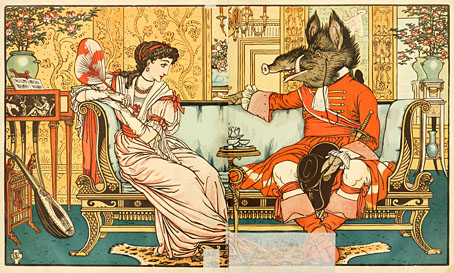
Beauty and the Beast.

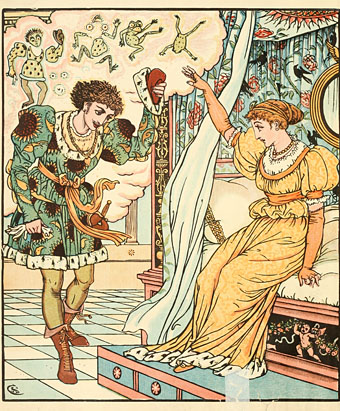
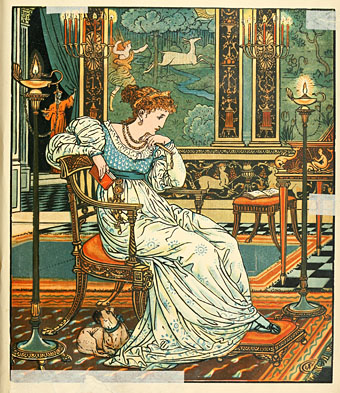
British artist and designer Walter Crane never illustrated a Perrault collection but he did illustrate individual editions of Perrault’s more well-known tales. These illustrations are from collections published in 1911 of the small books of nursery rhymes, alphabets and stories for children that Crane produced in the 1870s. The clear-line drawings are unusual for their avoidance of the decor one usually sees with these stories; Crane admired the work of the Pre-Raphaelites but the settings are a lot less medieval than some of his other books, the architecture and costumes owing more to the Empire style.

crane02.jpg

The Frog Prince.

Crane wrote several design books, including a very good one about the history of book design. His drawings for children may be simple but they’re all very precise and often contain significant details; many of the larger compositions draw the eye into the background with views through doors or windows, or into remote vistas. Crane also adapted each story into verse, and even manages to represent an act of metamorphosis in a single picture for the moment when the Frog Prince turns human. Elsewhere some of the pages are almost comic-like in their arrangement of multiple panels and text.

The samples here are taken from three different collections:

Beauty and the Beast / The Frog Prince / The Hind in the Wood
Cinderella / Puss in Boots / Valentine and Orson
The Sleeping Beauty / The Baby’s Own Alphabet / Bluebeard

crane03.jpg

The Hind in the Wood.

Continue reading “Walter Crane’s Picture Books”

Gustave Doré’s Fairy Tales of Charles Perrault

dore01.jpg

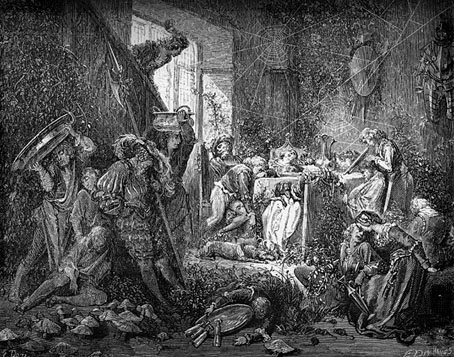
La Belle au bois dormant (The Sleeping Beauty in the Wood).

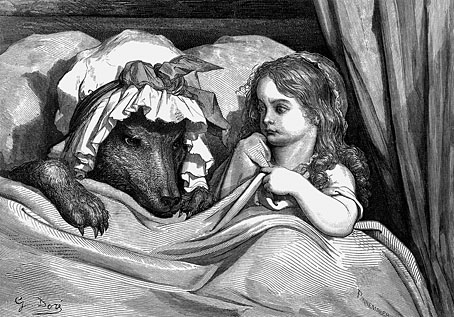
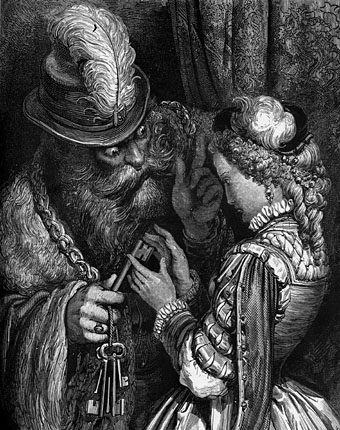
More illustrated Perrault. Gustave Doré’s intention to produce definitive illustrations for his editions certainly paid off when he turned his attention to the French fairy tales. Doré’s work may lack the light touch required for some of these stories but a couple of the engravings—Red Riding Hood in bed with the wolf, Puss-in-Boots—are reproduced endlessly whenever picture editors need a suitable illustration. Doré’s characters can be rather wooden at times but the expressions on the face of the wolf and the girl are perfect.

dore02.jpg

Le Petit Chaperon rouge (Little Red Riding Hood).

Elsewhere Doré contributes some original details: the court in Sleeping Beauty is usually shown besieged by thorns or bracken but Doré has giant fungi growing all over the floor; in Little Tom Thumb the children are described as knocking on the door of the ogre’s house then being let inside but Doré shows the ogre’s wife greeting them with a shaft of lamplight. These illustrations were published in several editions throughout the 1860s which makes that lamplight beam a very advanced pictorial effect. Incidentally, for those who read the Amon Düül II cover art post a couple of days ago, the figure of Tom Thumb stealing the ogre’s seven-league boots may be glimpsed outside the spacecraft window in the centrespread of Dance of the Lemmings.

Wikimedia Commons has more of the Doré illustrations; there’s also a set at Gallica although the quality of their scans isn’t always so good.

dore03.jpg

La Barbe bleue (Blue Beard).

Continue reading “Gustave Doré’s Fairy Tales of Charles Perrault”