The art of Ed Emshwiller, 1925–1990

vance.jpg

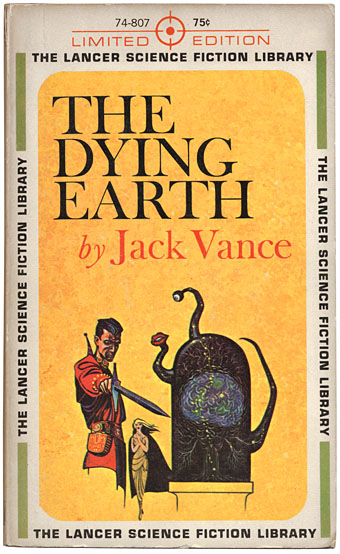
Another item brought to light during the Great Shelf Re-ordering and Spring Clean is this 1962 Lancer paperback of The Dying Earth by Jack Vance, a slim collection of six short connected stories, and another favourite book. Despite the SF label this is far more a work of fantasy (science fantasy, if you must), being tales of the bizarre and occasionally grotesque inhabitants of the last days of the earth. Magic is the order of the day, not advanced technology, although Vance hints that the book’s elaborate spells may be a higher ordering of mathematics capable of manipulating reality. I like the simple cover layout of this edition; Ed Emshwiller’s illustration manages to be sparing yet fully representative of a key scene.

emsh.jpg

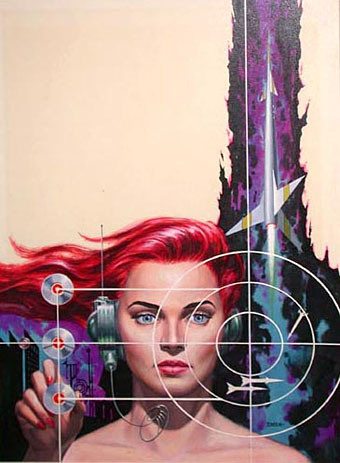
French sf portal Noosfere has recently revamped its artwork showcase and has a substantial collection of Emshwiller’s cover paintings. I’d prefer to see more of his earlier style but the collection includes some striking designs.

sunstone.jpg

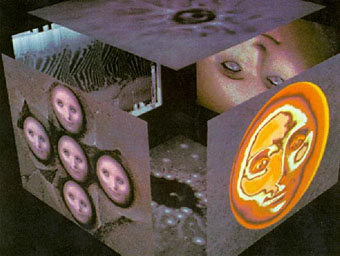
Sunstone (1979).

Emshwiller was a very prolific illustrator but from the 1960s on also developed his own style of experimental filmmaking, some examples of which can be found at YouTube. I’d actually seen Sunstone—a very early piece of computer animation—years ago without registering the credit. In addition there’s also Thanatopsis, a strange b&w short which is remarkably similar in tone to some of the films which William Burroughs and Antony Balch were making at around the same time.

The genre artist | Jack Vance profiled in the NYT

Elsewhere on { feuilleton }
The book covers archive
The illustrators archive

Previously on { feuilleton }
The King in Yellow
Ballantine Adult Fantasy covers
Clark Ashton Smith book covers
Revenant volumes: Bob Haberfield, New Worlds and others
The World in 2030
The art of Virgil Finlay, 1914–1971
Towers Open Fire

Harry Clarke’s stained glass

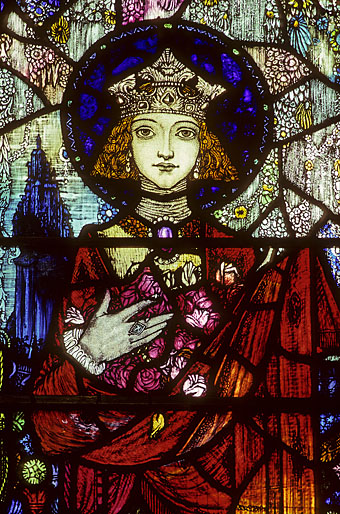
clarke_glass.jpg

Sturminster Newton, South aisle window (detail).

More from one of Ireland’s great artists. Harry Clarke’s book illustration is oft-reproduced but his stained glass work remains little seen unless you visit the churches where the windows are installed or find a copy of Nicola Gordon Bowe’s out-of-print monograph. Happily there’s a Flickr group who’ve done a great job photographing many of these windows, most of which will be impossible to adequately capture without erecting scaffolding. Someone really ought to publish a book of this work.

Elsewhere on { feuilleton }
The illustrators archive

Previously on { feuilleton }
Poe at 200
IKO stained glass
Harry Clarke’s The Year’s at the Spring
The art of Harry Clarke, 1889–1931

The Metamorphoses of Don José

velasquez1.jpg

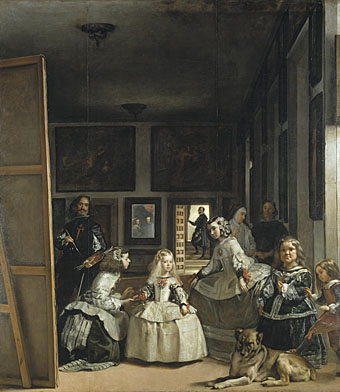
Las Meninas (1656) by Diego Velázquez.

The sight of one of Picasso’s many versions of Las Meninas (The Maids of Honour) by Velázquez earlier this week prompts this post. An endlessly fascinating painting whose influence runs through three hundred years of art history. That influence isn’t so surprising if you consider this as a painter’s painting; it certainly never seems to figure in the canon of favourite works among the wider public. But artists are beguiled by the games it plays with our ways of seeing: a self-portrait of the artist painting a subject (the royal couple) standing where the viewer would be, with the couple seen in reflection in the mirror on the back wall. We are the watchers and the watched. Wikimedia Commons has a decently large copy of the painting.
velasquez2.jpg

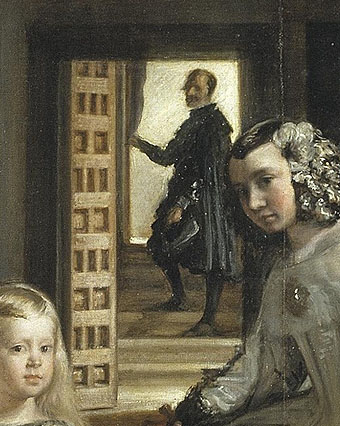
I’ve long been fascinated by the detail of the queen’s chamberlain, Don José Nieto Velázquez, standing on the steps at the back of the picture. Lines of perspective draw our attention to his figure, not only the perspective of the room but also the line which can be drawn across the heads of the three figures in the foreground right. I always look to see how Don José is treated in subsequent variations, some of which appear below.
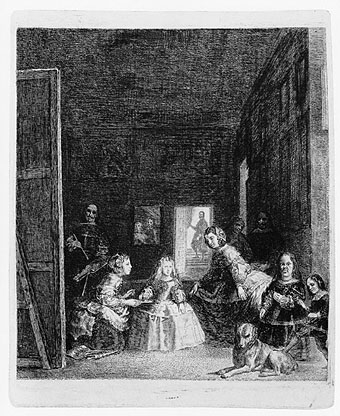
goya.jpg

Las Meninas, after Velázquez (c. 1778) by Francisco de Goya y Lucientes.

One of the commonplaces of contemporary art is artworks about other artworks. Goya’s etching shows that this idea is by no means a new one. Goya was apparently dissatisfied with his attempt, and its main interest is the degree to which he distorts various parts of the picture.
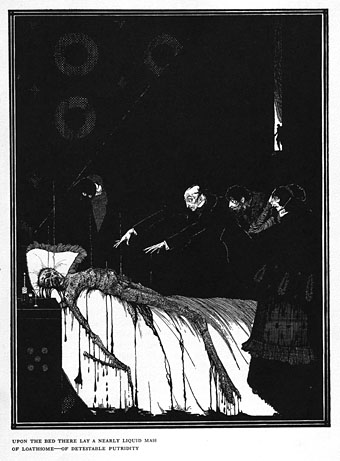
clarke.jpg

The Facts in the Case of M Valdemar (1919) by Harry Clarke.

Harry Clarke scholar Nicola Gordon Bowe proposed in The Life and Work of Harry Clarke (1989) that the figure in the background of this Poe illustration was a version of Don José. Clarke’s picture also has a similar grouping of foreground figures which adds to the speculation. The division of space in the Velázquez painting would have held considerable appeal for an artist used to dealing with similar divisions in his stained glass window designs. Will at A Journey Round My Skull recently uploaded a set of high-resolution scans of Clarke’s Poe drawings and paintings.
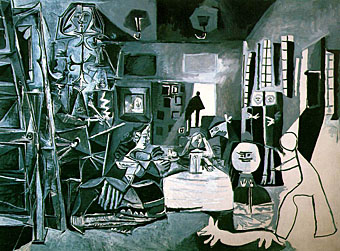
picasso.jpg

Las Meninas (after Velazquez) (1957) by Pablo Picasso.

In the 1950s Picasso took to producing a series of variations on favourite paintings. There are 44 versions of Las Meninas, some more abstract than others. This one reminds me of Guernica and I like the humour of presenting Velázquez’s dog—one of the great dogs of art history—as though it’s been drawn by Nicolas Pertusato, the child who attempts to rouse the animal with his foot. Velázquez here has a head surmounting a spindly body comprised of the Order of Santiago cross.
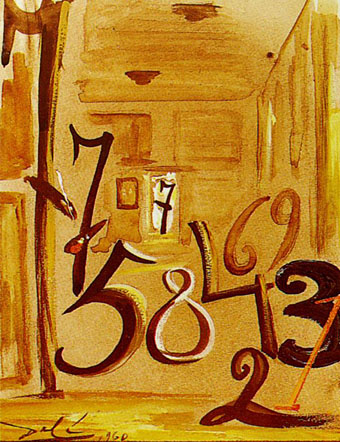
dali.jpg

Las Meninas (1960) by Salvador Dalí.

Salvador Dalí venerated Velázquez and he happily quoted other artists throughout his career so it’s no surprise to find variations of Las Meninas. This wins the award for the most eccentric, with the figures reduced to numerals. Closer examination shows it to be quite clever the way each number corresponds to a different figure. The use of the number 7 for the artist and for Don José makes sense when you consider that they share the same surname. Don José turns up alone is another painting the same year, a work entitled Maelstrom: Portrait of Juan de Pareja fixing a string of his mandolin.
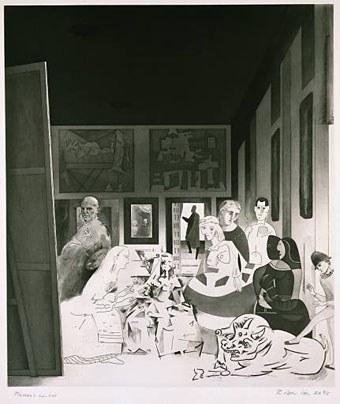
hamilton.jpg

Picasso’s Meninas (1973) by Richard Hamilton.

Richard Hamilton’s aquatint is equally playful, substituting Velázquez with Picasso and his works.
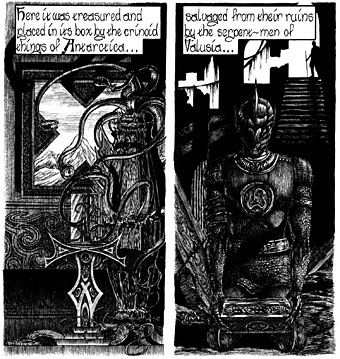
haunter.jpg

The Haunter of the Dark (1986).

I seem to have referred to my own work quite a lot recently, and here’s some more of it. The panel on the right quotes from Harry Clarke’s Poe illustration and so can be considered as continuing a trace element of the shadowy Don.
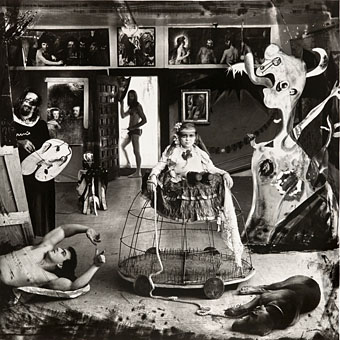
witkin.jpg

Las Meninas (Self Portrait) (1987) by Joel-Peter Witkin.

Joel-Peter Witkin has quoted Picasso’s works frequently in his photo-tableaux so the Picasso-esque figure on the right is perhaps inevitable. Witkin also has a considerable fondness for dead things so it’s quite likely that the dog in this photograph isn’t sleeping.

I’ll be surprised if there haven’t been a lot more variations during the past twenty years. If anyone knows of any which are better than this item by Antonio Guijarro Morales, please leave a comment.

Previously on { feuilleton }
Picasso-esque
Reflections of Narcissus
My pastiches
Guernica, seventy years on
The art of Harry Clarke, 1889–1931
The King in Yellow

king_ace.jpg

Along the shore the cloud waves break,
The twin suns sink beneath the lake,
The shadows lengthen
In Carcosa.

Strange is the night where black stars rise,
And strange moons circle through the skies
But stranger still is
Lost Carcosa.

The King in Yellow, Act i, Scene 2.

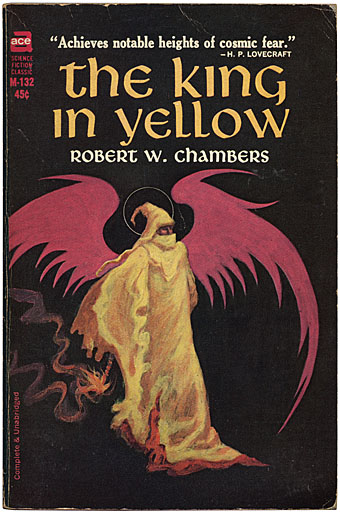
Rearranging the bookshelves this week had me looking again at this old Ace paperback of Robert Chambers’ weird classic, one of that select handful of books which can bear a blurb from HP Lovecraft. Any Lovecraft aficionados yet to read the first four stories in Chambers’ collection (the others pieces are of lesser interest) are missing out. These are as good as anything that Weird Tales published and together they achieve that unique blend of science fiction, fantasy and horror which Lovecraft and others also managed in the days when writers, and readers for that matter, were far less concerned with the definition and boundaries of genre.

king2.jpg

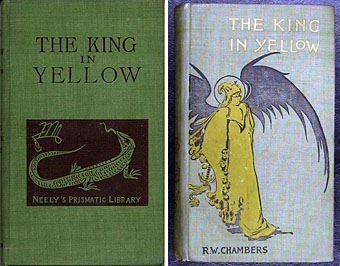
My Ace edition was the first paperback printing from 1965 and the cover painting is by Jack Gaughan, credited inside as being based on Chambers’ own first edition design. I’d often wondered what the original cover looked like and now, of course, it’s easy to find. Whether Chambers himself drew this is unclear but whoever the artist was, the design is rather more finessed than Gaughan’s sketchy painting.

king.jpg

Searching around reveals two further variations, one of which—the green cover—is described on a bookselling site as the actual first edition of the book from 1895. Yours for a mere $1,750. The other cover is probably a later reprint which gives a clearer view of the mysterious King. What’s notable here is the curious sigil on both the Neely editions. I was hoping this might be the dreaded Yellow Sign which is the subject of Chambers’ fourth (and Lovecraft’s favourite) story; it’s certainly more suitable than the squiggle which seems so unaccountably popular among certain quarters of Lovecraft fandom. It isn’t the Yellow Sign, however, it turns out to be the monogram for publisher F. Tennyson Neely. Perhaps this is just as well. “The solution to the mystery is always inferior to the mystery itself,” as Borges said, and some things, like the malevolent play which gives its name to this collection, are best kept out of reach.

The King in Yellow at the Internet Archive

Elsewhere on { feuilleton }
The book covers archive
The Lovecraft archive

Previously on { feuilleton }
Arthur Machen book covers
Clark Ashton Smith book covers

Henry Keen’s Dorian Gray

keen1.jpg

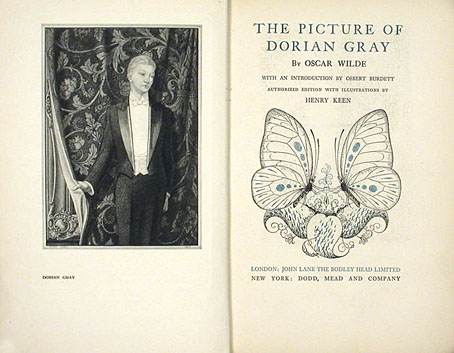
Returning to the golden boy again this week with an illustrated edition of Wilde’s novel from 1925. The publisher was Aubrey Beardsley’s old employer, John Lane, and the illustrator was Henry Keen, an artist of singular and dismaying obscurity. Perhaps some of my knowledgeable commenters can provide more information. Keen’s 12 plates look like lithographs but the book also featured ink embellishments and a splendid sunflower/butterfly design on the boards and slipcase.

Continue reading “Henry Keen’s Dorian Gray”