Leo Dillon, 1933–2012

dillons.jpg

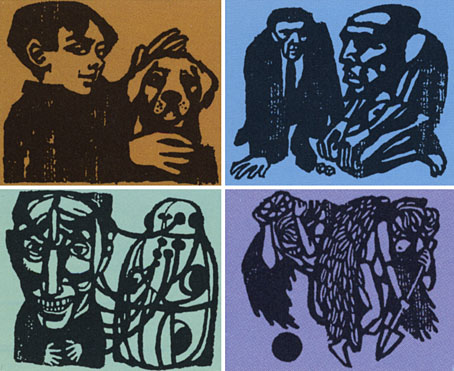
Illustrations for Dangerous Visions (1967) by Leo & Diane Dillon.
top left: Lord Randy, My Son by Joe L. Hensley; top right: Gonna Roll the Bones by Fritz Leiber
; bottom left: The Happy Breed by John Sladek; bottom right: Shall the Dust Praise Thee? by Damon Knight

Beyond my love for them and my understanding that they have influenced my ethical and moral life almost more than anyone else I’ve ever known, my respect for their artistic intelligence and their incomparable craft is enormous. Leo and Diane Dillon are the best. Simply put: the best.

Harlan Ellison, from The Illustrated Harlan Ellison (1978)

Pre-internet, illustrators and designers often suffered from being landlocked by whatever territories (to use that wretched marketing term) the work they embellished was sold in. I’ve said as much in the past but it’s worth repeating since it explains how reputations could loom large in one country while the artists in question might be unknown elsewhere. Leo and Diane Dillon are a good example of this, lauded in the US for work that spanned a variety styles and media yet barely visible in Europe unless you chanced across an imported paperback bearing one of their covers. Their long and fruitful relationship with Harlan Ellison saw them illustrate many of his major works, books which when they were reprinted here were often packaged with inappropriate spaceship art by Chris Foss or one of his imitators. Happily the Dillons’ superb woodcut illustrations for Ellison’s Dangerous Visions anthology survived the journey across the Atlantic. I still find those illustrations thrilling for the way they condensed the essence of thirty-two challenging stories with the greatest economy of means. And thanks to the internet we can see just how versatile they were at The Art of Leo and Diane Dillon. That site also includes links to interviews and further examples of their art.

Elsewhere on { feuilleton }
The illustrators archive

Previously on { feuilleton }
Science fiction and fantasy covers
Groovy book covers
Harlan Ellison: Dreams with Sharp Teeth
Maurice Sendak, 1928–2012

sendak1.jpg

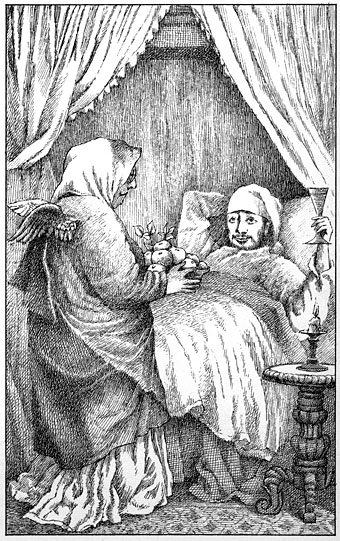
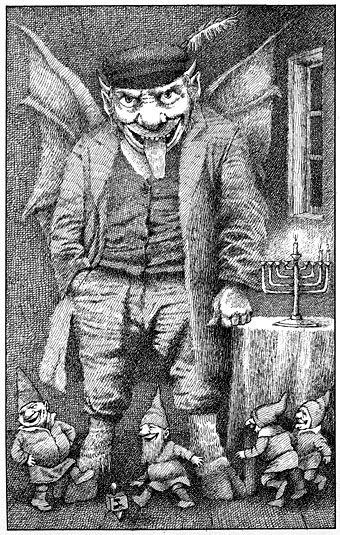
From Zlateh the Goat and Other Stories (1966) by Isaac Bashevis Singer.

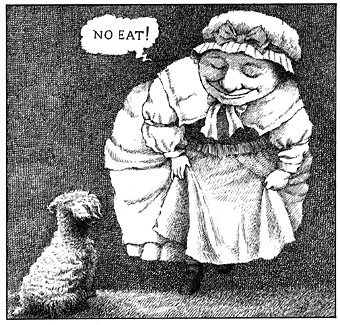
All the obituaries of the late Maurice Sendak have focused inevitably on Where the Wild Things Are. That gives me a chance to draw attention to some less familiar Sendak drawings whose finer crosshatching naturally appeals to an inveterate crosshatcher such as myself. The combination of bold characterisation and dense shading makes these pieces look remarkably similar to Mervyn Peake’s illustrations of the 1940s. Sendak spoke to Nick Meglin about some of the influences on his drawing in The Art of Humorous Illustration (1973). Given what he says here it’s evident that he and Peake (who also admired Cruikshank and Rowlandson) shared antecedents:

Many of the artists who influenced me were illustrators I accidentally came upon. I knew the Grimm’s Fairy Tales illustrated by George Cruikshank. I just went after everything I could put my hands on illustrated by Cruikshank and copied his style. It was quite as simple as that. I wanted to crosshatch the way he did. Then I found Wilhelm Busch and I was off again. But happily Wilhelm Busch also crosshatched so the Cruikshank crosshatching wasn’t entirely wasted. And so an artist grows. I leaned very heavily on these people. I developed taste from these illustrators.

The 1860’s, the great years of the English illustrators from whom so much of my work is derived, are familiarly known as “the sixties” to admirers of Victorian book illustration. The influence of Victorian artists such as George Pinwell and Arthur Hughes, to name just two, is evident in the pictures I created for Higglety Pigglety Pop! (Harper and Row, 1967), Zlateh the Goat (Harper and Row, 1966), and A Kiss for Little Bear (Harper and Row, 1968). And I’ve learned from other English artists as well. Randolph Caldecott gave me my first demonstration of the subtle use of rhythm and structure in a picture book. Hector Protector and As I Went Over the Water (Harper and Row, 1965) is an intentionally contrived homage to this beloved teacher.

sendak2.jpg

From Zlateh the Goat and Other Stories (1966) by Isaac Bashevis Singer.

For other fine points in picture book making, I’ve studied the works of Beatrix Potter and William Nicholson. Nicholson’s The Pirate Twins certainly influenced Where the Wild Things Are (Harper and Row, 1963).

A retrospective of my English passion can be found in Lullabies and Night Songs (Harper and Row, 1965). The illustrations for this book, which skip from Rowlandson to Cruikshank to Caldecott and even to Blake, are a noisy pastiche of styles, though I believe they still resonate with my own particular sound. Mr. Rabbit and the Lovely Present (Harper and Row, 1962) is as far as I am aware the only book I’ve done that reveals my admiration for Winslow Homer.

sendak3.jpg

Higglety Pigglety Pop! Or, There Must Be More to Life (1967).

About two-and-a-half years after the publication of Where the Wild Things Are, I finally became conscious of my reviving interest in the art I’ve experienced and loved as a child. The trigger was an exhibit (at The Metropolitan Museum) of pages from Little Nemo in Slumberland, Winsor McCay’s famous newspaper comic strip of the years 1905 to 1911. Before the exhibit I was ignorant of this popular American artist’s pure genius for graphic fantasy. It now sent me scooting back with new eyes to the popular art of my own childhood.

This recognition of personal roots is in no way meant as a triumphant revelation or as reverse snobbism, a put-down of my earlier, more ‘refined’ influences. What I’ve learned from English as well as French and German artists will, if I have my wish, become more absorbed into my creative psyche, blending and living peaceably with my own slice of the past. But of course all this happens on its own or it doesn’t happen at all.

Elsewhere on { feuilleton }
The illustrators archive

Virgil Finlay’s Tarzan

finlay.jpg

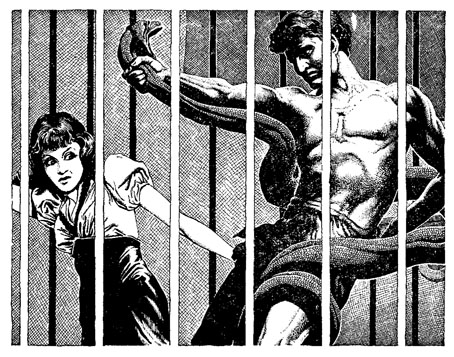
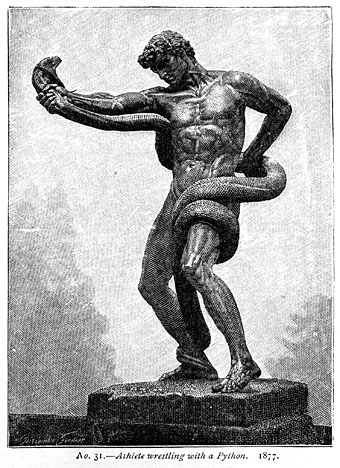
Thanks are due to Ty Reutel for alerting my attention to this one. I’d no idea that the great Virgil Finlay had illustrated Tarzan but here’s the proof, one half of an interior drawing for The Quest of Tarzan in Argosy Weekly for 1941. That’s the first surprise, the second, of course, was that Finlay had copied Frederic Leighton’s Athlete Wrestling with a Python (1877) ( below), a sculpture which has been a subject of discussion here recently. I’ve mentioned before my including Leighton’s work in one of my Lovecraft adaptations; I referred to many other artworks in those stories but never made any direct reference to Virgil Finlay even though he was the original illustrator of Lovecraft’s The Haunter of the Dark when it was first published in Weird Tales in 1936. Finlay’s illustrations for that story later appeared with some of my own in the enormous Centipede Press collection of Lovecraft art so it’s strange to find that we were also led to the same Leighton sculpture.

Tarzan illustration has been in my thoughts for the past few weeks while I’ve been at work (again!) on the collected Reverbstorm, many pages of which played variations on Burne Hogarth’s comic adaptations of the Tarzan stories. Reverbstorm is at long last very close to being finally, absolutely finished, and ready for printing in a single definitive volume. No production schedule just yet but any news will be announced here.

leighton4.jpg

Previously on { feuilleton }
Frederic Leighton’s sculptures
Virgil Finlay’s Salomé
Die Farbe and The Colour Out of Space
Lovecraft’s favourite artists revisited
Angelo Colarossi and son
The monstrous tome
Men with snakes

Weekend links 96

nunez.jpg

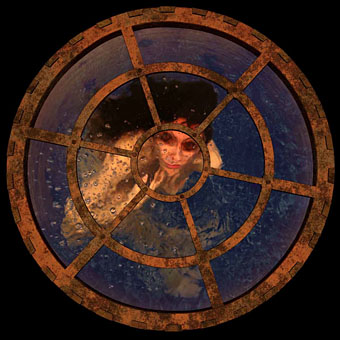
Sin título (monstruas) (2008) by Marina Núñez.   

• Salon asks Christopher Bram “Is gay literature over?” Bram’s new book, Eminent Outlaws: The Gay Writers Who Changed America, is reviewed here.

Robert Montgomery is profiled at the Independent as “The artist vandalising advertising with poetry.”

In addition to aesthetics, McCarthy noted a deeper link between great science and great writing. “Both involve curiosity, taking risks, thinking in an adventurous manner, and being willing to say something 9/10ths of people will say is wrong.” Profound insights in both domains also tend arise from a source beyond the limits of analytic reason. “Major insights in science come from the subconscious, from staring at your shoes. They’re not just analytical.”

Nick Romeo meets Cormac McCarthy at the Santa Fe Institute.

• For FACT mix 316 Julia Holter mixes radio broadcasts, street recordings and music.

• This week in the Tumblr labyrinth: fin de siècle art and graphics from Nocnitsa.

“There’s a widespread cultural barrenness across art and political culture. But there are some pockets of resistance on the extreme margins, like the techno-savvy protest movements, small press, the creator-owned comics, that seem to be getting some signs of hope for the future,” he says. “All of the genuinely interesting work is being done on the margins, with independent companies, self-producing, and alternative distribution networks.”

Alan Moore on Watchmen’s “toxic cloud” and creativity v. big business.

Stone Tape Shuffle, a 12” LP of readings by Iain Sinclair. Limited to 400 copies.

Monolake on how we cope with death: mythologies, rituals, drugs and Ghosts.

Kraftwerk perform at New York’s Museum of Modern Art in April.

Kathy Acker (in 1988?) interviewing William Burroughs.

pogany.jpg

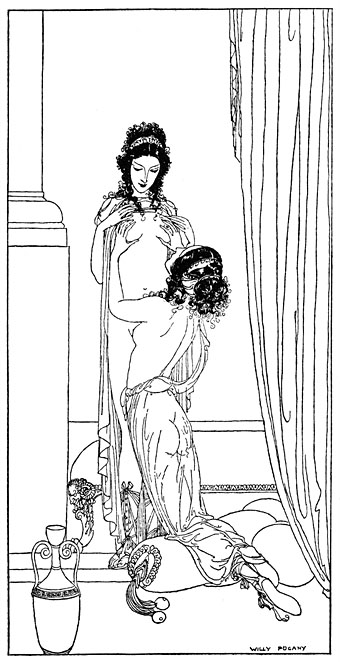
Willy Pogány’s erotica: illustrations for a 1926 edition of The Songs of Bilitis by Pierre Louÿs.

• Nicholas Lezard on David Lynch: director of dreams.

Did otherworldly music inspire Stonehenge?

Coilhouse has an Eyepatch Party.

Tanzmusik (1973) by Kraftwerk | The Model (1992) by the Balanescu Quartet | Trans Europe Express (2003) by the Wiener Sinfonie Orchestra & Arnold Schönberg Choir.

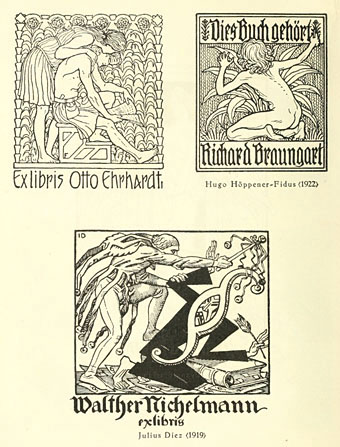
German bookplates

exlibris08.jpg

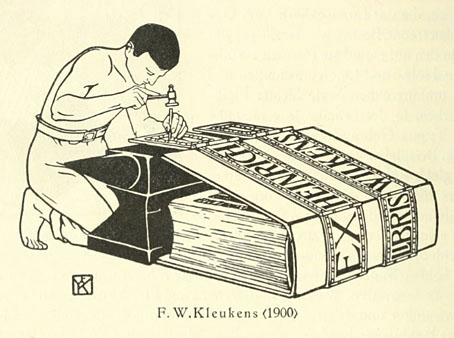
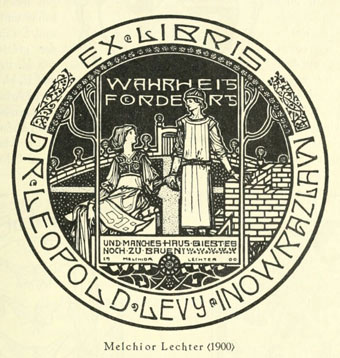
A selection from Das Moderne Deutsche Gebrauchs-Exlibris (1922) edited by Richard Braungart, an overview of the practioners of the bookplate form in Germany and Austria during the first decades of the 20th century. Some of the German and Austrian art magazines featured here over the past couple of years included bookplate designs, and Braungart’s collection includes many artists from those magazines: Melchior Lechter, Hugo Höppener (aka Fidus), Julius Diez, Heinrich Vogeler, Marcus Behmer, Franz von Bayros, Koloman Moser, Carl Otto Czeschka, Ephraim Moses Lilien, Franz Stassen and others. 400 examples in all.

exlibris01.jpg

exlibris02.jpg

Continue reading “German bookplates”