Weekend links 236

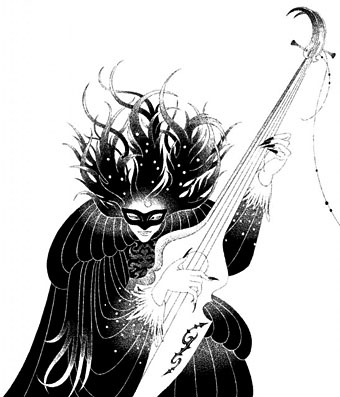
carvalho.jpg

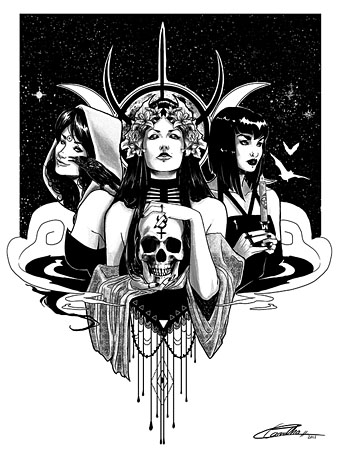
The Three Witches (2014) by Lorena Carvalho.

Immersion, a new album by Grey Frequency, “…is a recording of the broken signals, wraiths in the ether from lost futures and utopias which were once promised…”. Box Of Secrets (1999) is an album of electronica by Ian Boddy that’s a free download until the end of December.

• “Hothouse flowers, Egyptian statuary, jewels, Nubian servants, crystal balls, cocaine, opium and champagne were just some of the things she spent her money on…” Lucy Davies explores the riotous world of Marchesa Luisa Casati.

• “London is a network of complete nexuses, coincidences, overlaps, references…” Stephanie Boland talks to Iain Sinclair about his new book 70×70: Unlicensed Preaching: A Life Unpacked in 70 Films.

My Women’s Studies professors would say: “You don’t know how hard we fought for you.” And yet, when they told me my sexuality was not correct, I felt embarrassed. I knew I had longings that didn’t line up with the politics, but I refused to repress them, particularly in my writing. I fought to unravel a political correctness that was censoring desire.

Screenwriter Erin Cressida Wilson on sex, cinema and secrets

Cthulhu, Fiction and Real Magic, a lecture by Ian ‘Cat’ Vincent at Treadwell’s, London, on December 3rd. For those who can’t attend, Erik Davis has just posted his essay about Lovecraft and contemporary occultism.

• “John Gielgud was obsessed with trousers, loved corduroy and leather. And so he wrote a film set in a menswear shop.” Gielgud’s unfilmed screenplay for gay porn director Peter de Rome may now be filmed.

• “The stories are even more fantastic and full of marvels than those in the Arabian Nights.” Robert Irwin on the newly-translated Tales of the Marvellous.

• Mixes of the week: The Advisory Circle present Winter From Out Here; Fall by The Ephemeral Man; Secret Thirteen Mix 136 by Cosmin TRG.

Danny Cooke‘s drone views of Pripyat, Chernobyl. Related: Into the Zone: Gasworks Park (Seattle, WA) by Christina Scholz.

• Watch Dragnet’s 1967 LSD episode. More psychedelics: “Magic mushrooms change brain connections“.

• Earth Magic: Peter Bebergal on photography of witches at play and at ritual.

• Düsseldorf 1970: The crucible of Krautrock by those who were there.

• It’s Alright Ma, It’s Only Witchcraft (1968) by Fairport Convention | Witch’s Will (1973) by Wilburn Burchette | Witches’ Multiplication Table (1982) by Holger Czukay
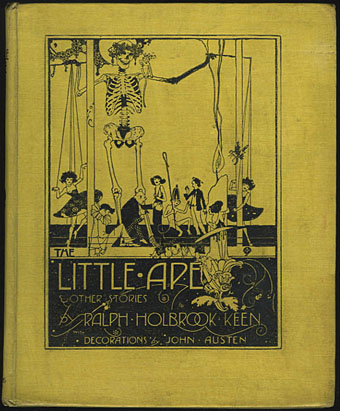
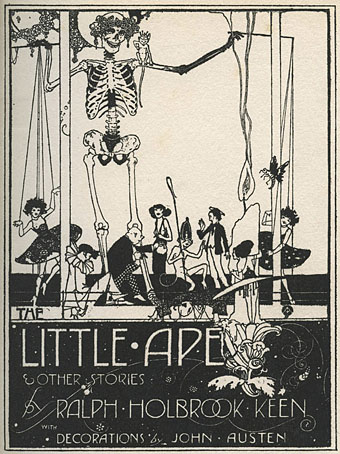
John Austen’s Little Ape

austen1.jpg

British illustrator John Austen (1886–1948) illustrated many classic works of fiction throughout the 1920s, one of which, Hamlet, was recently reprinted by Dover Publications. His other work isn’t so easy to find, however, and I’d not seen Little Ape and Other Stories (1921) until Nick H drew my attention to a copy for sale at silver-gryph’s eBay pages. (Thanks, Nick!)

Ralph Holbrook Keen’s story collection was Austen’s first illustrated edition although you wouldn’t necessarily take it for a debut work. There are the familiar nods to Beardsley—the black-and-yellow cover especially—and possibly Harry Clarke whose influence is more evident in the Hamlet drawings. Clarke and Austen exhibited together in 1925. The skeleton with a floral crown makes me think of the rose-crowned skeleton in Edmund J. Sullivan’s Rubáiyát (1913), although this may be a result of Sullivan’s drawing having been made very familiar by its use on Mouse & Kelley’s posters for the Grateful Dead. One of the many connections between the Golden Age of Illustration and the Golden Age of Psychedelia.

austen2.jpg

austen3.jpg

Continue reading “John Austen’s Little Ape”

The art of John Jack Vrieslander, 1879–1957

vrieslander01.jpg

The Darkness (1900).

Another discovery to add to the long list of post-Beardsley illustrators, John Jack Vrieslander was a German artist whose not-very-German name was a pseudonym of Hans Zarth. It took some searching to establish that a) it is Zarth, not “Zahrt” as one site has it, and b) the two were indeed one person. I’ve used the Vrieslander name here since that’s the credit used for most of these examples. Vrieslander/Zarth signed his pictures with a V or a Z according to the prevailing persona.

vrieslander02.jpg

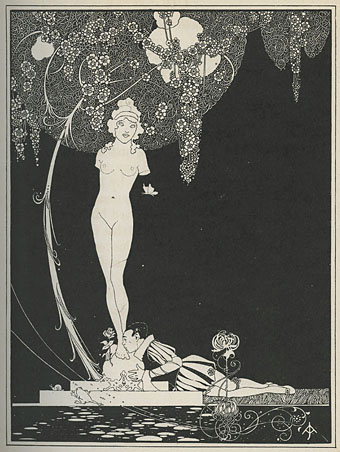
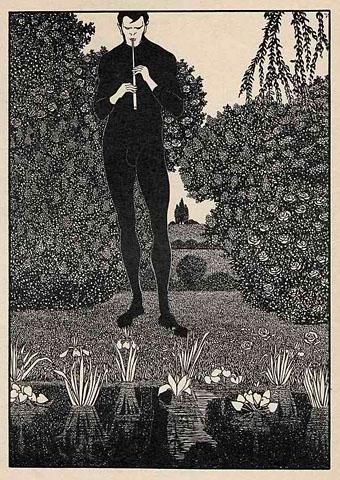
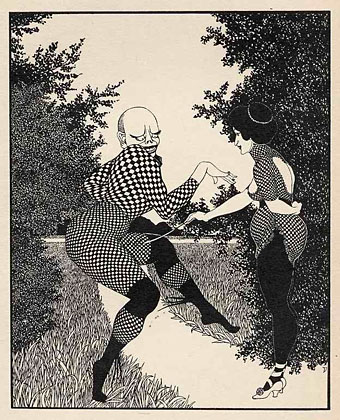
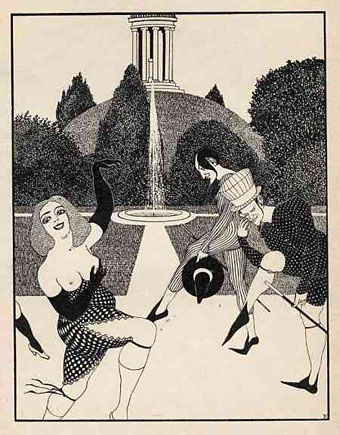
As Beardsley imitations go these drawings could be better—they lack Aubrey’s natural sense of balance and composition—but they’re of interest for leaning so heavily on the style of the later illustrations which favour elegant gardens and meticulously rendered foliage. Some of the figures refer to the earlier Aubrey, however, as does the vaguely lascivious atmosphere. The phallic plant pot in the Lilly Peters picture below is the kind of detail nobody in 1901 would have dared attempt without Aubrey’s lead.

vrieslander03.jpg

Continue reading “The art of John Jack Vrieslander, 1879–1957”

The art of Toshiaki Kato

kato01.jpg

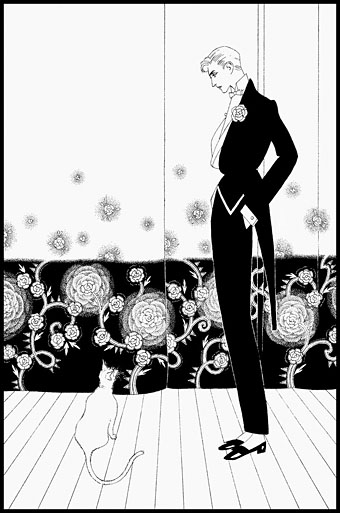
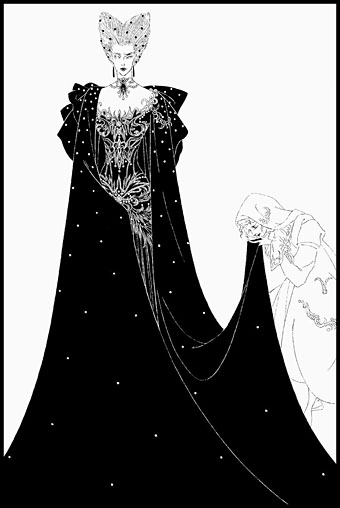
Toshiaki Kato isn’t the first contemporary Japanese artist to work variations on Aubrey Beardley’s style but he’s one I’d not come across before. Kato’s cover illustrations run a gamut of familiar styles, not only Beardsley but Harry Clarke, Gustav Klimt, Tamara Lempicka, Maxfield Parrish and no doubt a few more I haven’t recognised. Beardsley’s influence is something I like to follow so it’s the black-and-white work you see here. It’s particularly fascinating seeing Japanese artists playing with Beardsley motifs when so much of Beardsley’s early style was derived from Japanese prints; a rare example of cultural influence finding its way back home after a century or more.

There’s surprisingly little information about Toshiaki Kato on Anglophone websites but scans of his gorgeous paintings proliferate. This page is a good place to start but there’s plenty more at Pinterest and elsewhere.

kato02.jpg

kato03.jpg

Continue reading “The art of Toshiaki Kato”

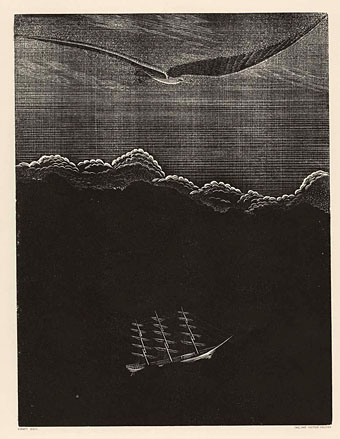
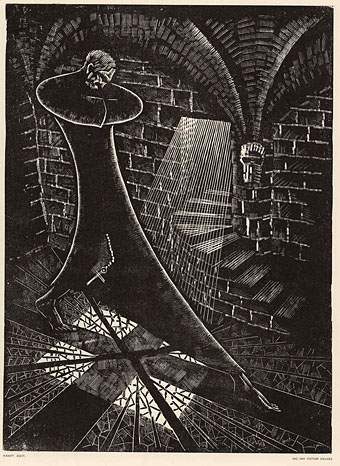
Victor Delhez’s Fleurs du Mal

delhez1.jpg

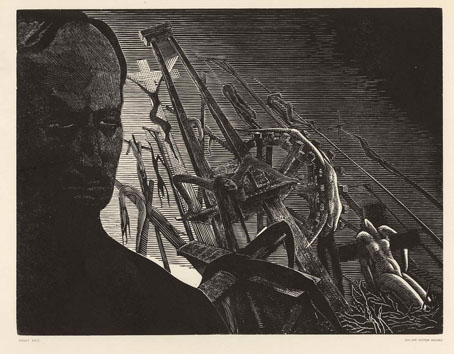
Another illustrated Baudelaire. Two editions that I might have featured in this series have already been posted in quality scans at 50 Watts: the 1935 Fleurs du Mal by Carlo Farnetti, and a 1947 edition by Beresford Egan, the latter being a good example of a well-matched artist and author.

The illustrations here are woodcuts once again, the artist being Victor Delhez (1902–1985), a Belgian who moved to South America. The 1950 Fleurs du Mal which featured these plates contained 20 illustrations in all but these are the only ones online. I hadn’t come across Delhez before but he was a prodigiously talented artist, as can be seen from the print collection at William P. Carl Fine Prints.

delhez2.jpg

delhez3.jpg

Continue reading “Victor Delhez’s Fleurs du Mal”