H.P.L.

hpl.jpg

It’s that man again. Presenting the latest reworked page from the ongoing reconstruction/improvement of my Haunter of the Dark book. The picture will illustrate “Abdul Alhazred”, the final section of Alan Moore’s text for The Great Old Ones in which HP Lovecraft is positioned at Malkuth, the “Kingdom” in Alan’s eldritch Kabbalah. This makes Lovecraft himself the receptive vessel of the energies descending from the spheres above, while paradoxically being the source of those energies. Or some of them at least… The Great Old Ones is a Mythos Kabbalah which features Dagon, Hastur, Tsathoggua and Yig as well as Cthulhu and the rest. Alan doesn’t subscribe to Kenneth Grant’s baseless theory that Lovecraft really was a receptacle for transmissions from interdimensional entities, but the incorporation of the writer into his own pantheon isn’t unprecedented. Abdul Alhazred was a childhood persona of Lovecraft’s before he assigned the name to the author of Al Azif, or the Necronomicon; further personas may be found in Through the Gates of the Silver Key (“Ward Phillips”), Robert Bloch’s The Suicide in the Study (“Luveh-Keraph, priest of Bast”), and other fictions.

hpl.jpg

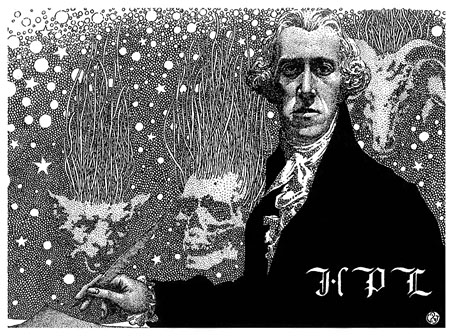
HPL (1937) by Virgil Finlay.

Whether this literary sport warrants the apparently limitless production of Lovecraftian art featuring the man himself, usually sprouting or festooned with tentacles, is a debatable matter. Virgil Finlay began the fantastic portrait trend in 1937 with his memorial depiction of the author writing with a quill pen while dressed in 18th-century garb. The earliest example that I can think of showing Lovecraft paired with the ubiquitous tentacles was the Moebius cover for Lettres d’Arkham in 1975, although there may well be other drawings prior to this. I’ve often wondered what Lovecraft would have made of the deluge of publications and images derived from his work, especially those that place him inside the products of his imagination.

moebius.jpg

Cover art by Moebius, 1975.

And speaking of which… I was at a loss at first with how to approach a new Lovecraft portrait, all I knew was that one was necessary. The original Malkuth picture from 1999 is another poor Photoshop job which has nevertheless been reused elsewhere on a few occasions, even appearing in 2007 on the cover of an issue of FATE magazine. For the new version I started with the portrait itself, using white lines on black to copy the same portrait photograph that formed the centre of the older picture. This was then duplicated and flipped horizontally to create a kind of Janus head which gives the portrait a suitably weird quality without wreathing it in tentacles. The mirrored head harks back to a sequence of treated photos by JK Potter which I first saw in the Heavy Metal Lovecraft special in 1979. Potter had used the same portrait photo to create effects that were somewhat compromised by poor reproduction, leading me to be believe that I’d created something slightly different to the first panel in his sequence. While researching this post I turned up an earlier version of the artwork which appeared on the back of the first issue of a US fanzine, Fantasy Mongers, also in 1979. The clearer reproduction revealed that the first head in Potter’s sequence is almost identical to my own. Ah well…

jkpotter.jpg

Photo art by JK Potter from the back cover of Fantasy Mongers #1, 1979.

The rest of the picture was improvised around this central image. Having drawn the portrait in white-on-black I decided to use a similar technique for the other elements. The Cthulhoid pillars are based on those in my Red-Night Rites painting from 1997, one of which appeared in the 1999 picture. The smaller figure on the right is from one of the photos that Wilfred Talman took while wandering the streets of New York with Lovecraft and Frank Belknap Long. This also appeared in the 1999 picture but for the new version I’ve emphasised what appears to be a book that Lovecraft is carrying in his right hand. Searching around for a complementary figure that might represent Abdul Alhazred turned up a 19th-century photo of a character who not only looked the part but is also standing in a manner similar to the Talman Lovecraft. If you look closely he’s also carrying a book, an addition of my own which turns him into the author of Al Azif. The polyhedra supporting the pair aren’t as arbitrary as they may seem. The spheres serve a dual purpose, preventing the figures from floating in space (or standing in water) while also relating to the Sephiroth of Malkuth which is identified with the Earth in the Kabbalistic scheme of planetary associations.

The next reworked picture will be Tsathoggua which is being polished rather than completely overhauled. I’m hoping I might have this done by the end of the month but I’m still chipping away at The Dunwich Horror while doing all this, as well as working on things which pay the bills. (I’ve just finished designing and illustrating another book.) Further progress will be announced in due course.

Elsewhere on { feuilleton }
The Lovecraft archive

Previously on { feuilleton }
The Return of the Crawling Chaos
Lettering Lovecraft
Weird ekphrasis and the Dunwich Horrors
Kadath and Yog-Sothoth
Another view over Yuggoth

Weekend links 803

USA-ad.jpg

Ad for The United States Of America from Helix magazine, 1968.

• American composer Joseph Byrd died this week but I’ve yet to see a proper obituary anywhere. He may not have been a popular artist but he was significant for the one-off album produced in 1968 by his short-lived psychedelic group, The United States Of America. Their self-titled album has been a favourite of mine since it was reissued in the 1980s, one of the few American albums of the period that tried to learn from, and even go beyond, the studio experimentation of Sgt Pepper. The United States Of America didn’t have the resources of the Beatles and Abbey Road but they did have Byrd’s arrangements, together with an energetic rhythm section, an electric violin, a ring modulator, some crude synthesizer components, the voice of Dorothy Moskowitz, and a collection of songs with lyrics that ranged from druggy poetry to barbed portrayals of the nation’s sexual neuroses. The album became an important one for British groups in the 1990s who were looking for inspiration in the wilder margins of psychedelia, especially Stereolab, Portishead (Half Day Closing is a deliberate pastiche), and Broadcast. Byrd did much more than this, of course, and his follow-up release, The American Metaphysical Circus by Joe Byrd And The Field Hippies, has its moments even though it doesn’t reach the heights of its predecessor. Byrd spoke about this period of his career with It’s Psychedelic Baby Magazine in 2013.

• At BBC Future: “The most desolate place in the world”: The sea of ice that inspired Frankenstein. Richard Fisher examines the history of the Mer de Glace in fact and fiction with a piece that includes one of my Frankenstein illustrations. The latter are still in print via the deluxe edition from Union Square.

• A Year In The Country looks at a rare book in which Alan Garner’s children describe the making of The Owl Service TV serial.

• The final installment of Smoky Man’s exploration of The Bumper Book of Magic has been posted (in Italian) at (quasi).

• At Public Domain Review: Perverse, Grotesque, Sensuous, Inimitable: A Selection of Works by Aubrey Beardsley.

• At Colossal: Ceramics mimic cardboard in Jacques Monneraud’s trompe-l’œil ode to Giorgio Morandi.

• At the Daily Heller: The “narrative abstraction” of Roy Kuhlman‘s cover designs for Grove Press.

• New music: Elemental Studies by Various Artists; and Gleann Ciùin by Claire M. Singer.

• Steven Heller’s font of the month is Archive Matrix.

Sensual Hallucinations (1970) by Les Baxter | The Garden Of Earthly Delights (United States Of America cover) (1982) by Snakefinger | Perversion (1992) by Stereolab

Elliott Dold’s Night

dold01.jpg

Looking for artwork by Elliott Dold turned up this remarkable set of illustrations for an unremarkable collection of poetry, Night, by a friend of the artist, Harold Hersey. Elliott Dold (1889–1957) was an American illustrator during the early days of the pulp magazines, best known today for drawings of huge machines which are a match for those by his more prolific contemporary, Frank R. Paul. The pulp magazines are so often filled with mediocre illustration that it’s a pleasure to find another talent lurking in their pages. But Dold was more than an illustrator of big science, as these illustrations for Hersey’s dubious poetry demonstrate.

dold02.jpg

Night is a collection of vaguely erotic poems, all of which Hersey labels “Nocturnes”. The collection was published in 1923 in a privately-printed subscriber-only edition, and every description I’ve read of it agrees that the illustrations are the best thing about it. The drawings are also radically different to Dold’s science-fiction art, to a degree that they could easily be taken for the work of a different illustrator. “What a pity the artist has to waste his time grinding out art for the pulps,” said HP Lovecraft, in a letter to Clark Ashton Smith. A pity, indeed. Dold’s illustrations are on a par with those that Wallace Smith was producing in the same year, and are close enough to Smith’s style that’s it’s tempting to accuse him of imitation. Smith’s style wasn’t unique, however; Ray Frederick Coyle was another American artist at work in the 1920s who favoured the same combination of strict black-and-white, careful linework and stylised figures. It’s curious that three books with somewhat controversial contents should have been published in the USA in 1922/23, all of them illustrated in a very similar manner: Ben Hecht’s Fantazius Malare (illustrated by Wallace Smith), James Branch Cabell’s new edition of Jurgen (illustrated by Ray Frederick Coyle), and Hersey’s Night. Rather than look for spurious influence I’d guess that this was a combination of coincidence and American literature acquiring a belated taste for Decadence which required suitably Beardsleyesque illustration. Similar trends were evident in cinema, especially in Alla Nazimova’s 1923 film adaptation of Oscar Wilde’s Salomé, where the costumes and settings were all based on Beardsley’s illustrations.

dold03.jpg

The images here are from a copy of the book at HathiTrust that’s another poor Google scan. The Hathi website isn’t as convenient for reading as the Internet Archive so I’ve downloaded all of the illustrations and, when necessary, cleaned the grey tone left by the scanner’s camera.

dold04.jpg

dold05.jpg

Continue reading “Elliott Dold’s Night”

Steven Arnold: Heavenly Bodies

arnold01.jpg

One consequence of writing posts like this for the past 19 years is the blossoming into familiarity of previously unknown subjects. Such has been the case with the work of Steven Arnold (1943–1994), an American artist/photographer/film-maker whose photographs I hadn’t seen until I was pointed towards the Steven Arnold Archive by a reader in 2009. (Hi Thom, if you’re out there!) Since that brief post I’ve logged the occasional appearance of Arnold exhibitions and, more recently, the blu-ray release of Arnold’s sole feature film, Luminous Procuress.

arnold02.jpg

Steven Arnold: Heavenly Bodies is a feature-length documentary by Vishnu Dass about Arnold and the circle of friends and collaborators who helped create his films and photographic tableaux. The documentary was released by the Steven Arnold Archive in 2019, and is now freely available for viewing at Vimeo. (The “Mature” tag means you need to either log in or create an account to watch it.) Dass presents a collection of video interviews with Arnold and his associates, together with more recent interviews with surviving friends and enthusiasts, to supply the biographical detail behind Arnold’s extraordinary endeavours. Angelica Huston narrates the film which also includes poignant testimony from Arnold’s close friend, Ellen Burstyn.

arnold03.jpg

The interviews chart the artist’s progress: education in Oakland and San Francisco; his early experiments with film; his experience as a member of Salvador Dalí’s circle of hippy acolytes; the creation of all those beautiful black-and-white photographs in his Los Angeles studio. Arnold is revealed to have been a pioneer even by the elevated standards of San Francisco in the 1960s; he was taking acid in 1964, and at the height of the psychedelic era was cultivating with his friends an attitude of glamorous, polymorphous sexuality and gender play that went beyond the out-gay status of the Beats. In one of the interviews he talks eloquently about his concept of androgyny, which he regarded as an almost spiritual state, an attitude the alchemists of old would have endorsed. Arnold was the founder of San Francisco’s midnight movie shows in 1967, the same shows which saw the birth of the Cockettes, an anything-goes performing troupe who turn up later in Luminous Procuress. I didn’t know that Arnold’s midnight shows (for which he designed the posters) were taking place three years before the screening of El Topo in New York, the event which is usually cited as the origin of the nationwide Midnight Movie trend.

arnold04.jpg

Luminous Procuress was the culmination of his time in San Francisco, and the film that caught the attention of Salvador Dalí when it too was screened in New York. The film is a rare example of Arnold arranging his tableaux in full colour. When he moved to Los Angeles he was living among vividly coloured fabrics and decorations yet all his photographs are high-contrast black-and-white creations. I was hoping we might hear more about the reason for this. Arnold does refer at one point to enjoying the directness of the black-and-white image, and monochrome no doubt made his tableaux arrangement easier if he didn’t have to worry about harmonising colours. But he doesn’t explain the choice in any detail.

arnold05.jpg

This is an inspiring documentary, and a valuable record of a thread of San Francisco’s cultural history which is seldom acknowledged in recountings of the psychedelic era. It’s also a dispiriting portrait when you’re watching another creative life cut short by the AIDS pandemic. When considering histories like these it’s easy to fret over the loss of unrealised works. Better, I think, to appreciate anew the work that remains. (Thanks to Larry for the tip!)

arnold06.jpg

arnold07.jpg

arnold08.jpg

Previously on { feuilleton }
The Liberation of Mannique Mechanique
Luminous Procuress
Flamboyant excess: the art of Steven Arnold

Edward Wadsworth woodcuts

wadsworth00.jpg

Englische Graphik (1923).

More art that caught my attention this week. Edward Wadsworth (1889–1949) is one of those artists with a single work that turns up regularly in social media, prompting a “Wow!” response before everyone moves onto something else. Dazzle Ships in Dry Dock at Liverpool (1919) is the Wadsworth that everyone likes, a painting that combines the artist’s persistent theme of ships and shipping with his experience as a member of the Vorticists, and a designer of “dazzle” camouflage for marine vessels. The dazzle fad didn’t last very long, and was of doubtful utility in any case, but it did give us many pictures of destroyers and batteships painted like floating masses of abstract art.

wadsworth01.jpg

Platelayers’ Sheds (1914/1918).

Wadsworth’s prints, which include a few dazzle ships, are the kind of bold black-and-white art I always enjoy seeing, pictures that push their representations to the edge of abstraction. The woodcuts differ so much from his later paintings—quasi-Surrealist accumulations of tidal flotsam and other objects arranged against views of the seashore—they might be the work of a different artist altogether.

wadsworth02.jpg

Liverpool Shipping (1918).

wadsworth03.jpg

Dock Scene (c.1918).

wadsworth04.jpg

Townscape (1920).

Continue reading “Edward Wadsworth woodcuts”