The Modern Antiquarian

modern1.jpg

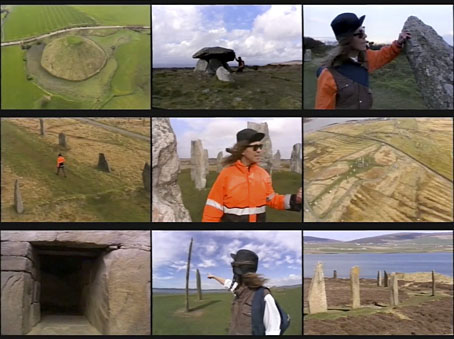
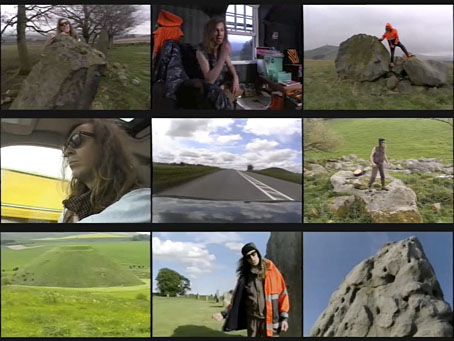
The stones of Callanish are explored again, this time by an energetic and erudite Julian Cope. The Modern Antiquarian was a 55-minute TV documentary produced by the BBC in 2000 as a spin-off from Cope’s book-length study of the ancient past of the British Isles, The Modern Antiquarian: A Pre-Millennial Odyssey Through Megalithic Britain (1998). Cope has always been a great enthusiast, blessed with a talent for communicating that enthusiasm in his own inimitable manner. Needless to say this film, which follows him while he visits some of his favourite neolithic sites, is nothing like the standard television approach to archaeology. Cope isn’t an academic (thank Odin) yet his book is 448-pages of deep investigation which involved visiting every one of the sites he was writing about; he’s also not that other television standby, the shallow audience proxy, he’s too well-informed for that. It would have been good if this one-off film had developed into a series but for its original screening it was shunted into a late-night slot where few people would have seen it. Cope then, as now, is probably too intense for a general audience.

The Modern Antiquarian: part 1 | part 2 | part 3 | part 4 | part 5 | part 6

modern2.jpg

Previously on { feuilleton }
Callanish panoramas
Japrocksampler

Callanish panoramas

callanish1.jpg

Photo by Serge (SEB) Bogdanov.

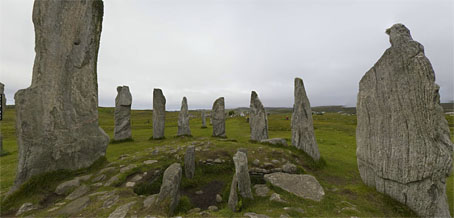
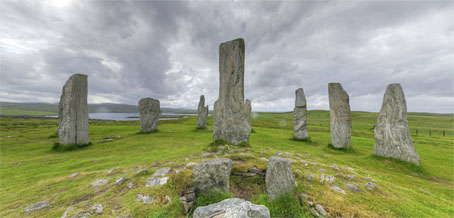
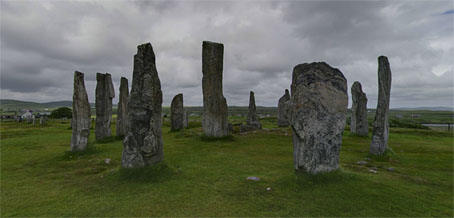
A post for the Summer Solstice. I’ve linked to panoramas of the Callanish standing stones before but these are more recent photos at 360Cities where the full-screen views are more immersive, especially if you have a large monitor. The stones are situated on the Isle of Lewis in north-west Scotland, and still tend to be overshadowed by the reputation of their more visible relations in the south of England. Stonehenge and Avebury may be more famous but they’re ruined cathedrals next to the Callanish stones which have survived four thousand years of harsh Atlantic weather very much intact by virtue of being so remote. In that respect they retain some of their original aura: anyone planning a visit has to really want to see these things, you can’t simply drive past them on the way to somewhere else.

callanish2.jpg

Photo by Alan McLean.

callanish3.jpg

Photo by Alan McLean.

Elsewhere on { feuilleton }
The panoramas archive

Atget’s corners

seine1.jpg

Un coin, rue de Seine (1924).

Photographer Eugène Atget had a thing for the architectural promontory, as do I for that matter, and this photo of a street corner in the rue de Seine, Paris, has always been a favourite. Atget liked the location enough to photograph it at least twice from different angles. The long exposures bleach the sky and turn passing figures into ghostly blurs.

seine2.jpg

Coin rue de Seine (1924).

seine3.jpg

Opening up Google Maps to see how the street looks today left me astonished when I realised I’d walked past this very corner without realising it was the location of Atget’s photos. The rue de Seine is one of two streets giving access to the rue des Beaux-Arts, the location of L’Hôtel where Oscar Wilde died. Matters weren’t helped by my walking in the opposite direction to this view so I didn’t notice the narrow corner. In any case the street looks very different today from Atget’s gloomy intersection.

clery1.jpg

Maison d’Andre Chenier en 1793–97, rue de Cléry (1907).

Equally as clean and unremarkable is another narrow building in the rue de Cléry which in 1907 was sporting some kind of wooden structure on its upper floor. Google’s cameras tend to diminish whatever space they photograph but the streets seem smaller today when cluttered with bollards, cars, bikes and the ubiquitous green bins of Paris.

clery2.jpg

Previously on { feuilleton }
Rue St. Augustin, then and now
Brion Gysin’s walk, 1966
L’Hôtel, Paris

Weekend links 163

michishita.jpg

Le Cadavre Exquis by Yukio Michishita. As featured in The Purple Book: Sensuality & Symbolism in Contemporary Art & Illustration by Angus Hyland & Angharad Lewis.

• ” Like Polo’s magic cities, which in the end all turn out to be Venice, fantasy finally refers us back to reality and the challenge of everyday social engagement.” Jonathan Galassi on The Dreams of Italo Calvino. In the same edition of the NYRB, Anna Somers Cocks on The Coming Death of Venice?

• Mix of the week: Solid Steel Radio Show 7/6/2013 Part 3 + 4: Peter “Look Around You” Serafinowicz compiles 70 minutes of Boards of Canada-inflected ambience.

• “Magic and art tend to share a lot of the same language. They both talk about evocation, invocation, and conjuring.” Alan Moore talks to Peter Bebergal.

The gay rights movement around the world has promoted a basic idea: we want to show society that we are human beings like everyone else. The problem is that the train driver at the Kashirskaya train station doesn’t necessarily think that those few dozen passengers in whose face he closes the doors are a priori inferior and deserve such treatment. He feels that he becomes superior to them by means of using his power over them. This sense of superiority can be trumped only by some higher superiority.

On the Moscow Metro and Being Gay by Dmitry Kuzmin.

• “I went from being a very promising young writer to being completely ignored in two novels.” Madeleine Monson-Rosen on Angela Carter.

Sequence6, another excellent sampler from Future Sequence: 40 new pieces of music as a free download.

timlin.jpg

The Arrival on Mars, an illustration from The Ship That Sailed to Mars (1923) by William Timlin.

• At PingMag: An Icon for Everyone: Shoryu Hatoba, Japanese Crest Artist.

• More Japanese weirdness at Sardines Bizarres.

• Larry Nolen on Bruno Schulz.

Magic Ritual (1976) by Black Renaissance | Magic Fly (1977) by Space | Magic Vox (1981) by Ippu-Do

Weekend links 162

penrose.jpg

Untitled drawing by Sophie Penrose.

• “…many arts producers – much more so than the artists themselves – were over-fearful of the prospect of prosecution, when in nearly all incidents there were no reasonable grounds for bringing charges.” Julia Farrington of Index on Censorship on self-censorship by artists and art institutions in the UK.

• “Tons of tones – some dissolved in beats, some beatless treatments – in a continuous mix of current ambient and electronic goodies, pouring more than a score of ambi-valent shapes and etheric waves into an occluded reverb-trail echo-veil mood-stream.” Ambivalentine, a mix by Albient.

• “I was followed by a bee, a golden bee. For three years, every day, the golden bee followed us.” Forty years ago Penthouse magazine talked to Alejandro Jodorowsky. This month Dazed magazine asked the polymath twenty questions.

• “…investigators were stupefied to find the spymaster’s quarters full of pink leather whips, cosmetics, and pornographic photographs, framed in snakeskin.” Erik Sass on Colonel Redl and a gay spy scandal in the Vienna of 1913.

• “With no one to sponsor him, Marino Auriti’s dream museum became the stuff of legends.” Stefany Anne Golberg on Marino Auriti’s Enciclopedico Palazzo del Mondo.

• The Crime Epics of Louis Feuillade: YouTube links and more. Related: YouTube’s Vault of Horrors.

Werner Herzog: 50 years of potent, inspiring, disturbing films.

• The doors of perception: John Gray on Arthur Machen.

• Some Sort of Alchemy: Albert Mobilio on Sun Ra.

• British Pathé’s film of ghost hunters in 1953.

• “Escape your search engine Filter Bubble

• RIP Jack Vance

Bumble Bee Bolero (1957) by Harry Breuer | The L S Bumble Bee (1967) by Peter Cook & Dudley Moore | Ant Man Bee (1969) by Captain Beefheart and His Magic Band | Be A Bee (2009) by Air