Valette’s steam and smoke

valette1.jpg

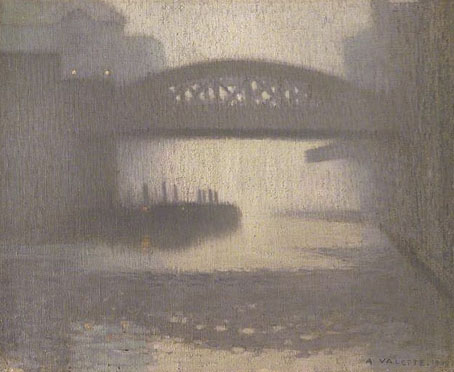
Windsor Bridge on the Irwell (1909).

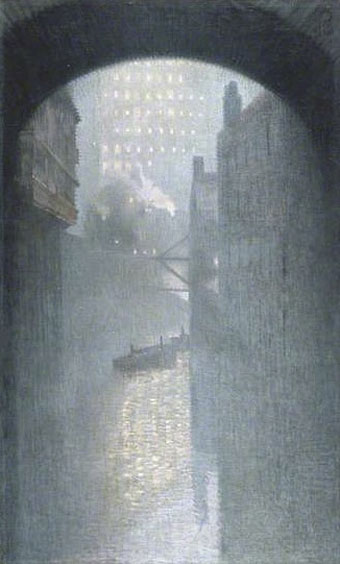
Adolphe Valette (1876–1942) was a contemporary of Lionel Walden, and where Walden was an American who spent some time painting views of Cardiff, Valette moved to Manchester in 1905 where he painted a series of celebrated views of the city. If it’s a commonplace that foreign eyes often see what locals ignore, this has certainly been the case in Manchester. Friedrich Engels catalogued the lethal living and working conditions of the city’s labourers in The Condition of the Working Class in England in 1845, and it took Valette to find a subject for his art in the city’s smogs and polluted atmospheres at a time when many British artists were still painting scenes from Tennyson or the tales of King Arthur.

valette2.jpg

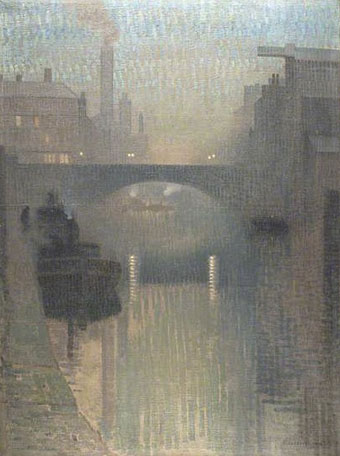
India House, Manchester (1912).

Valette’s Manchester paintings now reside in the Manchester Art Gallery whose curators have always made much of his being “the Manchester Impressionist”. The term isn’t unjustified even though Impressionism was long gone by the time he began these paintings; there is something Monet-like to a few of them. The gallery contains a large amount of fairly typical Victorian art, including a couple of well-known Pre-Raphaelite pieces, so Valette’s work has always stood apart not only for its urban theme but for its looser technique. My favourite is the view of India House from the banks of the River Medlock. Many of the bridges and buildings in these paintings can be seen today, albeit cleaned and (in the case of India House) gentrified. Valette captures the final years of unrestrained industrial pollution when the air in Manchester, London and other cities was often as bad as it is in some parts of China today.

valette3.jpg

Bailey Bridge, Manchester (1912).

Continue reading “Valette’s steam and smoke”

The art of Fabrizio Clerici, 1913–1993

clerici1.jpg

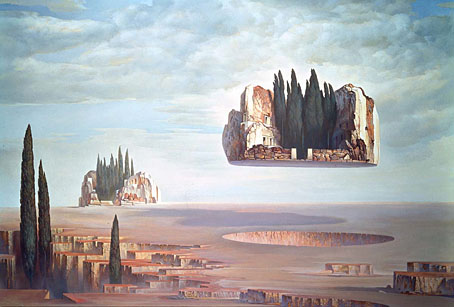
Un istante dopo (1978).

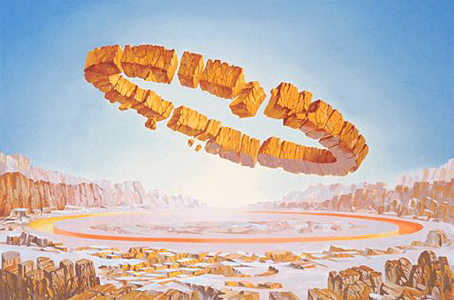
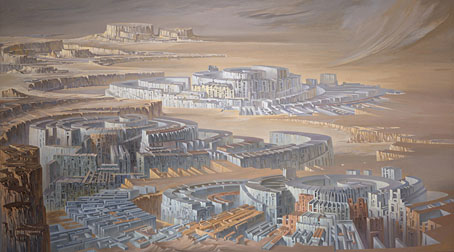
An Italian painter of the fantastic who’s managed to stay off my radar for one reason or another despite doing many of the things I like to see: weightless structures, imaginary architecture, and (towards the end of his career) a series of variations on Arnold Böcklin’s endlessly adaptable The Isle of the Dead. The latter paintings are some of the best Böcklin variants I’ve seen. These alone would have made him worthy of attention but the rest of his oeuvre is an equally accomplished development of late Surrealism (or, if you need another category, Fantastic Realism). The official website is a very good one so there’s plenty more to see. (Thanks to Michelangelo for the tip!)

clerici2.jpg

La tromba d’aria (1965).

clerici3.jpg

Latitudine Böcklin (1974).

Elsewhere on { feuilleton }
The fantastic art archive

Previously on { feuilleton }
A Picture to Dream Over: The Isle of the Dead
The Isle of the Dead in detail
Arnold Böcklin and The Isle of the Dead

Weekend links 225

mori.jpg

Still from The Shaman-Girl’s Prayer (1997), a video piece by Mariko Mori. This page has pictures of Mori’s futuristic/cosmic performances, films & environments.

Time Out of Mind (1979) was a BBC TV series about science fiction writers, five short films concentrating on Arthur C. Clarke, John Brunner, Michael Moorcock, Anne McCaffrey and an sf convention. I was only interested in the Moorcock film at the time, not least because it featured a short clip of Hawkwind playing Silver Machine, and inserted scenes from the film of The Final Programme (1973) between the interviews. The Moorcock episode is less about his books than about New Worlds magazine and the so-called New Wave of sf in general, so you also see rare footage of M. John Harrison in a Barney Bubbles “Blockhead” T-shirt talking then ascending a limestone cliff, and bits of interviews with Brian Aldiss and Thomas Disch. Ballard isn’t interviewed but is present via a scene from the Harley Cokeliss film Crash! (1971) in which Gabrielle Drake slides in and out of a car while someone reads Elements of an Orgasm from The Atrocity Exhibition.

• “…there happened to be a book on Ritual Magick that talked about John Dee and summonings and Dr. Faust and all that kind of stuff. So then obviously at that age, too, I read HP Lovecraft and then Michael Moorcock and what they call fantasy literature. Through HP Lovecraft I discovered Arthur Machen, and I think that sort of percolated down inside…” Dylan Carlson of Earth talking to Steel for Brains. The Wire has the vinyl-only track from the new Earth album, Primitive And Deadly, and a track from Carlson’s solo album, Gold. Related: Artwork by Samantha Muljat, designer/photographer for the new Earth album.

Phantasmaphile has details of the next two issues of deluxe occult magazine Abraxas. Issue 6 includes a major feature on Leonora Carrington while Luminous Screen is a special issue devoted to occult cinema.

• More Broadcast: Video of a performance at Teatro Comunale di Carpi, March 2010 (part 2 here), and “constellators and artifacts” at A Year In The Country.

• “Petition demands return of ‘Penis Satan’ statue to Vancouver.” There’s an uncensored photo of the contentious statue here.

• Literary Alchemy and Graphic Design: Adrian Shaughnessy on James Joyce’s writings among graphic designers.

• Frank Pizzoli talks to John Rechy about “the gay sensibility”, melding truth and fiction, and his literary legacy.

• Mixes of the week: Secret Thirteen Mix 127 by Roberto Crippa, and FACT Mix 459 by Craig Leon.

Alan Moore has finished the first draft of his million-word novel, Jerusalem.

• Crazy pavings: Alex Bellos on Craig Kaplan’s parquet deformations.

Noise Not Music: “Live recordings, obscure cassettes and more…”

Pylon of the Month

Zoot Kook (1980) by Sandii | Rose Garden (1981) by Akiko Yano | Telstar (1997) by Takako Minekawa

Weekend links 224

zona.jpg

Zona: concept art by Alex Andreyev for a planned TV series based on Roadside Picnic by Arkady & Boris Strugatsky.

The Black Sessions are a long-running series of concerts by international artists recorded for radio station France Inter. UK group Broadcast were recorded by the station in May, 2000. While copies of the shows can be often be hard to find, files of the Broadcast concert may be downloaded here. A fantastic performance, especially the white-hot psychedelic freakout at the end.

• Further investigations from the radio age: Invention for Radio No. 1: The Dreams (43 mins, 1964): “an attempt to re-create in five movements some sensations of dreaming—running away, falling, landscape, underwater and colour”. Voices recorded by Barry Bermange with Radiophonic manipulation by Delia Derbyshire.

• “…in his first description of Cthulhu he gives you a list of four things that Cthulhu isn’t quite like.” Nick Talbot talks to Alan Moore about HP Lovecraft. Related: one of my depictions of Azathoth appears in this list of “gods who have forsaken you”.

• Tracking the locations of JG Ballard’s Super-Cannes: an investigation by Rick Poynor. Related: houseboats, architecture and eco-disaster; Justin Sullivan photographs California’s extreme drought.

• “As her writing career existed outside the realm of respectable ‘high-lit’ fiction, she cast herself as an outsider icon.” Chris Kraus on I’m Very Into You, a collection of Kathy Acker’s emails.

• Cover design inspiring fiction: Susan Coll on how a photo of a Bauhaus chair on the cover of her new novel, The Stager, made her alter her text at the last minute.

• “People were either taken by it or felt it was the Antichrist.” MetaFilter on Clair Noto’s unmade science-fiction film, The Tourist.

The Norwood Variations is a new album by Drew Mulholland (Mount Vernon Arts Lab et al).

• Thought Maybe has a collection of the television essays made by Adam Curtis.

• From 1974: How To Make Magic, a children’s handbook of the occult.

• Mix of the week: Secret Thirteen Mix 126 by Mira Calix.

One Minute Blasts Rising To Three And Then Diminishing (2000) by Mount Vernon Arts Lab | Dashwood’s Reverie (2001) by Mount Vernon Arts Lab | Warner’s Reverie (2002) by Mount Vernon Astral Temple

Weekend links 222

wicker.jpg

A self-portrait by Nadia Wicker from her Projectie series.

• “And boy, did that Rain Parade sleeve look cool with its picture of the insouciant band sitting in front of large hot-house (or glass palace), the sky behind them tinted a sickly shade of apocalypse pink…” Joe Banks on the Rain Parade’s finest moment, Explosions In The Glass Palace.

• “…there are pleasures to be had from books beyond being lightly entertained. There is the pleasure of being challenged; the pleasure of feeling one’s range and capacities expanding…” Rebecca Mead on the pleasure of reading to impress yourself.

• “If Gengoroh Tagame performed the acts he drew in his comics he’d probably be dead or in jail,” says Zac Bayly, interviewing Tagame for BUTT.

Crime does not fascinate James Joyce as it fascinates the rest of us—the suggestion of crime dismays him. He tells me that one of his handicaps in writing Work in Progress is that he has no interest in crime of any kind, and he feels that this book which deals with the night-life of humanity should have reference to that which is associated with the night-life of cities—crime. But he cannot get criminal action into the work. With his dislike of violence goes another dislike—the dislike of any sentimental relation. Violence in the physical life, sentimentality in the emotional life, are to him equally distressing. The sentimental part of Swift’s life repels him as much as the violence of some of his writing.

Padraic Colum attended Joyce’s 47th birthday party.

• I’m currently reading The Wanderer, “a weird document” by Timothy J. Jarvis, which is officially published this week.

The Changes, another remarkable children’s TV series from the 1970s, is out on DVD next week.

Sir Richard Bishop has made all 14 of his solo albums available as free downloads.

• “How long do CDs last? It depends, but definitely not forever,” says Laura Sydell.

• “Readers absorb less on e-readers than on paper, study finds

• Book designer Craig Mod wants to talk about margins.

• Mix of the week: a mix for The Quietus by Helm.

Ozu’s passageways

• The Rain Parade: No Easy Way Down (BBC TV, 1984) | No Easy Way Down (studio, 1984) | No Easy Way Down (Tokyo, 1984)