Marsi Paribatra: the Royal Surrealist

marsi1.jpg

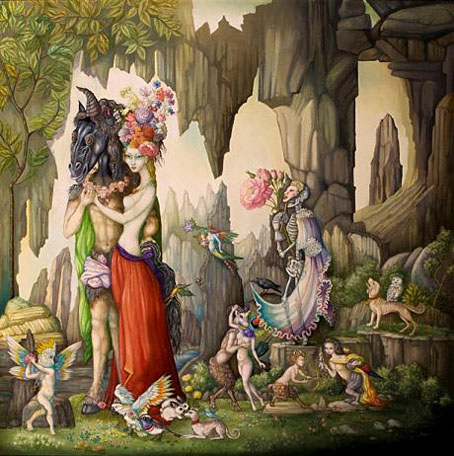
La Menace (1994).

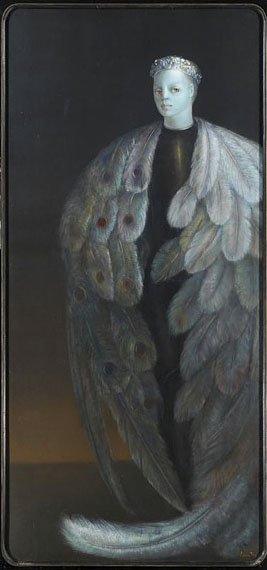
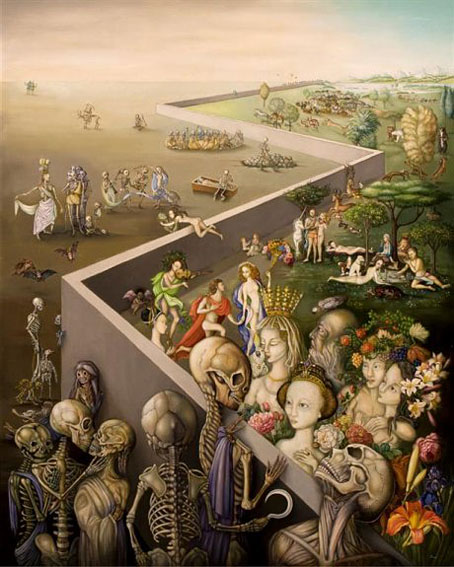
Two paintings by Princess Marsi Paribatra, a member of the royal family of Thailand who lists Dalí, Arcimboldo and Titian among her artistic influences. If it seems surprising that a princess should not only be an accomplished painter but also be possessed of a distinctly vivid imagination we might ask why this is the case. There’s no reason why a member of a royal family shouldn’t be as good a painter as anyone else although it’s the case that here in Britain our views of royalty are inevitably tainted by the uninspiring members of the current House of Windsor. Prince Charles in particular is a singularly dreary and frequently philistine figure, and also a painter whose daubs would never have received any attention at all were it not for his being born into the right family.

This hasn’t always been the case. It used to be that being an aristocrat gave you the free time and the wealth to indulge no end of manias and eccentricities. The British Isles are littered with architectural follies of various kinds built to appease the whims of rich landowners; William Beckford (1760–1844) is renowned for having written the Gothic melodrama Vathek and also for having built the lavish (and unfortunately short-lived) pile of Fonthill Abbey. In the 20th century we had Edward James (1907–1984), a lifelong champion of Surrealism who spent much of his later life building Las Pozas in the Mexican jungle at Xilitla, a concrete fantasia which looks like something dreamed up by Antonio Gaudí and JG Ballard. James collected the work of Leonora Carrington and Dorothea Tanning and I’d imagine him being equally entranced by some of Marsi Paribatra’s paintings. The recurrence of skeletal figures in her work invokes the Mexican Day of the Dead traditions which always excited the Surrealists.
marsi2.jpg

No title or date available.

Dali House has more about Marsi Paribatra’s life and art while further examples of her paintings can be found here and here. Thanks again to Monsieur Thombeau for pointing the way!

Elsewhere on { feuilleton }
The fantastic art archive

Previously on { feuilleton }
Angels of Anarchy: Women Artists and Surrealism
Return to Las Pozas
The art of Leonor Fini, 1907–1996
Surrealist women
Las Pozas and Edward James

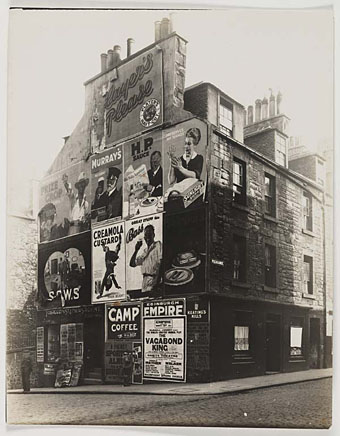
Edinburgh, 1929

edinburgh1.jpg

2A Arthur Street.

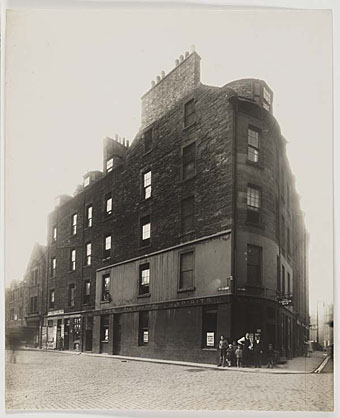
Samples from a collection of photographs by Alfred Henry Rushbrook at the National Library of Scotland’s Flickr pages showing the St Leonards area of Edinburgh. These were taken in 1929 but the age of the buildings and the curiously fogged appearance of the prints makes them seem a lot older. The City of Edinburgh Improvement Trust commissioned Rushbrook to record views of the area before slum clearances took place. In that respect his photos are like a Scots equivalent of the famous views of Paris taken by Atget before Hausmann’s demolition teams set to work.

edinburgh2.jpg

2–4 Lothian Street and 3–5–7 Potterow.

Previously on { feuilleton }
Old Bunker Hill
Inondations 1910
Berenice Abbott
Jessie M King’s Grey City of the North
Eugene de Salignac
Luther Gerlach’s Los Angeles
The temples of Angkor
The Bradbury Building: Looking Backward from the Future
Edward Steichen
Karel Plicka’s views of Prague
Atget’s Paris
Downtown LA by Ansel Adams

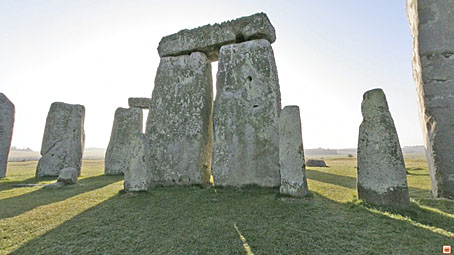
Stonehenge panorama

stonehenge.jpg

I would have posted this for the Solstice yesterday had it not been for the Chronophage. The panorama is at a BBC page since the corporation is one of the few organisations with the weight to gain permission to photograph the stones up close. Unless you’re an archaeologist or an English Heritage official your view is restricted to the path which surrounds the monument, something you can experience via Google Maps. There did used to be exceptions to this. I was fortunate to be at the Stonehenge Festival in 1982 which took place for a few days over Midsummer in one of the fields a short distance away. On Solstice Day the people from English Heritage let everyone—festival-goers and bemused tourists alike—wander inside the circle where a couple of pagan weddings took place. A couple of years later further festivals were prevented with heavy police action so I feel privileged to have been there on that day.

There was more Stonehenge recently at Bldg Blog with a post about Harold Egerton’s stunning photograph of the stones at night. And while we’re on the subject, let’s not forget Woodhenge, Seahenge , Timisoara’s Stonehedge, and the Ballardesque Carhenge.

Elsewhere on { feuilleton }
The panoramas archive

Weekend links 18

fini.jpg

Rogomelec (1978) by Leonor Fini. Via.

Moving Through Old Daylight: A recording of Mark Fisher, Jim Jupp and Julian House of Ghost Box Recordings and Iain Sinclair in conversation at the Roundhouse, Camden, London, 5 June 2010. Topics under discussion included Nigel Kneale, TC Lethbridge, John Foxx, BBC Radiophonic Workshop, alchemies of sound, the homogenisation of culture, imagining space and the impersistence of memory.

The Surreal House, “a mysterious dwelling infused with subjectivity and desire” at the Barbican, London.

Ars Homo Erotica at the National Museum of Warsaw. Related: “(Gothenburg) Museum stops exhibition about homosexuality in religion“.

• A lot of people still arrive here looking for art by Zack aka Oliver Frey. Bike Boy, 96 pages of Frey’s exuberantly homoerotic comic strips, is published in August by Bruno Gmünder.

• “EM Forster was a virgin until the age of thirty-nine, when he had his first ‘full’ sexual experience (a ‘hurried sucking off’, Wendy Moffat informs us) with a passing soldier on a beach in Alexandria.”

• JG Ballard’s archive is accepted by the British Library, or “saved for the nation” as they rather grandiloquently describe the process. Samples from the documents to be preserved at the BBC and the Guardian.

• Shades of Ballard’s singing sculptures, Sun Boxes is a solar-powered audio installation by Craig Colorusso. There’s more at Designboom.

• Nathalie visited the MAXXI, Rome’s new museum of contemporary art designed by Zaha Hadid.

Stephen Pinker wants everyone to stop fretting over the alleged distractions of electronic media.

• “It basically comes from love”: John McLaughlin in conversation with Robert Fripp, 1982.

• More collections of print ephemera: Agence Eureka and Ephemera Magica.

The Serpent and the Sword, an Alan Moore rarity from 1999.

Gulliverovy Cesty (1968) at A Journey Round My Skull.

Within the Without: a new Thombeau Tumblr.

The Hidden Posters of Notting Hill Gate.

The Letters of Sylvia Beach reviewed.

• It’s Kubrick Season in St Albans.

Riot In Lagos (1980) by Ryuichi Sakamoto still sounds futuristic thirty years on.

Old Bunker Hill

bunker.jpg

One of a number of photos of the elegantly decayed houses of early Los Angeles by ex-vaudeville artist George Mann. On Bunker Hill is a site dedicated to this vanished area of the city.

These never-before-published color images of old Bunker Hill were originally displayed in 3-D viewers of Mann’s own design, which were leased to various Los Angeles businesses, including Hody’s Drive-Ins, and other restaurants, bars and doctor’s offices. Mann would swap out the photo selection regularly, so if these evocative scenes of Bunker Hill weren’t available, one might peep at Calico Ghost Town, Catalina Island, Descanso Gardens, Disneyland, Knott’s Berry Farm, Pacific Ocean Park, Watts Towers or Palm Springs. (More.)

There’s more old LA at the Vintage Los Angeles Flickr pool.

Previously on { feuilleton }
Berenice Abbott
Eugene de Salignac
Luther Gerlach’s Los Angeles
The Bradbury Building: Looking Backward from the Future
Edward Steichen
Karel Plicka’s views of Prague
Atget’s Paris
Downtown LA by Ansel Adams