Salon Futura #1

salon-futura.jpg

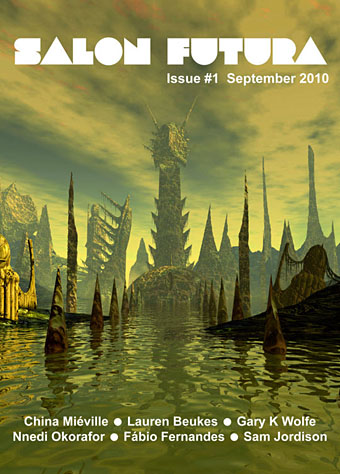
It’s been a pleasure this week seeing my 1999 portrait of Cthulhu’s rotting domicile, R’lyeh, used as the cover image for Salon Futura, a new online magazine edited by Cheryl Morgan. Cheryl describes SF as “a new and hopefully somewhat different magazine devoted to the discussion of science fiction, fantasy and other forms of speculative literature.” Among the contents there’s a podcast interview with Gary K Wolfe, Nnedi Okorafor and Fábio Fernandes (the latter is a contributor to the steampunk book I’m currently designing for Tachyon); there are video interviews with writers Lauren Beukes and China Miéville, and the Guardian‘s Sam Jordison writes an appraisal of EL Doctorow’s 1994 novel The Waterworks (about New York City’s minatory Croton Reservoir) which stimulated my interest enough to make me want to search out the book. And speaking of minatory architecture, {feuilleton} approves of the presence of Taschen’s fat volume of Piranesi works spied on China Miéville’s bookshelf. China always has interesting things to say; go and see for yourself.

Previously on { feuilleton }
Le horreur cosmique

The House of Orchids by George Sterling

sterling1.jpg

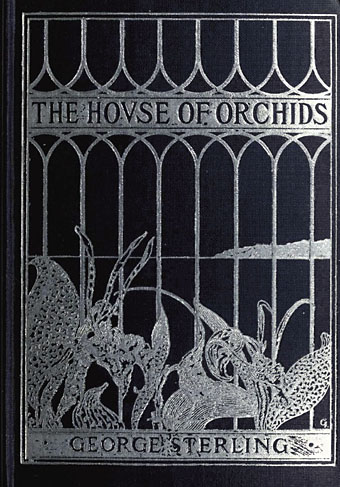
Do all roads lead to the Internet Archive? Not really but I keep ending up there when I happen to discover an interesting old book and wonder whether they have a PDF of the volume in question. The volume for consideration today, The House of Orchids, is a 1911 collection of verse by George Sterling (1869–1926), an American but another of those writers whose poetry looked to Decadent London and Paris for its flavour, hence the Wildean title, and, it should be said, the cover design. I haven’t been able to find an artist credit for this; if anyone knows who was responsible, please leave a comment.

sterling2.jpg

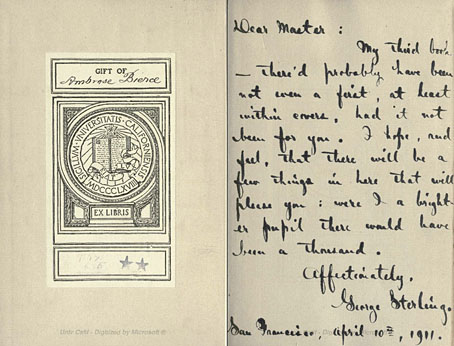
Many of the books at Archive.org are unremarkable library editions but this is a rare exception, being a gift to the University of California of writer Ambrose Bierce, Sterling’s idol and the person to whom he writes the above thanks and a dedication. Bierce praised Sterling’s work but must have passed the book on fairly soon after receiving it since he famously disappeared in Mexico two years later. Or maybe his library was passed to the university after his disappearance? Whatever the answer, this edition contains another curious feature in the form of a pasted-in newspaper clipping from 1926 concerning the death in mysterious circumstances of Sterling himself at San Francisco’s Bohemian Club. The general supposition is that he killed himself with a vial of cyanide he was in the habit of carrying around. One of Sterling’s young poetic protégés at the time The House of Orchids appeared was Clark Ashton Smith whose first volume of verse, The Star-Treader, and Other Poems, was published a year later. That book and another of Smith’s titles is also available at Archive.org, as I noted in June. Also there, and of particular {feuilleton} interest, is Sterling’s The Evanescent City, a paean to San Francisco’s 1915 Panama-Pacific International Exposition. (This site has scans of the text and photos.)

George-Sterling.org is a site devoted to the writer which includes many of his poems and other texts. Looking at his lengthy piece from 1907, A Wine of Wizardry, you can see what it was about his work that so appealed to Clark Ashton Smith and others.

Elsewhere on { feuilleton }
The book covers archive

Previously on { feuilleton }
Odes and Sonnets by Clark Ashton Smith
Clark Ashton Smith book covers
The Evanescent City

Mind the doors!

andreev1.jpg

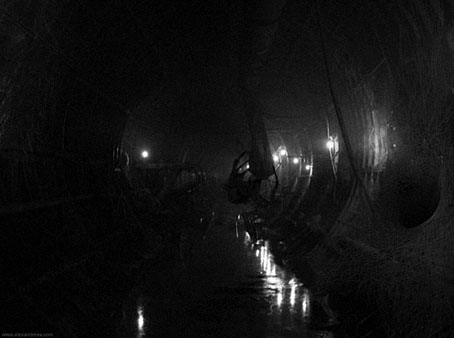
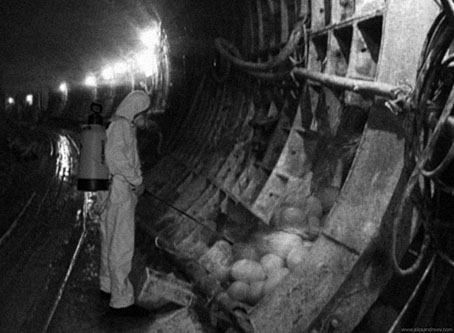
Russian artist Alexey Andreev populates the Moscow Metro with eldritch weirdness in a photo-collage series he calls Metronomicon. A couple of these pieces remind me of Clive Barker’s throat-grabbing story, The Midnight Meat Train, which was filmed a couple of years ago. For an earlier cinematic example of the horror inherent in underground transport systems there’s Gary Sherman’s Death Line, or Raw Meat as it was fatuously rebranded for the US, a very effective low-budget film from 1972. Fantastic Voyages reviews it here.

Andreev tip via MetaFilter.

andreev2.jpg

Previously on { feuilleton }
Subterrania
Tunnel 228

Constantinople, 1900

constantinople1.jpg

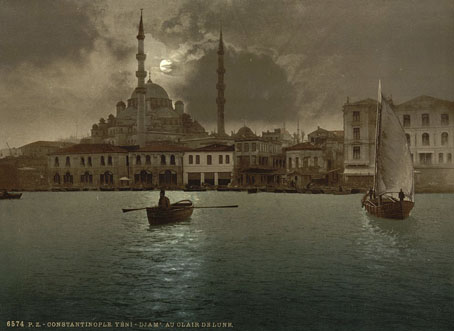
Yeni-Djama (ie, Yeni Cami) by moonlight, Constantinople.

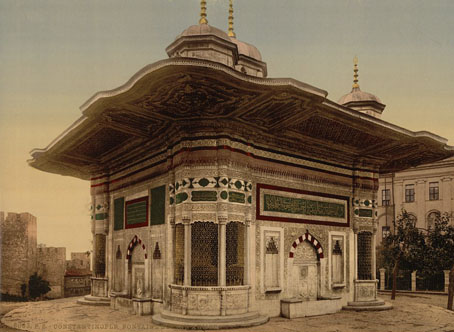
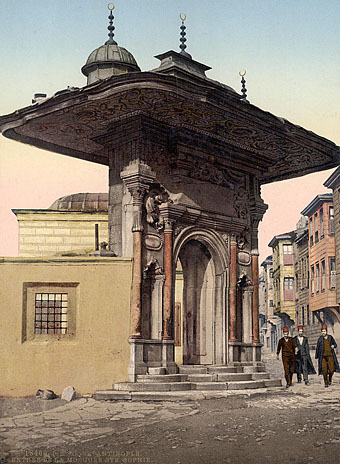
Fascinating views of the Turkish city circa 1890–1900 from the Photochrom collection of the Library of Congress. These are from the LoC Flickr selection; the library website has a lot more.

Published primarily from the 1890s to 1910s, these prints were created by the Photoglob Company in Zürich, Switzerland, and the Detroit Publishing Company in Michigan. The richly colored images look like photographs but are actually ink-based photolithographs, usually 6.5 x 9 inches.

constantinople2.jpg

The fountain of Sultan Ahmed, Constantinople.

constantinople3.jpg

Entrée de la Mosque Ste. Sophie, Constantinople.

Previously on { feuilleton }
Albert Kahn’s Autochromes
The Dawn of the Autochrome

Weekend links 25

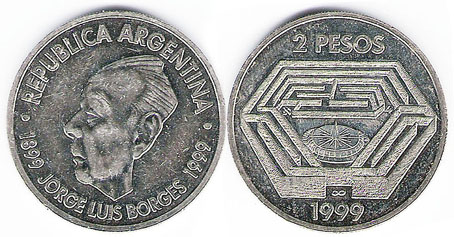
borgespesos

A commemorative Borges coin.

He says, “Two aesthetics exist: the passive aesthetic of mirrors and the active aesthetic of prisms. Guided by the former, art turns into a copy of the environment’s objectivity or the individual’s psychic history.” There, of course, he sums up all of realism, no? “Guided by the latter, art is redeemed, makes the world into its instrument and forges, beyond spatial and temporal prisons, a personal vision.” That’s Borges.

The Borges Behind the Fiction: Colin Marshall talks to translator Suzanne Jill Levine. Related: The Garden of Forking Paths.

• From The Quietus: Blondie in Conversation with William S. Burroughs by Victor Bockris, 1979; An Interview with Laurie Anderson by Robert Barry, 2010.

In 962 Abd-er Rahman III was succeeded by his son Al-Hakim. Owing to the peace which the Christians of Cordova then enjoyed […] the citizens of Cordova, Arabs, Christians, and Jews, enjoyed so high a degree of literary culture that the city was known as the New Athens. From all quarters came students eager to drink at its founts of knowledge. Among the men afterwards famous who studied at Cordova were the scholarly monk Gerbert, destined to sit on the Chair of Peter as Sylvester II (999–1003), the Jewish rabbis Moses and Maimonides, and the famous Spanish-Arabian commentator on Aristotle, Averroes.

Entry for The Diocese of Cordova from The Catholic Encyclopedia (1917).

Professor Newt’s Distorted History Lesson. A riposte to the ignorance of the wretched Gingrich. Related: the Mezquita de Córdoba.
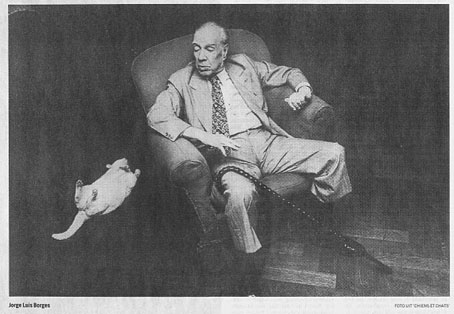
borgeskat

Jorge Luis Borges and a cat. Via.

Joseph and His Friend—A Story of Pennsylvania (1870) by Bayard Taylor, America’s first (?) gay novel. Related: 20 classic works of gay literature.

Elegies For Angels, Punks and Raging Queens at the Shaw Theatre, London, from 10–28 August 2010.

• Tristan Perich’s 1-Bit Symphony is released later this month. Café Kaput’s first release, Electronic Music in the Classroom by DD Denham, appears in September.

• “Just relax and enjoy it.” k-punk on the ambition and vision of David Rudkin’s Artemis 81.

• Chris Watson explores Alan Lamb’s The Wires: three audio recordings to download.

• Jonathan Barnbrook: Tuxedomoon fan, 1988, and Tuxedomoon designer, 2007.

• Rob Young’s Electric Eden reviewed by Michel Faber.

Brian Eno gets the Warp factor.

No Tears (1978) by Tuxedomoon; Atomic (1979) by Blondie; Everything You Want (1980) by Tuxedomoon; Next One Is Real (1984) by Minimal Compact; Hologram (2010) by These New Puritans.