The Public Voice by Lejf Marcussen

public1.jpg

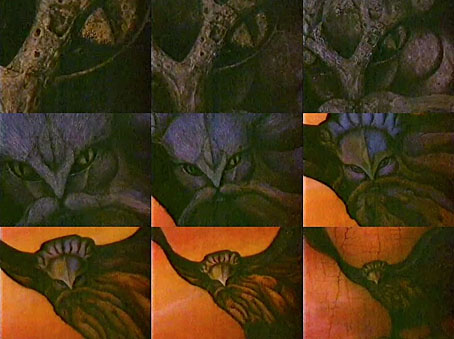
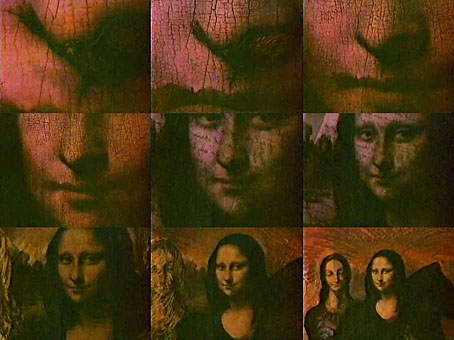
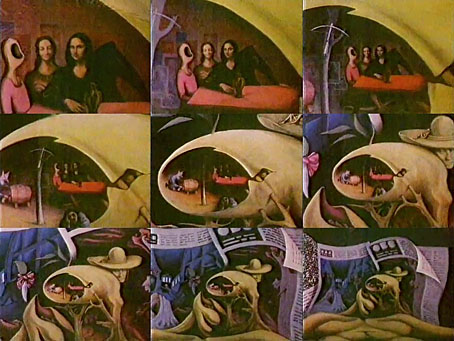
Lejf Marcussen is a Danish filmmaker whose animation Den Offentlige Røst (The Public Voice, 1988) I know from UK TV screenings, back in the days when the TV channels here used to screen more than cookery shows and soap operas. This is a short Surrealist piece which begins with zoom into a Paul Delvaux painting then reverses the process by pulling back from a continually changing picture some of whose details can be seen here. It is, of course, better to watch the film than read a description of it which is why I kept hoping a copy might turn up on YouTube. Sure enough, a rough copy has been languishing there for two years so I suggest you watch it here while you have the chance. These obscure shorts have a habit of getting deleted, and this miniature marvel is more obscure than most.

public2.jpg

public3.jpg

Update: changed the link to a better quality version. Thanks, Martin!

Previously on { feuilleton }
Patrick Bokanowski again
L’Ange by Patrick Bokanowski
The Hourglass Sanatorium by Wojciech Has
Babobilicons by Daina Krumins
Impressions de la Haute Mongolie revisited
Short films by Walerian Borowczyk
The Brothers Quay on DVD

Thomas Mackenzie’s Aladdin

aladdin1.jpg

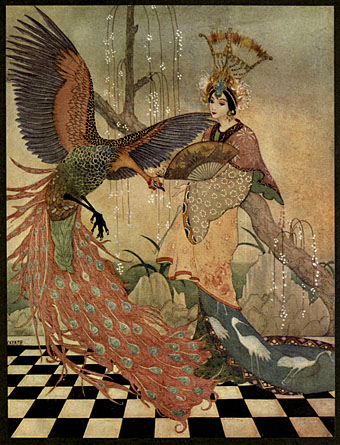
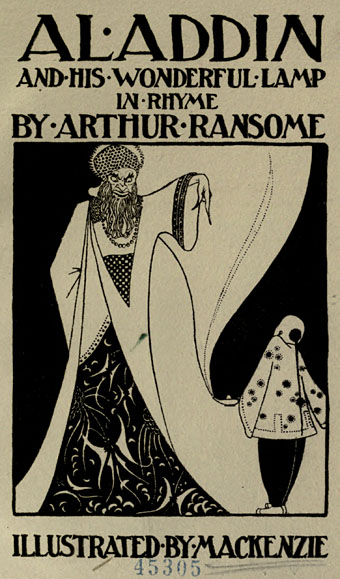
The tip for this one came via Beautiful Century. Thomas Mackenzie (1887–1944) was a minor British illustrator whose work I hadn’t seen before, and if I’d seen the picture above uncredited I might have taken it for something by Kay Nielsen or Edmund Dulac. Mackenzie’s colour plates for the 1919 edition of Aladdin and His Wonderful Lamp in Rhyme by Arthur Ransome are very similar to his more famous contemporaries, while the black-and-white pieces owe a considerable debt to Aubrey Beardsley, especially the title page below. Not all the drawing is as assured as one might hope but the book as a whole is still worth a look.

aladdin2.jpg

Continue reading “Thomas Mackenzie’s Aladdin”

Weekend links 51

narcissus.jpg

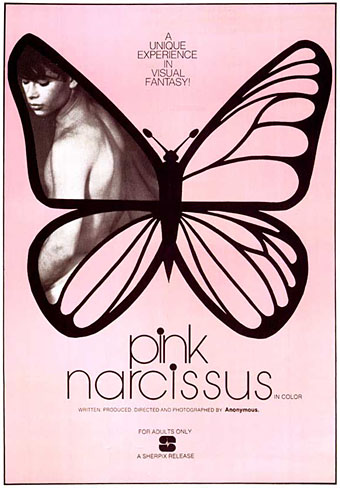
James Bidgood’s luscious and erotic micro-budget masterpiece Pink Narcissus (1971) receives a screening at the IFC Center Queer/Art/Film festival, NYC, on Monday. The film is presented by Jonathan Katz, curator of the Hide/Seek gay art show whose controversial history was recounted here in December. The NYT ran a short piece about Bidgood, now 77 and not the first artist to be disappointed by his past work; they also have a Bidgood slideshow. Hide/Seek, meanwhile, is now a touring exhibition.

• Related: the delightful Drew Daniel of Matmos (and Soft Pink Truth) posing in a jockstrap at the Club Uranus, San Francisco circa 1990; he also used to go-go dance wearing a fish.

• The Isle of Man may have one of the oldest parliaments in the world but its laws have often been out of step with its neighbour across the Irish Sea. This week the island joined the rest of the UK in granting civil partnerships to its citizens. Now the name whose punning appeal so delighted James Joyce doesn’t seem as inappropriate.

Howard Jacobson: “The novelist Yukio Mishima posed pointing a Samurai sword to his chest and ultimately had himself beheaded in public. This is what’s called taking your art seriously.”
hutter.jpg

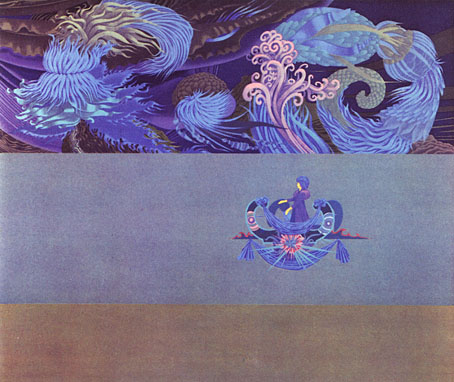
The Realm of the Queen of the Night (1974) by Wolfgang Hutter from Zauberflote at 50 Watts.

The revelatory operations of the chance encounter lie at the heart of le merveilleux (“the marvelous”)—the Surrealist conception of beauty. You find something marvelous in the world (an object, an image, a person, a place) that corresponds, like a piece clicking into a puzzle, to a deep inner need.

Slicing Open the Eyeball: Rick Poynor on Surrealism and the Visual Unconscious by Mark Dery.

Boy from the Boroughs: Alan Moore interviewed by Pádraig Ó Méalóid; Michael Moorcock interviewed at Suicide Girls.

• Illustrations from Quark, the anthology of speculative fiction edited by Samuel Delany & Marilyn Hacker in 1970.

The Residents, sans masks, filmed at their San Francisco home in the 1970s.

• Bach’s Toccata and Fugue in D minor played on a glass harp.

What art can do for science (and vice versa).

• You can never have too much Virgil Finlay.

• Lydia Kiesling reviews Lolita.

Alain Resnais film posters.

Red Mug, Blue Linen.

No GDM (dub version) (1979) by Gina X | L. Voag’s Kitchen (2004) by Soft Pink Truth.
The Arms of the Art

arms.jpg

The Arms of the Art (2000).

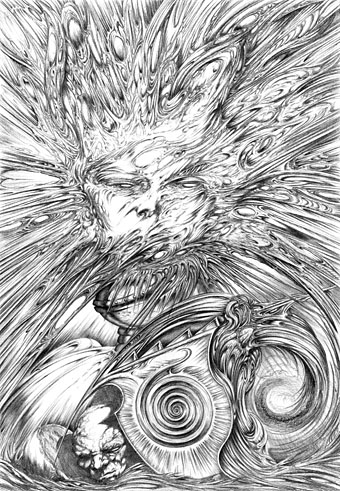
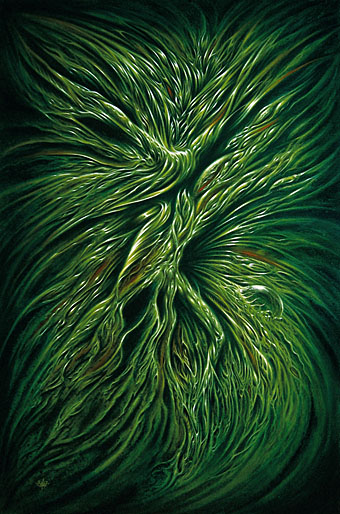
An addendum to the Splendor Solis post. The Arms of the Art was a drawing I did in 2000 intended to inaugurate a series of pencil improvisations based on the Splendor Solis alchemical plates. As things turned out I only managed the first in the series (the picture it uses as a starting point is here) and about half of the second one which is languishing in a pad somewhere. Nothing in this drawing was planned or sketched beforehand, it was all done directly onto the paper, the idea being that I’d take the basic symbols or elements of each plate as a starting point and see what emerged once I began moving the pencil around. What usually emerges in these situations is a kind of abstracted landscape of hybrid forms that could be either mineral, organic or something in between. Some of the paintings I was doing in the 1990s followed a similar process, the challenge being to see how far you can develop things without the result becoming either too pictorial or too abstract; the painting below is an earlier example. I still like the idea of re-interpreting the Splendor Solis, and if I didn’t have other projects in progress I might be prepared to try it again. Maybe later.

eidolon.jpg

Eidolon (1997).

Previously on { feuilleton }
Splendor Solis

Deutsche Kunst und Dekoration #12

dkd12-01.jpg

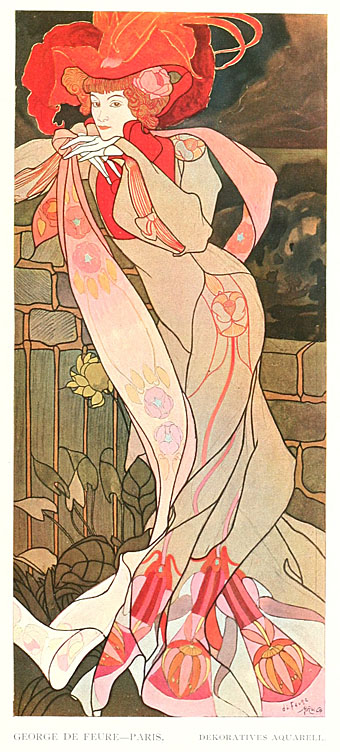
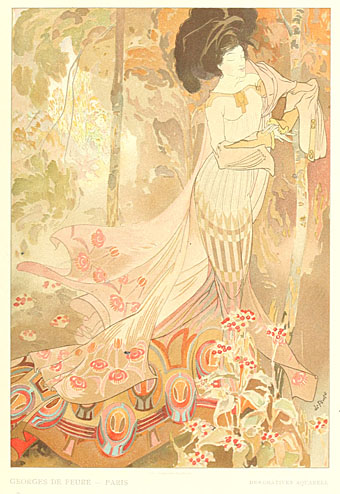
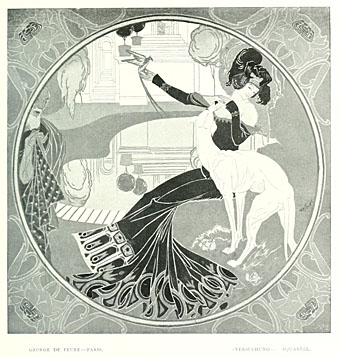
Continuing the delve into back numbers of Deutsche Kunst und Dekoration, the German periodical of art and decoration. Volume 12 covers the period from April 1903 to September 1903, and this edition opens with a feature on the French Art Nouveau artist and designer George de Feure. This is followed by more from sculptor Franz Metzner including some of his designs for Germany’s many Bismarck monuments. Earlier volumes of DK&D have featured similar Bismarck designs by other architects but they tend to be as ponderous as you’d expect, the kind of thing which nationalists of the time would have found grand but which to our eyes look either pompous or—at their worst—quasi-fascist. Another feature on artist Paul Bürck finishes the edition. As before, anyone wishing to see these samples in greater detail is advised to download the entire volume at the Internet Archive. There’ll be more DK&D next week.

dkd12-02.jpg

dkd12-03.jpg

Continue reading “Deutsche Kunst und Dekoration #12”