Mister Jarman, Mister Moore and Doctor Dee

tempest.jpg

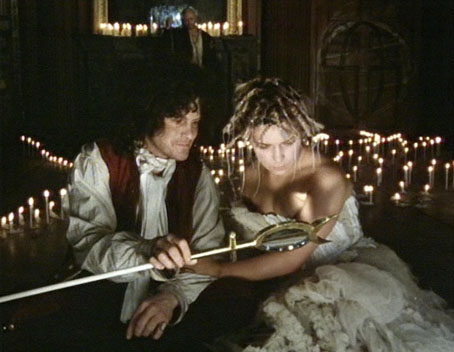
Prospero (Heathcote Williams) and Miranda (Toyah Willcox), The Tempest (1979).

The Shakespeare who spun The Tempest must have known John Dee; and perhaps through Philip Sidney he met Giordano Bruno in the year when he was writing the Cena di Ceneri—the Ash Wednesday supper in the French Ambassador’s house in the Strand. Prospero’s character and predicament certainly reflect these figures, each of whom in his own way fell victim to reaction. John Dee, with the greatest library in England, skrying for the angels Madimi and Uriel (so nearly Ariel)—all of which is recorded in the Angelic Conversations—ended up, in his old age, penniless in Manchester. Bruno was burnt for heresy.

Ten years of reading in these forgotten writers, together with a study of Jung and his disciples proved vital in my approach to both Jubilee and The Tempest. As for the black magic which David Bowie thought I dabbled in like Kenneth Anger, I’ve never been interested in it. I find Crowley’s work dull and rather tedious. Alchemy, the approach of Marcel Duchamp, interests me much more.

Derek Jarman, Dancing Ledge (1991).

Damon Albarn’s opera Doctor Dee has been all over the news this week following its premier as part of the Manchester International Festival. Last weekend one of the press ads was announcing this as an “untold story”, as though no one had given much thought to the Elizabethan magus prior to Mr Albarn’s arrival. Neither the ads nor anyone associated with the production will be in a hurry to tell you that the idea for the opera came from Alan Moore who’s had a fascination with John Dee’s life and work for many years. Albarn and fellow Gorillaz cohort Jamie Hewlett approached Alan about a collaboration a couple of years ago; Alan agreed to write something on the condition that Gorillaz provide a contribution to Alan’s magazine, Dodgem Logic. They agreed, Alan set to work, having suggested John Dee as a good subject then the whole thing fell apart: Gorillaz said they were too busy to accommodate themselves to the magazine’s generous deadlines so Alan told the pair that he was now too busy to have anything further to do with their opera. This is all old news (and being a Dodgem Logic contributor I have a partisan interest in the story) but it’s worth noting since the opera will be playing elsewhere once it’s finished its Manchester run so we’ll continue to hear about it. The point is that the subject matter was Alan Moore’s choice, not Damon Albarn’s; if Alan had decided to write something about Madame Blavatsky (say) we’d now be reading reviews of Blavatsky: The Opera. Albarn can at least be commended for staying with the subject. Despite John Dee’s exile in Manchester being part of the city’s history (among other things he helped organise the first survey of the streets) you can bet the apes from Oasis have never heard of him.
jubilee.jpg

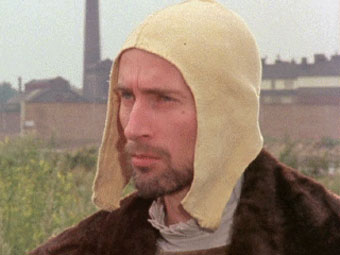
Richard O’Brien as John Dee in Jubilee (1978).

All of which had me thinking how John Dee, a maverick intelligence of the Elizabethan era, has a tendency to attract equally maverick intelligences in later eras. Derek Jarman’s work returns to John Dee often enough to make the magus a recurrent theme in his films, from the scenes in Jubilee (1978) (part of an earlier script) where he’s portrayed by Richard O’Brien showing Elizabeth I the future of her kingdom, to The Tempest (1979) where Prospero’s wand is modelled on Dee’s Monas Hieroglyphica, to The Angelic Conversation (1987) which borrows its title from Dee’s scrying experiments and finds via the sonnets another connection between John Dee and Shakespeare (Ariel being the contrary spirit whose magic allows a vision of the future in Jubilee). By one of those coincidences which make you think there must have been something in the air during the mid-70s, Michael Moorcock’s novel Gloriana, or The Unfulfill’d Queen was published the year Jubilee premiered, a fantasy in which the Elizabethan court is blended with its fictional counterpart from Spenser’s The Faerie Queen, and which features a Doctor John Dee as the queen’s Councillor of Philosophy. (If you want to stretch the connections further, Jenny Runacre who plays Elizabeth in Jubilee had earlier portrayed Miss Brunner in the film of Moorcock’s The Final Programme.)
mindscape_dee.jpg

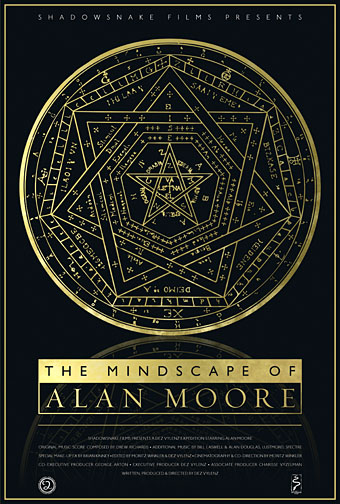
My 2009 poster design for The Mindscape of Alan Moore, a documentary by Dez Vylenz. John Dee’s Sigillum Dei Aemeth appears in the film so I used this as the principal motif for the packaging design and DVD interface.

Reading the reviews it’s impossible to tell how Alan’s libretto might have fared on stage compared to the work which is now showing, the content of which draws on Benjamin Woolley’s excellent biography, The Queen’s Conjuror. Alan and Benjamin Woolley can both be found among the interviewees in a Channel 4 documentary about John Dee broadcast in the Masters of Darkness (sic) series in 2001. For those keen to delve beyond the stage show, Derek Jarman’s films are all on DVD, of course, while fragments of Alan’s libretto can be found in the fourth edition of Strange Attractor along with his notes for the rest of the opera. Charlotte Fell Smith’s life of Dee from 1909, for many years the standard study of the man, can be found online here.

Previously on { feuilleton }
The Tempest illustrated
Robert Anning Bell’s Tempest
In the Shadow of the Sun by Derek Jarman
Designs on Doctor Dee
Derek Jarman at the Serpentine
The Angelic Conversation
The life and work of Derek Jarman

Max Reinhardt’s Dream

mnd1.jpg

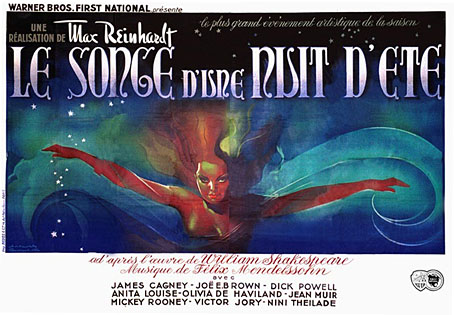
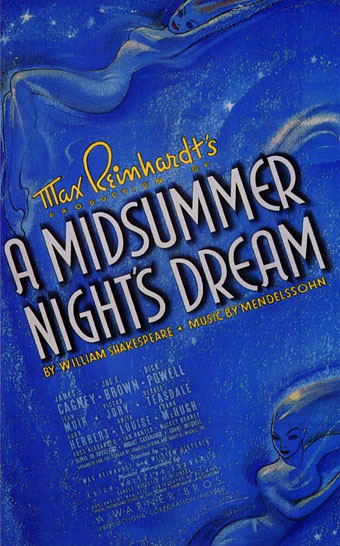
In which the great German theatre director goes to Hollywood to show America how to stage Shakespeare. Nearly everyone who was anyone in pre-war German cinema passed through Max Reinhardt’s Deutsches Theater in Berlin so it seemed natural that he’d gravitate eventually to film himself. The 1935 production of A Midsummer Night’s Dream was directed by William Dieterle but it’s very much a Reinhardt production, especially in the fantastic opening of Act II where the fairies dance into the moonlit sky on paths of mist accompanied by Mendelssohn’s music. With its blend of music, dance and lavish production design Dieterle’s film gives us some idea of the harmonising artistry at work in Reinhardt’s stage productions.

mnd2.jpg

There are other reasons to recommend this version over later adaptations, not least James Cagney’s performance as Bottom. A fifteen-year-old Mickey Rooney played Puck although he’s frequently more annoying than mischevious. Then there’s the mystery of whether that’s the young Kenneth Anger uncredited in the role of The Changeling Prince. Anger has always claimed it was him (he was a child actor for a while), Anger biographer Bill Landis agrees but plenty of other people have disputed the claim in recent years. The best viewing I had of the sequence in which the Changeling appears was on a big screen in a season of Kenneth Anger’s films in 1990. Whether Anger played the part or not, the charm of Dieterle’s film subtly invests The Magick Lantern Cycle, from the glittering surfaces in Eaux D’Artifice and the artificial forest in Rabbit’s Moon, to the appearance of Mickey Rooney’s Puck on a TV screen in Scorpio Rising. Anger’s later works were productions of Puck Films, their motto “Lord, what fools these mortals be!”

Ideally the magical opening of Act II would be on YouTube but it seems not. This scene, however, gives an idea of the atmosphere, while Doctor Macro has stills and more information.

Previously on { feuilleton }
The Midsummer Chronophage
Another Midsummer Night
A Midsummer Night’s Dadd
William Heath Robinson’s Midsummer Night’s Dream

The Choise of Valentines, Or the Merie Ballad of Nash His Dildo

nash.jpg

My little dilldo shall suply their kinde:
A knaue, that moues as light as leaues by winde;
That bendeth not, nor fouldeth anie deale,
But stands as stiff as he were made of steele;

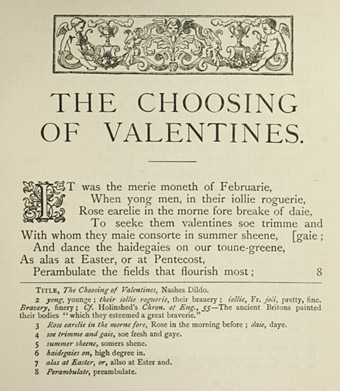
A salacious post for chocolate-and-roses day. There’s a degree of confusion around this work and its author, an Elizabethan poet, playwright and pamphleteer. The poem, which was distributed privately, dates from around 1593 and has a variety of titles, while its author is variously credited as Thomas Nashe or Thomas Nash. Despite the bawdy reputation of the Elizabethan era Nash’s contemporaries were sufficiently scandalised by the poem for it to remain unpublished, with the result that it survives imperfectly in a few handwritten copies. It’s a lengthy piece so let’s go to Wikipedia for a précis:

It describes the visit of a young man named “Tomalin” to the brothel where his girlfriend Frances (“Frankie”) is employed. Having paid ten gold pieces for her favours, Tomalin is embarrassed to find that merely lifting her skirts makes him lose his erection. She perseveres in arousing him however and they make love, but to her disappointment he has an orgasm before her. Frankie then decides to take matters into her own hands: hence the informal title by which the poem was known, Nashe’s Dildo.

The Oxford English Dictionary credits Nash with the first appearance in English of the word “dildo”, a term “of obscure origin” we’re told, whose usage here predates John Florio’s Worlde of Wordes (1598), Ben Jonson’s The Alchemist (1610), and Shakespeare’s A Winter’s Tale (1611). Nash’s achievement is something of a cheat since his poem wasn’t actually published until 1899, and then in a private edition. As usual the Internet Archive has the book in question, and it’s their version which follows, albeit without the copious footnotes.

The Renaissance English Literature site has more about Thomas Nash (or Nashe), his life and his work.

Continue reading “The Choise of Valentines, Or the Merie Ballad of Nash His Dildo”

Weekend links 35

cr.jpg

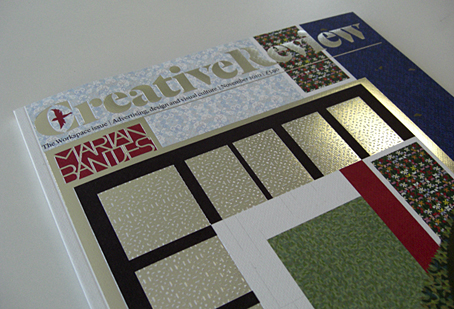
Marian Bantjes designs the cover of the latest Creative Review and there’s a feature about her work inside.

• “…the question: ‘was Shakespeare gay?’ strikes me as so daft as to be barely worth answering. Of course he was. Arguably he was bisexual, of sorts, but his heart was never on his straight side.” Don Paterson throws the cat among the pigeons in an examination of the Shakespeare’s sonnets. Related (sort of): Shakespeare and Company: The bookshop that thinks it’s a hotel. Also related: Jeanette Winterson revisits Shakespeare and Company.

100 orbs of light float in the Schuylkill River. Also in Philadelphia: Animators Amok in a Curiosity Cabinet: the Brothers Quay are making a film in the Mütter Museum. Can’t wait to see it.

• More Alan Moore: Fossil Angels, a lengthy essay about magic and the occult, was written in 2002 but hasn’t been given a public airing until now.

Alberto Manguel is always worth reading:

As Borges was well aware even then, the history of literature is the history of this paradox. On the one hand, the deeply rooted intuition writers have that the world exists, in Mallarmé’s much-abused phrase, to result in a beautiful book (or, as Borges would have it, even a mediocre book), and, on the other hand, to know that the muse governing the enterprise is, as Mallarmé called her, the Muse of Impotence (or, to use a freer translation, the Muse of Impossibility). Mallarmé added later that all who have ever written anything, even those we call geniuses, have attempted this ultimate Book, the Book with a capital B. And all have failed.

• Here Comes Everybody: Wake In Progress is a self-described “foolhardy attempt to illustrate Finnegans Wake”. Easier to illustrate than make a film of the book, I’d have thought, and Mary Ellen Bute already attempted the latter.

hoffmeister.jpg

Psychic Explosion: Adolf Hoffmeister’s illustrations for a 1967 edition of Lautréamont’s Poesies at A Journey Round My Skull.

Craig Colorusso’s Sun Boxes can be seen at Turner Falls, Massachusetts, during November.

Clive Hicks-Jenkins has a book and retrospective exhibition of his art due next year.

• A sneak peek into The Steampunk Bible to which I’m a contributor. And also here.

• “Human or other; depends who comes”: the Ballardian films of Paul Williams.

Transmission (1979) by Joy Division; Transmission (1995) by Low; Monkey (2010) by Robert Plant.

The Tempest illustrated

tempest.jpg

“Such stuff as dreams are made on”: Heathcote Williams and Toyah Willcox.

DVD viewing earlier this week was Derek Jarman’s wonderful adaptation of The Tempest which he directed in 1979. This is my favourite of Jarman’s films, partly because the play is my favourite Shakespeare (along with its polar opposite, Macbeth) and also because it’s a film infused with an occult sensibility which comes directly from the director’s own interests, rather than being the usual film or theatre conventions of what magic entails. An example of this is the grimoire which Prospero (Heathcote Williams) is seen leafing through which Jarman reveals in his autobiography, Dancing Ledge, to be his own 17th-century edition of Cornelius Agrippa’s Occult Philosophy. In his account of the filming he also describes his conception of Prospero as being based on Dr John Dee, the Elizabethan occultist who Shakespeare would certainly have known of, and may even have met since the pair both had business with Elizabeth I’s court. The most explicit reference to Dee comes in the shape of Prospero’s magical glass (above), based on Dee’s Monas Hieroglyphica, and a prop I’d dearly love to own. Dee was also a character in Jarman’s Jubilee (1978), and his Angelic Conversations gave a title to Jarman’s later filming of Shakespeare’s sonnets.

Seeing Jarman’s adaptation again had me thinking about the various representations of the characters. Ariel is generally depicted as a fairy type although he’s a lot more powerful than the fairies in A Midsummer Night’s Dream. As for Caliban, like Grendel in Beowulf, he’s an all-purpose monster whose predominant attributes seem to be whatever Ariel isn’t: ugly, earthbound, stupid, treacherous, and so on. I’d be tempted to propose the island’s quartet as representing the four elements—Prospero: water; Miranda: fire; Caliban: earth; Ariel: air—but I’m sure that’s not an original idea given the amount of academic trawling through the Bard’s corpus. Rather than dig for symbolism, what follows is a few pictures found during another trawl of my own through the Internet Archive, where the books aren’t drowned but patiently await their rediscovery.

Continue reading “The Tempest illustrated”