Weekend links 783

robinson.jpg

An illustration by William Heath Robinson for A Midsummer Night’s Dream (1914).

• New music: How To Shoulder The Radiance Of Revelations by Dadub; Leviathan by Stephen Roddy; and Echoes Of The Hollow Earth by Cryo Chamber.

• At Sight & Sound: “Every time I look at the film, it gets better.” Steven Soderbergh on Jaws.

• At Public Domain Review: The Language of Form: Lothar Schreyer’s Kreuzigung (1920).

Leafing through the merveilleux-scientifique novels today allows for a dual rediscovery: firstly, it uncovers the previously unrecognised richness of Belle Époque scientific fiction, which did not perish with the works of Verne. The stories take in journeys to Mars, solar cataclysms, reading of auras, psychic control, weighing of souls, death rays, alien invasions, even strolls among the infinitesimally small. But exploring the genre also offers insights into the cultural history of the era, marked by a significant permeability between science and pseudo-science. Reading this work, we can learn a lot about the aspirations, fears and beliefs of early 20th-century Europe.

Fleur Hopkins-Loféron on the evolution of French science fiction after Jules Verne

• Mix of the week: A Twin Peaks mix for The Wire by Lori Eschler & Dean Hurley.

• Steven Heller’s font of the month is Kefir.

Patrick Wolf’s favourite albums.

ultrawolvesunderthefullmoon

Frou-Frou Foxes In Midsummer Fires (1990) by Cocteau Twins | Midsummer Night (2010) by The Time And Space Machine | Midsummer Boulevard (2022) by Hawksmoor

Weekend links 782

binnie.jpg

Ushiwakamaru and Benkei (2015) by Paul Binnie.

• “Gohatto depicts homosexuality within a very specific subset of society. Kubi explores further than that, depicting homosexuality between equals, and between bosses and subordinates. It tries to depict the relationship between power and authority, and how sexuality is used to maintain that authority.” Takeshi Kitano talking about Kubi, his film about sex among the samurai, which is receiving a belated release in the UK.

• “De Rome later said he’d never felt persecuted for his sexuality, and it’s this sense of the carefree that’s reflected in the lightness of his filmmaking.” Luke Turner on Peter De Rome’s homoerotic films which are currently being screened at the Barbican, London.

• At Public Domain Review: Helen Haiman Joseph’s A Book of Marionettes (1920), “The first comprehensive history of marionette artistry in the English language.”

• Mixes of the week: Isolatedmix 132: Psilocybin Therapy Protocol v1.22a by Matt Xavier, and DreamScenes – June 2025 at Ambientblog.

• At Sight and Sound: Backwards through the backwoods: music editors Dean Hurley and Lori Eschler on David Lynch and  Twin Peaks.

Dennis Cooper’s favourite fiction, poetry, non-fiction, film, art, and internet of 2025 so far. Thanks again for the link here!

• New music: Interior of an Edifice Under the Sea by Pan American & Kramer, and Modulations IV by Ian Boddy.

• At The Quietus: Peer Review: Peter Strickland interviews Cosey Fanni Tutti…and vice versa.

Cosmic Dawn: A feature-length NASA documentary about the James Webb Space Telescope.

• RIP Sly Stone and Brian Wilson.

Les Marionnettes (1991) by Zbigniew Preisner | Sword Of The Samurai (2006) by Lisa Gerrard | Seven Samurai (Ending Theme) (2012) by Ryuichi Sakamoto

David Lynch, 1946–2025

lynch.jpg

Photo by Frank Connor from The Elephant Man: The Book of the Film (1980).

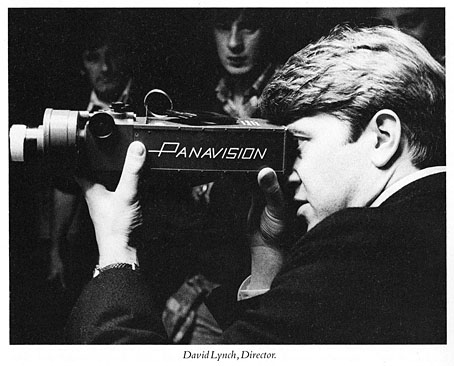
I feel at a loss for words on this occasion, Lynch’s films have been a continual presence in my life since I saw The Elephant Man in 1981. I’d actually been thinking of watching some of them again, maybe even having a full-on Lynch season the way I did in 2018 when I watched everything in sequence, from his early shorts through to Twin Peaks: The Return which at the time had just been released on disc.

A few random thoughts:

• My first sighting of Eraserhead was on the big video screens at the Hacienda in Manchester in late 1982. Claude Bessy used to play clips from his video collection, all of them silent because a DJ was usually playing music at the same time, so you’d end up seeing confusing, contextless shots from films like A Clockwork Orange, Shogun Assassin, various Andy Warhol films, and so on. I got to see Eraserhead in full shortly after this at a proper cinema on a double-bill with George Romero’s The Crazies. The Romero was fun but the Lynch was a doorway to another world.
lynch3.jpg

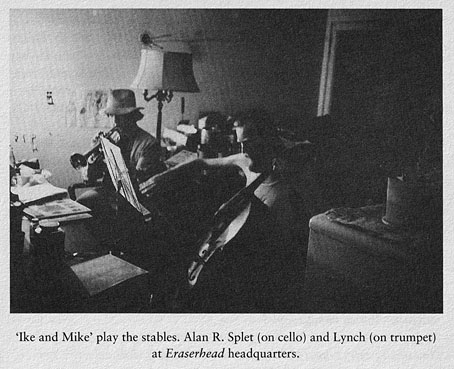
Photo from Lynch on Lynch (1997).

• Anyone writing about Lynch’s early features, especially Eraserhead, ought to mention sound designer Alan Splet. Lynch himself was always full of praise for Splet; the pair worked on the soundtracks together but Splet had a unique way of processing sounds which is all over the early films from The Grandmother on. You can gauge Splet’s sonic invention by watching The Black Stallion, a Lynch-less film for which Splet won an Oscar, where the sounds of panting horses are stranger than anything in any other film about horses or horse-racing. If you were familiar with Splet’s weirdness then his absence from Wild at Heart was a significant loss; Randy Thom is a good sound designer but he’s not in the same league. As Paul Schütze noted in his Splet obituary for The Wire in 1995, the soundtrack of Eraserhead is one of the foundations of the whole “dark ambient” genre of music.

• Some favourite Splet moments in Lynch’s films: the industrial sounds that accompany Treves’ walk through the East End in The Elephant Man; the visit from the Guild Navigator at the beginning of Dune; Jeffrey’s dream in Blue Velvet.

• For all the times I’ve watched Blue Velvet I still don’t know what that thing is hanging on Jeffrey’s bedroom wall.

• Lynch films are dog films.

• It was difficult not to feel like a Lynch hipster in 1990 when the world at large was forced to confront Lynch’s imagination via Twin Peaks and (to a lesser extent) Wild at Heart. We had to endure a year of people who’d spent the past decade ignoring Lynch’s films offering their opinions, along with inane comments such as “But does he have anything to say?” It was a relief when Fire Walk With Me came out and drove away the lightweights. I remember Kim Newman pointing out in his Sight and Sound review that the Twin Peaks prequel was more of a genuine horror film than many films explicitly labelled as such. The same could be said of Lost Highway and Mulholland Drive.
lynch2.jpg

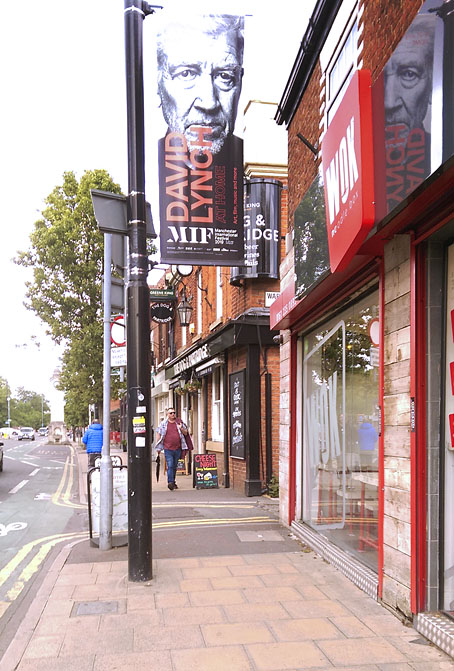
• I was pleased that Lynch was invited to contribute to the Manchester International Festival in 2019; I got to see some of his paintings and also buy Twin Peaks badges and Lynch postcards. Best of all, however, was the two weeks or so when his face was peering out of posters at tram stops and (as he is here) gazing down on pedestrians in my local high street. I’ve mentally tagged that pole as The David Lynch Lamp Post ever since.

Okay, maybe not so lost for words after all…

• Elsewhere:
(offline) Lynch on Lynch (1997), edited by Chris Rodley. 270 pages of interviews which aren’t always very revealing but which still contain a wealth of detail and anecdote about the making of the films. Also a fair amount of discussion about his paintings and other artworks.
(online) 46 issues of Wrapped in Plastic, the Lynch fan magazine.

Previously on { feuilleton }
Lynch dogs
42 One Dream Rush
Through the darkness of future pasts
David Lynch window displays
David Lynch in Paris
Inland Empire

The ghost at the window

bava1.jpg

I’ve been taking advantage of the Spook Season to finally watch some of the horror films that I’ve known about for decades but never managed to see until now. Among the collection has been Ishiro Honda’s fungal nightmare, Matango (1963), and the Poe-themed Spirits of the Dead (1968), one of those Italian anthology films that proliferated in the 1960s, this one featuring episodes directed by Roger Vadim, Louis Malle and Federico Fellini. Still to come is Ugetsu Monogatari (1953), Kenji Mizoguchi’s ghost film.

curse.jpg

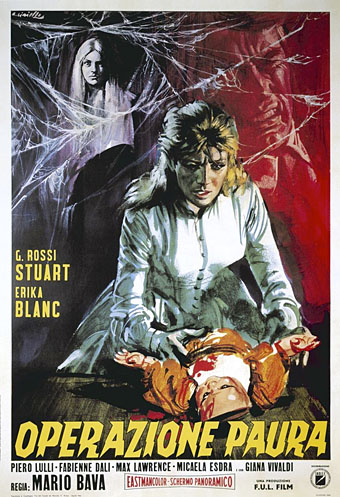
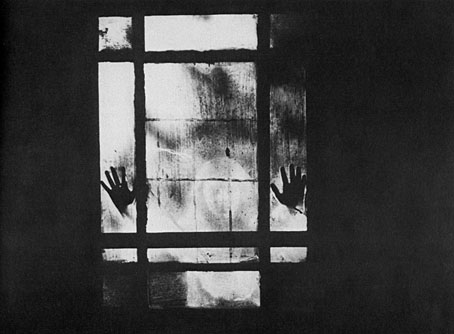
Topping the list was Curse of the Dead (1966), another ghost film directed by Mario Bava. Ten years ago I wrote a post about a black-and-white still from Bava’s film (see above) which has proved surprisingly popular, finding its way onto a number of book and record covers. The still is one of many that fill the pages of Denis Gifford’s A Pictorial History of Horror Movies (1973), and had intrigued me long before I started to notice its use elsewhere. Gifford, however, wasn’t much help when trying to find out more about the film itself. Curse of the Dead is one of the few films that he doesn’t discuss in his book, and its title compounded the mystery when nothing with that name was listed in film guides. The problem turned out to be one that plagues horror films, especially the older variety, whereby a film’s title changes each time it crosses a national border. Gifford was using the British name given to something originally released in Italy as Operazione Paura (Operation Fear). Curse of the Dead is rather vague—it would suit any number of other films—but it’s preferable to the Italian one, which makes it sound like a spy thriller, and far better than the other alternatives. Since America dominates the film business it’s usually the American title, Kill, Baby, Kill, that you see this one listed under, a typical piece of overkill (so to speak) from US distributors AIP. In Germany it was released as The Thousand Eyes of Dr Dracula, a ridiculous play on Fritz Lang’s final Dr Mabuse film.

bava2.jpg

Curse of the Dead.

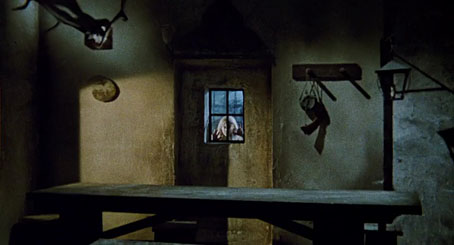
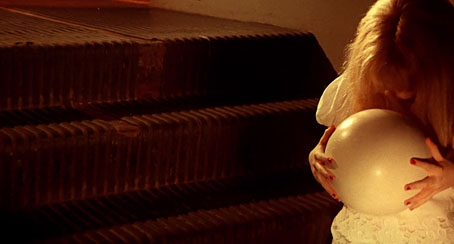
Whatever the title, Bava’s film is well worth seeking out. The story concerns a doctor who arrives at a small Carpathian village to perform an autopsy on a young woman who has died in mysterious circumstances. The death is one of several that have blighted the village, all caused by a blonde ghost girl whose appearance at night—always dressed in white, and playing with a bouncing white ball—seals the doom of anyone who encounters her. A story that in other hands might be rote and predictable (hello, Hammer Films) is anything but, thanks to Bava’s visual artistry and inventiveness in the face of a severely limited budget. Halfway through the film the narrative logic dissolves into an extended nocturnal investigation punctuated by remarkable dreamlike moments, notably a scene in which the doctor ends up chasing himself through a succession of doors in identical rooms twenty-five years before Agent Cooper did something similar in Twin Peaks. The “Carpathian” exteriors are mostly Italian countryside, filmed in a mountain village whose ruined nature adds a great deal to the atmosphere. As for the intriguing hands-at-the-window moment, I was prepared to be disappointed by its eventual appearance but Bava makes it a key moment after teasing us with other shots like the one above, showing spectral hands and faces at windows.

fellini.jpg

Toby Dammit.

Bava’s ghost (or a version of her) reappeared two years later in the Fellini episode of Spirits of the Dead, a detail I’d forgotten about until this week. Fellini’s Toby Dammit is the best part of the anthology feature but the Poe story he was adapting, Never Bet the Devil Your Head, doesn’t involve any blonde ghost girls. Terence Stamp is the title character, playing an actor rather like himself who succumbs to an alcohol-fuelled breakdown while being flattered and harassed by fans, paparazzi and a gallery of grotesques from the Italian film business. The ghost haunting him for inexplicable reasons is less a homage than an outright theft (she even has a bouncing white ball), something that apparently dismayed Mario Bava, understandably so after the problems he had to get his own film made. That said, Toby Dammit still carries a spooky charge even if Fellini’s spectre is a poor relation to Bava’s, with the whole episode playing like a particularly nightmarish out-take from 8 1/2.

Previously on { feuilleton }
Juliet of the Spirits
A Pictorial History of Horror Movies by Denis Gifford
Design as virus 14: Curse of the Dead

Weekend links 431

eckman-lawn.jpg

Postcard collage by Alex Eckman-Lawn.

• “He deserves to be a major figure not only in the history of Japanese music, but in popular music writ large.” Geeta Dayal on Haruomi Hosono, a musician whose solo albums from the 1970s are reissued this month by Light In The Attic.

Erica X Eisen reviews Black Light: Secret Traditions in Art since the 1950s, an exhibition of occult art at the Barcelona Contemporary Culture Centre. Related: Gary Lachman‘s talk from the same exhibition.

• Mixes of the week: Jesús Bacalão’s Light Entertainment Programme 2, Secret Thirteen Mix 265 by Alexander Tucker, and FACT Mix 672 by Rian Treanor.

Whenever horror is criticised, it is criticised for staging a dark carnival of physicality. Perhaps the only sort of media we moralise more than we do horror is that other mainliner of bodily response, pornography.

Horror’s historical ghettoisation has meant that weightier, smarter horror reliably gets labelled as something else. The finest films of our current golden age have been dubbed “elevated horror” and “post-horror”. In literary circles, works of horror seen as sufficiently cerebral get relabelled “Gothic”. It’s certainly true that great horror is always about more than gore. But we should be careful not to gentrify the genre by cleansing it of everything but the philosophy.

MM Owen on the perennial attractions of a perennially despised genre

• “Netflix is a woeful service,” says Jeremy Allen who prefers DVD/Blu-ray to streaming video (as do I). Related: The problem with film aspect ratio on Netflix.

• The Thought Gang album, a Twin Peaks-related collaboration between David Lynch & Angelo Badalamenti from 1993, will be released next month.

Tangerine Dream: Sound From Another World: a TV documentary from 2016. In German but with auto-translated subtitles.

The Thing’s Incredible! The Secret Origins of Weird Tales by John Locke.

Haute Macabre Staff Favorites: Tarot Decks

First Light (1980) by Harold Budd & Brian Eno | Blue Light (1993) by Mazzy Star | Black Light (1994) by Material