The Return of the Sorcerer

sorcerer1.jpg

The story’s first appearance in Strange Tales of Mystery and Terror, September 1931. No illustrator credited.

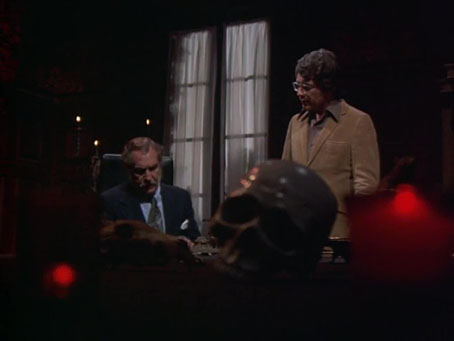
Rod Serling’s Night Gallery is a series I’d have happily watched if one of the UK channels had rebroadcast it in the 1980s, the way that Channel 4 did with the original Twilight Zone. This weekend I watched for the first time the opening episode of Night Gallery‘s third and final season, an adaptation by Halsted Welles of Clark Ashton Smith’s The Return of the Sorcerer. Smith is a writer whose works are still mostly neglected by film and television but he was in good company in Night Gallery, a series which featured adaptations of stories by a number of fellow Weird Tales writers including HP Lovecraft, Fritz Leiber and Robert Bloch. The story is one of Smith’s modern-day horror tales in which a poverty-stricken translator is offered a lucrative position at an old and sinister house, a place where a fearful occultist requires translations of an ancient volume. The Arabic text turns out to be passages from an early edition of everybody’s favourite forbidden tome, the Necronomicon, and Smith’s story, which was published in Strange Tales of Mystery and Terror in 1931, is the first outside Lovecraft’s own to mention the book, thus beginning the expansion of the Cthulhu Mythos by other hands.
sorcerer2.jpg

The Night Gallery adaptation was broadcast in 1972. Unlike the first two seasons, where episodes ran for an hour, the third season reduced the running time to under 30 minutes which doesn’t give director Jeannot Szwarc (credited as Jean Szwarc) any time to build up the suspense, if he was capable of such a thing. If you’ve ever seen any of Swarc’s feature films you know not to raise your expectations. As a compensation for the absense of atmosphere we get some striking set designs and a decent cast. The fearful magus, John Carnby, is played by Vincent Price, encountering the Necronomicon for the second time in his career after he’d earlier used the book to summon an eldritch monstrosity in Roger Corman’s The Haunted Palace. Bill Bixby plays the wary translator, while Patricia Sterling is Carnby’s toad-loving partner in Satanism, an addition to the story by Halstead Welles, whose presence adds an extra dimension to the proceedings. The episode could never be considered a lost classic but I enjoy seeing stories by the Weird Tales writers making their first infiltrations into the wider culture. This one is worth watching for Vincent Price and the magical decor alone. I think I ought to go looking for more Night Gallery episodes.
sorcerer3.jpg

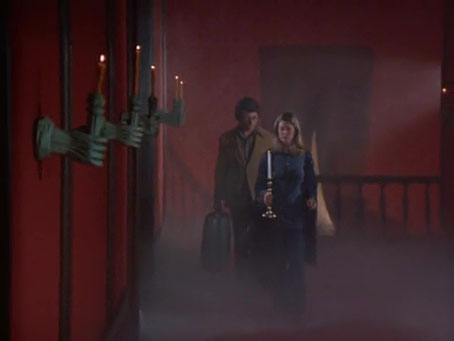
More of those Cocteau hands-through-the-wall. Bixby’s character doesn’t seem very perturbed that the scarlet hall is filled with mysterious vapours.
sorcerer4.jpg

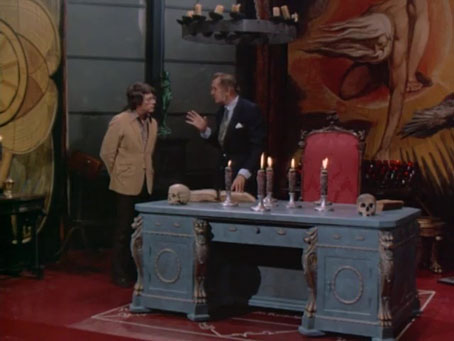
Mystical decor: on the left, Frieda Harris’s Ace of Discs from the Thoth Tarot deck; on the right, The Ancient of Days by William Blake.
sorcerer5.jpg

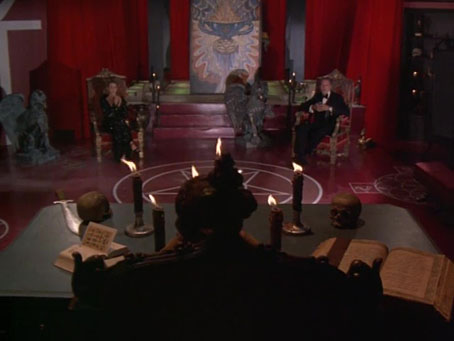
Mystical/Satanic decor: the painting in the background is Frieda Harris’s Ace of Cups from the Thoth Tarot deck.

Previously on { feuilleton }
The Cthulhu Mythos in the pulps
Illustrating Zothique
The Plutonian Drug
More trip texts
Yuggoth details
The Garden of Adompha
The City of the Singing Flame
Haschisch Hallucinations by HE Gowers
Odes and Sonnets by Clark Ashton Smith
Clark Ashton Smith book covers

Moon and Serpent Rising

masbbom1.jpg

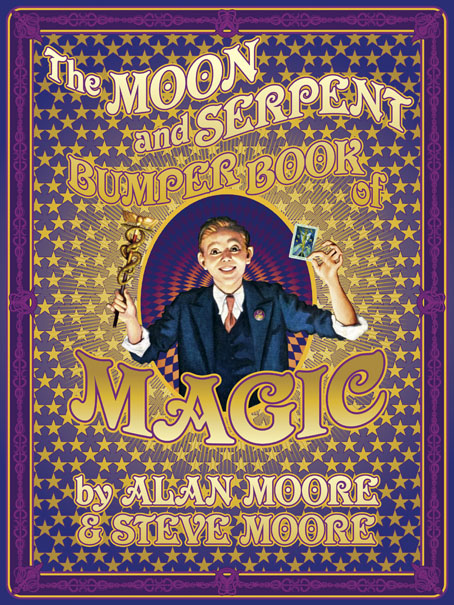
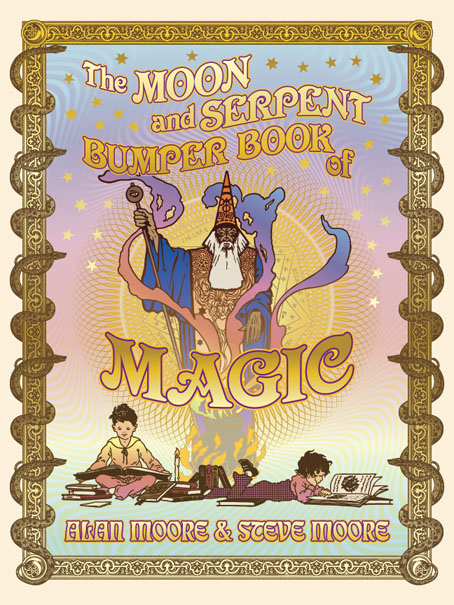
Top Shelf announced this one on Friday so I can break my silence about the book I’ve been working on since May 2021. The Moon and Serpent Bumper Book of Magic by Alan Moore and Steve Moore was first announced in February 2007. I’d created the cover design which was used for promotional purposes after which the project went into hibernation for several years. In 2014 Alan and Steve were back at work again, and were co-writing the final essay when Steve died suddenly in March of that year, whereupon the book retreated to limbo once more. Since 2007 my cover has been floating around the internet like the lid for an empty toybox, but the book really is finished at last, and will be published by Knockabout (UK) and Top Shelf (US) in October.

masbbom2.jpg

In addition to the cover design I was also slated to be working on two of the book’s internal features: The Soul, a six-part illustrated serial set in the 1920s which evolved out of the occult-detective strip that Alan and I were planning circa 1999; also a series of twenty full-page illustrations for a feature titled Magical Landscapes. When Tony at Knockabout informed me at the beginning of 2021 that the book was being revived I made the audacious suggestion to him and to Alan that I could, if need be, design the whole thing as well as illustrate my own sections. Alan readily agreed, saying he trusted me implicitly, which was good to hear; his sole brief was that the book should be “beautiful and psychedelic”. One reason for his trust is that we’d already made excursions into the Moon & Serpent zone together. I designed three of the Moon & Serpent CDs in the 2000s, and made the video that accompanied the William Blake-themed reading/performance by Alan and co. at the Purcell Room, London, in 2001. Consequently, I’ve often felt like a floating member of the Moon & Serpent cabal.

masbbom3.jpg

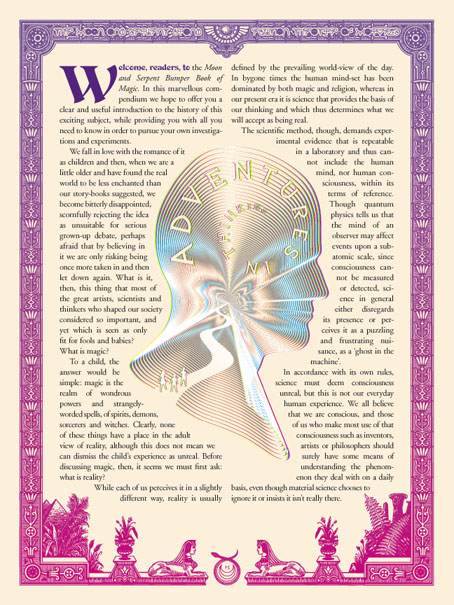
A couple of things are worth noting now that the book is about to enter the world. The first is that the contents are a little different to the press release from 2007 which announced a book of 320 pages, with 78 of those pages being brand new Tarot card designs. The authors subsequently realised that creating an entirely new Tarot deck is a huge task in itself, especially if, as was the intention, you wanted it to be as wide-ranging and authoritative as the Crowley/Harris Thoth deck. There is a chapter about the Tarot in the finished book but readers will now have to choose decks of their own. I can imagine disappointment being expressed about this, and about some of the other changes but the book as it now stands is actually bigger than the original proposal, with an additional 32 extra pages. The expansion is partly a result of my page design which put fancy borders on all of the text pages. I ended up doing a lot more work for the book than I expected, adding new pages here and there, creating a lot of extra graphics and illustrations, and breaking up the long final essay into sections which are illustrated throughout with small pictures.

Continue reading “Moon and Serpent Rising”

First Papers of Surrealism, 1942

surrealisme.jpg

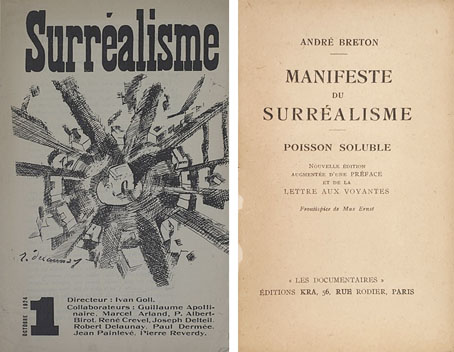
As I was saying a couple of weeks ago, Surrealism will be 100 years old this year, if you mark the movement’s birth from the first manifestoes (there were two different ones) published in October 1924. Surrealism doesn’t really have a definite beginning, however, either in 1924 or earlier on; the movement evolved over several years, with different factions competing for followers while squabbling over intentions. After a great deal of ferment the manifestoes from the opposed groups led by Yvan Goll and André Breton were a declaration that something substantial had been happening that required definition. I’m not sure why all of this interests me as much as it does just now, but I’m looking forward to seeing where the interest leads. Don’t be surprised to see more posts on the subject in the coming months.

firstpapers1.jpg

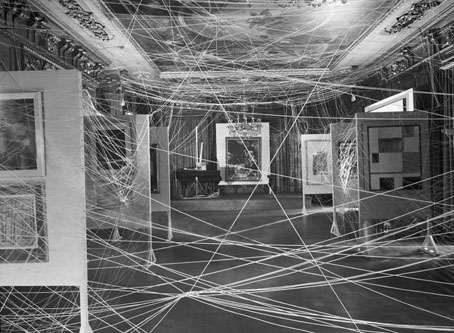
So, then… Fast-forward to 1942 and First Papers of Surrealism, an exhibition of paintings staged in New York City by the Coordination Council of French Relief Societies in October of that year. The exhibition was curated by André Breton with the assistance of Marcel Duchamp, Breton having recently arrived in the United States after escaping from Nazi-occupied France together with a small group of Surrealist artists, some of whom were represented in the show. Duchamp’s main contribution was His Twine, an installation of a large quantity of string threaded around the exhibition space through which the visitors had to peer in order to see the paintings. Duchamp also invited a group of children to play ball games inside the gallery on the opening night. This wasn’t the first Surrealist exhibition to be held in New York—Julien Levy had introduced the city to the latest art movement at his own gallery in 1933, and had been showing Surrealist paintings and Joseph Cornell’s artworks in the years that followed—but First Papers on Surrealism was an important event, with many major artists represented.

firstpapers2.jpg

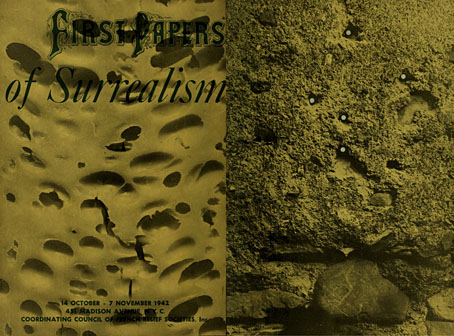
What you see here are pages from the exhibition catalogue, a publication which is more like one of the smaller Surrealist magazines than a mere list of the pictures on display. Marcel Duchamp designed the die-cut cover (those holes make me wonder whether these were also originally threaded with string), while the catalogue interior contains an intriguing collection of quotes, captions, photographs and illustrations. Breton’s “Great Transparent Ones” raise their invisible heads again, while the artists and curators are all depicted in a series of “compensation portraits” which stand in for an absence of suitable photos.

Continue reading “First Papers of Surrealism, 1942”

Weekend links 649

chihuly.jpg

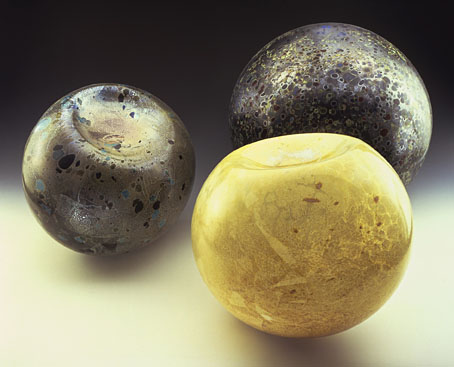
Niijima Floats: Mottled Blue Black Float with Silver Leaf (1991) by Dale Chihuly.

• “Blue whale songs fall below the range of human hearing. If you want to listen to one, to actually hear its ethereal patterns of wobbly pulses and haunting moans, you have to speed it up by at least two-fold. But according to Hildebrand and McDonald’s instruments, the tonal frequencies of the songs had been sinking to even greater depths for three straight years. ‘This is weird,’ Hildebrand thought. To figure out if it was just an anomaly or something more, Hildebrand and McDonald embarked on a quest to find some really old songs. Eventually they got their hands on some of the earliest known recordings, created by the Navy in the 1960s and stored on analog cassettes. They were floored. The frequencies had declined by 30 percent over 40 years.” Kristen French on a mysterious development in blue whale songs.

• “She didn’t see it as a game, or for divination, but as a model of the universe.” Joanna Moorhead on the Tarot designs of Leonora Carrington.

• “A collection of blogs about every topic”: ooh.directory. (Ta to whoever added this place to the list.)

• New music: Pop Ambient 2023 by Various Artists, and Aeolian Mixtape by Quinta.

• At Public Domain Review: The Tanzmasken of Lavinia Schulz and Walter Holdt.

• At Wormwoodiana: Mark Valentine on mazes and labyrinths. (Previously)

• At Spoon & Tamago: Paper-cut cityscapes by kirie artist Hiroki Saito.

• At Smithsonian Magazine: The Unrivaled Legacy of Dale Chihuly.

• Mix of the week: Neo-Medieval Mix by Moon Wiring Club.

• Old music: Back To The Woodlands by Ernest Hood.

• At Dennis Cooper’s: Jacques Rivette Day.

Weyes Blood’s favourite music.

(Gorgeous Curves Lovely Fragments Labyrinthed On Occasions Entwined Charms, A Few Stories At Any Longer Sworn To Gathered From A Guileless Angel And The Hilt Edges Of Old Hearts, If They Do In The Guilt Of Deep Despondency.) (2004) by Akira Rabelais | The Private Labyrinth (2008) by The Wounded Kings | Labyrinths (2018) by Jonathan Fitoussi & Clemens Hourrière

Weekend links 639

alphaville.jpg

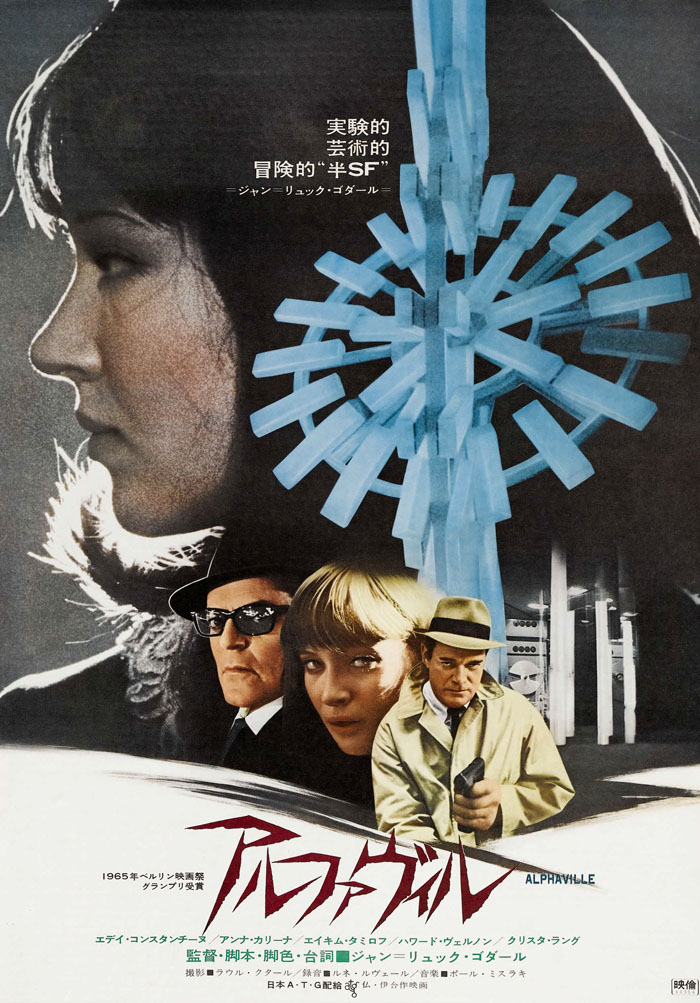
Japanese poster for Alphaville (1965).

Peter Bogdanovich: I think we’d better have your thoughts on Godard.

Orson Welles: Well, since you’re so very firm about it. He’s the definitive influence if not really the first film artist of this last decade, and his gifts as a director are enormous. I just can’t take him very seriously as a thinker—and that’s where we seem to differ, because he does. His message is what he cares about these days, and, like most movie messages, it could be written on the head of a pin. But what’s so admirable about him is his marvellous contempt for the machinery of movies and even movies themselves—a kind of anarchistic, nihilistic contempt for the medium—which, when he’s at his best and most vigorous, is very exciting.

• RIP JLG. I was watching Alphaville again just two weeks ago after a DVD turned up in the local charity shop. Still the only Godard film I like 100% but “liking” seems beside the point. His influence today is everywhere, so fully absorbed into the language of cinema that people barely notice it.

• “The things that cause my gaze to linger are usually the portraits or landscapes that spark a feeling of unease, disquiet and discomfort. A shadow amongst the summer trees, a lurking silhouette reflected in a perfect blue iris, a vibrant flower in the early stages of decay.” S. Elizabeth talking to Beautiful Bizarre about her new book, The Art of Darkness: A Treasury of the Morbid, Melancholic and Macabre.

• Allow John Waters (again) to dictate your film viewing with a Letterboxd list of his favourite films, based on comments in his writings and interviews. On the subject of Godard, Waters’ Crackpot book contains a whole chapter about Hail Mary.

• Astor’s Electrical Future: Iwan Rhys Morus explores a vision of the year 2000 recounted in A Journey in Other Worlds (1894), a “scientific romance” by John Jacob Astor IV, with illustrations by Daniel Carter Beard.

• Strange Attractor has announced a Kickstarter campaign to fund the publication of an Austin Osman Spare Tarot deck.

• At Wormwoodiana: The Parrot, the Unicorn and the Golden Dragon: Some 17th Century Booksellers’ Signs.

• At Bandcamp: Andy Thomas on Chris Watson‘s post-Cabaret Voltaire career in nature recordings.

• A new outlet for cinematic obscurities: Radiance Films.

Alphaville (1978) by Klaus Schulze | Alphaville (1979) by The Monochrome Set | Alphaville (1999) by Scanner