Weekend links 237

trouille.jpg

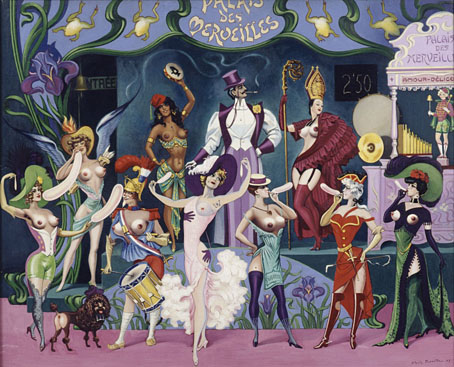
Le Palais des Merveilles, 1907 – 1927 – 1960 by Clovis Trouille.

• “Why is it OK to show a male ejaculation but not a female one? What are the qualifications of those who cobble together these rules?” Suzanne Moore on the latest batch of discriminatory restrictions against porn production in the UK. Porn laws in Britain have long been like the drug laws, sprouting fresh Hydra-heads of unwarranted bans and crackdowns after the previous bans and crackdowns have been discredited. Last month Zoe Williams talked to women who make niche porn for other women. This week she discovered that some of those she interviewed now find their work is illegal under the latest restrictions.

• “[Derek Jarman] considered In the Shadow of the Sun to be just as important as any of the feature films that he made in the 1970s.” Film producer and archivist James Mackay talking to Beatrix Rux about Derek Jarman’s Super-8 films. Related: Tilda Swinton is GQ’s Woman of the Year.

The Art of Big O by Michael Fishel (author) and Nigel Suckling (editor), a collection of the fantastic and psychedelic poster art published by Peter Ledeboer’s company in the 1970s. Good to see but at $67 (really?) I’d expect a better cover design.

• New electronica: More “confusing English electronic music” from Moon Wiring Club; Shut-Eyed Stories, an album by Jim Cheff; and Shapwick by Jon Brooks, previously vinyl-only and out-of-print, now has a digital edition.

JK Potter Mutates the Story: Christopher Burke & David Davis talk to the horror illustrator about his photographic work.

• Beth Maiden on The Fascinating Life of Pamela Colman Smith, artist of the Rider-Waite-Smith Tarot deck.

• Under the Influence: The Sexy, Sordid Surrealism of Clovis Trouille by Kirsten Anderson.

Geoff Manaugh on The Fiery Underground Oil Pit Eating LA.

• Mix of the week: Secret Thirteen Mix 137 by Teste.

The Wild Horny Goat

The Young People (2010) by Belbury Poly & Moon Wiring Club | Goat Foot (2012) by Belbury Poly | Walking Through Me (2014) by Moon Wiring Club
Weekend links 234

dezso.jpg

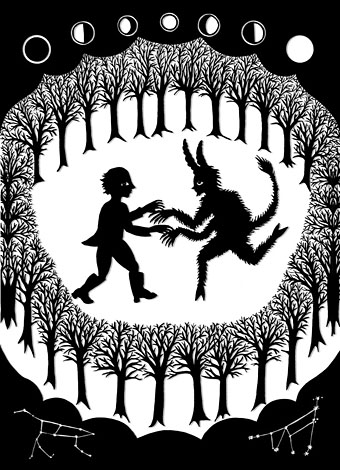
The Devil in the Green Coat by Andrea Dezsö, an illustration for a new, uncensored edition of the Grimm Brothers’ Fairy Tales.

• That { feuilleton } object of cult attention, Penda’s Fen, a 1974 television film by David Rudkin directed by Alan Clarke, continues its long journey out of the shadows. To coincide with a screening in London of a 16mm print, Sukhdev Sandhu looks back at a unique drama, and examines its connections to other British films of the period. There’s still no sign of a DVD release although rumours persist. Related: Penda’s Fen at A Year In The Country.

• “One of the reasons I’m sure I found the horror genre congenial is that it’s almost always focused on the body. The body is the center of all horror films.” David Cronenberg talking to Calum Marsh about his novel, Consumed.

• Mix of the week: Antony Hegarty’s Future Feminist Playlist, and Secret Thirteen Mix 134 by James Ginzburg & Yair Elazar Glotman. Related: Nimbes by Joaniele Mercier & James Ginzburg.

• Another week, another Kickstarter: Suzanne Ciani: A Life in Waves is a planned feature-length documentary about the American synthesist and composer.

• “[Marjorie] Cameron’s connections to Scientology and powerful men once drew headlines, but now her art is getting its due,” says Tanja M. Laden.

Jay Babcock found a Hawkwind Tarot spread in International Times for 1971. Is this an overlooked Barney Bubbles design?

• “Tempered in the flames of hell”: Helen Grant on the precursors of Robert Louis Stevenson’s The Bottle Imp.

Hawthonn: Phil and Layla Legard (and others) remember John Balance with a special musical project.

Derek Jarman Super 8 by James Mackay, a book of stills from Derek Jarman’s Super 8 films.

• “Coltrane’s free jazz wasn’t just ‘a lot of noise’,” says Richard Brody.

This might be the world’s first book on colour palettes.

Paris 1971 (1971) by Suzanne Ciani | The Fifth Wave: Water Lullaby (1982) by Suzanne Ciani | Blue Amiga (2014) by NeoTantrik & Suzanne Ciani

The occult Knapp

knapp01.jpg

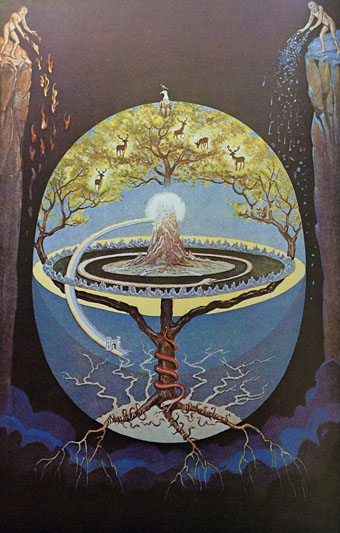
Yggdrasil, the World Tree of Norse mythology.

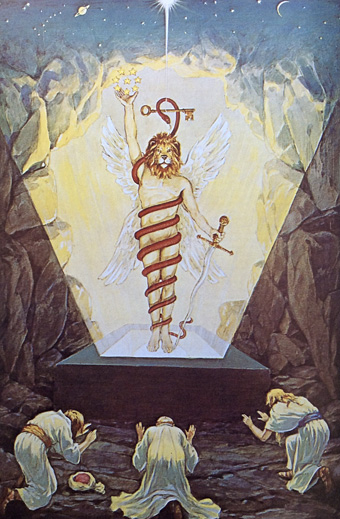
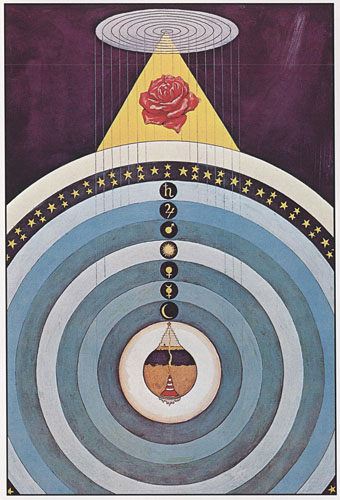
Following up the work of Etidorhpa‘s illustrator, J. Augustus Knapp (1853–1938), I realised that I’d already encountered some of his later paintings. After illustrating books by John Uri Lloyd, Knapp moved to California where he met occult historian, mystic and book collector Manly Palmer Hall. Knapp exchanged Lloyd’s fungi researches and weird fiction for Hall’s mysticism, illustrating The Initiates of the Flame (1922), and Hall’s magnum opus, The Secret Teachings of All Ages (1928). Knapp’s 54 paintings for the latter volume have since proved convenient for the occult encyclopedias that followed, many of which plundered Hall’s study for its illustrations. Knapp’s depictions aren’t always very successful—Odin’s wolves look silly rather than fierce—but they served Hall’s purpose of fixing mythological characters and metaphysical schemes in a colourful manner for a contemporary audience.

knapp06.jpg

Mithra in the form of Boundless Time.

Hall and Knapp also produced their own Tarot deck (see here and here) which can still be bought today from the University of Philosophical Research in Los Angeles. The UPR was founded by Manly Hall, and has a collection of Knapp’s paintings. They also sell Hall’s books, of course, and you can browse a copy of The Secret Teachings of All Ages if you visit the library, as I discovered in 2005 when Jay Babcock and I paid the place a visit.

knapp10.jpg

The Key to Dante’s Divine Comedy.

Continue reading “The occult Knapp”

The art of Frieda Harris, 1877–1962

harris01.jpg

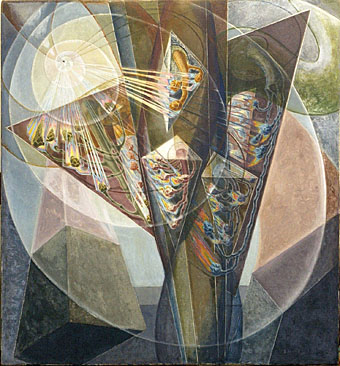
Searching around for artwork by Frieda Harris turned up a few examples I hadn’t seen before including the marvellous painting above which is unfortunately untitled and undated. Harris is very familiar to Aleister Crowley aficionados and those with an interest in the Tarot via her paintings for the Thoth Tarot deck, a project that she and Crowley worked on during the 1930s. The deck is justly celebrated for its modernising of the Tarot symbolism, and for its radical art style which wasn’t afraid to combine some of the developments in 20th-century art with Harris’s studies of Projective Synthetic Geometry.

harris05.jpg

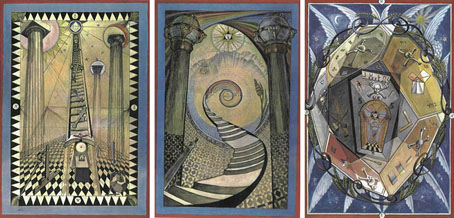
Masonic Tracing Boards.

Less familiar is her work away from the Tarot deck, some of which can be seen here. Prior to meeting Crowley, Harris was involved with Freemasonry for which she produced three designs for the Masonic teaching aids known as Tracing Boards. (See larger copies here.) I used to think these looked like outtakes from the Tarot deck but seeing them in the light of the mysterious painting above it’s evident that the Tarot style wasn’t unique to that set of cards.

harris04.jpg

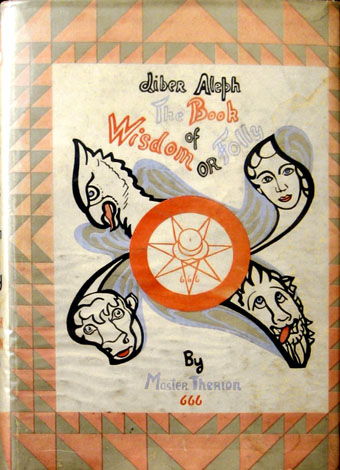
Liber Aleph vel CXI: The Book of Wisdom or Folly (1918) by Aleister Crowley.

A book cover which pre-dates the Tarot designs. The heads are the traditional embodiments of the four elements but with one change: the human figure has a feminine face rather than the usual masculine features. The same figures appear on her painting for the final Tarot Trump, The Universe (below), but in a more traditional guise.

Continue reading “The art of Frieda Harris, 1877–1962”

Konx om Pax

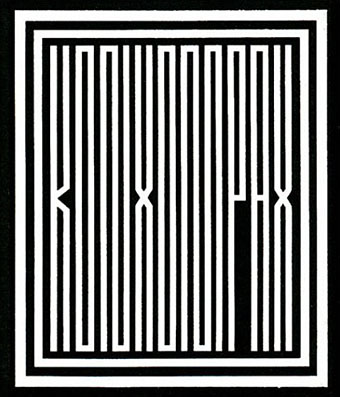
konx1.jpg

Not the musician but the book of “Essays in Light” published by Aleister Crowley in 1907. I’ve been familiar with this for years but only via the many reprints. It was only recently that I discovered the striking cover design of the first edition which, we’re told, was designed by Crowley himself during a hashish bout. I’ve not been able to find the source for this piece of information but it’s not in the chapter of his autobiography where he discusses the writing of the book. (Matters aren’t helped by Konx om Pax not being listed in the index.) If anyone has the relevant details then please leave a comment.

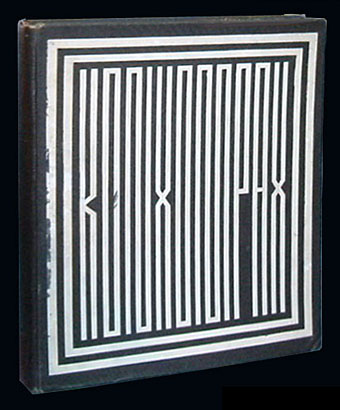
konx2.jpg

In design terms this cover might seem radical for 1907 but if Crowley did design it I’d guess he was thinking of a quite common geometric variation of Kufic script. Crowley travelled East as far as China, and had an abiding interest in languages of all kinds. Konx om Pax opens with a quote in Arabic from the Qur’an which is followed by a succession of quotes in different languages including Hebrew, Chinese, Ancient Greek, Sanskrit and hieroglyphic Egyptian.

konx3.jpg

Konx om Pax (2011) by Fredrik Söderberg.

Crowley’s lettering turns up much later in this painting by Fredrik Söderberg. The phrase was also referenced during the 1990s on many of Bill Laswell’s recordings, often by cryptic phrasing on CD stickers. The name forms part of one of the tracks on Laswell’s Axiom Ambient album from 1994, an album which includes a sample of Crowley’s voice. Also in the 1990s, Laswell was making frequent use of what MacGregor Mathers claimed was the English translation of the Egyptian origin of the phrase: “Khabs am Pekht” or “Light in extension”. One of Laswell’s many dub projects, Divination, released two compilation albums called Light In Extension, while the phrase “Khabs am Pekht” (which had me mystified for years) appears on the back of Material’s magnificent Hallucination Engine (1994). One of my favourite albums, which also includes a portion of a Crowley Tarot card in its James Koehnline artwork.

Previously on { feuilleton }
Burroughs at 100
Aleister Crowley: Wandering The Waste
Brush of Baphomet by Kenneth Anger
Rex Ingram’s The Magician
The Mysteries of Myra
Aleister Crowley on vinyl