Cosmic jokes and a cosmic conundrum

td.jpg

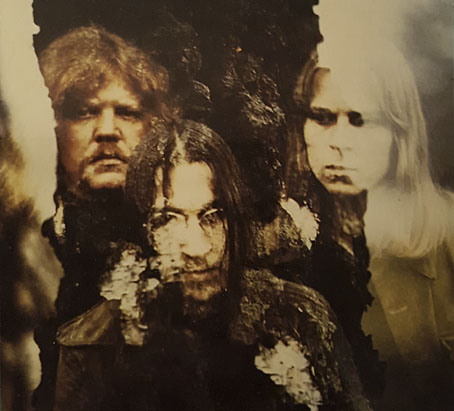
Tangerine Dream in 1973.

Here’s an item of news that will be of little interest to many readers but I’ve not seen it reported widely so it’s worth noting. (This place is nothing if not a cornucopia of deeply excavated niches, so you can take this as further niche excavation.) The news concerns recordings that Tangerine Dream made with Timothy Leary in 1973…or Leary recordings which were added to Tangerine Dream music in the same year. One problem with writing about all of this is that documentation remains elusive. Bearing this in mind, the details are as follows:

• Tangerine Dream were signed to Ohr Records from 1970 to 1973, a label for whom they recorded their first four albums plus one seven-inch single. During this time they were also featured along with label-mates Ash Ra Tempel, Popol Vuh and Klaus Schulze on an Ohr compilation, Kosmische Musik.

• “Kosmische” is the key word here. Ohr boss Rolf-Ulrich Kaiser liked the word enough to create an Ohr offshoot, Die Kosmischen Kuriere (The Cosmic Couriers), which later became the short-lived Kosmische Musik label.

• Also in the early 1970s, Timothy Leary, on the run from the US authorities, arrived in Switzerland where he and his allies (including Brian Barritt and Leary’s future wife, Joanna Harcourt-Smith) began hanging around with various members of the Swiss psychedelic avant-garde. Among the latter were writer Sergius Golowin, and a pair of artists, Walter Wegmüller and HR Giger.

• Ohr/Kosmische Kuriere/Kosmische Musik was based in Berlin, but at some point after Leary’s arrival in Switzerland R-U Kaiser and a handful of his recording artists met up with the Swiss psychonauts, an encounter that led to a series of musical collaborations: Seven Up, the third Ash Ra Tempel album which featured vocal intrusions from Leary and friends; Lord Krishna Von Goloka by Sergius Golowin, an album of Golowin readings with music by Klaus Schulze and others; and Tarot, an ambitious double-disc concept album narrated by (and credited to) Walter Wegmüller which included contributions from many of the major Ohr/Kosmische Kuriere artists. No Tangerine Dream, however.
cosmic1.jpg

Spalax CD reissues from the mid-1990s. Cover designs by Peter Geitner.

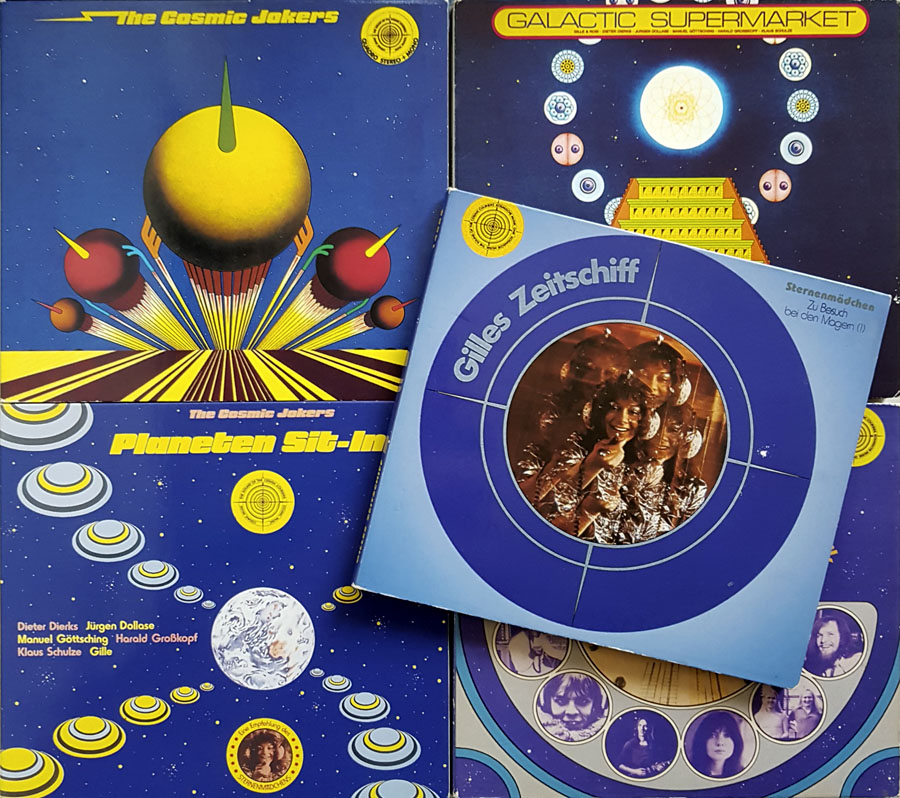
• Here’s where things get complicated. At some point while the above were being recorded, R-U Kaiser decided to release a series of “kosmische” jams by Ash Ra Tempel, Klaus Schulze and others which were credited to an imaginary group, The Cosmic Jokers. There are various reports about these sessions, with claims and counter-claims about whether or not permission was granted by the musicians. I can’t comment on the legal history (which led eventually to the collapse of Kaiser’s company) but Kaiser and his wife, Gille Letteman, appear to have been gripped by a kind of cosmic megalomania in 1974. The Cosmic Jokers album was quickly followed by four more releases in the same year: Galactic Supermarket (yet more jams by the same musicians but credited to Galactic Supermarket); Gilles Zeitschiff by Sternenmädchen (in which Gille Letteman and friends recount Timothy Leary’s flight to Switzerland and the meetings with the Cosmic Couriers); Planeten Sit-In (a quadrophonic sampler album created as a promotion for the Kosmische Musik label in conjunction with Germany’s Hobby magazine); and Sci Fi Party, an uneven compilation album which blends various Kosmische Musik recordings into a cosmic slop presided over by the label bosses who dominate the front cover.
Continue reading “Cosmic jokes and a cosmic conundrum”

Weekend links 714

agar.jpg

An Exceptional Occurrence (1950) by Eileen Agar.

• New music: The Endless Echo by Pye Corner Audio, coming soon from Ghost Box. PCA continue to fly the flag for the original Ghost Box mission of bringing various forms of weirdness to electronic music. The new album “draws inspiration from scientific and science-fictional notions about the nature of time and the idea that it may be entirely unreal”. Over at Bandcamp there’s Here by Stefano Guzzetti and Ian Hawgood.

• “Powell and Pressburger emerge from this film, more than ever, as sui generis: inventors of their own kind of film, gentleman amateurs of cinema in some ways…” Peter Bradshaw reviewing Martin Scorsese’s Made in England: The Films of Powell and Pressburger.

Velocity and Creation, a pair of short films by Vadim Sherbakov made with magnets, glitter and inks. The scores are too bombastic but I like the visuals.

Art is for increasing life. That, I believe, after all the other purposes receive their due, is really what it’s for—why we revere it, why we give our hearts to it. What do I mean by increasing life? How can we live more, given that we can’t live longer? Through attention and intensity. Being fully present to the world, and feeling without reservation: the two things that making art requires and that experiencing it involves.

William Deresiewicz on thirteen ways of looking at art

Modern Illustration is a project by illustrator Zara Picken, featuring print artefacts from her extensive personal collection.

• Mix of the week: Aquarium Drunkard presents Pulp Jazz: Twenty-First Century Groove Music. Great stuff.

• At Public Domain Review: Tales of the Catfish God: Earthquakes in Japanese Woodblock Prints.

• At The Quietus: Jonathan Meades interviews Saint Leonard. And vice versa.

• At Dennis Cooper’s: Michelangelo Antonioni Day.

• The Strange World of…Bill Laswell.

Creation (1971) by Arthur Brown’s Kingdom Come | Création Du Monde (1971) by Vangelis | Creation (1977) by Tangerine Dream

Weekend links 693

sime.jpg

Imaginary (no date) by Sidney Sime.

• Victor Rees was in touch this week to alert me to a one-off screening of The Gourmet (previously), a cult TV drama from 1986 written by Kazuo Ishiguro and directed by Michael Whyte. The screening, which will take place at Swedenborg House, London, on 16th October, is one of a series of retrospective events based around an exhibition from 1974, Albion Island Vortex, by Brian Catling and Iain Sinclair. The film, which is connected to Sinclair’s oeuvre by its use of one of the Hawksmoor churches, will be followed by a Q&A session with Sinclair and Michael Whyte. The screening is free but places are limited so prior booking is required.

• “Alongside his thieves and vagabonds, Hotten includes religious slang, public schoolboy slang, pirate slang, equine stable slang, phrases coined by Dr. Johnson, the slang of softened oaths, workmen’s slang, stagehand slang, shopkeeper’s slang, and dozens of other argots.” Hunter Dukes on A Dictionary of Modern Slang, Cant, and Vulgar Words (1860) by John Camden Hotten.

The Night Land, William Hope Hodgson’s “Dying Earth” doorstop, is republished in an abridged version as part of MIT Press’s Radium Age series, “proto–science fiction stories from the underappreciated era between 1900 and 1935”. All the reprints come with new introductions, the one for Hodgson being by Erik Davis.

• “My partner wanted me to stop buying lava lamps. It was an expensive hobby, and we were running out of room in our apartment.” Nora Claire Miller on the lure of the lava lamp. I only own a single one but I appreciate the obsessive attraction.

• Rambalac takes his roaming camera for a walk through teamLab Planets, Tokyo, a labyrinthine exhibition featuring plenty of water (and wet feet), and a moss garden filled with large silver eggs.

• At Strange Flowers: An examination of the connections between the self-mythologising Marie Corelli and her fictional counterparts in the Mapp and Lucia novels of EF Benson.

• Coming soon from Strange Attractor: Cabarets of Death, a book about the otherworldly cabarets of Montmartre by Mel Gordon, edited by Joanna Ebenstein.

• Among the new titles at Standard Ebooks, the home of free, high-quality, public-domain texts: The Secret Glory by Arthur Machen.

10 essential Japanese reggae releases selected by Kay Suzuki.

• Mix of the week: A Fact Mix by Venus Ex Machina.

Modern Art in Mid-Century Comics.

• RIP Michael Gambon.

Planet Caravan (1970) by Black Sabbath | Planet Queen (1971) by T. Rex | Oszillator Planet Concert (1971) by Tangerine Dream

Weekend links 689

cossard.jpg

Salammbô (1899) by Adolphe Cossard.

• At Unquiet Things: “A mystery that no longer exists: Wrinkle in Time cover artist revealed”. S. Elizabeth explains. I did a little research of my own into this enigma without success. Good to know that it’s been resolved.

• James Balmont’s latest guide to Japanese cinema is an examination of the transcendental oeuvre of Yasujiro Ozu.

• At Spoon & Tamago: Trains intersect with everyday life in nostalgic illustrations by Shinjiro Ogawa.

• DJ Food discovered a set of Zodiac posters by Bruce Krefting from 1969.

• At Wormwoodiana: John Howard on looking for misplaced Machens.

• At Vinyl Factory: Discovering Mort Garson with Hilary Wood.

• At Dennis Cooper’s: More Ozu in Yasujiro Ozu Day.

• New music: Multizonal Mindscramble by Polypores.

• Mix of the week is a mix for The Wire by Aho Ssan.

• Ioneye in conversation with Bill Laswell.

Train Song (1969) by Pentangle | Love On A Real Train (1984) by Tangerine Dream | Tokyosaka Train (2002) by Funki Porcini

Weekend links 663

wt.jpg

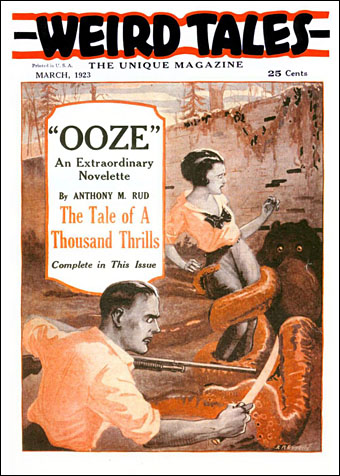
Weird Tales celebrates its centenary this month (although the first issue was on the shelves in February, 1923). Thirty years later, one of the last issues from the initial run had Slime by Joseph Payne Brennan as the story featured on its cover. The magazine maintained a viscous consistency if nothing else. Tentacular art by RR Epperly.

• A big surprise in yesterday’s Bandcamp Friday was the announcement of Singularity, a new album by synth ensemble Node. Or new-ish since the previously unreleased recording is almost 30 years old:

Singularity is the legendary “lost” Node album. Recorded at the same time as their original sessions in 1994 this has DiN stalwart Dave Bessell join Buller & Flood alongside original member Gary Stout who was later replaced by Mel Wesson for the two DiN releases. Presented here for the first time, mastered to modern standards but otherwise untouched and in its original form and recorded to two track with no overdubs.

Node have never been very prolific—two decades separate their first album from their second—so this was very welcome. The new release includes a bonus addition of the 16-minute version of Terminus, one of their best pieces which has only been available previously on a scarce CD-single.

• Steven Watson at Print Mag on skeuomorphic magazine design that turns print into play. Now I want to design a book that fits inside a cassette box.

• RIP jazz giant Wayne Shorter, and David Lindley, co-founder of one of my favourite psychedelic groups, the incredible Kaleidoscope.

• S. Elizabeth at Unquiet Things on The Sensitive Plant, a poem by Percy Shelley illustrated by Charles Robinson.

• Christopher Parker at Smithsonian Magazine asks “Did Salvador Dalí paint this enigmatic artwork?” Yes, he did.

Tangerine Dream in 1973 playing Atem live (with pre-recorded drums) on Spotlight, an Austrian TV show.

• New music: Mohanam by Shakti, and Area Code 601 by William Tyler & The Impossible Truth.

• At Spoon & Tamago: Bento boxes inspired by notable Japanese architecture.

• At Tentaclii: Ian Miller cover art for metal albums.

Northern lights seen across the UK.

New Blue Ooze (1970) by Kaleidoscope | Ooze Out And Away, Onehow (1986) by Harold Budd/Simon Raymonde/Robin Guthrie/Elizabeth Fraser | Ooze (1986) by 23 Skidoo