Weekend links 813

bruenchenhein.jpg

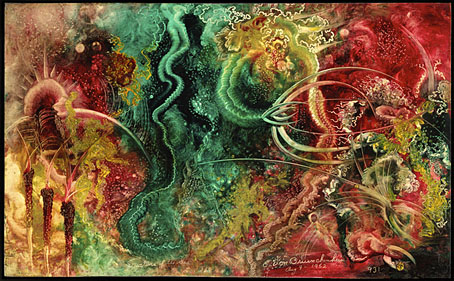
Dwellers of the Sea (1962) by Eugene Von Bruenchenhein.

• Among the new titles at Standard Ebooks, the home of free, high-quality, public-domain texts: Conan Stories by Robert E. Howard.

• At Colossal: “Uncanny personalities appear from nature in Malene Hartmann Rasmussen’s ceramics.”

• New music: Glory Black by Sunn O))); Through Lands Of Ghosts by Foster Neville; Sirenoscape by NIMF.

If we insist that art functions as a tool for promoting a limited set of political principles, what happens when an ideology that doesn’t share our values sweeps into power? Learning to engage with complexity is a necessary skill if we are ever to drag ourselves out of the puerile swamp of the culture wars. But if we continue to reduce art to moralistic soundbites, we will only succeed in stripping it of its capacity to transform us, which would be a huge loss. Art can help us to better understand ourselves, and the world we live in, by expressing those things that words cannot. It exposes us to a vast range of experiences, and asks us to sit with the fundamental ambivalences, moral complexities and conflicting emotions that are a part and parcel of being human.

Rosanna McLaughlin on attempts to make art of the past reflect the moral platitudes of the present

Strange Attractor is having a winter sale with 30% off all its available titles.

• At the BFI: Miriam Balanescu selects 10 great filmmaker biopics.

• Mix of the week: DreamScenes – January 2026 at Ambientblog.

• The Strange World of…Free Jazz & Improvised Music.

Free (1991) by Mazzy Star | The Free Design (1999) by Stereolab | Everything Is Free (2001) by Gillian Welch

Weekend links 639

alphaville.jpg

Japanese poster for Alphaville (1965).

Peter Bogdanovich: I think we’d better have your thoughts on Godard.

Orson Welles: Well, since you’re so very firm about it. He’s the definitive influence if not really the first film artist of this last decade, and his gifts as a director are enormous. I just can’t take him very seriously as a thinker—and that’s where we seem to differ, because he does. His message is what he cares about these days, and, like most movie messages, it could be written on the head of a pin. But what’s so admirable about him is his marvellous contempt for the machinery of movies and even movies themselves—a kind of anarchistic, nihilistic contempt for the medium—which, when he’s at his best and most vigorous, is very exciting.

• RIP JLG. I was watching Alphaville again just two weeks ago after a DVD turned up in the local charity shop. Still the only Godard film I like 100% but “liking” seems beside the point. His influence today is everywhere, so fully absorbed into the language of cinema that people barely notice it.

• “The things that cause my gaze to linger are usually the portraits or landscapes that spark a feeling of unease, disquiet and discomfort. A shadow amongst the summer trees, a lurking silhouette reflected in a perfect blue iris, a vibrant flower in the early stages of decay.” S. Elizabeth talking to Beautiful Bizarre about her new book, The Art of Darkness: A Treasury of the Morbid, Melancholic and Macabre.

• Allow John Waters (again) to dictate your film viewing with a Letterboxd list of his favourite films, based on comments in his writings and interviews. On the subject of Godard, Waters’ Crackpot book contains a whole chapter about Hail Mary.

• Astor’s Electrical Future: Iwan Rhys Morus explores a vision of the year 2000 recounted in A Journey in Other Worlds (1894), a “scientific romance” by John Jacob Astor IV, with illustrations by Daniel Carter Beard.

• Strange Attractor has announced a Kickstarter campaign to fund the publication of an Austin Osman Spare Tarot deck.

• At Wormwoodiana: The Parrot, the Unicorn and the Golden Dragon: Some 17th Century Booksellers’ Signs.

• At Bandcamp: Andy Thomas on Chris Watson‘s post-Cabaret Voltaire career in nature recordings.

• A new outlet for cinematic obscurities: Radiance Films.

Alphaville (1978) by Klaus Schulze | Alphaville (1979) by The Monochrome Set | Alphaville (1999) by Scanner

Weekend links 638

feherlofia.jpg

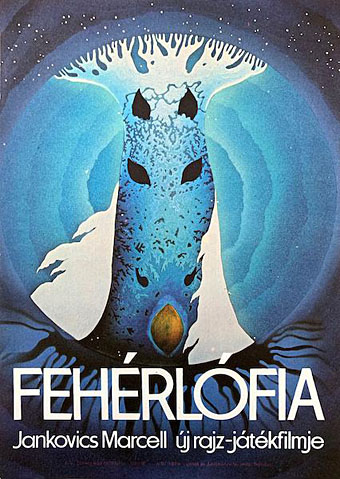
• After writing about Hungarian animator Marcell Jankovics back in January, I left a comment expressing the hope that Arrow or Eureka might give us a Region B blu-ray of Son of the White Mare (aka Fehérlófia), Jankovics’s “psychedelic” animated feature from 1982. Fast-forward nine months to Eureka’s announcement that they’ll be doing exactly this in November. Watch the trailer. The release will include some of the director’s short films plus his first feature, Johnny Corncob (1973), a historical tale presented in the “groovy” style (previously) popularised by Yellow Submarine. If idle wishes can be granted so easily then I’ll hope again that Eureka might do the same for René Laloux’s second and third animated features, the Moebius-designed Time Masters (1982) (made in the same studio as Son of the White Mare) and the Caza-designed Gandahar (1987). Fingers crossed.

• “I don’t think anybody copies me, but Harmony Korine, Todd Solondz, Bruno Dumont, Gaspar Noé, I like those kinds of directors. They’re sometimes not funny at all. They’re very serious and eerily melodramatic. I just like movies that surprise me.” John Waters (yet again) talking to Conor Williams about films, writing and a prayer for Pasolini.

• “There is something profoundly haunting about a master artist’s last painting left unfinished upon its easel…” Kevin Dann on The Mermaid (1910) by Howard Pyle.

• At Bandcamp: Navigating the Nurse With Wound List: A Gateway to Far-Flung Sounds.

• “Juicy With Meaning”: Alex Denney chooses five essential films by David Cronenberg.

• Mix of the week: Discovering 1970s jazz fusion with Kerri Chandler.

• Coming soon from Strange Attractor: Purgatory by Ken Hollings.

• Steven Heller’s font(s) of the month: Farandole & Lustik.

Dennis Cooper’s favourite albums.

• RIP Peter Straub.

White Horses (1968) by Jacky | Five White Horses (1968) by Sun Dragon | Ride A White Horse (2006) by Goldfrapp

Weekend links 637

wong.jpg

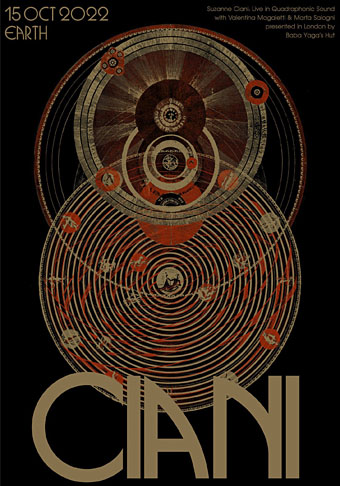
A Risograph print by Raimund Wong for a forthcoming London concert by Suzanne Ciani. Via.

• “What makes him such an exemplary film composer is the adroitness with which he used style as a catalyst, conspiring with directors to illuminate crucial elements of character, tone, and plot through the expressive resources at his disposal.” Nate Chinen on Henry Mancini, a timely piece since I’ve been watching a lot of film noir recently, including two of the features mentioned there, Touch of Evil and Experiment in Terror. The latter is an uncharacteristic thriller from Blake Edwards with a marvellous, brooding score by Mancini. Here’s the main theme.

• “Infinitesimal as they are, phytoplankton produce more oxygen than all the world’s rainforests combined and roughly half of the oxygen on the planet—in other words, roughly half of the air we humans breathe.” David Greer on the importance of plankton.

• “Someday I’ll come into a place and someone’s playing my music and I’ll leave immediately because I don’t want to go through the editorial process again!” Diamanda Galás talking to Kevin Mccaighy about her new album, Broken Gargoyles.

• At Dennis Cooper’s: 25 experimental horror films. Not sure I’d class Night of the Lepus as “experimental”—”rubbish” would be more accurate—but you may disagree.

• Coming soon from Strange Attractor: 69 Exhibition Road: Twelve True-Life Tales from the Fag End of Punk, Porn & Performance by Dorothy Max Prior.

• At Spoon & Tamago: Gunkanjima (aka Battleship Island) from above: exploring what was once the world’s most-densely populated city.

• Previews of pages from A Tiger in the Land of Dreams by Tiger Tateishi, newly reprinted by 50 Watts Books.

• Mix of the week: A mix for The Wire by Ali Safi of the Marionette label.

• New music: Verde Pino by Beautify Junkyards.

Mark Pawson & Disinfotainment

Tiger Rag (1929) by Duke Ellington And His Orchestra | Night Of The Tiger (1959) by The Markko Polo Adventurers | Tiger (1967) by Brian Auger & The Trinity

Weekend links 635

bubble.jpg

A close-up image of the surface of a soap bubble. The image reveals ‘lipid islands’ of soap floating on a very thin film of water. The film on which the soap floats is so thin that it does not interfere with the light hitting it, therefore allowing the light to pass through. This creates an appearance of a black abyss. Magnification x250.”

• Coming soon from Strange Attractor Press: Everything Keeps Dissolving, Conversations with Coil edited by Nick Soulsby. I helped out a little with this one so I’m looking forward to seeing it. And since the cult fervour around the group remains undiminished, anyone interested in buying a copy is advised to do so sooner rather than later.

• There are over 90 stories in The Complete Short Stories of JG Ballard (quantities vary according to edition) but few of them have been adapted into other media. The Drowned Giant is an exception, an animated short directed by Tim Miller.

• “You could spend your life exploring its dream logic without arriving at a definitive destination.” Anne Billson on the mysteries of Lucile Hadžihalilović’s Earwig.

• Meta-mix of the week: links to yearly mixes of favourite ambient releases by A Strangely Isolated Place.

• At Spoon & Tamago: Matchstick cookies keep the flame of tradition alive.

• At Dennis Cooper’s: George A. Romero Day.

Felicia Atkinson’s favourite music.

• RIP Wolfgang Petersen.

Das Boot: Titel (1981) by Klaus Doldinger | Martin (1983) by Soft Cell | Everything Keeps Dissolving (2000) by Coil