Dune designs

dune01.jpg

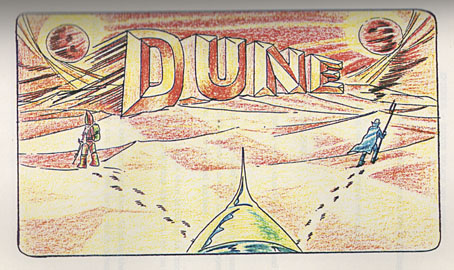
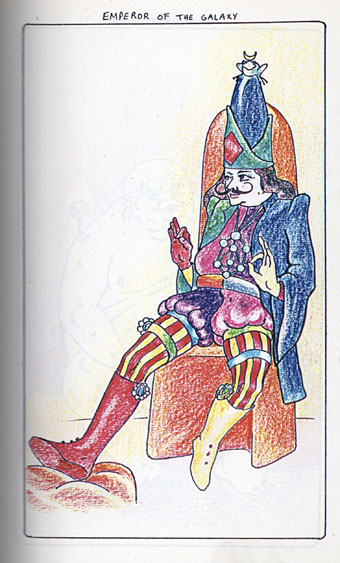
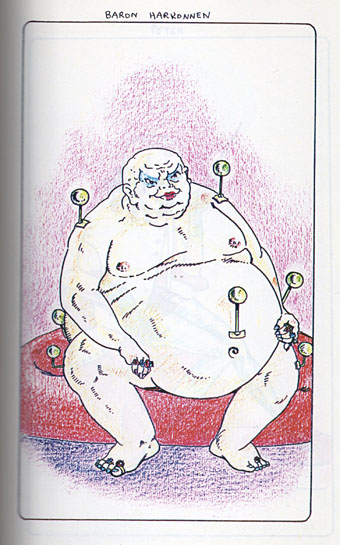
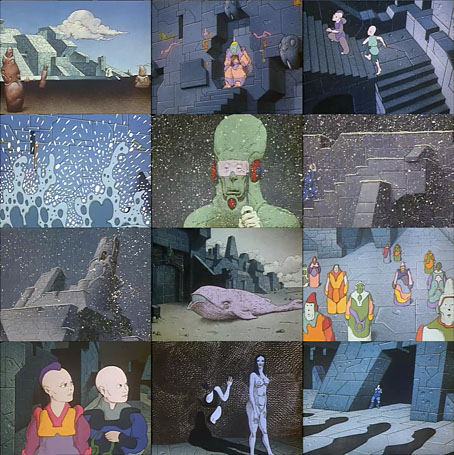
Currently racking up the bids at eBay (again) is an early draft of Alejandro Jodorowsky’s script for his ill-fated film of Dune. Aside from some diverting glimpses of dialogue and plot elaboration, what’s most interesting about the draft is the character and scene sketches, some of which are sampled below. I’ve still not seen the documentary about the unmade film so I can’t say whether any of these have appeared in public before but if they have they’re new to me. No artist is credited but the naive style rules out both Moebius and HR Giger (who arrived late to the project in any case). Best bet is either Jodorowsky himself—in 1967 he was writing and illustrating a comic strip, Fabulas Panicas—or Jodorowsky’s colleague from the Panic Movement days, Roland Topor. In the early 70s Topor was working with René Laloux on the animated SF film Fantastic Planet.
dune02.jpg

Many of the conceptions differ radically from the more graceful designs that Moebius produced later on. Also of note are details such as the anal entrance to the Emperor’s throne room, a Harkonnen orgy and an insemination scene viewed from inside Jessica’s vagina. By the time Giger joined the production team the instruction was not to create anything too erotic or adult since the film needed to reach a large audience.

There’s more from the Dune script (and larger copies of these images) here. (Thanks to Jay for the tip!)
dune03.jpg

Continue reading “Dune designs”

The Captive, a film by René Laloux

captive.jpg

The feature films of French animator René Laloux are the closest thing to cinematic equivalents of comics magazine Métal Hurlant. Laloux’s collaboration with Roland Topor, Fantastic Planet (1973), is familiar to Anglophone audiences but fewer people are aware of Time Masters (1982) and Gandahar (1988), two more science fiction films made with Moebius and Philippe Caza respectively. Time Masters looks marvellous but the story (based on a novel by Stefan Wul) lacks the strangeness of Fantastic Planet. Gandahar,  based on a novel by Jean-Pierre Andrevon, I’ve yet to see but anyone searching for it should be aware that the version dubbed into English (and retitled The Light Years) dumped Gabriel Yared’s score, and had a sexual encounter censored by the usual rabble of prudish American producers.

The Captive (1988) continues the collaboration with Philippe Caza being a 7-minute adaptation of Caza’s comic story Equinoxe (1982). The music for this one is also by Gabriel Yared, and this copy at YouTube includes English subtitles. For comparison, the comic story is here. Of the two I prefer the comic but then I’ve always enjoyed Caza’s work.

Previously on { feuilleton }
Les Temps Morts by René Laloux

Weekend links 214

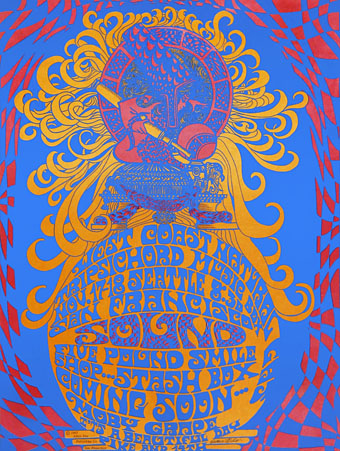
/sfsound.jpg

San Francisco Sound (1967). Art by Wallace Studio, Seattle.

• RIP gay porn pioneer Peter de Rome. BUTT posted de Rome’s surprisingly daring Underground (1972), a film in which two men have an unfaked sexual encounter on a New York subway train. That film and others are available on the BFI’s DVD collection. Related: Brian Robinson remembers a director of films whose supporters included Andy Warhol, William Burroughs and John Gielgud.

• “My stuff is implicitly critical of television as it is now,” explains Jonathan [Meades], “Television used not to be as openly moronic as it has become…” A lengthy and typically pugnacious Meades interview with Remy Dean.

Thurston Moore remembers the Burroughs-themed Nova Convention staged in New York in 1978. William Burroughs 100—Nova Convention is a retrospective exhibition running at Red Gallery, London, next month.

How are we expected to take seriously…any work which appears to have engaged less than the whole passionate attention of its author? To be fobbed off, at the last, with something which we feel to be less true than the author knew it to be, challenges the importance of the whole art of writing, and instead of enlarging the bounds of our experience, it leaves them where they are.

Katherine Mansfield was also a book reviewer.

• JG Ballard’s Crash is reissued in August by Fourth Estate with an introduction by Zadie Smith. There’s a tantalising extract from the intro at the NYRB or you can read the whole thing if you’re a subscriber.

• “Between 1959 & 1980 Shirley Collins changed the course of folk music in England & America. Thirty years after disappearing, she’s back.”

Photos by Anne Billson of one of the more attractive Parisian arcades. Related (in a flâneur sense): Christina Scholz‘s Vancouver dérive.

• “Why did Borges hate soccer?” asks Shaj Matthew. Related: George Orwell on the same subject.

• Mixes of the week: FACT mix 447 by Forest Swords, and Programme 13 from Radio Belbury.

• At Dangerous Minds: Roland Topor’s cheerfully violent illustrations from Les Masochistes.

• Rainy Day Psychedelia: Ben Marks on Seattle’s neglected 1960s poster scene.

• Strange Flowers looks at Oskar Schlemmer‘s Triadic Ballet designs.

• A Journey to Avebury: Stewart Lee interviews Julian Cope.

It’s All Over Now (1963) by The Valentinos featuring Bobby Womack | It’s All Over Now (1964) by The Rolling Stones | It’s All Over Now (1974) by Ry Cooder

Polanski details

polanski01.jpg

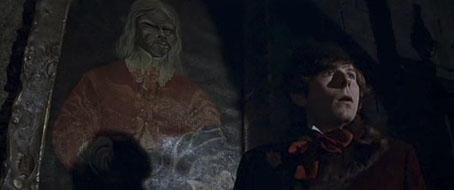
Roman Polanski as Alfred in Dance of the Vampires (1967).

I’ve always admired the attention to detail in Roman Polanski’s films, a quality evident not only in his careful adaptations but also in areas that lesser filmmakers might ignore. Dance of the Vampires (1967) is a good example (sorry, I refuse to call it by the title MGM used for its edited US release): the sets and decor are remarkable, and the editing and camera work so skilfully blends studio constructions with location shots that for years I was convinced the film was made in a genuine European castle. The atmosphere is so carefully sustained that I found the whole thing as terrifying on first viewing as any Hammer film, despite the broad humour. In the set-piece moments Polanski (and soundtrack composer Krzysztof Komeda) put many of the later Hammer vampire films to shame.


The Vampire Portraits

polanski02.jpg

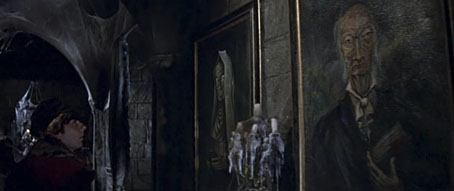
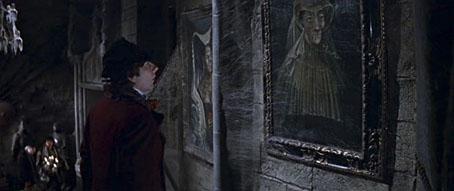
The production design and art direction for Dance of the Vampires was created by Wilfred Shingleton and Fred Carter, both of whom later worked on Polanski’s Macbeth, and who fill the rooms with mouldering furnishings and rotting decoration. One striking sequence concerns a walk through a gallery of vampire portraits that are the creepiest paintings seen on film since Ivan Albright’s portrait of a decrepit Dorian Gray. Film credits in the 1960s were sparse so there’s no indication of the artist responsible. However, one portrait glimpsed at the end of the gallery (below) is a copy of the “Ugly Duchess” painting by Quinten Matsys.

polanski03.jpg


Rosemary’s Book

polanski04.jpg

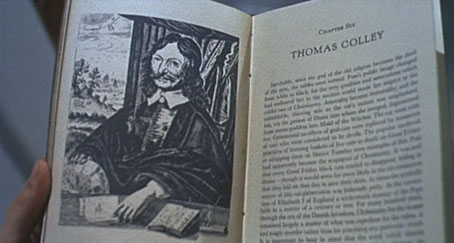
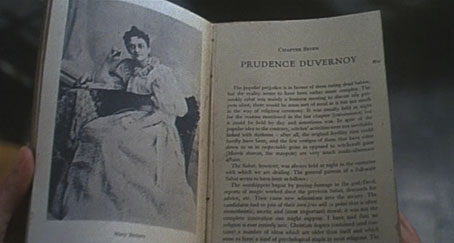
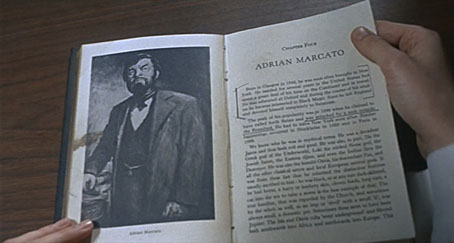
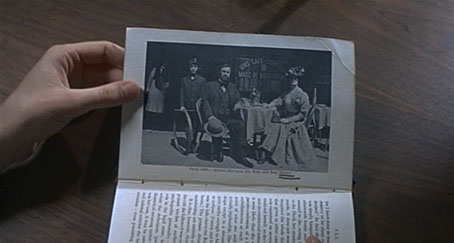
A sign that filmmakers care about detail is when they make their fictional books look like the genuine article. The history of witchcraft in Rosemary’s Baby (1968) could easily have been glimpsed very briefly but Polanski shows Rosemary leafing through its pages in a sequence of Hitchcock-like view-reaction-view shots that make it appear as convincing as possible. The shots also make the viewer examine the book through Rosemary’s eyes, something Polanski does throughout the film.

polanski05.jpg

polanski06.jpg

polanski07.jpg


Trelkovsky’s Paintings

polanski09.jpg

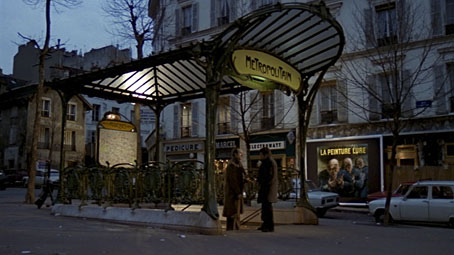
The Tenant (1976) is Polanski’s third study of apartment-dwelling paranoia, a superb adaptation of Roland Topor’s novel, Le Locataire chimérique (1964). The screenplay removes some of Topor’s ambiguity—and the film is spoiled by unsympathetic dubbing of the French actors—but in every other respect it’s as good as Repulsion for its portrait of an isolated individual (here portrayed by Polanski himself) surrendering to madness.

polanski10.jpg

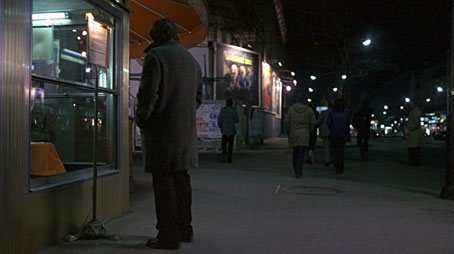
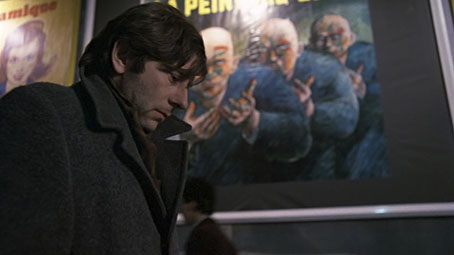
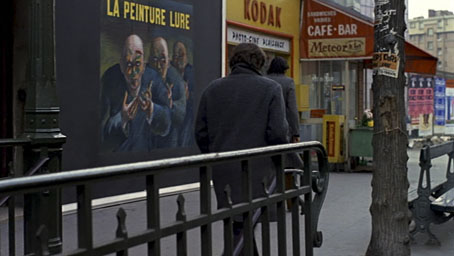
Among the many visual details which add to the unease is the appearance halfway through the film of billboards advertising…what? A painting exhibition? Or something more sinister? We never find out. The presence of these figures and their slogan—”La Peinture Lure”—remains as cryptic as many of the other unresolved questions which prey upon the beleaguered Trelkovsky.

polanski11.jpg

polanski12.jpg


Corso’s Postcard

polanski13.jpg

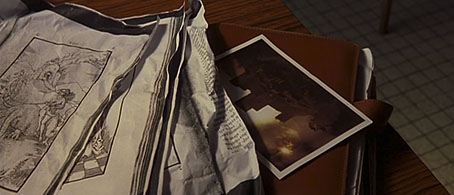
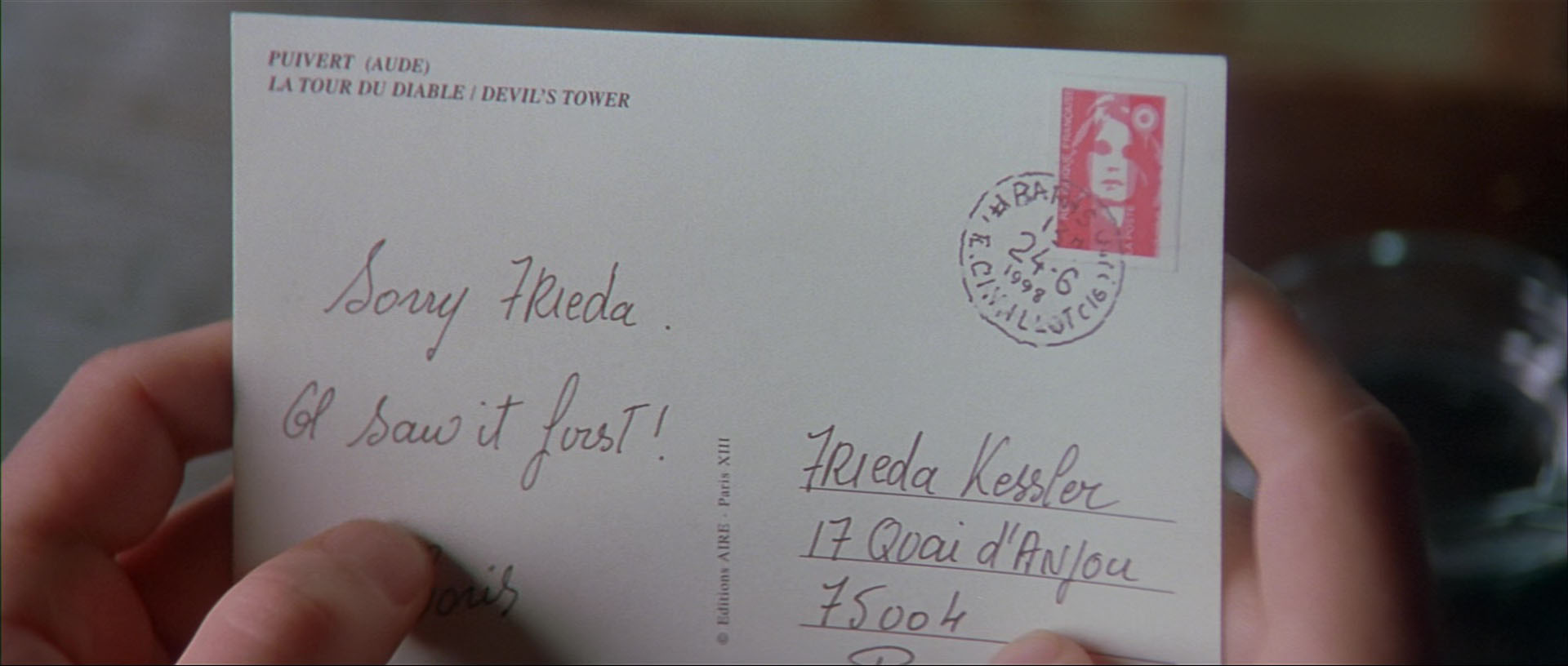
I’m in the minority of people who like The Ninth Gate (1999) a great deal even though it takes some liberties with Arturo Pérez-Reverte’s wonderful novel The Dumas Club. Once again, the bibliographic details are perfectly done, a crucial matter in a film about the antiquarian book trade. Near the end of the film Dean Corso (played by Johnny Depp) finds a postcard that leads him to the final location. On the back of the card there’s a blink-and-you-miss-it detail. Polanski’s wife, Emmanuelle Seigner, plays the mysterious and nameless woman who follows Corso throughout the film. By this point we already know she possesses occult powers so it’s not really surprising to see her face in the postage stamp, something that Corso doesn’t seem to notice.

polanski14.jpg

Previously on { feuilleton }
Repulsion posters
Atalanta Fugiens
Le Grand Macabre
Les Temps Morts by René Laloux
The writhing on the wall

Les Jeux des Anges by Walerian Borowczyk

jeux1.jpg

Les Jeux des Anges.

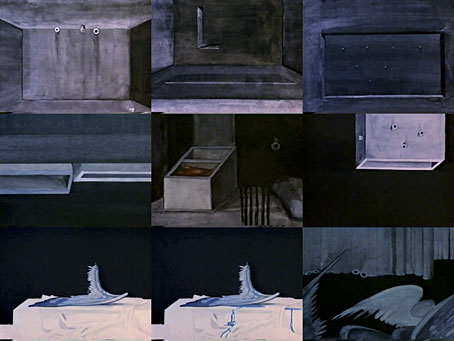
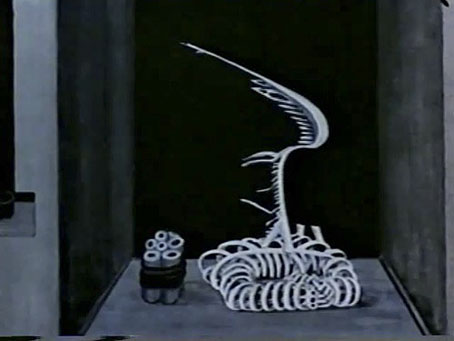
Following yesterday’s post, we can be certain that Terry Gilliam had seen Les Jeux des Anges (1964) because in 2001 he included it in a list of ten favourite animated films. Jan Lenica co-directed Dom (1959) with Walerian Borowczyk but doesn’t work on this film which is the darkest and strangest of all Borowczyk’s works I’ve seen to date. Once again there’s some unavoidable subtext, although whether that applies to the Holocaust or to Stalinist repression is for the viewer to decide. What we see is a series of painted tableaux in which various mechanical processes are butchering angels. The atmosphere isn’t far removed from the cruelties of Roland Topor while the painted scenes are very similar to those that David Lynch would be animating a couple of years later. The soundtrack is credited to electronic composer Bernard Parmegiani. Watch it for yourself here.

jeux2.jpg

Previously on { feuilleton }
Labirynt by Jan Lenica
Les Temps Morts by René Laloux
Short films by Walerian Borowczyk