Weekend links 794

views.jpg

Green Castle (1975) by Roger Dean.

• Roger Dean’s first book, Views, was published 50 years ago this month. The book sold 60,000 copies in its initial run, and was reprinted twice the following year. This extraordinary success gave Dean and his associates at the newly-formed Dragon’s Dream the resources to publish a line of art books by other imaginative artists such as Chris Foss, Ian Miller and Syd Mead. Without Views there wouldn’t have been a Dragon’s Dream, and without Dragon’s Dream there wouldn’t have been Paper Tiger, a publishing house launched by Roger Dean, Martyn Dean and Hubert Schaafsma in 1976. All this activity made a huge impression on me at the time, with books that provided a showcase for artists whose work would otherwise only be seen on the covers of paperbacks or vinyl records.

• At Alan Moore World: 3 novels and The Great When, an extract from a new video interview in which Alan talks about three of the books that have influenced his novels.

• At the BFI: “Dead of Night: 80 years on, Ealing’s anthology horror is still a waking nightmare,” says Edward Parnell.

…Drexler’s vision of nanotechnology was a chimera. It was like the philosophers’ stone of the alchemists: magic dressed in the science of its time, by means of which almost anything becomes possible. I call these oneiric technologies: they do not and quite probably cannot exist, but they fulfil a deep-rooted dream, or a nightmare, or both.

These are not simply technologies of the future that we don’t yet have the means to realise, like the super-advanced technologies that Arthur C Clarke said we would be unable to distinguish from magic. Rather, oneiric technology takes a wish (or a terror) and clothes it in what looks like scientific raiment so that the uninitiated onlooker, and perhaps the dreamer, can no longer tell it apart from what is genuinely on the verge of the possible. Perpetual motion is one of the oldest oneiric technologies, although only since the 19th century have we known why it won’t work (this knowledge doesn’t discourage modern attempts, for example by allegedly exploiting the ‘quantum vacuum’); anti-gravity shielding is probably another.

Philip Ball on unrealistic prognostications in science, from nanotechnology to artificial intelligence

• New music: Rún by Rún; Other Sides Of Nowhere by Underwater Sleep Orchestra; I Believe In You by Ladytron.

• At Dennis Cooper’s it’s Curtis Harrington‘s Day.

• Steven Heller’s font of the month is Ritualist.

A View From Her Room (1982) by Weekend | A Private View (1982) by Bill Nelson | Aerial View (2014) by Jon Hassell
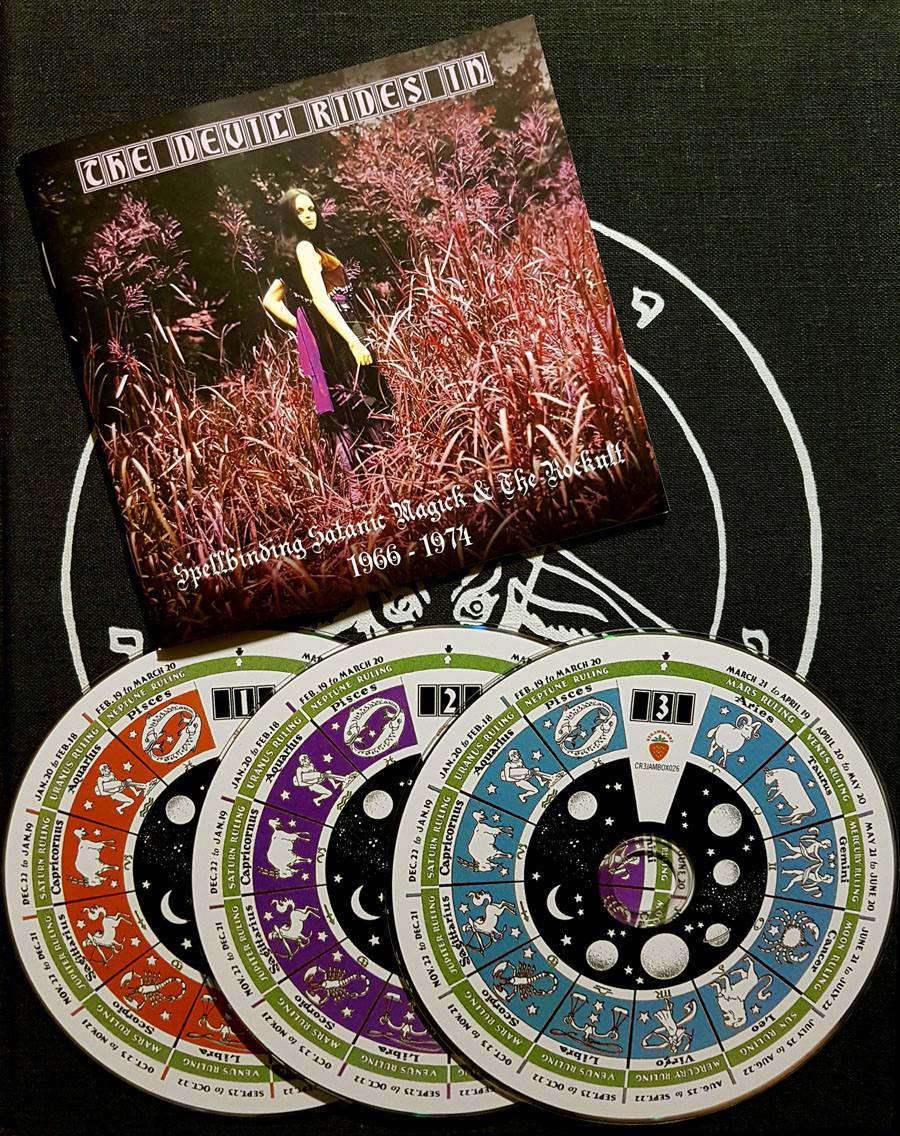
Occult rock: The Devil Rides In

devil.jpg

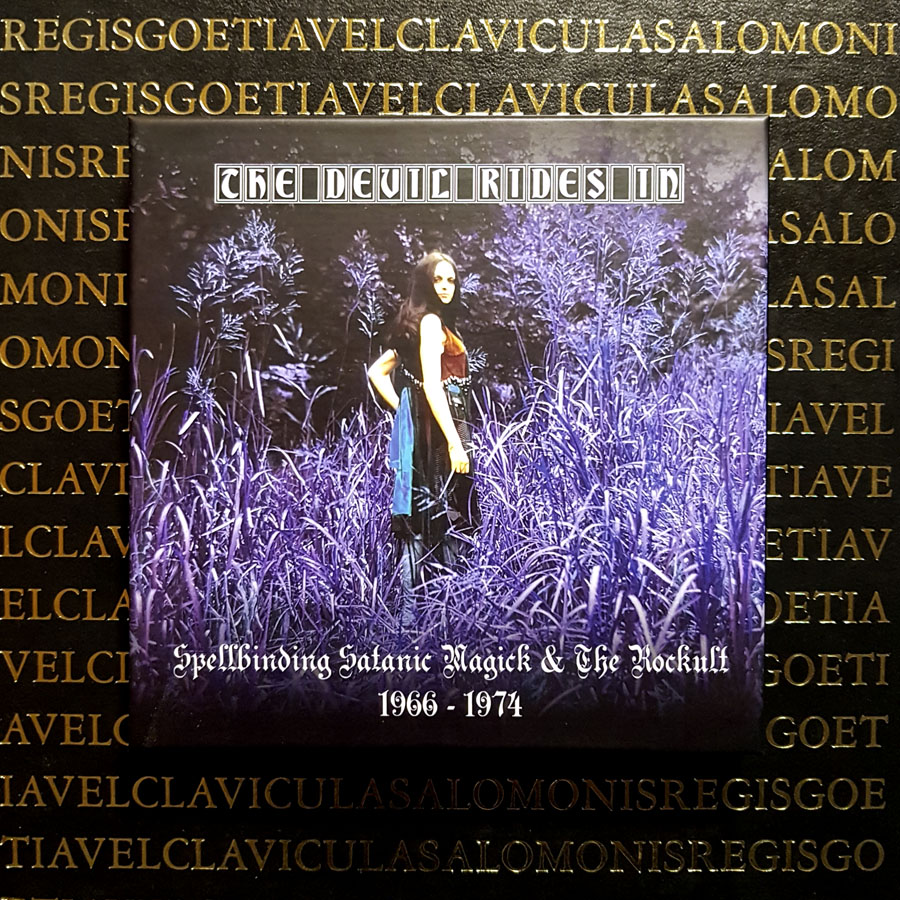
The Devil rode in at the weekend on three shiny compact discs crammed with Satanic psychedelia and the pentagram-branded rock music of the early 1970s: 55 tracks in all. I’d been hoping for some time that an enterprising anthologist might put together an officially-sanctioned collection like the series of mixes compiled by The Ghost of the Weed Garden. Cherry Red Records are ideal candidates for the task, having distinguished themselves in recent years with a series of multi-disc compilations that mine specific periods of British music: psychedelia, heavy rock, folk, punk, reggae, post-punk, experimental electronics, electro-pop, and so on. The Devil Rides In bears a subtitle that ties the collection to the prime years of the Occult Revival, “Spellbinding Satanic Magick & The Rockult 1966–1974”, a period when the Aquarian transcendence of the hippy world was jostling with darker trends in the media landscape. 1967 was the year the Beatles put Aleister Crowley on the cover of the Sgt Pepper album; it was also the year that Hammer were filming their first Dennis Wheatley adaptation, The Devil Rides Out. The song of the same name by Icarus appears on the second disc of this compilation, a single intended to capitalise on the publicity generated by the film. For all the serious occult interest that flourished during by this period many of the cultural associations were frivolous or superficial ones, either cash-ins like the Icarus single or exploitations by those who followed in Dennis Wheatley’s wake. Serious occultists no doubt abhorred the exploitation but it helped create a market for Man, Myth and Magic magazine, and for all the reprints of grimoires and other magical texts that were appearing in paperback for the first time. I’ve always enjoyed the frivolous side of the Occult Revival, probably because I grew up surrounded by it. Without Ace of Wands and Catweazle on the TV I might not have been so interested in my mother’s small collection of occult paperbacks, or gravitated eventually to the Religion and Spirituality shelves of the local library.

devil2.jpg

The Devil Rides In was conceived, designed and annotated by Martin Callomon, working here under the “Cally” pseudonym he uses for many of his activities. The accompanying booklet is evidence of a labour of love, the detailed notes being illustrated throughout with Occult Revival ephemera: film posters and magazines (the inevitable Man, Myth & Magic), also plenty of paperback covers which tend towards the lurid and exploitational end of the magical spectrum (the inevitable Dennis Wheatley). Cherry Red always take care with their sleeve notes but Cally’s booklet design has gone to considerable lengths to track down many obscure book covers, some of which I’d not seen before. The same diligence applies to the music, with the proviso that compilations are often restrained by the hazards of licensing law. There’s a track list on the Cherry Red page but this doesn’t tell you that the collection is divided into eight themed sections:

1) Buried Underground
2) Phantom Sabbaths
3) Popular Satanism
4) She Devils
5) Folk Devils
6) Evil Jazz
7) Beelzefunk
8) Let’s All Chant

Many of the selections on the first disc are the kinds of songs I’d usually avoid outside this collection, the lumbering heavy rock that filled the Vertigo catalogue for the first half of the 1970s. But groups that you wouldn’t want to hear at album length become palatable when placed in a context such as this.

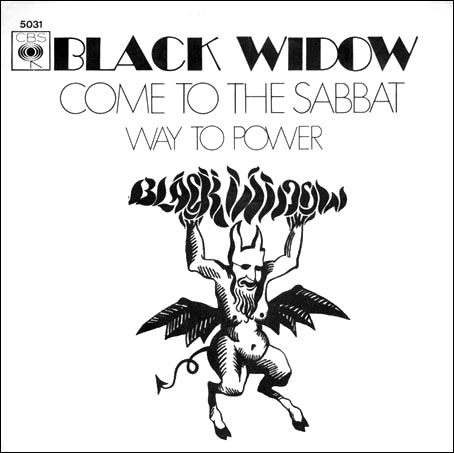
blackwidow.jpg

Among the immediate highlights I’d pick Race With The Devil by The Gun, already a favourite of mine by the group that launched Roger Dean’s career as a cover artist; Black Mass by Jason Crest, a psychedelic B-side whose subject matter and high-pitched wailing is a precursor of the heavy-metal future; and the perennially popular Come To The Sabbat by Black Widow. A few of the selections have been chosen more for their name than anything else, something I’m okay with so long as the choices are good ones. Cozy Powell’s Dance With The Devil, for example, is a drum-led instrumental with a musical theme swiped from Jimi Hendrix; it has nothing at all to do with the Devil but it’s still a great piece of music which was also a surprise UK chart hit in 1973. More of a reach is Magic Potion by The Open Mind, a song about psychedelic drugs not witches’ brews. I included this one on one of my psychedelic mixes so I can tolerate its presence here. Less tolerable is Long Black Magic Night by Jacula, an Italian prog band whose contribution features Vittoria Lo Turco as “Fiamma Dallo Spirito” stuck in one channel of the stereo mix where she intones monotonously in very poor English; the cumulative effect is diabolical in the wrong way. And I would have prefered Julie Driscoll’s long, slow version of Season Of The Witch instead of Sandie Shaw squeaking her way through Sympathy For The Devil. But you can’t always get what you want, as Mick Jagger reminds us elsewhere, something which is especially true of compilation albums.

Continue reading “Occult rock: The Devil Rides In”

Eco Del Universo

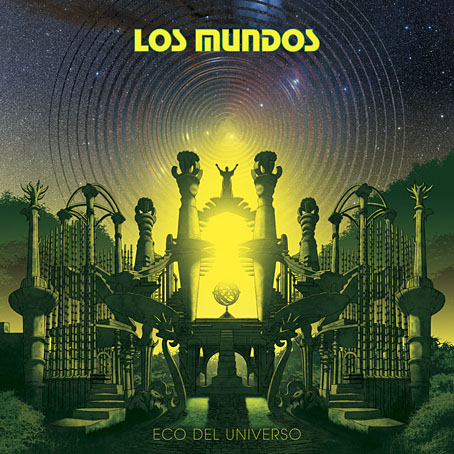
edu1.jpg

Eco Del Universo, the ninth album by Mexican band Los Mundos, was released last month on Acid Test Recordings. I designed and illustrated the outer and inner sleeves for an album whose music is described on the group’s Bandcamp page as psychedelic rock. I’ve not seen a physical copy yet but the vinyl disc is available in two pressings that complement the colours of the cover.

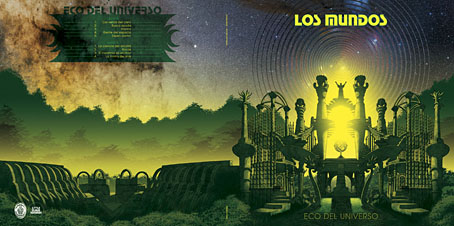
edu2.jpg

The brief for this one was for something based on the concrete fantasia known as Las Pozas, an overgrown park with accompanying hotel that Edward James spent many years and a great deal of money building in the Mexican jungle. James was a British aristocrat who fell for Surrealism in a big way in the 1930s, using his inherited wealth to support artists such as Salvador Dalí, René Magritte and Leonora Carrington, while creating Surrealist-styled homes for himself, first at Monkton House in West Sussex then at Xilitla in Mexico. James and his jungle resort have been recurrent subjects here so I didn’t need much encouragement to create something based on his constructions. In the past I’ve described Las Pozas as unfinished but this suggests a scheme with a final goal in mind. I don’t think this was ever James’s intention. His creations are more like very large concrete sculptures rather than architecture, even though some of them have a recognisable architectural form. Finished or not, the structures are a unique hybrid of the purposeless architectural folly—a popular indulgence for British landowners of the 18th and 19th centuries—and caprices like the Palais Idéal of Ferdinand Cheval.

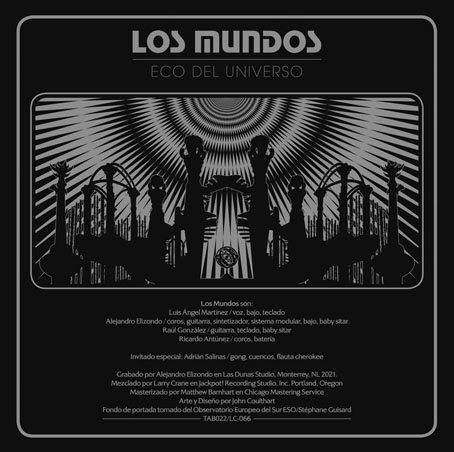
edu3.jpg

My cover art is a fantasy on the fantasy which makes James’s improvisations look a little more planned than they are by mirroring their disposition. I also crowded together several of the constructions which at Las Pozas are in separate areas of the complex. Looking at the artwork again I’m reminded of some of Roger Dean’s views which wasn’t my intention originally. I think it’s the combination of unusual architecture, layered foliage and the treatment of light and shade. If the structures weren’t outlined and the sky was a Dean-like gradient there’d be even more of a similarity. The beautiful stellar photo is from the European Southern Observatory (ESO) whose images of the cosmos are free to use so long as you give them credit. This one was by Stéphane Guisard.

Previously on { feuilleton }
The Secret Life of Edward James
Palais Idéal panoramas
Las Pozas panoramas
Return to Las Pozas
Las Pozas and Edward James

Shusei Nagaoka album covers

nagaoka01.jpg

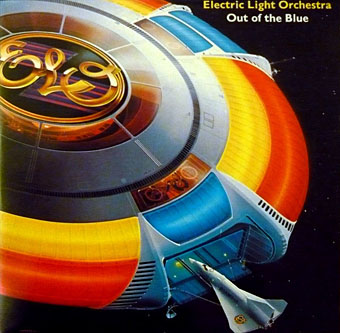
Out Of The Blue (1977) by Electric Light Orchestra.

Many different labels may be attached to the 1970s but it was definitely the science-fiction decade as much as anything else, a time when the use of SF imagery became a widespread trend, often superficially applied but there all the same. You see this in the music packaging of the period, and not only in the obvious enclaves of progressive rock. Here’s Motown Chartbusters Vol. 6 (1971) with a spaceship cover by Roger Dean; here’s Herbie Hancock on the cover of Thrust (1974) piloting his keyboard-driven craft over Machu Picchu while an alarmingly swollen Moon seems ready to crash into the Earth.

nagaoka02.jpg

Out Of The Blue gatefold interior.

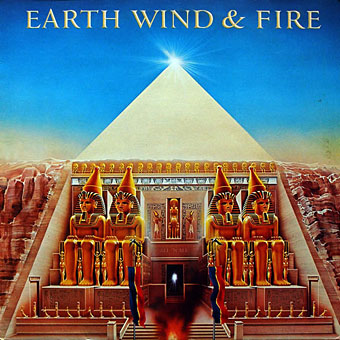
The exploitation of SF imagery on the covers of funk, soul and disco albums was much more widespread than the jazz world, and lasted long enough to join up with the emergence of synth-pop and electro in the early 1980s. The meticulous airbrush paintings of Shusei Nagaoka dominate this era and idiom, thanks in part to his covers for two of the biggest albums of 1977: Out Of The Blue by Electric Light Orchestra, and All ’n All by Earth, Wind & Fire.

nagaoka03.jpg

All ’n All (1977) by Earth, Wind & Fire.

nagaoka04.jpg

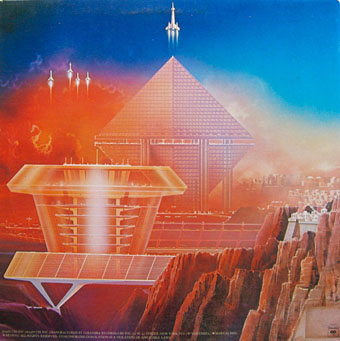
The latter doesn’t look especially science-fictional until you flip it over and its Egyptian scene morphs into a futuristic cityscape with a fleet of rockets heading for the stars. (That pyramidal building is based on one of Paolo Soleri’s hexahedron megastructures.) Many of the albums that followed this pair were jumping on the post-Star Wars/Close Encounters SF bandwagon but there were other reasons for funk and disco artists to embrace the Space Age, as Jon Savage has noted: “Disco’s stateless, relentlessly technological focus lent itself to space/alien fantasies which are a very good way for minorities to express and deflect alienation: if you’re weird, it’s because you’re from another world. And this world cannot touch you.”

nagaoka05.jpg

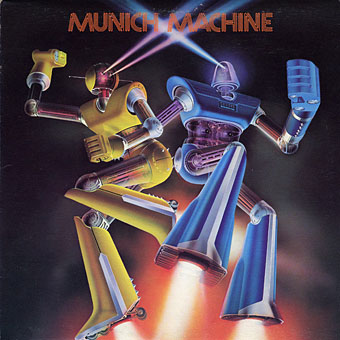
Munich Machine (1977) by Munich Machine. (A Giorgio Moroder production.)

Nagaoka was in demand for his cover art even before hitching a ride to the top of the album charts so what you see here is a limited selection. As usual, there’s more to be seen at Discogs although I often wish they’d allow larger image uploads. Future Life magazine ran a feature about Nagaoka in October 1978 which includes a brief interview with the artist together with some biographical details.

nagaoka06.jpg

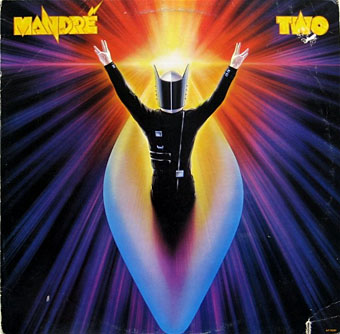
Mandré Two (1978) by Mandré.

Continue reading “Shusei Nagaoka album covers”

A.R.T. art

ARTflyer.jpg

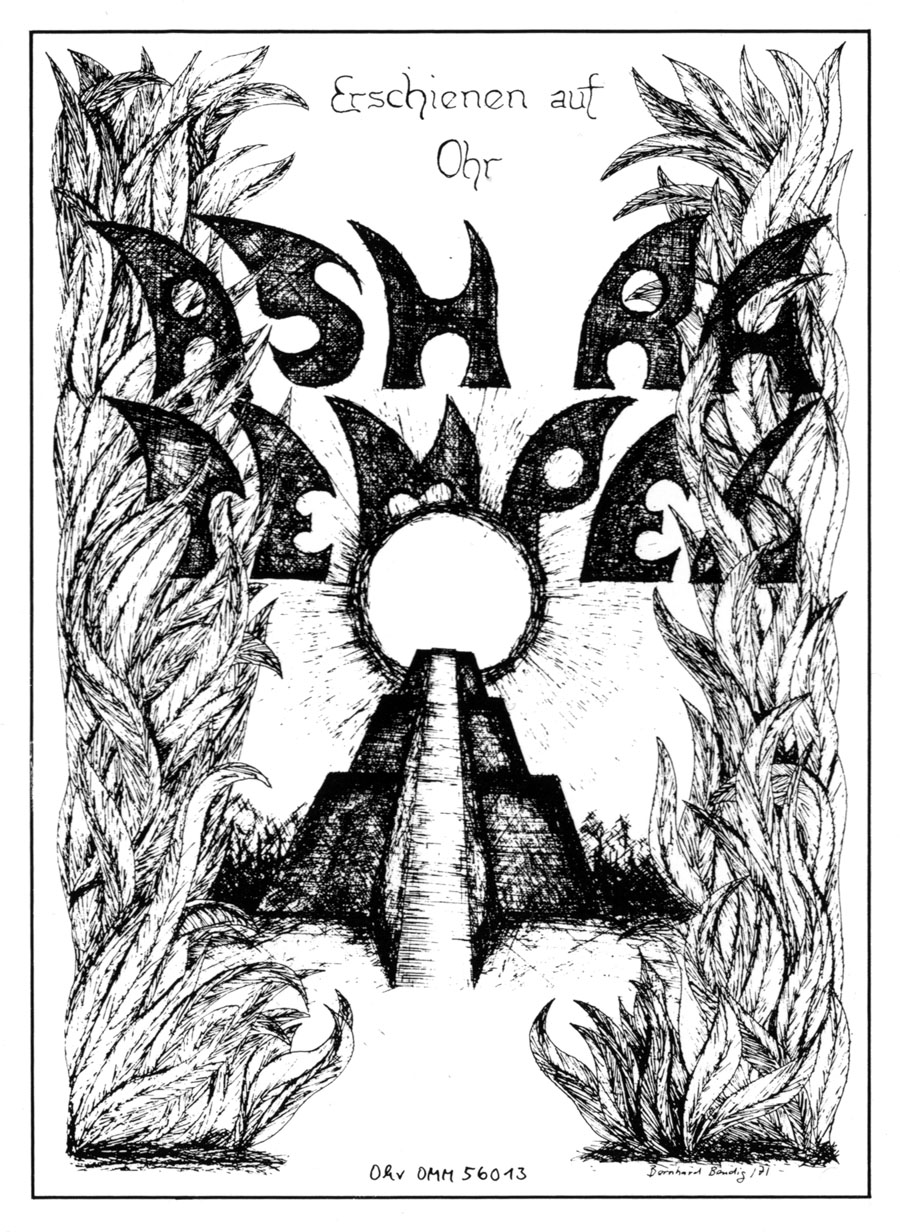
Some Manuel Göttsching-related graphic ephemera. This 1971 flyer for Ash Ra Tempel seems to be a rare item, the only place I’ve seen it being inside one of the inserts for The Private Tapes, a series of six CDs limited to 1000 copies each that Manuel Göttsching released in 1996. I was lucky to buy these when they were first released. A double-disc selection from the series followed two years later but neither this nor the rest of the set have been reissued since, despite containing a wealth of previously unreleased recordings from Göttsching’s archives, including many live concert recordings of Ash Ra Tempel. The flyer was the work of Bernhard Bendig who also drew the sleeve art for the group’s first two albums.

ARTcosmic.jpg

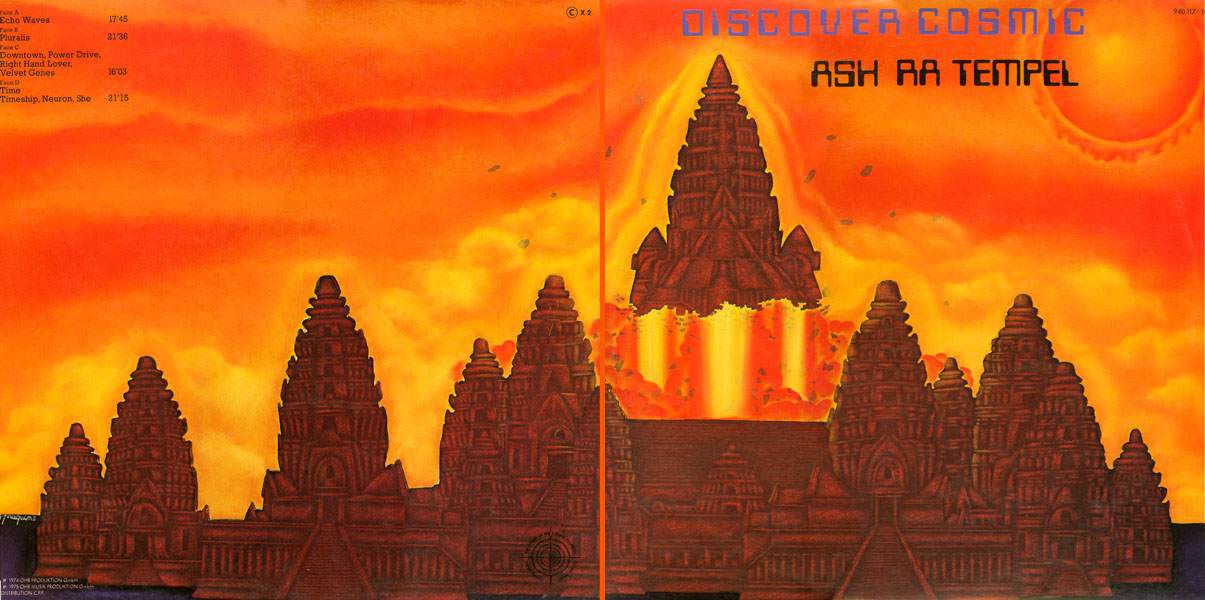
Not as scarce, but not very visible either, is this painting of another somewhat wonky temple by P. Praquin for a 1975 reissue of two Ash Ra Tempel albums: Inventions For Electric Guitar (which isn’t really ART), and Seven Up, the ramshackle studio jam which is mostly spoiled by the bellowings of Timothy Leary and friends. Discover Cosmic was a short-lived series of double-disc reissues of albums originally released on Cosmic Music, an imprint of Barclay Records that repackaged releases from Ohr and Kosmische Musik for the French market. There were three volumes of Discover Cosmic, the other two showcasing Popol Vuh and “The Klaus Schulze Sessions”, this being the first Cosmic Jokers album plus Join Inn by Ash Ra Tempel. The mysterious P. Praquin was responsible for all three cover paintings of which this is the best, wonky or not, a variation on the church-as-spaceship idea that may have been borrowed from the Roger Dean cover for Space Hymns by Ramases. This is one of those graphic contrivances that I usually expect to find repeated elsewhere, although to date the only other example I’ve seen was a Viennese museum poster. But there are more than enough churches that resemble spaceships to give people ideas, especially recent constructions like the Hallgrímskirkja in Reykjavík. If you know of any other steeples blasting off then please leave a comment.

Previously on { feuilleton }
Manuel Göttsching, 1952–2022
The kosmische design of Peter Geitner
Raising the roof