The real Basil Hallwards

dorian.jpg

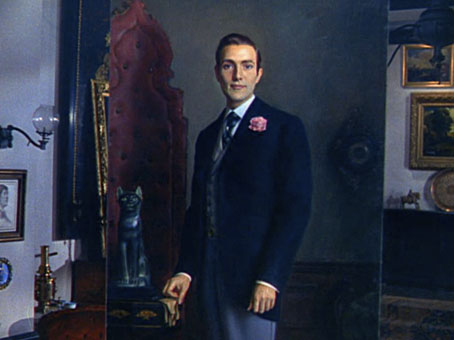
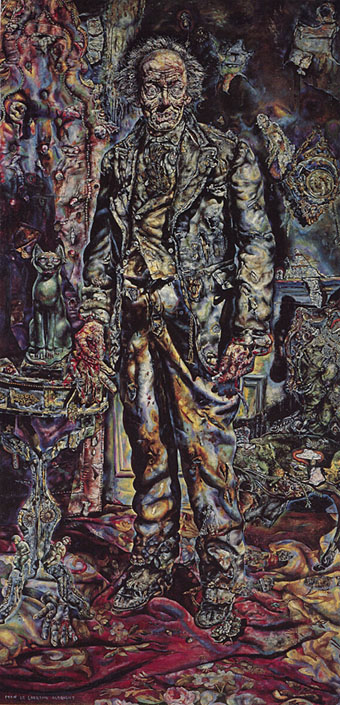
Well, two of them anyway… Discussion with commenter Noel in one of my old (and rather scant) posts about Albert Lewin’s 1945 film of The Picture of Dorian Gray touched on the fate of the original version of Dorian’s portrait (above). For some reason I’d always assumed this to have been produced by MGM’s art department despite a clear credit at the opening of the film for artist Henrique Medina (1901–1988). I no doubt miss this since my eyes always go to the credit for Ivan Albright (1897–1983), the artist responsible for the famous deteriorated final state of the picture (below). That painting is so splendidly grotesque its presence almost overpowers the entire film but its power would be lessened without the contrast of Medina’s elegant original. Examples of Medina’s other portrait works show a distinct similarity.
albrights.jpg

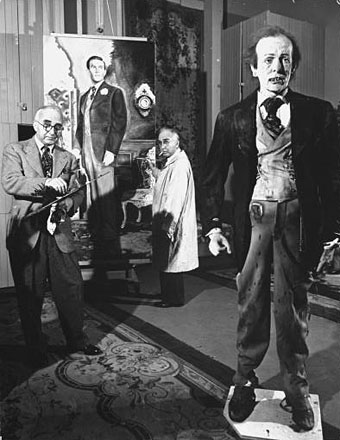
Noel pointed the way to photos from the LIFE magazine archives which show Ivan Albright and his identical twin brother, Malvin, at work on the portrait. (Another here.) Fascinating not only to see an early stage of the painting but also a dummy of the decayed Dorian they were using as a model.
albright.jpg

Albright’s dissolute masterpiece can be seen at the Art Institute of Chicago, together with a number of his other works. Noel notes that Medina’s picture was bought at auction for $25,000 but its current whereabouts and ownership remain a mystery. If anyone knows more about this, please leave a comment.

Elsewhere on { feuilleton }
The Oscar Wilde archive

The Great God Pan

pan_daphnis.jpg

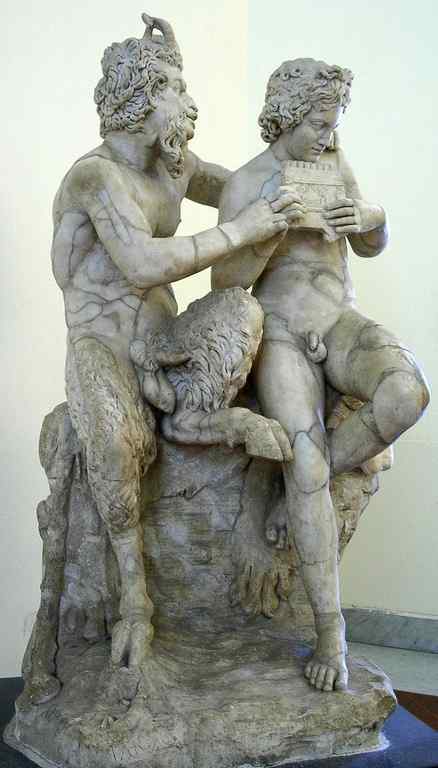
Pan teaching Daphnis to play the panpipes; Roman copy of a Greek original from the 3rd-2nd centuries BCE by Heliodoros.

“The worship of Pan never has died out,” said Mortimer. “Other newer gods have drawn aside his votaries from time to time, but he is the Nature-God to whom all must come back at last. He has been called the Father of all the Gods, but most of his children have been stillborn.”

So says a character in The Music on the Hill, one of the slightly more serious stories from Saki’s The Chronicles of Clovis (1911). Saki’s Pan is a youthful spirit closer to a faun than the goatish creature of legend. But being a gay writer whose tales regularly feature naked young men (surprisingly so, given the time they were written) I’m sure Saki would have appreciated the Roman statue above. There’s nothing chaste about this Pan with his “token erect of thorny thigh” as Aleister Crowley put it in his lascivious 1929 Hymn to Pan, a poem which caused a scandal when read aloud at his funeral some years later. The Roman statue was for a long while an exhibit in the restricted collection of the Naples National Archaeological Museum where all the more scurrilous and priapic artefacts unearthed at Pompeii were kept safely away from women, children and the great unwashed. These are now on public display and include the notorious statue of a goat being penetrated by a satyr.

Continue reading “The Great God Pan”

Einar Nerman

nerman1.jpg

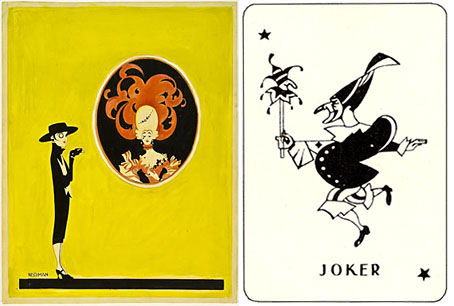
left: No title or date; right: Joker from a playing card set (1924).

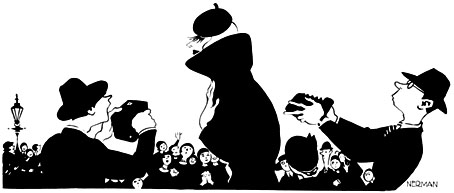
A recent post by Silent-Porn-Star draws my attention to Swedish illustrator and cartoonist Einar Nerman (1888–1983) whose work I don’t recall having come across before. There isn’t much available to see online unfortunately, a shame as SPS’s posting of a 1926 cigarette ad shows a distinct Beardsley influence. Nerman seems known chiefly today for his caricatures of Greta Garbo, one of which was used on a commemorative postage stamp in 2005.

nerman2.jpg

Greta Garbo.

Elsewhere on { feuilleton }
The illustrators archive

Previously on { feuilleton }
Oscar Wilde playing cards
Surrealist cartomancy

Darwin at 200

darwin.jpg

Man is But a Worm by Edward Linley Sambourne (1882).

Happy birthday Charles Darwin. The reaction to Darwin’s work from Punch and other journals was typical. While his studies remain controversial among those who believe there were dinosaurs on Noah’s Ark, his life and work are now celebrated on the Bank of England’s Ten Pound Note (but with the wrong kind of bird, it seems). Dogmatists take note: the Vatican is no longer on your side:

Father Giuseppe Tanzella-Nitti, Professor of Theology at the Pontifical Santa Croce University in Rome, said that Darwin had been anticipated by St Augustine of Hippo. The 4th-century theologian had “never heard the term evolution, but knew that big fish eat smaller fish” and that forms of life had been transformed “slowly over time”. Aquinas had made similar observations in the Middle Ages, he added.

He said it was time that theologians as well as scientists grappled with the mysteries of genetic codes and “whether the diversification of life forms is the result of competition or cooperation between species”. As for the origins of Man, although we shared 97 per cent of our “genetic inheritance” with apes, the remaining 3 per cent “is what makes us unique”, including religion.

“I maintain that the idea of evolution has a place in Christian theology,” Professor Tanzella-Nitti added.

Edward Linley Sambourne provided Punch with many caricatures of Victorian notables including the famous one of Oscar Wilde undergoing his own process of evolution by turning into a sunflower.

Dawkins on Darwin

Previously on { feuilleton }
“Weirdsley Daubery”: Beardsley and Punch
The Poet and the Pope