Weekend links 807

kouninos.jpg

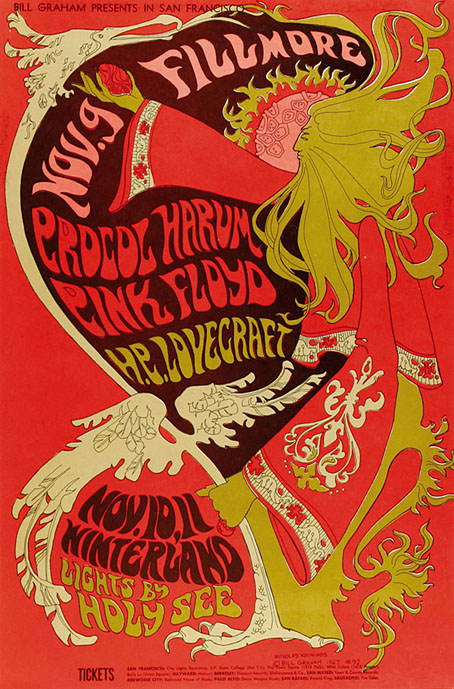
Poster art by Nicholas Kouninos for Procol Harum / Pink Floyd / HP Lovecraft at the Fillmore, San Francisco, 1967.

• Take a break from so-called reality with Gruesome Shrewd, more queasy psychedelia by Moon Wiring Club. MWC’s Ian Hodgson described his intentions to Simon Reynolds in a Reynolds roundup which notes the 20th anniversary of the Ghost Box project. The label is apparently on hold for the moment but I have to admit that my interest waned some time after the 10th anniversary, when it became increasingly apparent that the ghost had fled the box. Reynolds ends his piece with a list of favourite GB recordings which I mostly agree with, although I’d shuffle the order and swap some entries with Pye Corner Audio.

• “‘You know that feeling you get when you’ve just gotten back from the dry cleaners a pair of slacks, Dacron slacks, and you reach your hand in a pocket and you feel those fuzzy sandwiches with your fingers? Well, that’s the feeling I’m looking for.’ I just nodded and replied, ‘OK, Dave, I know exactly what you mean.’” Barry Gifford remembers David Lynch.

Aschenbach’s Last Journey: Lesley Chamberlain, the most recent translator of Thomas Mann’s Death in Venice, approaches the text by following the progress of its doomed protagonist from Brioni to the Venetian Lido. Related: Polly Barton describes to Katy Whimhurst some of the difficulties involved in translating Japanese fiction to English.

• From The Shout to Bait: Darran Anderson on the uses of sound in cinema. Rupert Hines’ soundtrack to The Shout has just been released by Buried Treasure.

• Video footage of modular synthesists Arc (Ian Boddy & Mark Shreeve) performing Arcturus live in 2004: part one | part two.

• At Aeon: “Black holes may be hiding something that changes everything,” says Gideon Koekoek.

• At the BFI: Michael Brooke selects 10 great Hungarian films.

• Steven Heller’s font of the year is Fillmore.

Shout The Storm (1984) by :Zoviet:France: | Shout At The Devil (2002) by Jah Wobble & Temple Of Sound | Shout (2005) by Tod Dockstader
Weekend links 755

emsh.jpg

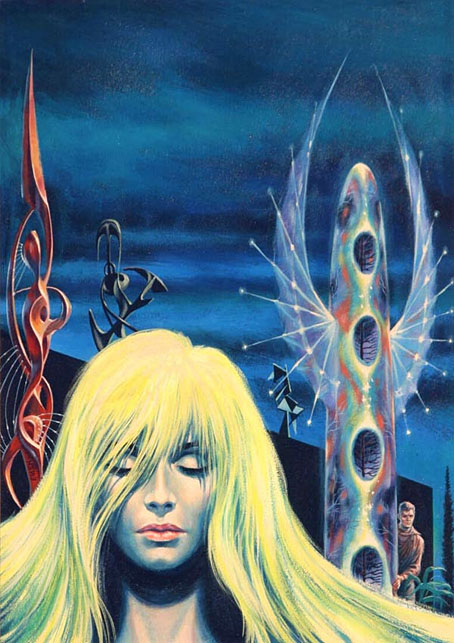
A painting by Ed Emshwiller for the cover of Fantastic Stories of Imagination, July 1962, illustrating The Singing Statues by JG Ballard .

• This week in the Bumper Book of Magic: my comments about the creation of the book’s cover and magical alphabet have been posted at Alan Moore World. At (Quasi), Smoky Man (in Italian) looks at other parts of the book, and includes my answers to his questions about the creation of The Soul, a character originally planned for a comic strip that Alan Moore and I were working on. I’ve been trying recently to find the first sketches I made of The Soul back in 2000 or 2001, without success. If I do find any of them I’ll post them here.

• New music: Juk-Shabb by Cryo Chamber Collaboration is this year’s installment in the Lovecraft-themed album series (previously) from Cryo Chamber. Also this week: Xerrox Vol. 5 by Alva Noto; Nocturne (Soundtrack for an Invisible Film) by Avi C. Engel; and Cat Location Conundrum by Moon Wiring Club.

Code: Damp: An Esoteric Guide to British Sitcoms by Sophie Sleigh-Johnson, being “an alternative occult and esoteric history of England told through one of its most popular cultural forms: the comedy sitcom”.

…the joy of art isn’t only the pleasure of an end result but also the experience of going through the process of having made it. When you go out for a walk it isn’t just (or even primarily) for the pleasure of reaching a destination, but for the process of doing the walking. For me, using AI all too often feels like I’m engaging in a socially useless process, in which I learn almost nothing and then pass on my non-learning to others. It’s like getting the postcard instead of the holiday.

Brian Eno at Boston Review

• “The typographic choices that Godard made were thematic and not only chosen for their stylistic properties.” Arijana Zeric looks inside the design world of Jean-Luc Godard.

• Coming soon from Strange Attractor: The Stammering Librarian: Essays by Timothy D’Arch Smith, edited by Edwin Pouncey & Sandy Robertson.

• At Public Domain Review: Fantastic Planet: The Microscopy Album of Marinus Pieter Filbri (1887–88).

• At the BFI: Michael Brooke offers suggestions for where to begin with Guy Maddin.

• At The Quietus: The Strange World of…Dennis Bovell.

• Mix of the week: A mix for The Wire by KMRU.

• Steven Heller’s font of the month is Gigafly.

Fantastic Cat (1996) by Takako Minekawa | Fantastic Analysis (2001) by Mouse On Mars | Fantastic Mass (2016) by Time Attendant

Weekend links 753

brewer.jpg

Grow (1970) by Linda Brewer.Via.

• The week in work-related reviews: Raymond Tyler reviewed the Bumper Book of Magic at Religious Socialism, while James Palmer did the same at Foreign Policy. Meanwhile, Rob Latham at the Los Angeles Review of Books examined the legacy of the New Wave of science fiction with reviews of New Worlds 224, and The Last Dangerous Visions, Harlan Ellison’s long-delayed story collection.

• “Incline Press is a private fine press publisher in the UK, stubbornly printing with hand set, metal type on a collection of vintage machines, working with poets and artists to make limited edition books and ephemera.”

• New music: Horses In Your Blood, another dose of unhinged weirdness from Moon Wiring Club; The Source by Jon Palmer; and Ekkorääg by Tarotplane.

• At Dennis Cooper’s: Spotlight on…Rikki Ducornet The Fan-Maker’s Inquisition: A Novel of the Marquis de Sade (1999).

• At Smithsonian Magazine: “Rare atlas of astronomy from the Dutch Golden Age goes on display in England“.

• Old music: Jon Savage’s Space, a space-themed compilation on Caroline True Records.

• At The Daily Heller: Berman’s Book Boom is a boon to graphic design’s legacy.

• At Public Domain Review: Christoph Jamnitzer’s Neuw Grotteßken Buch (1610).

• Mix of the week: A Dungeon Synth mix by Flickers From The Fen for The Wire.

• At Heavy Metal Magazine: The HP Lovecraft Art of John Holmes.

• At The Quietus: The Strange World of…Laurie Anderson.

I Can Hear The Grass Grow (1967) by The Move | Grow Fins (1972) by Captain Beefheart | The Growing (2011) by The Haxan Cloak

Weekend links 740

severin.jpg

Winged Figure (no date) by Mark Severin.

• At Wormwoodiana: News of the publication of two uncollected early stories by Cormac McCarthy. I happen to be reading McCarthy’s penultimate novel, The Passenger, at the moment. Very enjoyable and very different to what I was expecting.

• At Smithsonian Magazine: Yayoi Kusama‘s largest permanent public sculpture arrives in London.

• At Colossal: A futuristic 150-foot installation imagines Chicago’s never-built architecture.

The record sounded like nothing else, seemingly came from nowhere and related to nothing I could identify with any confidence: whistling, whispering, mumbling, pig grunts, exhalations of breath, chants and vocal imitations of nocturnal forest sounds, arco double bass and electric bass, nursery rhymes, impenetrable accents and languages, tambourines, unidentifiable tuned percussion imprecisely struck, mandolin, banjo, flutes, congas, bottleneck guitar, second line drumming with virtually no cymbals, dense percussion, organ bass, harpsichord, reed instruments played through electronic effects and organ lines sounding like anything but themselves. There was no piano, despite what some later commentators have claimed, and in fact very little harmonic underpinning in the majority of tracks. Instead of piano or guitar chords to fill out the ensemble sound there is the celebrated Gold Star echo chamber, into which instruments and voices sank as if dropping away into the abyss.

Zozo la Brique, Jump Sturdy, Coco Robichaux, Queen Julia Jackson, Mama Roux, Tit Alberta—questions flared like fireworks. Who were these characters who populated the lyrics. Were they voodoo practitioners, alive or dead, fictitious or real? Ishmael Reed’s visionary novel, Yellow Back Radio Broke-Down, was published not long after, in 1969. Years later I read it and was startled to bump into Zozo la Brique once more. So these were real people, or named phantoms, or figures of legend at least. “O Doc John,” Reed wrote, “Doc Yah Yah and Zozo Labrique Marie Laveau the Grand Improvisers if I am not performing these rites correctly send the Loa anyway and allow my imagination to fill the gaps.”

David Toop in an extract from Two-Headed Doctor: Listening For Ghosts In Dr. John’s Gris-Gris

• New music: Hidden Structures by Time Being, and Buried (Your Life Is Short) by The Bug.

• At Spoon & Tamago: Minimal and tranquil charcoal drawings by Masahiko Minami.

• New weirdness: Cat Location Conundrum by Moon Wiring Club.

• At Unquiet Things: The art of Dylan Garrett Smith.

• At Dennis Cooper’s: Toshio Matsumoto Day.

• RIP Alain Delon.

Gris-Gris Gumbo Ya Ya (1968) by Dr John | Gumbo (1971) by Santana | Roochoo Gumbo (1976) by Harry “The Crown” Hosono

Weekend links 702

miller.jpg

The Great Bear (1933) by Marjorie Miller.

• New music: “Lo-fi no-fi post-fi fragments of disparate SCATTERBRAIN thoughts scrapbooked together using industrial glue discretely purloined from building site tea-break opportunities to fully form the definitive SEPIA PUNK AMBIENT (?) statement of assiduous apathy intent ~ hextracted from SEPIA CAT CITY (GEpH017LP) available via moonwiringclub.com areet now TA.” Nobody writes product descriptions like Moon Wiring Club.

• “Both the Harry Smith and the Sun Ra books were hard sells, because they were virtual unknowns who had pretty much given their life for art. In each case only about two publishers were interested in either one of them. The editors said either that they hadn’t heard of him, or else they had heard of him and didn’t want to hear any more.” John Szwed talking to Raymond Foye about the mercurial Harry Smith, and the problems of writing biography.

• At Public Domain Review: Max Beerbohm’s A Christmas Garland (1912), a collection of seasonal parodies of well-known writers of the day. As with any such work, the success of each piece depends upon familiarity with the author being parodied, but Beerbohm’s prose is always a delight.

Mirrorshades (1986), the cyberpunk story anthology edited by Bruce Sterling, is currently available for reading or e-text download at Rudy Rucker’s website. The book is still in copyright but I’m guessing this has been done with the agreement of the contributors.

• “…the richness of terrestrial creatures which at points are capable of sounding utterly extra-terrestrial.” Daryl Worthington explores the history of birdsong and its influence on human music.

• At Smithsonian Magazine: Listen to the centre of the Milky Way translated into sound or look at yet more photos of the aurora borealis. (Or do both at the same time.)

• At Wormwoodiana: Through the Golden Valley to the Dark Tower. Mark Valentine and friends go on a book-buying expedition.

14 x 14, a collection of Oulipo poems by Ian Monk, translated by Monk and Philip Terry, with collage cover art by Allan Kausch.

• “I am fascinated by electromagnetic waves.” Carsten Nicolai (aka Alva Noto) discussing art and creativity with Max Dax.

Secret Satan, 2023, the essential end-of-year book list from Strange Flowers.

Spice Islands Sea Birds (1957) by Les Baxter | Trippin’ With The Birds (1997) by Stereolab + Nurse With Wound | Strange Birds (1999) by Coil