Relighting the Magick Lantern

anger2.jpg

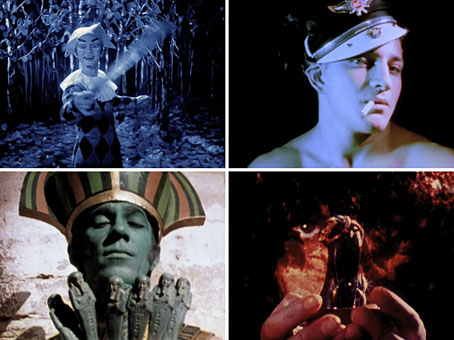
The first part of Kenneth Anger’s Magick Lantern Cycle appeared on DVD in a splendid edition from Fantoma earlier this year. The second and final part is due for release on October 2nd and you can see the mouthwatering trailer here.

This new set includes the Cocteau-esque Harlequinade, Rabbit’s Moon (1950); homoerotica, bikers and rock’n’roll in Scorpio Rising (1964); a hot rod, a blond boy in tight pants and the Paris Sisters crooning Dream Lover in Kustom Kar Kommandos (1965); magick ceremonies and Mick Jagger playing with a Moog synth in Invocation of My Demon Brother (1969); and Donald Cammell, Marianne Faithfull, Egypt, volcanoes, Aleister Crowley, an orange UFO and a great score from Bobby Beausoleil in the miniature epic, Lucifer Rising (1982).

The Magick Lantern Cycle is a great work of cinema that’s suffered from shoddy presentation on previous video releases; Fantoma have given these films the care and attention they deserve. If you haven’t seen them yet, you’re in for a treat.

Previously on { feuilleton }
James Bidgood
Kenneth Anger on DVD…finally
Un Chant d’Amour by Jean Genet

Juice from A Clockwork Orange

clockwork_poster.jpg

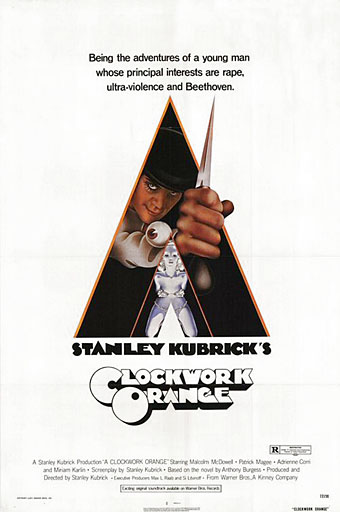
Philip Castle’s poster design. Castle also created the artwork for Full Metal Jacket.

Searching through old magazines whilst researching the epic Barney Bubbles post turned up this, a short reaction by Anthony Burgess to the success of Stanley Kubrick’s Clockwork Orange. Burgess became increasingly ambivalent about the attention brought about by Kubrick’s adaptation, not least because of the way it dominated the rest of his career; some of that ambivalence is already in evidence here.

Juice from A Clockwork Orange
by Anthony Burgess

Rolling Stone, June 8th, 1972

WHEN IT WAS first proposed about eight years ago, that a film be made of A Clockwork Orange, it was the Rolling Stones who were intended to appear in it, with Mick Jagger playing the role that Malcolm McDowell eventually filled. Indeed, it was somebody with the physical appearance and mercurial temperament of Jagger that I had in mind when writing the book, although pop groups as we know them had not yet come on the scene. The book was written in 1961, when England was full of skiffle. If I’d thought of giving Alex, the hero, a surname at all (Kubrick gives him two, one of them mine), Jagger would have been as good a name as any: it means “hunter,” a person who goes on jags, a person who doesn’t keep in line, a person who inflicts jagged rips on the face of society. I did use the name eventually, but it was in a very different novel—Tremor of Intent—and meant solely a hunter, and a rather holy one.

I’ve no doubt that a lot of people will want to read the story because they’ve seen the movie—far more than the other way around—and I can say at once that the story and the movie are very like each other. Indeed, I can think of only one other film which keeps as painfully close to the book it’s based on—Polanski’s Rosemary’s Baby. The plot of the film is that of the book, and so is the language, although naturally there’s both more language and more plot in the book than in the film. The language used by Alex, my delinquent hero, is called Nadsat—the Russian suffix used in making words like fourteen, fifteen, sixteen—and a lot of the terms he employs are derived from Russian. As these words are filtered through an English-speaking mind, they take on meanings and associations unknown to Russians. Thus, Alex uses the word horrorshow to designate anything good—the Russian root for good is horosh—and “fine, splendid, all right then” is the neuter form we ought really to spell as chorosho (the ch is guttural, as in Bach). But good to Alex is tied up with performing horrors, and when he is made what the State calls good it is through the witnessing of violent films—genuine horror shows. The Russian golova—meaning head—is domesticated into gulliver, which reminds the reader he is taking in a piece of social satire, like Gulliver’s Travels. The fact that Russian doesn’t distinguish between foot and leg (noga for both) and arm and hand (ruka) serves—by suggesting a mechanical doll—to emphasise the clockwork-view of life that Alex has: first he is self-geared to be bad, next he is state-geared to be good.

Continue reading “Juice from A Clockwork Orange”

Further back and faster

jagger_beaton.jpg

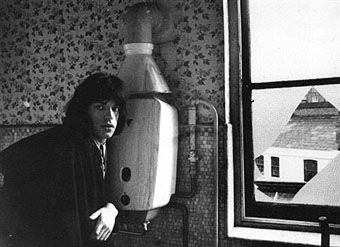
Mick Jagger by Cecil Beaton (1968).

Donald Cammell thought Mick Jagger to be a more provocative rock star than Elvis Presley because Jagger was willing to experiment with his masculinity. Elvis, although extraordinarily erotic to a generation of young women, never did. What this difference suggests, among other things, is that Mick Jagger’s appeal is not Elvis’s—and never was. Critic Greil Marcus has argued that what Elvis did was to purge the Sunday morning sobriety from folk and country music and to purge the dread from blues; in doing so, he transformed a regional music into a national music, and invented party music. Elvis popularized an amalgam of musical forms and styles into “rock’n’roll,” a black American euphemism for sexual intercourse. What the Rolling Stones did to rock music, some years after Elvis made sex an integral part of its appeal, was to infuse rock with a bohemian theatricality, at first through Brian Jones, who was the first British pop star to cultivate actively a flamboyant, androgynous image. For a time, Brian even found his female double in Anita Pallenberg. Brian Jones and the Stones thus re-introduced into rock music its erotic allure, and hence made it threatening (again).

From an excellent piece by Sam Umland for PERFORMANCE: A Photographic Exhibition featuring the work of Donald Cammell and Nicolas Roeg at the Drkrm. Gallery, Los Angeles, opening on January 20th. Umland wrote the recent biography of Donald Cammell with Rebecca Umland (published by Fab Press) for which I designed the cover. Featured in the exhibition are prints from the Del Valle Archive, including eleven photographs of Mick Jagger taken by Cecil Beaton when Performance was being filmed.

performance.jpg

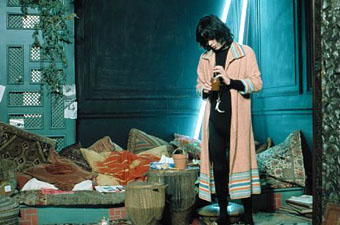
“When are Warner Brothers going to do the right thing and release Performance on DVD?” I asked in April last year. Well now they are, although it remains to be seen which version of the film has been used; several exist, some of them shorter than others. Release is scheduled for February 13th in the US and March 12th in the UK.

PERFORMANCE: A Photographic Exhibition
featuring the work of Donald Cammell and Nicolas Roeg

January 20-February 24, 2007
Drkrm. Gallery
2121 San Fernando Road
Suite 3
Los Angeles
CA 90065

Previously on { feuilleton }
Quite a performance
Borges in Performance

Queer Noises

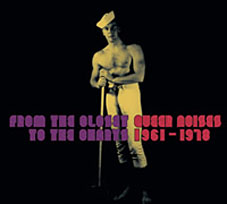
queer_noises.jpgBeyond Bowie and Frankie, there’s a whole secret history of gay pop, reports Alexis Petridis

‘Wilder, madder, gayer than a Beatle’s hairdo’

It was the love that dare not sing its name—or was it? Beyond Bowie and Frankie, there’s a whole secret history of gay pop, reports Alexis Petridis

Tuesday July 4, 2006

The year 1966 is known as rock’s annus mirabilis. It was the year the right musicians found the right technology and the right drugs to catapult pop into hitherto unimagined realms of invention and sophistication: the year of the Beatles’ Revolver, the Beach Boys’ Pet Sounds and Bob Dylan’s Blonde on Blonde. But the most astonishing record of 1966 did not emanate from the unbounded imagination of Brian Wilson, or from an Abbey Road studio wreathed in pot smoke. Instead, it was the work of hapless instrumental combo the Tornados.

By 1966, the Tornados’ moment of glory—with 1962 number one Telstar—had long passed; they hadn’t had a hit in three years and every original member had departed. The single they released that year, Is That a Ship I Hear?, was their last. Tucked away on its B-side, the track Do You Come Here Often? attracted no attention, which was probably just as well. A year before the partial decriminalisation of homosexuality, the Tornados’ producer, Joe Meek, had taken it upon himself to record and release Britain’s first explicitly gay rock song, apparently undaunted by his own conviction for cottaging in 1963. (more)

Tracklist
01. Jose: At The Black Cat 02:09
02. Rod McKuen: Eros 01:42
03. Mr. Jean Fredericks: Nobody Loves A Fairy When She’s Forty 03:56
04. Byrd E. Bath & Rodney Dangerfield: Florence of Arabia 03:40
05. B.Bubba: I’d Rather Fight Than Swish 03:16
06. The Kinks: See My Friend 02:40
07. The Tornados: Do You Come Here Often? 03:53
08. The Brothers Butch: Kay, Why? 03:13
09. Teddy & Darrel: These Boots 02:22
10. Zebedy: The Man I Love 03:09
11. Curt Boettcher: Astral Cowboy 02:18
12. Harrison Kennedy: Closet Queen 03:43
13. Polly Perkins: Coochy Coo 03:19
14. Michael Cohen: Bitterfeast 03:09
15. Jobriath: I’m A Man 03:30
16. Chris Robison: Lookin’ For A Boy 03:57
17. Peter Grudzien: White Trash Hillbilly Trick 02:56
18. Valentino: I Was Born This Way 03:20
19. The Miracles: Ain’t Nobody Straight In LA 03:43
20. The Ramones: 53rd And 3rd 02:19
21. The Twinkeyz: Aliens In Our Midst 03:17
22. Dead Fingers: Talk Nobody Loves You When You’re Old And Gay 04:30
23. Black Randy & The Metro Squad: Trouble At The Cup 01:53
24. Sylvester: You Make Me Feel (Mighty Real) 03:45

Previously on { feuilleton }
Gay book covers

Quite a performance

cammell.jpg

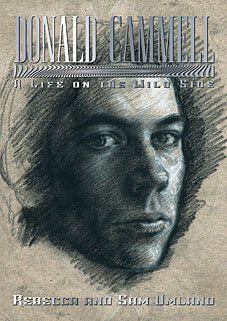
As mentioned earlier, I designed the jacket for this excellent biography of Donald Cammell some time ago. The book is reviewed in today’s (London) Times by Barry Miles.

Quite a performance
review by Barry Miles

DONALD CAMMELL: A Life on the Wild Side
by Rebecca and Sam Umland
FAB Press, £24.95 hardback, £16.95 paperback; 304pp

THERE IS A PERSISTENT rumour that after shooting himself in the head the filmmaker Donald Cammell lived on in a delirious, euphoric state for 45 minutes. The story is that he asked his wife China to place a mirror so that he could watch himself die and said: “Do you see the picture of Borges”? This is a reference to the death scene in Performance, his best known film, when the gangster Chas (played by James Fox) shoots the rock star Turner (played by Mick Jagger).

In a profoundly shocking sequence, the camera follows the bullet into his brain, only to find there a photograph of the Argentine author Jorge Luis Borges who is much quoted in the film. This is but one of the many myths surrounding Cammell that these authors debunk — he died the instant the .38 bullet entered his skull.

Continue reading “Quite a performance”