Art is magic. Magic is art.

millidge.jpg

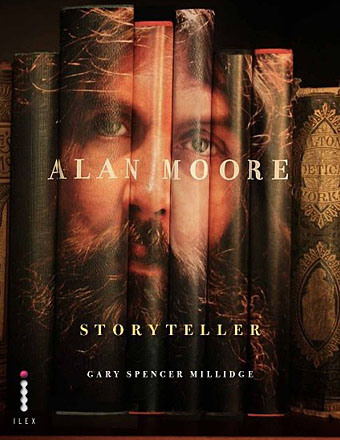
Cover concept by Chip Kidd.

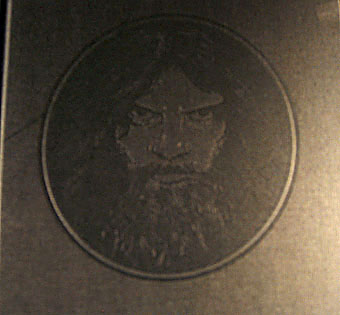
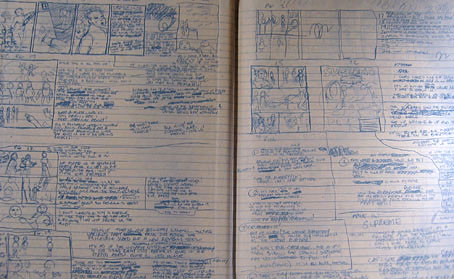
I noted the imminent arrival of Gary Spencer Millidge’s labour of love last month and the volume itself turned up this week, and what a book it is, a heavyweight hardback that’s far more lavish than I anticipated. The first surprise comes when removing the dust jacket to find Alan’s scowling visage embossed on the boards. Inside there’s a wealth of Moore ephemera from biographical material (lots of family photos) to insights into the scripting process behind the comics. I already knew Alan made little thumbnail sketches of his comic layouts before writing his scripts, having been fortunate enough to see one of the work-in-progress books for From Hell one time when I was chez Moore. Now everyone can have that opportunity. In addition there’s a thorough overview of Alan’s career, from the earliest juvenilia through to recent issues of Dodgem Logic. The comics career often overshadows his other work but in a later part of the book there’s considerable attention given to his collaborations with musicians, dancers and others for the Moon and Serpent performances. For my part it’s a pleasure to see some of the designs I created for the Moon and Serpent CDs printed large-size and in better quality than pressing plants manage with compact discs. None of those releases sold in great quantities and all are now out-of-print so the artwork often feels lost.

moore01.jpg

The front board.

What else? How about two sections of the book with fold-out pages? How about the first ever public appearance of Alan’s huge chart mapping the progress of every character through the unfinished Big Numbers? How about an introduction by Michael Moorcock where he calls Alan “a Robert Johnson of the Age of Doubt; questioning, confronting, mourning and yearning, representing his readers in profound ways, an intellectual autodidact, one of my few true peers for whom I have limitless respect.”? How about a compact disc featuring extracts from the Moon and Serpent CDs plus many other previously unreleased songs including pieces by the Emperors of Ice Cream? This is a gorgeous production designed by Simon Goggin and art directed by Julie Weir, and I haven’t even begun to read it yet. Is it necessary to state that it’s an essential purchase for anyone with more than a passing interest in Mr Moore and his many talented collaborators? Yours for twenty-five quid from Ilex Press. Some page samples follow.

moore02.jpg

Front endpapers showing Alan’s working notes and sketches.

Continue reading “Art is magic. Magic is art.”

Mervyn Peake in Coronation Street

gormenghast1.jpg

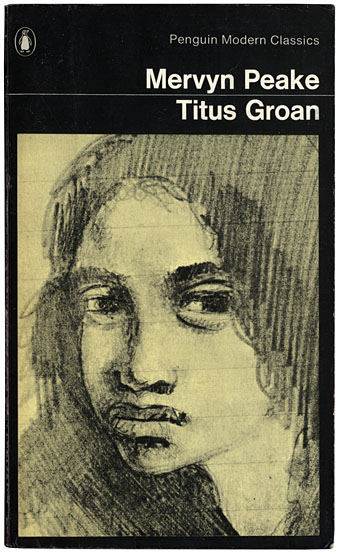
First paperback edition of Titus Groan, 1968.

If you’re British then, no, it isn’t what you think. Having mentioned my hometown of Blackpool yesterday there’s one detail about the town I usually regard as an annex of Hell which, if not quite a saving grace, raises it into some lesser locus of perdition.

There are many Coronation Streets in Britain (and Coronation Roads, Terraces, etc), Manchester has several real ones besides the fake one which provides the setting for the world’s longest-running soap opera. Most are named after a royal event, of course, although I don’t know when the one in Blackpool was built, possibly around 1911 which would mean it takes its name from the coronation of George V. I remember it as being a very undistinguished street of shops, and had no idea all the time I was in Blackpool that Mervyn Peake had lived for a short period in that street (no. 62) with wife Maeve Peake (later Gilmore) and son Sebastian in 1940. Mervyn was in the Royal Artillery in the early years of the war, and was posted to Blackpool as part of an Anti-Aircraft Training Regiment. Once established he found there was little for him to do so he continued work on the manuscript of Titus Groan, still at that point being referred to as Goremenghast (with an extra “e”). Later on the family moved to Bloomfield Road, the home of Blackpool’s football club, before Maeve and Sebastian returned to London.

All this detail can be found in G. Peter Winnington’s Peake biography, Vast Alchemies (2000), and came as something of a shock to me. One thinks of Peake as an inhabitant of Sarke and London, not Blackpool, however brief his stay. But I was stunned most of all to hear about him writing there as well. Peake noted on his manuscript where the chapters were written so Winnington can tell us that some of Titus Groan was set down on the town’s North Pier. The piers are one of the few things I liked about Blackpool, North Pier most of all for being the longest structure with the best views of the sea. It’s also notable for me in being the place where I began my first (and strongest) acid trip in 1980. That’s nothing to do with Peake, of course, but the significance of these separate events tangles in a curious and unexpected way, so that I can’t think of that pier now, or of the early chapters of the Gormenghast trilogy, without this knowledge coming to the surface.

This year is the Peake centenary, and I wrote at the beginning of the month about some of the events and exhibitions being staged in the UK. One of these, Mervyn Peake: A Celebration, will take place at the British Library, London, on Tuesday, 26th July. Described as “an evening of words, memories and images with Peake’s associates, experts and family members”, the speakers will include Fabian Peake, Sebastian Peake, Clare Penate, Brian Sibley, Hilary Spurling and others, with a specially filmed contribution by Michael Moorcock. Further details here. Don’t expect Peake’s presence in Blackpool to be acknowledged this year; the philistine nature of the place is one reason I escaped as soon as I could.

Update: Mervyn Peake’s war paintings unveiled by National Archives.

• G. Peter Winnington’s Peake Studies

Previously on { feuilleton }
The Worlds of Mervyn Peake
A profusion of Peake
Joseph Cavalieri’s stained glass
Mervyn Peake at Maison d’Ailleurs
Peake’s Pan
Buccaneers #1
Mervyn Peake in Lilliput
The Illustrators of Alice

The Thackery T. Lambshead Cabinet of Curiosities

lambshead-cover.jpg

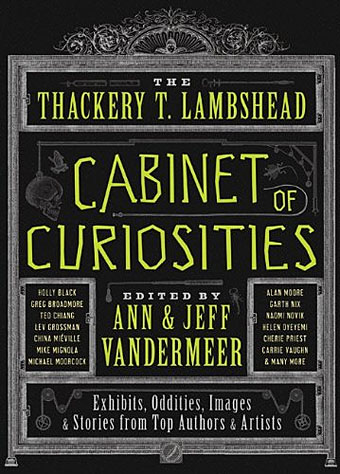
Cover design by James Iacobelli.

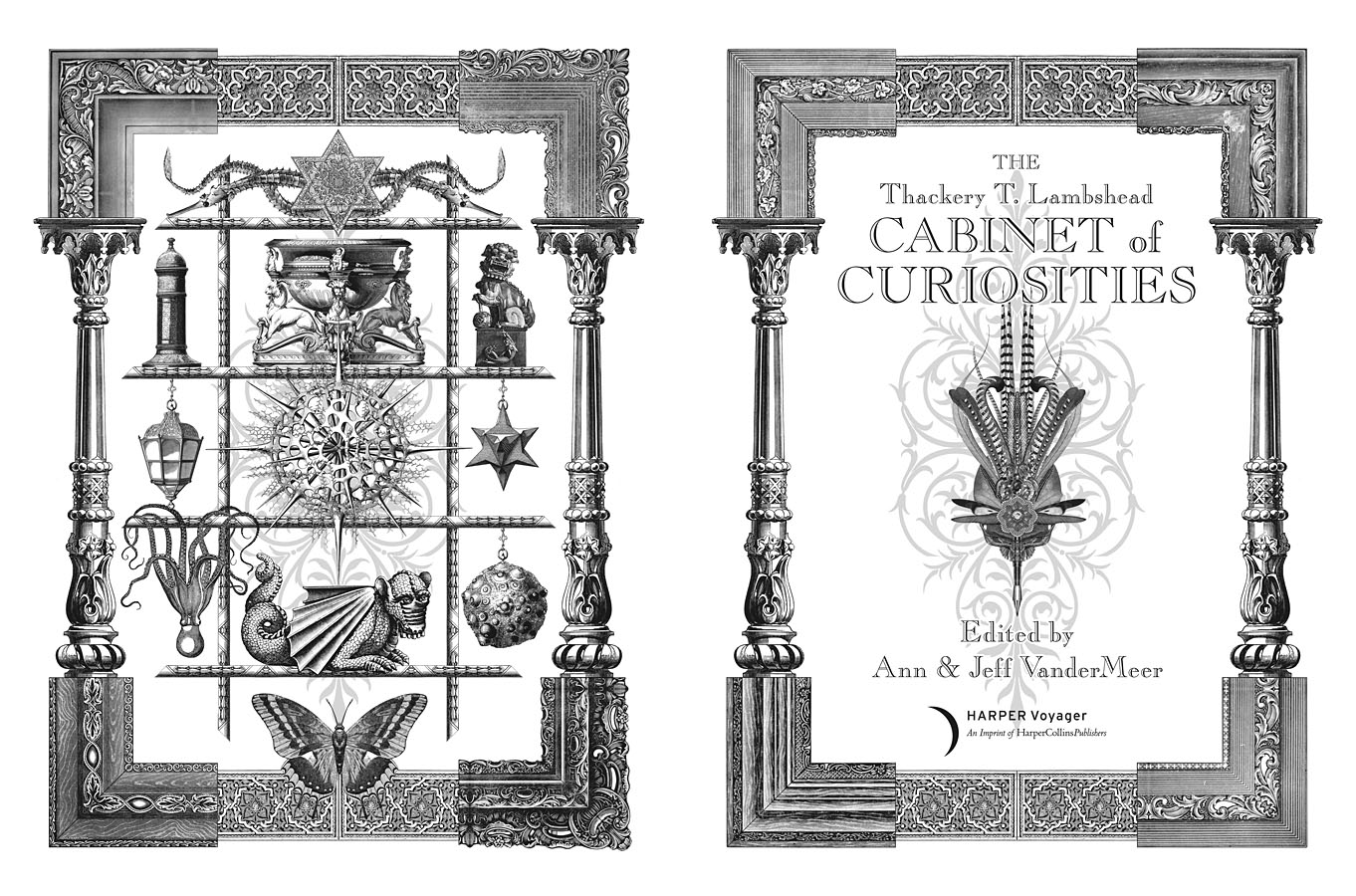
The sequel to The Thackery T. Lambshead Pocket Guide to Eccentric & Discredited Diseases is published next week in the US but we have permission to write about it before the official release. The Thackery T. Lambshead Cabinet of Curiosities is a chunky hardback of 320 pages with a host of contributors including Holly Black, Greg Broadmore, Ted Chiang, Rikki Ducornet, Amal El-Mohtar, Minister Faust, Jeffrey Ford, Lev Grossman, N.K. Jemisin, Caitlín R. Kiernan, China Miéville, Mike Mignola, Michael Moorcock, Alan Moore, Garth Nix, Naomi Novik, James A. Owen, Helen Oyeyemi, J.K. Potter, Cherie Priest, Ekaterina Sedia, Jan Švankmajer, Rachel Swirsky, Carrie Vaughn, Jake von Slatt, Tad Williams, Charles Yu and others. I provided title pages for the various sections of the book, as well as a variety of found and bespoke illustrations. And seeing as how I seldom miss an opportunity to take a dig at Rupert Murdoch (especially this week), it would be remiss of me if I didn’t mention that it’s published by an imprint of HarperCollins which means I’m currently feeling somewhat tainted by the Evil Empire. Mea culpa. When you sup with the devil, use a long spoon.

lambshead-title.jpg

My title spread.

That aside, this is a treat for anyone who enjoys the more experimental, eccentric and surreal end of the fantasy spectrum:

After the death of Dr. Thackery T. Lambshead at his house in Wimpering-on-the-Brook, England, a remarkable discovery was unearthed: the remains of an astonishing cabinet of curiosities. Many of these artifacts, curios, and wonders related to anecdotes and stories in the doctor’s personal journals. Others, when shown to the doctor’s friends, elicited further tales from a life like no other. Thus, in keeping with the bold spirit exemplified by Dr. Lambs­head and his exploits, we now proudly present highlights from the doctor’s cabinet, reconstructed not only through visual representations but also through exciting stories of intrigue and adventure. A carefully selected group of popular artists and acclaimed, bestselling authors has been assembled to bring this cabinet of curiosities to life.

From what I’ve read so far the general tone is a lot less overtly wacky than the first book, and if set beside some of the more clichéd and pedestrian fantasy works being jobbed out at the moment will probably seem downright avant garde. Editors Ann and Jeff VanderMeer have been at pains to emphasise that this isn’t another steampunk collection although seeing as how many people now equate steampunk with any kind of antique graphics that’s the way some may take it. Alan Moore aficionados should know that Alan’s piece, Objects Discovered in a Novel Under Construction, is a riff on some of the contents of his forthcoming novel Jerusalem. My illustration for that entry is below.

Jeff had some blog posts this week related to the book, one looking back at the Disease Guide, the other with details of the US tour he and Ann will shortly be undertaking. A couple of my other contributions follow.

Continue reading “The Thackery T. Lambshead Cabinet of Curiosities”

The Worlds of Mervyn Peake

peake-sphinx.jpg

Illustration by Mervyn Peake for The Sphinx by Oscar Wilde (1949).

The centenary of writer, artist and poet Mervyn Peake is being celebrated this year with a number of events in the UK. Mervyn Peake: A Centenary Celebration is a small exhibition of Peake’s drawings which has been running since April at the Pallant House Gallery, Chichester. That show ends on July 17th so if you want to be glared at by Fuchsia Groan you’re advised to get your skates on.

The Worlds of Mervyn Peake is a more substantial affair opening this week at the British Library, London, which promises to have materials from the British Library collection and the Peake archive on display. Two evenings of talks are also scheduled although the first of these, Mervyn Peake’s Gormenghast, is now sold out. The Guardian ran a feature at the weekend with pieces by some of the people who’ll be involved in the discussions, including Michael Moorcock, who’s been championing Peake’s work since the early 1960s, and China Miéville. For those who can’t make it to the exhibitions, there are also books: The Gormenghast Trilogy has been republished in a new illustrated edition, and the British Library is selling an American edition of Maeve Gilmore’s Peake’s Progress, a 592-page selection of writings, drawings and poetry which has been out-of-print in the UK for years. Essential purchases for any Peake enthusiast.

Update: There’s also an exhibition of artwork by Mervyn Peake and Maeve Gilmore at Viktor Wynd, London. Thanks to Vadim for the tip.

Elsewhere on { feuilleton }
The illustrators archive

Previously on { feuilleton }
A profusion of Peake
Joseph Cavalieri’s stained glass
Mervyn Peake at Maison d’Ailleurs
Peake’s Pan
Buccaneers #1
Mervyn Peake in Lilliput
The Illustrators of Alice

Mister Jarman, Mister Moore and Doctor Dee

tempest.jpg

Prospero (Heathcote Williams) and Miranda (Toyah Willcox), The Tempest (1979).

The Shakespeare who spun The Tempest must have known John Dee; and perhaps through Philip Sidney he met Giordano Bruno in the year when he was writing the Cena di Ceneri—the Ash Wednesday supper in the French Ambassador’s house in the Strand. Prospero’s character and predicament certainly reflect these figures, each of whom in his own way fell victim to reaction. John Dee, with the greatest library in England, skrying for the angels Madimi and Uriel (so nearly Ariel)—all of which is recorded in the Angelic Conversations—ended up, in his old age, penniless in Manchester. Bruno was burnt for heresy.

Ten years of reading in these forgotten writers, together with a study of Jung and his disciples proved vital in my approach to both Jubilee and The Tempest. As for the black magic which David Bowie thought I dabbled in like Kenneth Anger, I’ve never been interested in it. I find Crowley’s work dull and rather tedious. Alchemy, the approach of Marcel Duchamp, interests me much more.

Derek Jarman, Dancing Ledge (1991).

Damon Albarn’s opera Doctor Dee has been all over the news this week following its premier as part of the Manchester International Festival. Last weekend one of the press ads was announcing this as an “untold story”, as though no one had given much thought to the Elizabethan magus prior to Mr Albarn’s arrival. Neither the ads nor anyone associated with the production will be in a hurry to tell you that the idea for the opera came from Alan Moore who’s had a fascination with John Dee’s life and work for many years. Albarn and fellow Gorillaz cohort Jamie Hewlett approached Alan about a collaboration a couple of years ago; Alan agreed to write something on the condition that Gorillaz provide a contribution to Alan’s magazine, Dodgem Logic. They agreed, Alan set to work, having suggested John Dee as a good subject then the whole thing fell apart: Gorillaz said they were too busy to accommodate themselves to the magazine’s generous deadlines so Alan told the pair that he was now too busy to have anything further to do with their opera. This is all old news (and being a Dodgem Logic contributor I have a partisan interest in the story) but it’s worth noting since the opera will be playing elsewhere once it’s finished its Manchester run so we’ll continue to hear about it. The point is that the subject matter was Alan Moore’s choice, not Damon Albarn’s; if Alan had decided to write something about Madame Blavatsky (say) we’d now be reading reviews of Blavatsky: The Opera. Albarn can at least be commended for staying with the subject. Despite John Dee’s exile in Manchester being part of the city’s history (among other things he helped organise the first survey of the streets) you can bet the apes from Oasis have never heard of him.

jubilee.jpg

Richard O’Brien as John Dee in Jubilee (1978).

All of which had me thinking how John Dee, a maverick intelligence of the Elizabethan era, has a tendency to attract equally maverick intelligences in later eras. Derek Jarman’s work returns to John Dee often enough to make the magus a recurrent theme in his films, from the scenes in Jubilee (1978) (part of an earlier script) where he’s portrayed by Richard O’Brien showing Elizabeth I the future of her kingdom, to The Tempest (1979) where Prospero’s wand is modelled on Dee’s Monas Hieroglyphica, to The Angelic Conversation (1987) which borrows its title from Dee’s scrying experiments and finds via the sonnets another connection between John Dee and Shakespeare (Ariel being the contrary spirit whose magic allows a vision of the future in Jubilee). By one of those coincidences which make you think there must have been something in the air during the mid-70s, Michael Moorcock’s novel Gloriana, or The Unfulfill’d Queen was published the year Jubilee premiered, a fantasy in which the Elizabethan court is blended with its fictional counterpart from Spenser’s The Faerie Queen, and which features a Doctor John Dee as the queen’s Councillor of Philosophy. (If you want to stretch the connections further, Jenny Runacre who plays Elizabeth in Jubilee had earlier portrayed Miss Brunner in the film of Moorcock’s The Final Programme.)

mindscape_dee.jpg

My 2009 poster design for The Mindscape of Alan Moore, a documentary by Dez Vylenz. John Dee’s Sigillum Dei Aemeth appears in the film so I used this as the principal motif for the packaging design and DVD interface.

Reading the reviews it’s impossible to tell how Alan’s libretto might have fared on stage compared to the work which is now showing, the content of which draws on Benjamin Woolley’s excellent biography, The Queen’s Conjuror. Alan and Benjamin Woolley can both be found among the interviewees in a Channel 4 documentary about John Dee broadcast in the Masters of Darkness (sic) series in 2001. For those keen to delve beyond the stage show, Derek Jarman’s films are all on DVD, of course, while fragments of Alan’s libretto can be found in the fourth edition of Strange Attractor along with his notes for the rest of the opera. Charlotte Fell Smith’s life of Dee from 1909, for many years the standard study of the man, can be found online here.

Previously on { feuilleton }
The Tempest illustrated
Robert Anning Bell’s Tempest
In the Shadow of the Sun by Derek Jarman
Designs on Doctor Dee
Derek Jarman at the Serpentine
The Angelic Conversation
The life and work of Derek Jarman