02026

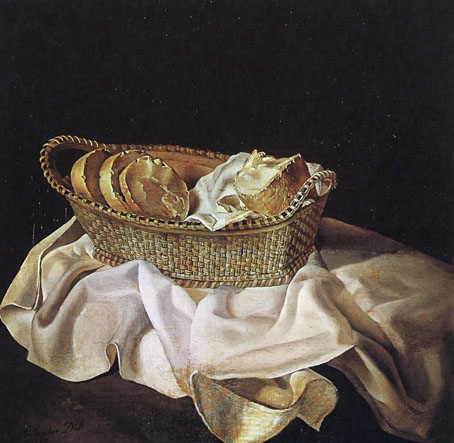
1926-02.jpg

The Basket of Bread (1926) by Salvador Dalí.

Happy new year. 02026? An affectation via the Long Now.

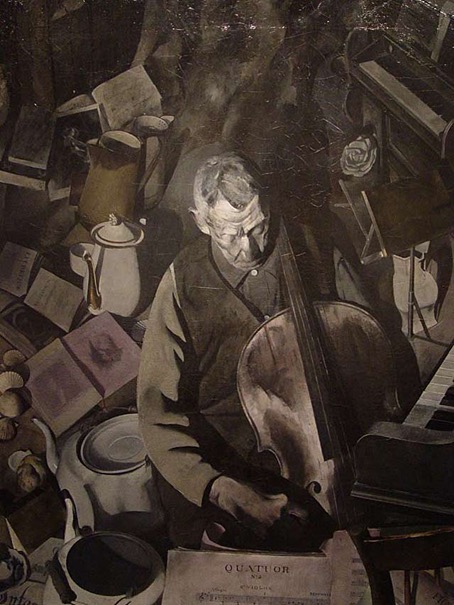
1926-05.jpg

The Cello Player (1926) by Edwin Dickinson.

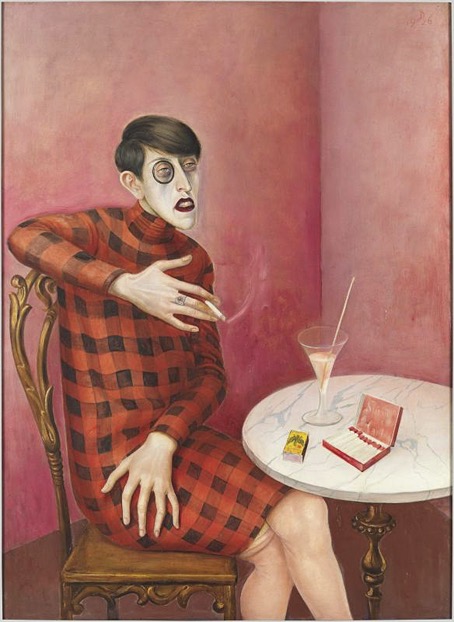
1926-12.jpg

Portrait of the Journalist Sylvia von Harden (1926) by Otto Dix.

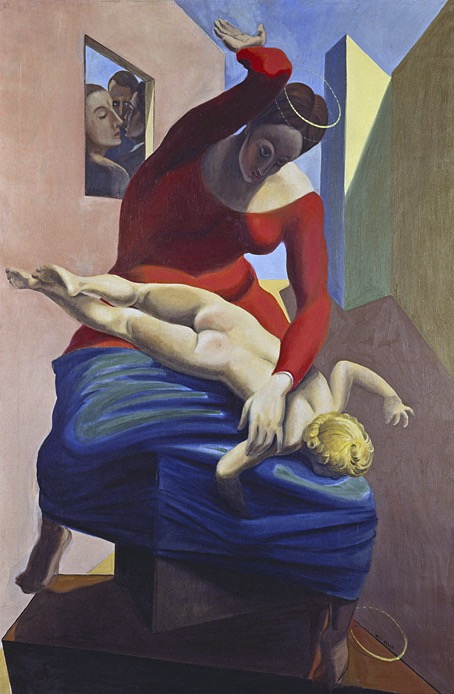
1926-11.jpg

The Virgin Spanking the Christ Child before Three Witnesses: André Breton, Paul Eluard and the Artist (1926) by Max Ernst.

1926-10.jpg

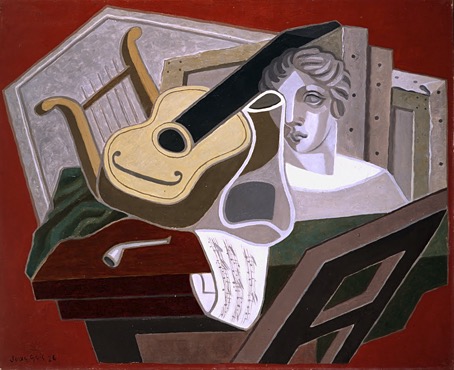
The Musician’s Table (1926) by Juan Gris.

Continue reading “02026”

Weekend links 802

grimshaw.jpg

November (1879) by John Atkinson Grimshaw.

• As usual, the first links in November are heavy with the spirit of Halloween. At the BFI: Zombies in the Lake District: how locations from The Living Dead at Manchester Morgue look today; Adam Scovell looks back at one of the more curious zombie films of the 1970s, a Spanish/Italian production directed by Jorge Grau in and around my home city. Also at the BFI: Georgina Guthrie selects 10 great erotic horror films.

• “We must recognise that reality without mystery is impossible.” In a recently digitised film clip, René Magritte is interviewed (in French) by Belgian TV in 1961.

• The Italian edition of The Moon and Serpent Bumper Book of Magic is out now from Panini. Thanks to Smoky Man for posting photos!

• Among the new titles at Standard Ebooks, the home of free, high-quality, public-domain texts: Short Fiction by Saki.

• At Smithsonian Mag: Elizabeth Djinis explains how an Italian town came to be known as the “City of Witches”.

• New music: The Whole Woman by Anna von Hausswolff ft. Iggy Pop; Forces, Reactions, Deflections by Scanner.

• RIP Jack DeJohnette, jazz drummer; Prunella Scales, actor; Peter Watkins, film-maker.

Space Type Generator

Algiers November 1, 1954 (1965) by Ennio Morricone | November Sequence (2011) by Pye Corner Audio | Richter: November (2019) by Mari Samuelsen

Art on film: Crimes of Passion

cop11.jpg

Continuing an occasional series about artworks in feature films. I’ve been spending the past couple of weeks working my way through the Ken Russell filmography, rewatching familiar documentaries and feature films while acquainting myself with the portions of the Russell oeuvre that I’d missed in the past. Crimes of Passion (1984) was a film that I did see when it turned up on video in the late 1980s but I didn’t remember much about it apart from its overheated erotic atmosphere and a red/blue lighting scheme. It’s not one of Russell’s best—the script lurches uncomfortably between mundane domestic drama and lurid, sex-crazed delirium; Rick Wakeman’s synthesizer score is persistently annoying—but it does feature spirited performances by the lead actors, Kathleen Turner and Anthony Perkins.

cop03.jpg

Turner is Joanna Crane, a swimwear designer who deals with the vacuity of her life by moonlighting as an in-demand prostitute named China Blue. (The polite term “sex worker” didn’t exist in the 1980s.) Russell delivers the art references early on, with unexpected cuts to erotic figures from Aubrey Beardsley’s Lysistrata (above), various Japanese shunga prints, and a flash of The Rape by René Magritte. Since the real woman behind the China Blue persona isn’t revealed until later in the film we don’t know at first that Joanna Crane’s apartment contains reproductions of some of the same pictures. She eventually admits to thinking of them during stressful moments.

cop01.jpg

cop02.jpg

Despite this admission, there’s nothing in the script of Crimes of Passion that warrants the references, Crane’s apartment could easily have been furnished in a blandly expensive manner suited to a successful designer. The only other character who seems remotely interested in art is Anthony Perkins’ Reverend Shayne, a splenetic, sex-obsessed preacher who has a hotel room next door to China Blue. In one of several references to Psycho, Shayne watches his neighbour’s erotic encounters through a spyhole. The walls of his own room are covered in a collage of religious and pornographic imagery but little is made of this.

cop04.jpg

The Lovers by René Magritte.

cop05.jpg

Joanna Crane and Bobby Grady (John Laughlin) in Joanna’s apartment. Among the pictures on the walls are Romeo and Juliet by Marc Chagall, The Embrace by Gustav Klimt, and The Kiss by Gustav Klimt.

Continue reading “Art on film: Crimes of Passion”

Minotaure, 1933–1939

minotaure35.jpg

Art by Diego Rivera for the Mexican supplement in Minotaure no. 13.

I was tempted to title this one Minotaure! since I’ve been searching for copies of the magazine in question for many years. I’m certain I went looking in all the usual sources last year in the run-up to the Surrealist centenary, without success. Anyway, here they all are at last, a complete run of one of the major Surrealist periodicals.

Minotaure was notable for a number of reasons, first among them the publisher, Albert Skira, whose resources enabled the production of a very desirable item, with good design, colour prints in each issue, and plenty of photos and other artwork throughout. The Surrealist publications of the 1920s had been historically important but all of them were monochrome documents with few pictures and few pages. Minotaure had the production values of a quality magazine and an impressive roster of artists and writers to fill each issue. Skira and editor E. Tériade originally intended their periodical to cover a wide range of art, past and present, but with most of the early contributors being members of André Breton’s Surrealist circle the magazine quickly became a showcase for Surrealist art and theorising. The first issue featured a cover by Pablo Picasso, with more Picasso artwork inside. Subsequent issues had covers by leading Surrealist artists–Dalí, Ernst, Magritte, Masson–which captured the movement at a time before Breton’s persistent expulsions hollowed out the original group. Breton writes in nearly all the issues but was forbidden from using Minotaure as a political platform (the previous Surrealist journal had been the very political Le Surréalisme au service de la révolution), a restriction he kept to. His manner was often dictatorial but he always had an eye for the main chance, or the bonne chance in this case.

The written contents of Minotaure are mostly in French but the pictorial matter is worth seeing even if much of it is very familiar today. Among the written highlights are two essays by Salvador Dalí, the first on the “edible” nature of Art Nouveau architecture, with an emphasis on the work of Gaudí; the second about Pre-Raphaelite painting. It’s understandable that Dalí would be attracted by the meticulous realism of early Millais and William Holman Hunt but I didn’t know his essay included an analysis of Hunt’s The Hireling Shepherd, a painting I look at every time I’m in the Manchester Art Gallery. Elsewhere there are articles about automatism, mediumship, the decalcomania technique in painting, the esoteric symbolism of the alchemists, naive or untutored art, and plenty of single-page items and visual novelties. Photography by Man Ray and Brassaï is a recurrent feature. Skira’s magazine established a template which the two American Surrealist periodicals of the 1940s, View and VVV, did their best to follow. Now that Minotaure is freely available I’ll be waiting impatiently for complete runs of its followers to turn up somewhere.

(Note: some of the copies linked below have had their colour prints removed.)


Minotaure no. 1 (1933)

minotaure01.jpg

Cover art by Pablo Picasso.

minotaure02.jpg

minotaure03.jpg


Minotaure no. 2 (1933)

minotaure04.jpg

Cover art by Gaston-Louis Roux.

Continue reading “Minotaure, 1933–1939”

Art on film: The Medusa Touch

medusa1.jpg

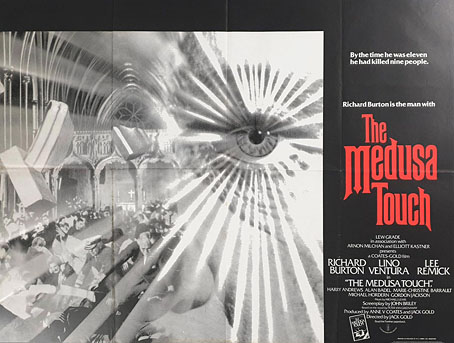
Continuing an occasional series about artworks in feature films. The Medusa Touch (1978) is the kind of film I usually dislike: a supernatural horror story with a preposterous premise—a man who causes disasters to occur with the power of his mind—which is also an ITC production directed by Jack Gold with a TV-friendly gloss, all overlit interiors and zoom-happy camera work. Richard Burton plays the man with a name you only find in horror novels, “John Morlar”, whose telekinetic gift is also a curse, the Medusa touch of the title, although his affliction is never quite described as such. It’s Burton who makes this one worth watching, he burns with a misanthropic intensity in every scene he appears in, delivering his lines with a conviction that suggests he identified rather too much with Morlar and his hatred for the world. The film unfolds as a police procedural, opening with the attempted murder of Morlar by an unknown assailant, then following the investigation that reveals the victim’s history. The police business is the weakest part of the film; being a British/French co-production means that the man leading the investigation, Inspector Brunel, is a Frenchman working in London as part of an exchange programme. Brunel’s dull character is further diminished by having him played by Lino Ventura with a dubbed voice, but it’s the inspector’s quest for clues to Morlar’s past that bring us eventually to the art.
medusa2.jpg

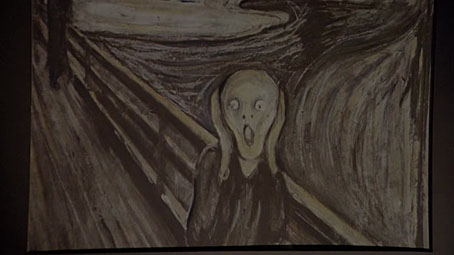
The first artwork, however, appears before all of this. The film opens in the street outside Morlar’s London home then cuts to the inside of his flat with this close view of a print of Edvard Munch’s The Scream. Munch’s most famous painting wasn’t quite the visual cliché in 1978 that it is today. Morlar’s history is recounted in a series of flashbacks which reveal him to have been a barrister whose distaste for the legal profession leads to his becoming a novelist with characters used as mouthpieces for his misanthropy. The art in his mansion flat is scrutinised by Brunel without being subjected to any discussion, leaving us to decide whether these works are the kinds of things that Morlar actually liked or exterior emblems related to his condition.
medusa3.jpg

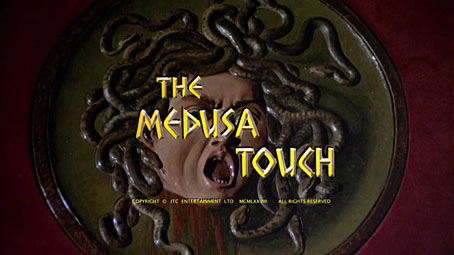
A relief based on Caravaggio’s Medusa (c.1597).

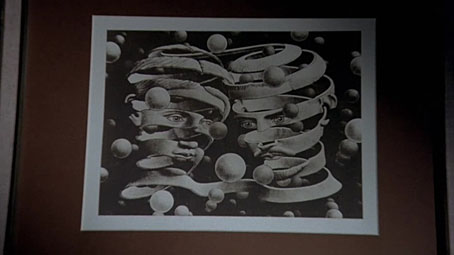
The head of Medusa pinned on Morlar’s wall suggests the latter, although the only introspective comments from Morlar come in the scenes with him and his psychiatrist, Dr Zonfeld (Lee Remick), which are mostly discussions of his calamity-filled life. Morlar and Zonfeld’s combative relationship may explain the next artwork which catches Brunel’s eye, a print of Bond of Union (1956) by MC Escher.
medusa4.jpg

The choice is an unusual one when the print was made to celebrate Escher’s marriage which was relatively happy, unlike Morlar’s disintegrated union which ends with him willing his wife to death in a car crash. Escher was very trendy in the 1970s, collections of his work were being published for the first time and his prints were everywhere. A better match for a story of this type might have been Eye (1946), an image with greater symbolic resonance that would also complement all the moments when Jack Gold’s camera zooms into Morlar’s basilisk glare.
medusa5.jpg

munch.jpg

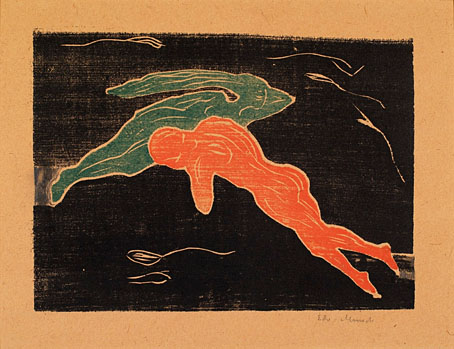
Encounter in Space (1899) by Edvard Munch.

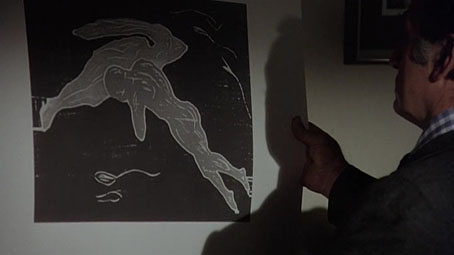
After looking at the Escher, Brunel leafs through Morlar’s print collection, pulling out another Munch, and a very strange choice it is. This is an odd scene: the prints are all badly lit and none of them have much overt reference to either Morlar’s character or the story as a whole.

Continue reading “Art on film: The Medusa Touch”