Weekend links 801

waterhouse.jpg

The Magic Circle (1886) by John William Waterhouse.

The Moon and Serpent Bumper Book of Magic has just been published in France by Editions Delcourt. A preview here shows how carefully they’ve managed to translate and reletter my page designs.

• Among the new titles at Standard Ebooks, the home of free, high-quality, public-domain texts: Algernon Blackwood’s stories of John Silence, occult detective.

• Relevant to some of my recent reading: The Necronomicon Wars, an examination of the many attempts to give life to HP Lovecraft’s fictional grimoire.

Altered States is tremendously exciting to watch—and not only during its psychedelic interludes when goat Jesus is being crucified and writhing red figures are toppling, Hieronymus Bosch–like, into hell and abstract splotches give the impression of cells endlessly dividing or murky membranes dissolving and beautiful women stare into Magritte skies and waves of lava crash as though the molten core of humanity itself were erupting. Even in its quieter moments, it is a beautiful film, with Hurt’s every appearance shot by cinematographer Jordan Cronenweth to emphasize his character’s alien otherworldliness.

Jessica Kiang explores the creation of Ken Russell’s flawed but fascinating psychedelic feature, Altered States

• A new catalogue of lots at another After Dark: Gay Art and Culture online auction. Homoerotic art, photos, historic porn. etc.

Tarot decks through the ages: a video showing some of the cards from Victoria and Albert Museum’s collection.

• More psychedelia: Neuroscientist Grigori Guitchounts asks “What is your brain doing on psychedelics?”

• At the Daily Heller: Ryan Hughes has published a weighty collection of his typeface designs.

• Old music: Caged (25th Anniversary Edition) by Ian Boddy & Chris Carter.

• At the BFI: Rory Doherty selects 10 great Technicolor melodramas.

• At Dennis Cooper’s: The Old School Horrors of Terence Fisher.

Photographs from the 2025 Wildlife Photographer of the Year.

Ambientblog celebrates 20 years of existence.

• RIP Dave Ball.

Necronomicon (1970) by Les Baxter | Liriïk Necronomicus Kahnt (1975) by Magma | Necronomicon–The Magus (2004) by John Zorn

Weekend links 789

ullman.jpg

Niemand (1990) by Micha Ullman.

The Diary of a Nobody (1964) by Ken Russell, John McGrath, Weedon Grossmith & George Grossmith. A recent posting at Play For Forever, an archive of hard-to-find/unreissued British TV drama.

• New music: Paul St. Hilaire With The Producers by Paul St. Hilaire; Atoms In The Void by Ivan the Tolerable & Hawksmoor; The Cosmic Tones Research Trio by The Cosmic Tones Research Trio.

• At Public Domain Review: Julie Park explores the history of the camera obscura.

• At The Wire: Read an extract from Philosophy of Jazz by Daniel Martin Feige.

• At Unquiet Things: Jana Heidersdorf’s fairy tale subversions.

• At Colossal: Five decades of land art by Andy Goldsworthy.

• The Strange World of…Marissa Nadler.

• RIP Robert Wilson.

Nobody (1968) by Larry Williams & Johnny Watson with Kaleidoscope | “There Is Nobody” (1976) by Brian Eno | Nobody (1978) by Ry Cooder

The art of Dick Ellescas

ellescas01.jpg

The Boy Friend (1971).

I chanced upon the album cover art of Dick Ellescas a few weeks ago when I was searching for something on Discogs. Classical music labels are extraordinarily lazy when it comes to packaging their recordings, as a result of which the commissioning of original art always stands out. Dick Ellescas turned up again more recently when I was working my way through the Ken Russell filmography. Russell’s Sandy Wilson adaptation, The Boy Friend, was released in the US with an Ellescas poster that combines an Art Deco style with the modishness of early 70s graphics. This also stood out from the crowd and sent me in search of more of the same. The examples here are only a small selection from the Ellescas oeuvre; Discogs credits him with over 30 album covers. The Strauss cover below is uncredited so there may be more out there. Some of Ellescas’s illustrations for Cosmopolitan magazine may be seen here.

ellescas02.jpg

The Magic Christian (1969).

ellescas03.jpg

Borodin/Liadov: Symphony No.1/From The Book Of Revelation From Days Of Old/A Musical Snuff-box (1971); Moscow Radio Symphony Orchestra, USSR Symphony Orchestra.

ellescas04.jpg

Strauss: Die Frau Ohne Schatten (1971); Kurt Eichhorn, Orchestra of Bavarian Radio, James King.

ellescas05.jpg

Continue reading “The art of Dick Ellescas”

Art on film: Crimes of Passion

cop11.jpg

Continuing an occasional series about artworks in feature films. I’ve been spending the past couple of weeks working my way through the Ken Russell filmography, rewatching familiar documentaries and feature films while acquainting myself with the portions of the Russell oeuvre that I’d missed in the past. Crimes of Passion (1984) was a film that I did see when it turned up on video in the late 1980s but I didn’t remember much about it apart from its overheated erotic atmosphere and a red/blue lighting scheme. It’s not one of Russell’s best—the script lurches uncomfortably between mundane domestic drama and lurid, sex-crazed delirium; Rick Wakeman’s synthesizer score is persistently annoying—but it does feature spirited performances by the lead actors, Kathleen Turner and Anthony Perkins.

cop03.jpg

Turner is Joanna Crane, a swimwear designer who deals with the vacuity of her life by moonlighting as an in-demand prostitute named China Blue. (The polite term “sex worker” didn’t exist in the 1980s.) Russell delivers the art references early on, with unexpected cuts to erotic figures from Aubrey Beardsley’s Lysistrata (above), various Japanese shunga prints, and a flash of The Rape by René Magritte. Since the real woman behind the China Blue persona isn’t revealed until later in the film we don’t know at first that Joanna Crane’s apartment contains reproductions of some of the same pictures. She eventually admits to thinking of them during stressful moments.

cop01.jpg

cop02.jpg

Despite this admission, there’s nothing in the script of Crimes of Passion that warrants the references, Crane’s apartment could easily have been furnished in a blandly expensive manner suited to a successful designer. The only other character who seems remotely interested in art is Anthony Perkins’ Reverend Shayne, a splenetic, sex-obsessed preacher who has a hotel room next door to China Blue. In one of several references to Psycho, Shayne watches his neighbour’s erotic encounters through a spyhole. The walls of his own room are covered in a collage of religious and pornographic imagery but little is made of this.

cop04.jpg

The Lovers by René Magritte.

cop05.jpg

Joanna Crane and Bobby Grady (John Laughlin) in Joanna’s apartment. Among the pictures on the walls are Romeo and Juliet by Marc Chagall, The Embrace by Gustav Klimt, and The Kiss by Gustav Klimt.

Continue reading “Art on film: Crimes of Passion”

Stomu Yamash’ta’s Seasons

stomu1.jpg

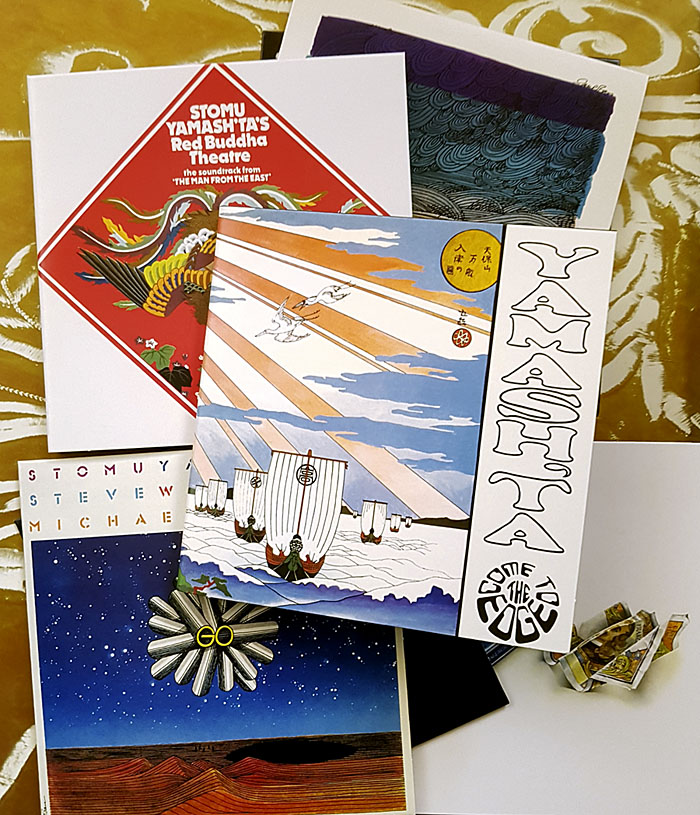
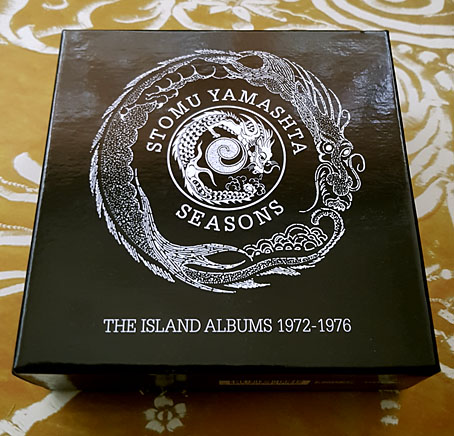
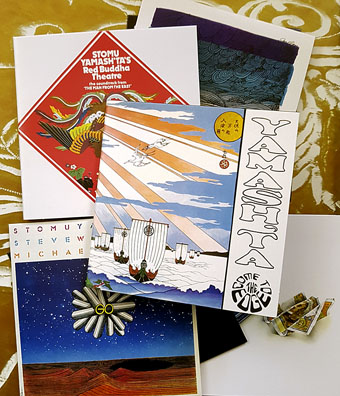
If you’ve ever watched The Man Who Fell to Earth then you’ve heard music by Japanese percussionist and composer Stomu Yamash’ta. The opening scene where David Bowie’s duffle-coated alien stumbles down a hillside (falling to earth for a second time) is scored with the first few minutes of Poker Dice, the opening track on Yamash’ta’s Floating Music album; more Yamash’ta pieces are heard later in the film. Floating Music has just been reissued on CD by Cherry Red in Seasons, a box set which contains all seven of the albums Yamash’ta recorded for the Island label from 1972 to 1976, with each disc housed in a facsimile card sleeve.
stomu2.jpg

Stomu Yamash’ta’s artistic profile was very high in the 1970s, high enough to make his apparent disappearance in the decade that followed an unusual thing. Unusual for me, anyway. I only started to notice his name in the early 1980s, mostly in connection with feature films, and couldn’t work out why he was no longer mentioned anywhere as an active artist. In addition to the Roeg soundtrack he plays on the soundtracks for Robert Altman’s Images (1972) and Saul Bass’s Phase IV (1974); he’s also one of the performers on the Peter Maxwell Davies score for The Devils (1971) although Ken Russell’s film gets to be so chaotic I’ve yet to identify his contribution. Later in the decade Yamash’ta was the only non-Western artist to appear in the final episode of Tony Palmer’s television history of pop music All You Need Is Love, in a programme that explored new musical directions. Away from films and TV there were numerous concerts; Yamash’ta’s history as a percussion prodigy in the 1960s had seen him performing compositions by Peter Maxwell Davies and Toru Takemitsu when he was still in his teens. His energetic performances gave way to a frenzied recording schedule—in 1971 alone he recorded six studio albums—which culminated in 1976 with the founding of Go, a short-lived jazz-fusion supergroup whose lineup included Steve Winwood, Al Di Meola, Michael Shrieve, and (surprisingly) Klaus Schulze.

Yamash’ta’s “disappearance” in the 1980s was really a retreat from the spotlight after a decade-and-a-half of almost continual public activity. He returned to Japan where he continued recording but gravitated away from jazz and avant-garde music towards the spiritual side of Japanese culture. Most of his albums since 1980 have only been Japan-only releases, another factor contributing to his obscurity elsewhere. More recently he’s taken to playing the Sanukitophone, a bespoke percussion instrument made from a variety of volcanic rock unique to the Japanese archipelago.
stomu3.jpg

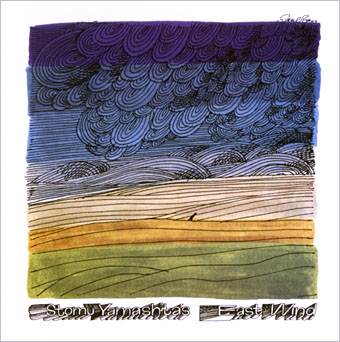
Freedom Is Frightening (1973), one of three Yamash’ta albums with cover designs by Saul Bass.

The albums in the new box set encapsulate what might be called Yamash’ta’s “Kozmigroov” period, although Yamash’ta’s name is absent from the generally thorough and wide-ranging Kozmigroov Index. This is also his most commercial period. Prior to 1972 Yamash’ta’s recordings were soundtracks, performances with orchestras or improvised freakouts; from 1980 his music seems to be predominantly meditational (“New Age”, if you must) but I’ve not heard most of it so can’t say much about it. Kozmigroov is jazz fusion at core, usually combining a variety of disparate influences, which is what you have here: extended arrangements of jazz, funk, soul, rock, electronics, and occasional moments of traditional Japanese music. The continually changing group names testify to a restless nature: Floating Music (1972) by Stomu Yamash’ta & Come To The Edge (a British jazz group), Freedom Is Frightening (1973) by Stomu Yamash’ta’s East Wind, The Soundtrack From “The Man From The East” (1973) by Stomu Yamash’ta’s Red Buddha Theatre, One By One (1974) by Stomu Yamash’ta’s East Wind, and Raindog (1975) by Yamashta [sic]. Then there’s the self-titled Go album (with a cover design by Saul Bass) and its live counterpart, Go…Live From Paris. (A third and final album by the group, Go Too, was released on Arista so isn’t included in this set.) The sound evolves from semi-improvised instrumentals on the first few albums to songs and more rock-oriented arrangements on Raindog and the Go releases, with the Steve Winwood songs on the latter coming across as a step into more predictable territory compared to the earlier recordings. The Go live album is much better than the uneven studio set, a sustained suite of songs and instrumentals linked by Klaus Schulze’s synthesizers; Schulze gets a big cheer when the band is introduced. If you like jazz fusion there’s a lot to enjoy in this box, a third of which I hadn’t heard before. Dunes, the opening track on Raindog, unfolds over 15 minutes with an insistent groove that brings to mind the Mahavishnu Orchestra and early Santana, although Maxine Nightingale is a better singer than anyone on the Santana albums. And if you are familiar with The Man Who Fell to Earth then you get all of Yamash’ta’s music from the soundtrack scattered across these albums, most of which is only heard as extracts during the film.

With the recent reissue of Sunrise From West Sea “Live” I’m tempted to think that we might be due for a resurgence of interest in Stomu Yamash’ta’s music, but the prior availability of the Seasons albums as individual CDs doesn’t appear to have prompted a clamour for more. There’s a lot more out there, however, especially the rare Japanese releases from the early 1970s. Follow the links below for more detail.

The Infinite Horizons of Stomu Yamash’ta by Gregor Meyer.
The Strange World of…Stomu Yamash’ta by Miranda Rimington.

Previously on { feuilleton }
The Devils on DVD
Directed by Saul Bass
Saul Bass album covers
Images by Robert Altman