Two new covers

rockhill.jpg

My latest cover designs have arrived in time for Spook Month, although the first of these suits the season more by association than its appearance. Jim Rockhill’s A Mind Turned in Upon Itself is a study of the work of J. Sheridan Le Fanu, Ireland’s leading writer of ghost stories and Gothic fiction. This is another design for Swan River Press which adheres to the publisher’s preferred format of a dustjacket that wraps a small hardback with textured and illustrated boards. The brief was fairly straightforward, to present a rare photograph of Le Fanu in a suitably attractive manner. My initial idea was to create a frame that would reflect to some degree various aspects of Le Fanu’s fiction, but it quickly became apparent that the portrait photo was too tall and narrow to sit easily inside a frame that matched the ratio of the book. A better option was to look for a frame which could fit the shape of the book while also filling in the space around the photo.

dore.jpg

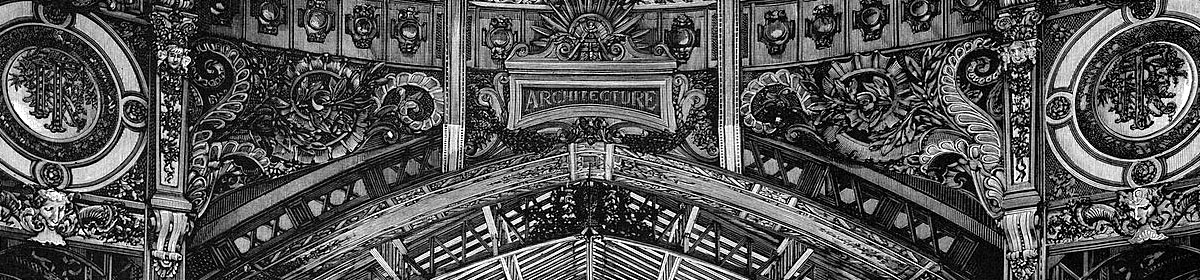
A page from The Workshop: a Monthly Journal Devoted to Progress of the Useful Arts.

When Le Fanu was writing in the mid-19th century book design had become very lavish, with a proliferation of presentation volumes gold-blocked and embossed on their covers and spines. The Heztel editions of Jules Verne are prime examples, as are the many editions of Gustave Doré’s books. My cover is an adaptation of a German edition of Doré’s Bible which had an unusual panel in the centre that happened to be a good size and shape to accommodate the Le Fanu photo, although I still had to extend the design a little. My version also includes a pair of small Le Fanu monograms embedded in the frame.

outline.jpg

For the board illustration I followed the form of an earlier Swan River book with an Irish theme, The Far Tower, whose boards I covered with an engraving collage. The end result, which looks like a single illustration, is a composite of two smaller illustrations from a book of views of Ireland, together with a quantity of foliage which frames the design and joins the pictures together.

ppc.jpg

The second cover is for a book I’m working on at the moment, Lovecraft’s Brood, a sequel to Tachyon’s well-received Lovecraft’s Monsters. I was very pleased to be asked to work on this one, the earlier book is a favourite of mine from among the books I’ve done for Tachyon, and Ellen Datlow is an expert at compiling well-chosen story collections. There’s not much I can say about the cover which follows the form of the previous book. As with Lovecraft’s Monsters, the framed face will also appear as one of the interior illustrations. You’ll have to wait a while to see the results of this, however. Watch this space.

brood-cover.jpg

Meanwhile, I’ve neglected to mention another Tachyon book whose interiors I’ve designed which is available now. The Essential Horror of Joe R. Lansdale is a great introduction to the work of a master of horror fiction whose stories manage to be grim and witty in equal measure. Very grim at times; visceral horror is Lansdale’s forte. The collection includes his best-known story, Bubba Ho-Tep, and features cover art by another Swan River Press cover artist, Dave McKean.

Previously on { feuilleton }
Lovecraft’s Monsters

Karel Zeman film posters

zeman17.jpg

A festival poster from 2022. Zeman’s films are popular in Japan.

Last week’s post about Czech film-maker Karel Zeman prompted me to see whether any more of his feature films have become available on disc. The international success of Zeman’s semi-animated adventures led to the production of more films along similar lines, although not all of these are as fantastic (or as popular) as Invention for Destruction or Baron Munchausen. A Jester’s Tale, for example, is a historical drama, albeit one which still makes use of Zeman’s skill with animation and special effects. The Karel Zeman Museum in Prague has been slowly restoring and reissuing the director’s features on DVD and blu-ray discs, the most recent title being The Stolen Airship, another film based on Jules Verne’s novels which I’m looking forward to seeing. The museum has also been increasing its production of spin-off products, including poster prints which include a couple of designs I hadn’t seen before. Browsing the poster sites revealed a few more attractive designs for international releases.


The Treasure of Bird Island (1953)

zeman01.jpg

Czech, 1953. Art by Jindřich Cech.

I still haven’t seen Zeman’s first two features. The Treasure of Bird Island is wholly animated story based on a Persian fairy tale.


Journey to Prehistory (1955)

zeman02.jpg

Poland, 1955. Art by Jan Młodożeniec.

Zeman’s second feature is his first film to mix live action and animation, with a story about a group of boys whose journey down a river leads to an encounter with prehistoric creatures. I like the way this poster reduces the narrative to its basic elements while also looking like a design for a Godzilla-themed postage stamp.


Invention for Destruction (1958)

zeman03.jpg

Czech, 1958. Art by Karel Knechtl.

A film I’ve enthused about before, and an ideal place to start with Zeman’s fantasies.

zeman04.jpg

Poland, 1958. Art by Jan Lenica.

“That looks like a Jan Lenica design,” I thought, and so it is. The human-headed fish vehicle has little to do with Zeman’s film but a character like this wouldn’t be out of place in one of Lenica’s own animations, especially Labirynt.

Continue reading “Karel Zeman film posters”

Weekend links 783

robinson.jpg

An illustration by William Heath Robinson for A Midsummer Night’s Dream (1914).

• New music: How To Shoulder The Radiance Of Revelations by Dadub; Leviathan by Stephen Roddy; and Echoes Of The Hollow Earth by Cryo Chamber.

• At Sight & Sound: “Every time I look at the film, it gets better.” Steven Soderbergh on Jaws.

• At Public Domain Review: The Language of Form: Lothar Schreyer’s Kreuzigung (1920).

Leafing through the merveilleux-scientifique novels today allows for a dual rediscovery: firstly, it uncovers the previously unrecognised richness of Belle Époque scientific fiction, which did not perish with the works of Verne. The stories take in journeys to Mars, solar cataclysms, reading of auras, psychic control, weighing of souls, death rays, alien invasions, even strolls among the infinitesimally small. But exploring the genre also offers insights into the cultural history of the era, marked by a significant permeability between science and pseudo-science. Reading this work, we can learn a lot about the aspirations, fears and beliefs of early 20th-century Europe.

Fleur Hopkins-Loféron on the evolution of French science fiction after Jules Verne

• Mix of the week: A Twin Peaks mix for The Wire by Lori Eschler & Dean Hurley.

• Steven Heller’s font of the month is Kefir.

Patrick Wolf’s favourite albums.

ultrawolvesunderthefullmoon

Frou-Frou Foxes In Midsummer Fires (1990) by Cocteau Twins | Midsummer Night (2010) by The Time And Space Machine | Midsummer Boulevard (2022) by Hawksmoor

Weekend links 752

nemo.jpg

Captain Nemo by Alphonse de Neuville, from Twenty Thousand Leagues Under the Seas (1875) by Jules Verne.

• “…physical remoteness is a category of its own. It is an enhancer: It can make the glorious better and the terrible worse. The oceanic pole of inaccessibility distills physical remoteness on our planet into a pure and absolute form. […] Point Nemo is nearly impossible to get to and offers nothing when you arrive, not even a place to stand. It is the anti-Everest: It beckons because nothing is there.” Cullen Murphy explores the remotest place on Earth. A long and fascinating read, but no mention of Point Nemo’s dreaming tenant.

• More Bumper Book business: Smoky Man has posted the second part of his analysis of the book for (Quasi) (in Italian) which includes some comments from myself about the origin of the Moon and Serpent Magical Alphabet, and why the letter Q in the alphabet is assigned to Cthulhu. Elsewhere, Panini have announced an Italian edition of the Bumper Book for May next year, while at The Beat Steve Baxi reviewed the book from a philosophical perspective.

• At the BFI: David Parkinson on where to begin with Louis Feuillade. I’d suggest starting with Fantômas rather than Les Vampires but then I’m biased.

The combination of magic(k)al, ceremonial action, vivid colour and paradoxically serious camp in Jarman’s Super 8 films of the ’70s bears the influence of Kenneth Anger, but the differences between Jarman’s sensibility and Anger’s are more striking than the resemblances. Jarman’s vision is more materialist, austere and hermetic, and less sociological; where Anger identifies the glamour of American popular culture with the Will of the Crowleyan magician, Jarman situates the discovery of the cinematographic mechanism imaginatively within the history of alchemy. Anger cast rock stars as gods and adepts with the intention of harnessing the energy of their recognition; Jarman casts Fire Island, then in its heyday as a gay resort, as a desert defined by sculptural details and occupied by a single masked figure, in scenes that both recall his landscape paintings of the ’60s and ’70s and anticipate the design of his garden at Dungeness.

Luke Aspell on Derek Jarman’s hermetic film/painting, In the Shadow of the Sun

• At Smithsonian Magazine: “Visions of nuclear-powered cars captivated Cold War America, but the technology never really worked”.

• At The Spectator podcast: host Sam Leith talks to Michael Moorcock about 60 years of New Worlds magazine.

• At Public Domain Review: “Light from the Darkness” — Paul Nash’s Genesis (1924).

• At Bandcamp: “Disco godfather Cerrone’s enduring influence on dance music”.

• At Unquiet Things: The Art of Survival: Eyeball Fodder in Dark Times.

• Mix of the week: DreamScenes – November 2024 at Ambientblog.

• New music: The Laugh Is In The Eyes by Julia Holter.

• At The Daily Heller: The College of Collage.

• RIP jazz drummer Roy Haynes.

Thermonuclear Sweat (1980) by Defunkt | Nuclear Drive (1982) by Hawkwind | Nuclear Substation (2005) by The Advisory Circle

A territory always rather nocturnal and almost subaqueous

verne.jpg

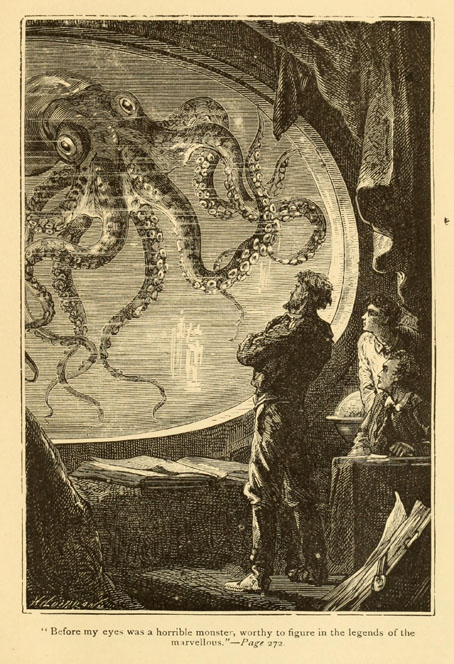
I’m still reading through Umberto Eco’s essays in between various novels, the current Eco volume being Chronicles of a Liquid Society, a book which includes an appraisal of the works of Jules Verne. Enthusiastic remarks about engraved illustrations are uncommon things so I wanted to draw attention to the following:

Verne’s engravings are far more mysterious and intriguing, and they make you want to examine them through a magnifying glass. Captain Nemo, who sees the giant octopus from the large porthole of the Nautilus; Robur’s airship bristling with high-tech masts; the balloon that crashes down on the Mysterious Island (“Are we rising again?” “No. On the contrary.” “Are we descending?” “Worse than that, captain! We are falling!”); the enormous projectile that points toward the Moon; the caves at the centre of the Earth—all are images that emerge from a dark background, outlines with thin black strokes alternating with whitish gashes, a universe without areas of uniform colour, a vision scratched and scored, reflections that dazzle for lack of any strokes, a world seen by an animal with a retina all its own, as seen perhaps by oxen or dogs or lizards, a world glimpsed at night through the thin slats of a venetian blind, a territory always rather nocturnal and almost subaqueous, even in full daylight, made with the dots and abrasions that generate light only where the engraver’s tool has dug or left the surface in relief.

The illustrators of Captain Nemo’s adventures were Alphonse de Neuville and Édouard Riou, their drawings being engraved by Henri Hildibrand. See the rest of them here.

Elsewhere on { feuilleton }
The etching and engraving archive

Previously on { feuilleton }
Eco calls on Cthulhu