Master musicians

mmob1.jpg

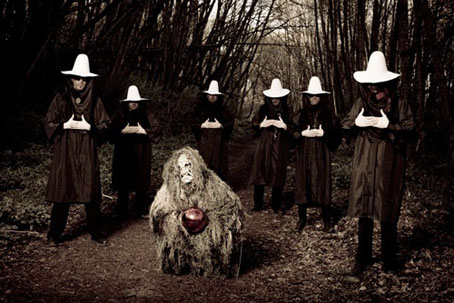
This year I’m seeing out December with (among other things) several albums by the Master Musicians of Bukkake, a Seattle group led by producer Randall Dunn. MMOB’s name started as a joke (and no doubt still catches unawares anyone unfamiliar with Japanese pornography) but now positions the ensemble as indigenous performers from an imaginary country, a persona reflected in the masks and robes the musicians wear, and in their music which blends chants, non-Western instruments, synthesizers and extended wah-wah guitar drones that wouldn’t be out-of-place on a German album from the 1970s. The music alone would be enough for me but there’s the added bonus of songs based on Borges texts, Tibetan references (Dunn is a Buddhist) and outfits borrowed from Jodorowsky films. Dunn and some of the other group members have connections with Seattle groups Earth and Sunn O))), and it’s possible to detect trace elements of both those bands in the MMOB sound, especially on live recordings.
mmob2.jpg

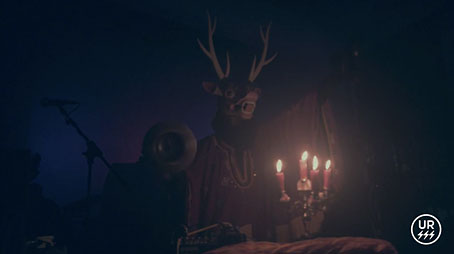
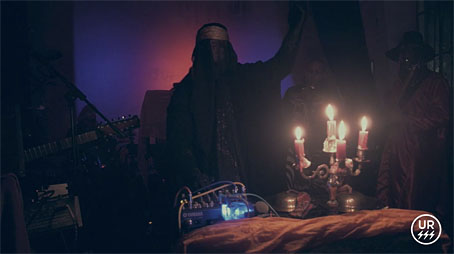
As usual I’ll be taking my winter break over the next few days so I’ll activate the blog archive and leave you with a tremendous 75-minute performance by the Master Musicians of Bukkake at Leoncavallo, Milan, in 2013. The stage is rather cramped for the group’s theatrics, and there’s only the one camera, but the band raise a considerable cone of power performing extended variations on numbers from their recent Far West album. Far West and its follow-up, the synth-oriented Further West Quad Cult, can be listened to on their own or played together in a mix of your own choosing. MMOB aren’t the first band to do this but I don’t know of any album or (albums) that sound so different in isolation. Perfect listening for the darkest weeks of the year.

mmob3.jpg

MC Escher book covers

escher08.jpg

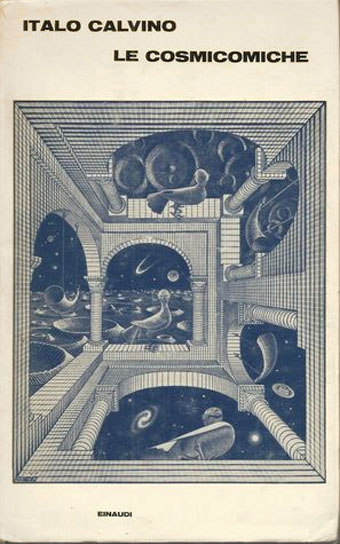
1963. Art: Other World (1947).

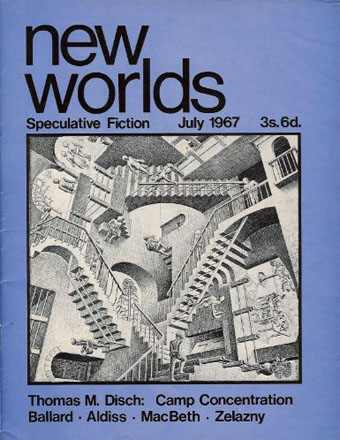
MC Escher’s prints have been touring the UK this year: a few months ago they were in Scotland, this month they can be seen at the Dulwich Picture Gallery in London. The renewed attention prompted the BBC to produce a documentary, The Art of the Impossible: MC Escher and Me, in collaboration with Professor Roger Penrose. One of the programme researchers saw my earlier post about the use of Escher’s work on album covers, and asked if I wanted to appear on camera talking about this, something I politely refused to do. I’m happy to hold forth from a keyboard, however, so here’s a post about some of the books that have used Esher’s work to decorate their covers. Most of these are fiction but there must be many more non-fiction titles—especially in the fields of science and mathematics—that borrow Escher’s prints.

escher09.jpg

The first edition of Calvino’s comic stories from 1965.

escher10.jpg

Art: Relativity (1953).

Not a book but editor Michael Moorcock has claimed that this was the first UK magazine to print any of Escher’s work.

Continue reading “MC Escher book covers”

Weekend links 278

sanmartin.jpg

El Hotel Satina (2006) by Oscar Sanmartin.

Andrew Kötting’s By Our Selves is “a melancholy, maverick film” says David Jays. With Toby Jones following in the footsteps of poet John Clare, Iain Sinclair in a goat mask, and Alan Moore warning about the “vision sump” of Northampton.

• “Shunga means ‘spring pictures’. They depict sometimes spectacular sexual contortions and come imbued with the power of taboo. For years they have largely been out of sight—until now.” Related: shunga prints at Ukiyoe Gallery.

• “Who else could link Smokey Robinson and JG Ballard, Iggy Pop and Josephine Baker, James Bond and Stephen Sondheim, Gary Numan and Johnny Cash, Tricky and Tom Moulton…” Grace Jones is the best, says Joe Muggs.

Ballardian space – what he called “inner space” to differentiate it from the science fiction that concerned itself with distant planets and space rockets – is in fact a fusion of inner and outer space. There is no “out there” totally separate from his characters; just as there is no exclusively private, isolated inner life. His most psychologically fulfilled characters look to transcend their physical surroundings, however hostile, by embracing them.

Chris Hall on High-Rise by JG Ballard

• “In March 1984, Jorge Luis Borges began a series of radio ‘dialogues’ with the Argentinian poet and essayist Osvaldo Ferrari, which have now been translated into English for the first time.”

• “I came up with a couple of tunes, literally in my bedroom. People think of bedroom recordings as a modern, laptop invention. It wasn’t.” Daniel Miller on the accidental success of Mute Records.

• “It was in Prague that I first awoke.” Strange Flowers on Gustav Meyrink’s life in Prague.

• At 50 Watts: Stencilled ornament and illustration by William Addison Dwiggins.

• Mix of the week: The Ivy-Strangled Path Vol. X by David Colohan.

Wyrd Daze, Lvl2 Issue 4, is free and brimming with the weird.

Mythology, a new series of drawings by Howard Hardiman.

Spike Jones is the best, says MetaFilter.

Peacocks at National Geographic.

Warm Leatherette (1980) by Grace Jones | Warm Leatherette (1998) by Chicks On Speed | Warm Leatherette (2013) by Foetus

Gérard Trignac’s Invisible Cities

trignac09.jpg

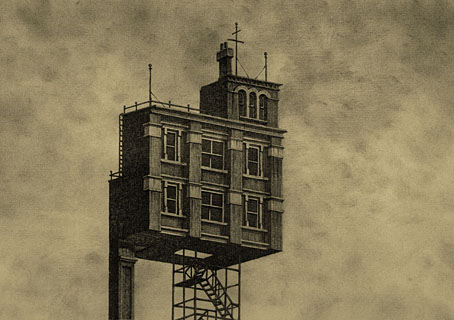
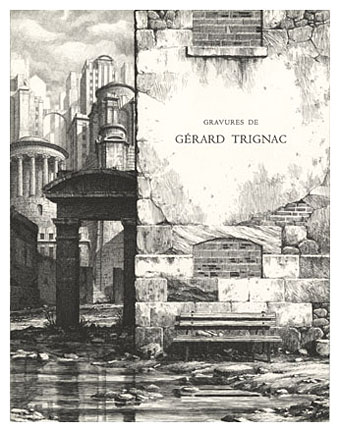
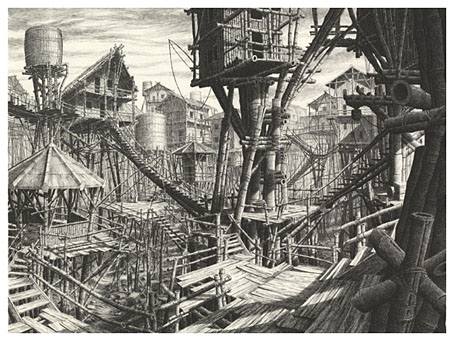
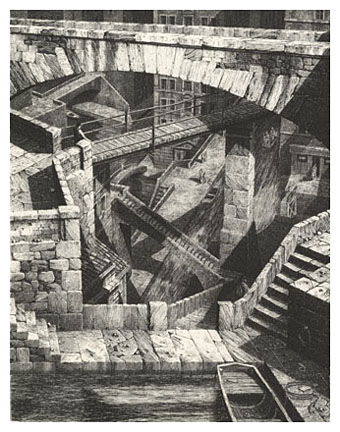
I wrote a short appreciation of French artist Gérard Trignac back in 2006, and he’s been mentioned a few times since, so it would be remiss of me to not include his etchings in this week’s illustration series. Trignac is a favourite of mine among the current crop of French etchers and engravers for his superb renderings of fantastic architecture. Most of this work is from his own imagination but he’s also illustrated Borges (The Immortal) and Calvino, producing plates for expensive limited volumes. Les Villes Invisibles was published in 1993 by Les Amis du Livre, Paris, in an edition of 200. The combination of a small print run with a series of ten etchings makes this a costly volume; the cheapest edition on Abe.com just now is going for €1500.

Scarcity aside, these are marvellous depictions of Calvino’s cities, as detailed and meticulous as any of Trignac’s other works. One thing that becomes apparent when you start looking at illustrations of Calvino’s novel is that artists tend to pick the same few cities. So in Trignac’s case we have more views of Armilla, Octavia, Zenobia and so on. All of these may be seen at Trignac’s website, while one of the expensive volumes is for sale here. For those who can’t afford the latter I recommend Les Portes du Silence (2004), a collection of Trignac’s work that includes all the plates for Les Villes Invisibles, the Borges’ illustrations, and much more besides.

trignac03.jpg

Thin Cities 2: Zenobia.

trignac02.jpg

Trading Cities 5: Esmeralda.

Continue reading “Gérard Trignac’s Invisible Cities”

La Bibliothèque de Babel

babel01.jpg

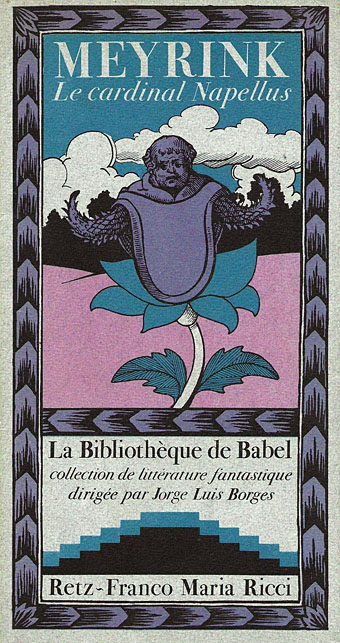
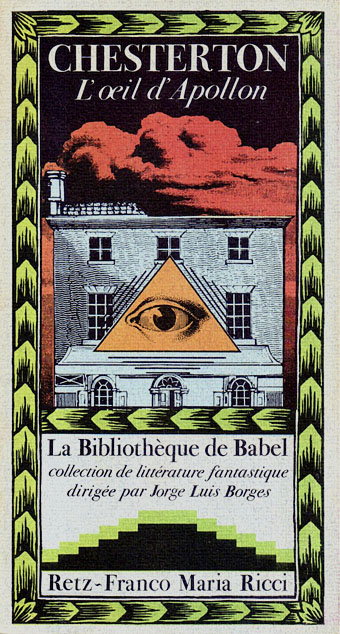
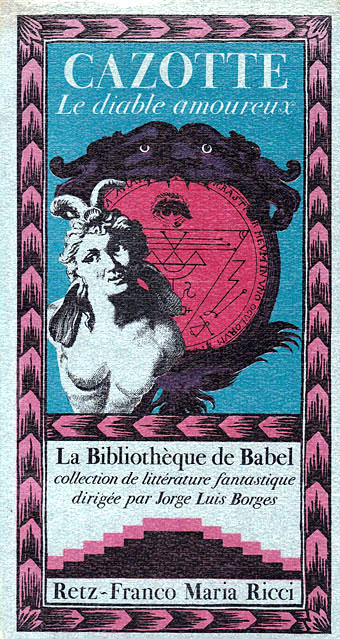
It was perhaps inevitable that this small collection of works of fantastic fiction was named after its director’s most famous creation, the Library of Babel. Jorge Luis Borges chose the titles, and also wrote introductions for each of the books. The series was published in France by Retz–Ricci, with 4000 numbered copies of each title appearing from 1977 to 1981.

Many of the selections will be familiar to Borges aficionados, others seem obscure as a result of the vagaries of translation: Jack London’s Les Morts Concentriques is The Minions of Midas, a story that Borges had earlier translated into Spanish as Las Muertas Concéntricas (The Concentric Deaths). The story of linked deaths apparently influenced the writing of Death and the Compass. I’ve never seen Borges discuss Arthur Machen at length so the inclusion of Machen in the selection is a welcome sight. In addition to The Shining Pyramid, the Machen volume also contained The Novel of the Black Seal and The Novel of the White Powder, two of the oft-anthologised sections of The Three Imposters.

The only detail that’s defeated me  is the identity of the illustrator of the series. If anyone knows who was responsible then please leave a comment.

Update: the covers are credited to publisher/designer Franco Maria Ricci and Marcella Boneschi. Thanks to herr doktor bimler and Al Diniz.

babel02.jpg

babel03.jpg

Continue reading “La Bibliothèque de Babel”