Weekend links 821

tevis.jpg

The first UK paperback edition, 1976. Cover art by David Bowie’s illustrator friend George Underwood.

• At the BFI: “Humanity, lost and found”. The original Sight and Sound review by Tom Milne of The Man Who Fell to Earth which was released 50 years ago this month. The film is another Nicolas Roeg project whose lofty reputation today has made everyone forget the bewildered or even hostile reaction it generated at the time, including from the US distributor, Paramount, who hated it. Milne, by contrast, had read the novel it was based on, and paid close attention to what the film’s writer, Paul Mayersberg, described as its “minefield of images”.

• Among the new titles at Standard Ebooks, the home of free, high-quality, public-domain texts: The Varieties of Religious Experience by William James.

• Issue 13 of Verbal magazine features an interview with Michael Moorcock, Iain Sinclair in the “Talking Books” section, and more.

• New music: 4 Hours (DVATION 2026 Version) by Clock DVA; -Music For Oriental Hotel Okinawa Resort & Spa- by Harikuyamaku.

• The Shaw Brothers Cinema YouTube channel has whole feature films from the studio’s huge archive free to view.

• At Colossal: “Historic architecture emerges from stone in Matthew Simmonds‘ ethereal sculptures”.

• “Music with Balls”: Terry Riley performing live with an arrangement of shiny silver spheres on KQED TV in 1969.

• Mixes of the week: DreamScenes – March 2026 at Ambientblog, and Motorik by Jon Savage.

• “What is electronic music?” Daphne Oram explains.

• RIP Country Joe MacDonald.

Stardust (1941) by Artie Shaw And His Orchestra | Stardust (1959) by Martin Denny | Stardust (1985) by Yasuaki Shimizu & Saxofonettes

Weekend links 775

kokoschka.jpg

The Bride of the Wind (1914) by Oskar Kokoschka.

• Among the new titles at Standard Ebooks, the home of free, high-quality, public-domain texts: Fantômas, by Pierre Souvestre and Marcel Allain (translated by Cranstoun Metcalfe).

• This week’s Bumper Book of Magic news: the Brazilian edition of the book, titled A Lua e a Serpente: Almanaque de Magia, will be published in June. It’s available for pre-order here.

• “The basis of compilations as far as I’m concerned is, ‘I like this stuff, you may like it too.’” Jon Savage on the art of the compilation album.

• At Public Domain Review: The strange story of Oskar Kokoschka, Hermine Moos, and the Alma Mahler Doll.

• At the Daily Heller: Psychedelics, Day-Glo, Hallmark and The Peculiar Manicule.

Brion Gysin’s Dreamachine, a new version for sale from Important Records.

• The Strange World of…Michael Chapman.

• At Dennis Cooper’s: Boris Karloff Day.

• RIP David Thomas of Pere Ubu.

Dream Machine (1968) by Les Sauterelles | Dream Machine (1980) by The Androids | Dream Machine (1981) by Phantom Band

Weekend links 753

brewer.jpg

Grow (1970) by Linda Brewer.Via.

• The week in work-related reviews: Raymond Tyler reviewed the Bumper Book of Magic at Religious Socialism, while James Palmer did the same at Foreign Policy. Meanwhile, Rob Latham at the Los Angeles Review of Books examined the legacy of the New Wave of science fiction with reviews of New Worlds 224, and The Last Dangerous Visions, Harlan Ellison’s long-delayed story collection.

• “Incline Press is a private fine press publisher in the UK, stubbornly printing with hand set, metal type on a collection of vintage machines, working with poets and artists to make limited edition books and ephemera.”

• New music: Horses In Your Blood, another dose of unhinged weirdness from Moon Wiring Club; The Source by Jon Palmer; and Ekkorääg by Tarotplane.

• At Dennis Cooper’s: Spotlight on…Rikki Ducornet The Fan-Maker’s Inquisition: A Novel of the Marquis de Sade (1999).

• At Smithsonian Magazine: “Rare atlas of astronomy from the Dutch Golden Age goes on display in England“.

• Old music: Jon Savage’s Space, a space-themed compilation on Caroline True Records.

• At The Daily Heller: Berman’s Book Boom is a boon to graphic design’s legacy.

• At Public Domain Review: Christoph Jamnitzer’s Neuw Grotteßken Buch (1610).

• Mix of the week: A Dungeon Synth mix by Flickers From The Fen for The Wire.

• At Heavy Metal Magazine: The HP Lovecraft Art of John Holmes.

• At The Quietus: The Strange World of…Laurie Anderson.

I Can Hear The Grass Grow (1967) by The Move | Grow Fins (1972) by Captain Beefheart | The Growing (2011) by The Haxan Cloak

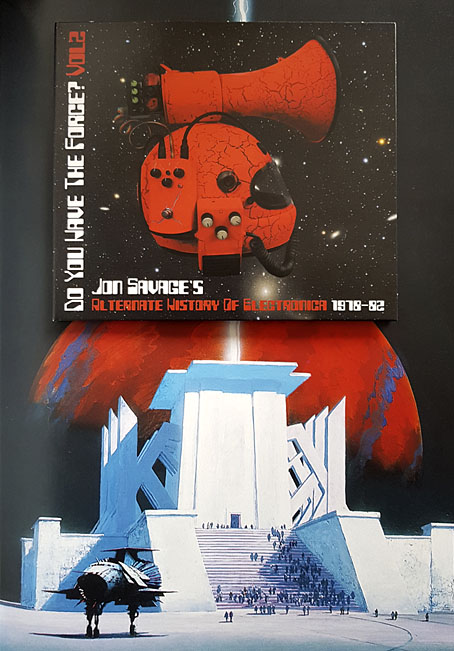
Do You Have The Force? Volume 2

savage.jpg

Cosmic background by John Harris.

Three years have passed since the release of Do You Have The Force?, Jon Savage’s compilation of space disco and post-punk recordings. The collection proved popular enough to prompt a follow-up which arrived here last week. I enjoy Mr Savage’s curatorial instincts so a second dose was irresistible even though I already own more of the tracks on the new album than I do with the earlier collection.

jackson.jpg

Data 70 for the win. Dee D. Jackson opens the new collection with a pulsing paean to robot sex.

I was thinking recently that the value of the historical compilation album—those collections that contain previously released material—has been diminished considerably by the rise of the internet mix. Before Mixcloud et al the home-made cassette compilation was a youth-culture staple (I made lots of them) but cassette collections seldom travelled beyond their maker’s immediate circle of friends. Official compilations had the advantage of wide distribution, access to quality sources and scarce recordings. The better ones also featured authoritative sleevenotes, an essential thing where those scarce recordings where concerned. One of the drawbacks of the home-made tape was brought to my attention in the late 1980s when a Dutch friend sent me a mix he’d made for a group of acquaintances who staged live art/occult performances. The contents were a soup of dialogue and music recorded from TV layered over borrowings from record-library albums which included a particularly haunting snatch of something that he only remembered as being “music from Ancient Egypt”. I spent the next ten years searching for this whenever I was in a record shop with a decent international section. I did find it eventually (it’s the funeral music from this) but without persistence and a chance discovery I might never have known what it was. One thing we don’t lack today is information, so the chances of being nonplussed in this manner are much more remote. The erosion of the former strengths of the compilation album have only placed more emphasis on the person of the compiler; all those Back To Mine collections have turned out to be models for the future.

lizards.jpg

Do You Have The Force? Volume 2 follows the form of Savage’s earlier collection by starting out in the disco/dance zone before sliding in the second half into the post-punk world, an area conterminous with disco yet seen at the time as being in opposition to any rock and pop that was regarded as too commercial, too trivial, etc. I’ve never been someone who needed to reappraise disco, there was more than enough in its cosmic and futuristic excursions to engage my interest at its peak of popularity. Not being a club-goer, however, the good stuff wasn’t always easy to find so I’m still learning from collections such as these. The post-punk material is home territory by comparison. The contents of the new album include yet more Cabaret Voltaire (I’d probably have chosen the uptempo Sluggin’ Fer Jesus instead of Red Mask), the beatless Beachy Head by Throbbing Gristle (the closest TG get to Eno’s On Land), and Monochrome Days by Thomas Lear & Robert Rental. The latter is from Lear & Rental’s The Bridge, a one-off collaboration released on Throbbing Gristle’s Industrial Records, and a cult album round these parts. If you’re familiar with Savage’s tastes, all the above are the kinds of inclusions you’d expect. Less predictable was another number from Fourth Wall, the second album by The Flying Lizards, which follows the Fourth Wall track that Savage included on Volume 1. I bought Fourth Wall when it was released in 1981, in part because Robert Fripp was credited among the players and I was curious to know what Fripp was doing with such an eccentric bunch. (This, if you’re equally curious.) David Cunningham’s Lizards are best known for their off-beat cover versions, the most popular of which, Money, was a surprise chart success in 1979. But Cunningham was (and still is) an experimental musician, and Fourth Wall showed much more of this side of his group, juxtaposing short looped pieces and other weirdness with a handful of original songs. Patti Palladin does most of the singing, also co-writing a huge favourite of mine, Hands 2 Take, that (once again) I would have chosen over Savage’s selections even though it’s not electronic enough for the album as a whole. But that’s one of the benefits of the compilation: it compels you to follow somebody else’s inclinations instead of your own. Biggest surprise of all has been Soft Space on the disco side, an electronic instrumental credited to Soft Machine. If you’re familiar with Soft Machine’s early albums, which evolved from psychedelic pop in the late 1960s to jazz-rock improvisation in the 1970s, then nothing prepares you for this piece, a one-off synthesizer composition recorded in 1978 by keyboard player Karl Jenkins. And that’s another benefit of the compilation album: an introduction to discographic anomalies that you’ve been missing all these years.

Will there now be a third volume? There’s more than enough musical material for another collection along the same lines so we’ll have to wait and see. Volume 2 is out now on Caroline True Records.

Previously on { feuilleton }
Talking time: Cabaret Voltaire interviews
Do You Have The Force?

Weekend links 727

maar.jpg

Untitled (Hand-Shell) (1934) by Dora Maar.

• “The Secret Public…reads like the book he was born to write…and speaks to the taboo around homosexuality which the bravest pop stars did their best to dispel.” Alex Needham reviewing The Secret Public: How LGBTQ Resistance Shaped Popular Culture (1955–1979) by Jon Savage. Anyone buying the book should also find themselves a copy of Savage’s Queer Noises compilation.

• At Dangerous Minds: Richard Metzger advises everyone to seek out Sion Sono’s 237-minute Love Exposure (2008), “Japan’s eroto-theosophical answer to the allegorical journeys of Alejandro Jodorowsky”.

Prince – Sign O’ The Times (Live at Paisley Park 12/31/87). Pro-shot video of the last performance of the Sign O’ The Times tour, with a unique contribution from Miles Davis.

• Old music: Camembert Electrique by Gong. A rocking riposte to the stereotype of the group as a bunch of whimsical hippies.

• New music: Lambda by ZULI. This is another release on the Subtext label which I designed.

• The Devil in the Flesh: Patrick Clarke on David Sylvian’s Red Guitar at 40.

Milky Way photographer of the year 2024.

The Strange World of…Gastr del Sol.

Jungle Guitar (1961) by The Palatons | Lunatic Guitar (1980) by Ippu-Do | Naive Guitar (1982) by Adrian Belew