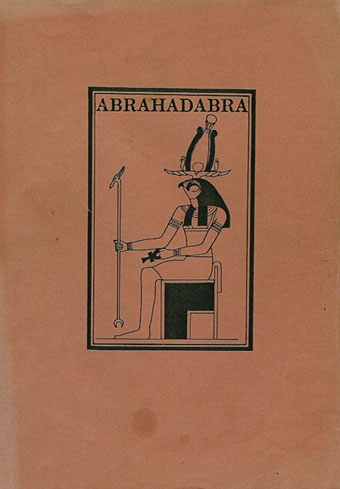
Abrahadabra

abrahadabra01.jpg

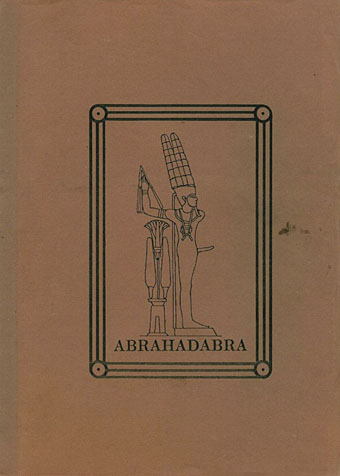
01 First (1985).

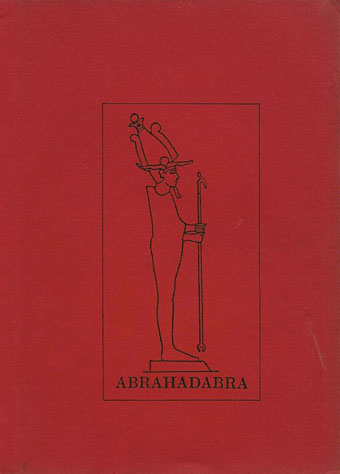
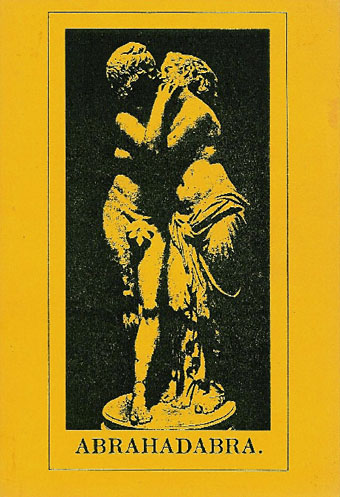
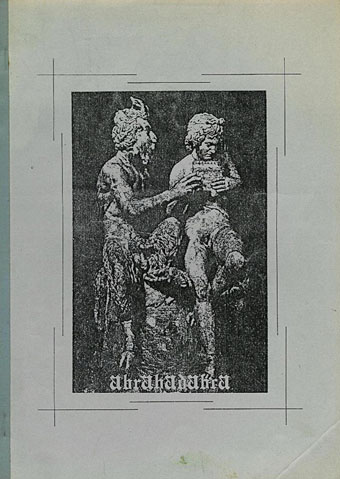
I’ve linked to so many publications at the Internet Archive I’m a little surprised it’s taken me this long to find something featuring my own work. Abrahadabra was a Dutch periodical covering subjects familiar to readers of the esoteric magazines of the 1980s (RE/Search, Rapid Eye, etc): Industrial music of the TG/Psychic TV/Coil variety, transgressive writers such as Burroughs, Ballard and Bataille, weird fiction of the Lovecraft/Machen school, and a heavy emphasis on occultism. My friend Ed was one of the contributors which is how my Pan drawing ended up in the Witches issue in 1987.

For a publication with minimal resources the production was often impressive, the drawing on the cover of the Austin Spare issue, for instance, being printed in silver ink on black paper. The contents were mostly in Dutch but each issue featured interesting and often original graphics. I also drew a small Horus head for issue 11 (which I’d forgotten about until I saw it again), whose title design was used on the cover of issue 12. Some of the other issues I hadn’t seen before so it’s good to find them scanned and easily available. The 1980s was the last time print was used as the primary medium for underground culture to talk to and disseminate itself. By the end of the decade many of the small magazines had either evolved—both RE/Search and Rapid Eye turned into books—or expired. The final Abrahadabra is dated 1990.

abrahadabra02.jpg

02 Second (1985).

abrahadabra03.jpg

03 Third (1985).

abrahadabra04.jpg

04 Sex (1985).

abrahadabra05.jpg

05 Derangement (1985).

Continue reading “Abrahadabra”

Cthulhu Labyrinth

cthulhulabyrinth.jpg

Something I was working on last August when I was putting together new pictures for the Cthulhu calendar, I’d actually forgotten about this until this week. The idea was to do something that was more of an abstract design than the rest of the art; having got this far I was undecided whether I wanted to try and incorporate the labyrinth shape into a larger picture. With time running out and nothing resolved I ended up using the Keep Calm Cthulhu design which, looking back, I feel this alone could easily have replaced. (They both share the same Cthulhu glyph.) As it is I may make this one available as another CafePress design since it’s more suited to T-shirts and things. If it needs a justification then consider the story of The Call of Cthulhu as a labyrinthine investigation which reveals Cthulhu dreaming at its centre.

Elsewhere on { feuilleton }
The Lovecraft archive

The Stone Tape

stonetape1.jpg

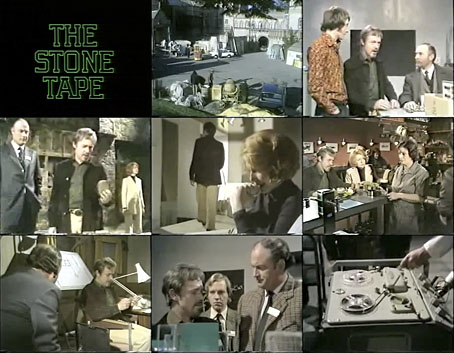
The Stone Tape has accrued a considerable cult reputation since it was first broadcast as a BBC ghost story during Christmas, 1972. I was too young to see the original transmission—I used to hear awed reports from those who remembered it—and didn’t get to see it until the BFI brought out on DVD a few years ago. That disc is now deleted, and the play is another unfortunate omission from the BFI’s Ghost Stories box set, so this seems a good opportunity to point the curious to the full-length copy that’s currently on YouTube.

stonetape3.jpg

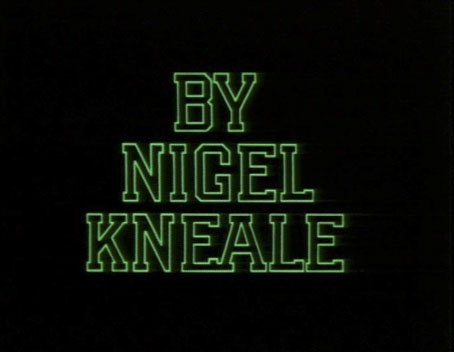
In the past I’ve compared Nigel Kneale, the writer of The Stone Tape, to HP Lovecraft. This isn’t a comparison the often curmudgeonly Kneale might have agreed with but you can find similarities in the way both Kneale and Lovecraft (in his later fiction) created scenarios featuring scientists or technical people which grade from science fiction to outright horror. The horror can be something ancient and earthbound or, as in the case of Kneale’s Quatermass cycle, it can be extraterrestrial. Kneale’s narratives may return continually to scientific investigation but he was smart enough to avoid explaining away his mysteries. The Stone Tape is an uncanny masterpiece that often seems so bare-bones you can hardly believe the effect it’s creating compared to lavishly-budgeted yet inferior feature films. Something about Kneale’s drama works it way insidiously under the skin then lodges there. It leaves with its mysteries intact.

stonetape2.jpg

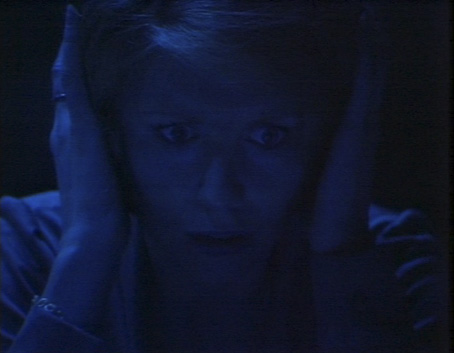
One reason Kneale’s Christmas play may have been left out of the BFI box is that it doesn’t fit the MR James model of accumulation-of-clues leading to revelation-of-spook. In Kneale’s story an industrial research and development team move into an old mansion building which turns out to be haunted. The manifestation of the ghost—usually the end point of most supernatural stories—quickly becomes an almost commonplace occurrence when the team decide to start probing its presence with their machines. Like most TV plays of the period this is done in the electronic studio but any absence of film atmosphere is compensated for by excellent writing and performances. Jane Asher plays a computer programmer and the only female professional in a group of loud and blustering men. She’s not only the person most sensitive to the spectral happenings but also proves to be the only one with the brains and tenacity to fathom the true nature of the haunting.

The conviction in the performances, Asher’s especially, and the quality and detail of Kneale’s characterisation, is what makes this production work so well. Among the other actors Michael Bryant is the stubborn team leader while Iain Cuthbertson plays the mediating foreman. Cuthbertson later had a major role in the cult TV serial Children of the Stones, and in 1979 was a memorable Karswell in an adaptation of MR James’ Casting the Runes. Also among the cast is Michael Bates who most people will know as the bellowing prison guard in A Clockwork Orange. The sound effects are by the Radiophonic Workshop’s Desmond Briscoe who also created electronic effects for The Haunting, Phase IV and The Man Who Fell to Earth. Director Peter Sasdy worked on a couple of the lesser Dracula films for Hammer but this is his finest hour-and-a-half. And if that isn’t enough priming for you I don’t know what else would suffice. I urge anyone who hasn’t seen this drama to turn off the lights and start the tape. It’s perfect Halloween viewing that grips to the very end.

Previously on { feuilleton }
Haunted: The Ferryman
Schalcken the Painter

Weekend links 131

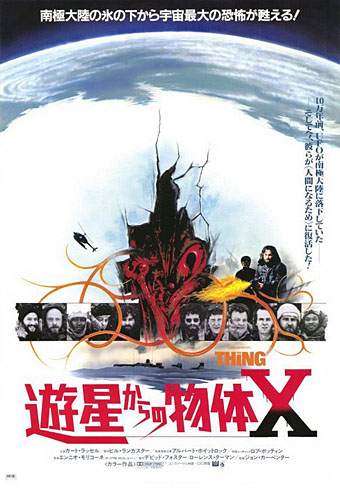
thingposter.jpg

Japanese poster (1982).

At The Quietus Steve Earles looks back at John Carpenter’s visceral and uncompromising The Thing which exploded messily onto cinema screens thirty years ago. It’s always worth being reminded that this film (and Blade Runner in the same year) was considered a flop at the time following bad reviews and a poor showing at the summer box office. One reason was The Thing‘s being overshadowed by the year’s other film of human/alien encounters, something called E.T. the Extra-Terrestrial. To The Thing‘s status as the anti-E.T. you can add its reversal of the can-do heroics of Howard Hawks’ The Thing from Another World (1951), an attitude out-of-step with Reaganite America. Carpenter’s film is not only truer to the original story but from the perspective of 2012 looks like one of the last films of the long 1970s, with Hawks’ anti-Communist subtext replaced by bickering, mistrust, paranoia and an unresolved and completely pessimistic ending that most directors would have a problem getting past a studio today.

I was fortunate to see The Thing in October of 1982 knowing little about it beyond its being a John Carpenter film (whose work I’d greatly enjoyed up to that point) and a remake of the Hawks film (which I also enjoyed a great deal). One benefit of the film’s poor box office was a lack of the kind of preview overkill which made E.T. impossible to avoid, and which a couple of years earlier did much to dilute the surprise of Ridley Scott’s Alien. I went into The Thing mildly interested and came out overwhelmed and aghast. For years afterwards I was insisting that this was the closest you’d get on-screen to Lovecraft’s At the Mountains of Madness. The correspondence is more than merely Antarctica + monsters when you consider this:

Lovecraft’s story was rejected by his regular publisher Weird Tales but was accepted by Astounding Stories in 1936 >> The editor of Astounding, John W. Campbell, published his own Antarctica + monsters story (under the pen-name Don A. Stuart), “Who Goes There?”, in the same magazine two years later >> Charles Lederer wrote a loose screen adaptation of Campbell’s story which Howard Hawks and Christian Nyby filmed as The Thing from Another World.

This isn’t to say that Campbell copied Lovecraft—both stories are very different—but I’d be surprised if Lovecraft’s using Antarctica as the setting for a piece of horror-themed science fiction didn’t give Campbell the idea.

More things elsewhere: Anne Billson, author of the BFI Modern Classics study of The Thing, on the framing of Carpenter’s shots, and her piece from 2009 about the film | Mike Ploog’s storyboards | Ennio Morricone’s soundtrack music, of which only a small percentage was used in the film.

• The week in music: 22 minutes of unreleased soundtrack by Coil for Sara Dale’s Sensual Massage | Analog Ultra-Violence: Wendy Carlos and the soundtrack for A Clockwork Orange | A Halloween mixtape by The Outer Church | Herbie Hancock & The Headhunters, live in Bremen, 1974: a 66-minute set, great sound, video and performances | Giorgio Moroder’s new SoundCloud page which features rare mixes and alternate versions | A video for Collapse by Emptyset.

One of the main themes of the book, and what I found in The Arabian Nights, was this emphasis on the power of commodities. Many of the enchanted things in the book are lamps, carpets, sofas, gems, brass rings. It is a rather different landscape than the fairy tale landscape of the West. Though we have interiors and palaces, we don’t have bustling cities, and there isn’t the emphasis on the artisan making things. The ambiance from which they were written was an entirely different one. The Arabian Nights comes out of a huge world of markets and trade. Cairo, Basra, Damascus: trades and skills.

Nina Moog talks to Marina Warner

John Palatinus, “one of the last living male physique photographers of the 1950s”, is interviewed. Related: the website of Ronald Wright, British illustrator for the physique magazines.

• “A classic is a work which persists as a background noise even when a present that is totally incompatible with it holds sway.” Italo Calvino’s 14 Definitions of What Makes a Classic.

Huge Franz Kafka archive to be made public. Related: Judith Butler asks “Who owns Kafka?”

• Geoff Manaugh’s Allen Ginsberg Photos & Ephemera, 1994–Dec 1996.

Magic mushrooms and cancer: My magical mystery cure?

Clark Ashton Smith Portfolio (1976) by Curt Pardee.

Jan Toorop’s 1924 calendar.

artQueer: a Tumblr.

• All The Things You Are (1957) by Duke Ellington | Things That Go Boom In The Night (1981) by Bush Tetras | Things Happen (1991) by Coil | Dead People’s Things (2004) by Deathprod.

Hanging in Lovecrafton

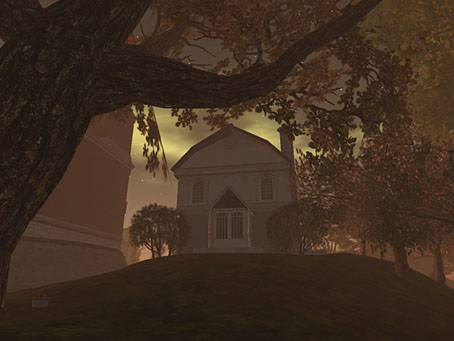
lovecrafton01.jpg

Lovecrafton.

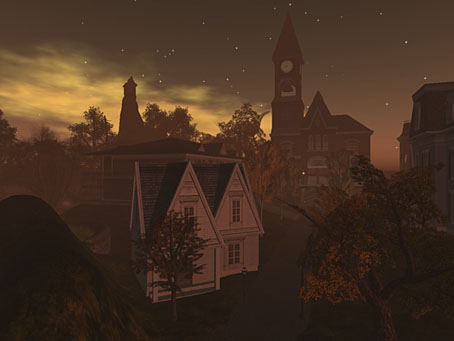
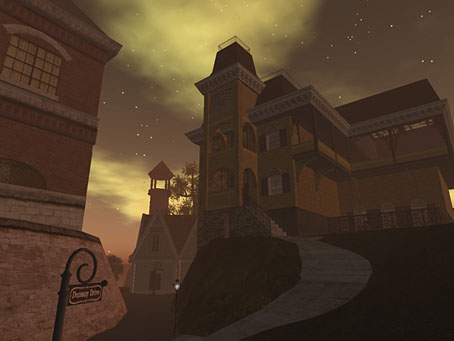
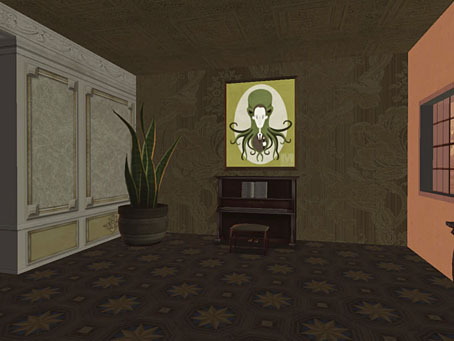
I’ve had online art exhibitions in the past but this month some of my work can be seen inside a virtual space. Lovecrafton is a Lovecraft-themed town in Second Life created by illustrator John Aardema. As is evident from the screenshots, the atmosphere is suitably autumnal with the requisite Colonial architecture. I was slightly surprised by these views, almost everything I’d seen of Second Life in the past looked overlit and underdeveloped, giving the impression of a crude computer game.

lovecrafton02.jpg

Carter Family Homestead.

I’ve not visited Lovecrafton but if you have a Second Life account you can access it via this link. Lovecraft-derived artwork by several artists will be displayed in the art gallery there throughout October, all of it annotated and linked to the websites of each artist.

lovecrafton03.jpg

The art gallery.

lovecrafton04.jpg

Continue reading “Hanging in Lovecrafton”