Weekend links 803

USA-ad.jpg

Ad for The United States Of America from Helix magazine, 1968.

• American composer Joseph Byrd died this week but I’ve yet to see a proper obituary anywhere. He may not have been a popular artist but he was significant for the one-off album produced in 1968 by his short-lived psychedelic group, The United States Of America. Their self-titled album has been a favourite of mine since it was reissued in the 1980s, one of the few American albums of the period that tried to learn from, and even go beyond, the studio experimentation of Sgt Pepper. The United States Of America didn’t have the resources of the Beatles and Abbey Road but they did have Byrd’s arrangements, together with an energetic rhythm section, an electric violin, a ring modulator, some crude synthesizer components, the voice of Dorothy Moskowitz, and a collection of songs with lyrics that ranged from druggy poetry to barbed portrayals of the nation’s sexual neuroses. The album became an important one for British groups in the 1990s who were looking for inspiration in the wilder margins of psychedelia, especially Stereolab, Portishead (Half Day Closing is a deliberate pastiche), and Broadcast. Byrd did much more than this, of course, and his follow-up release, The American Metaphysical Circus by Joe Byrd And The Field Hippies, has its moments even though it doesn’t reach the heights of its predecessor. Byrd spoke about this period of his career with It’s Psychedelic Baby Magazine in 2013.

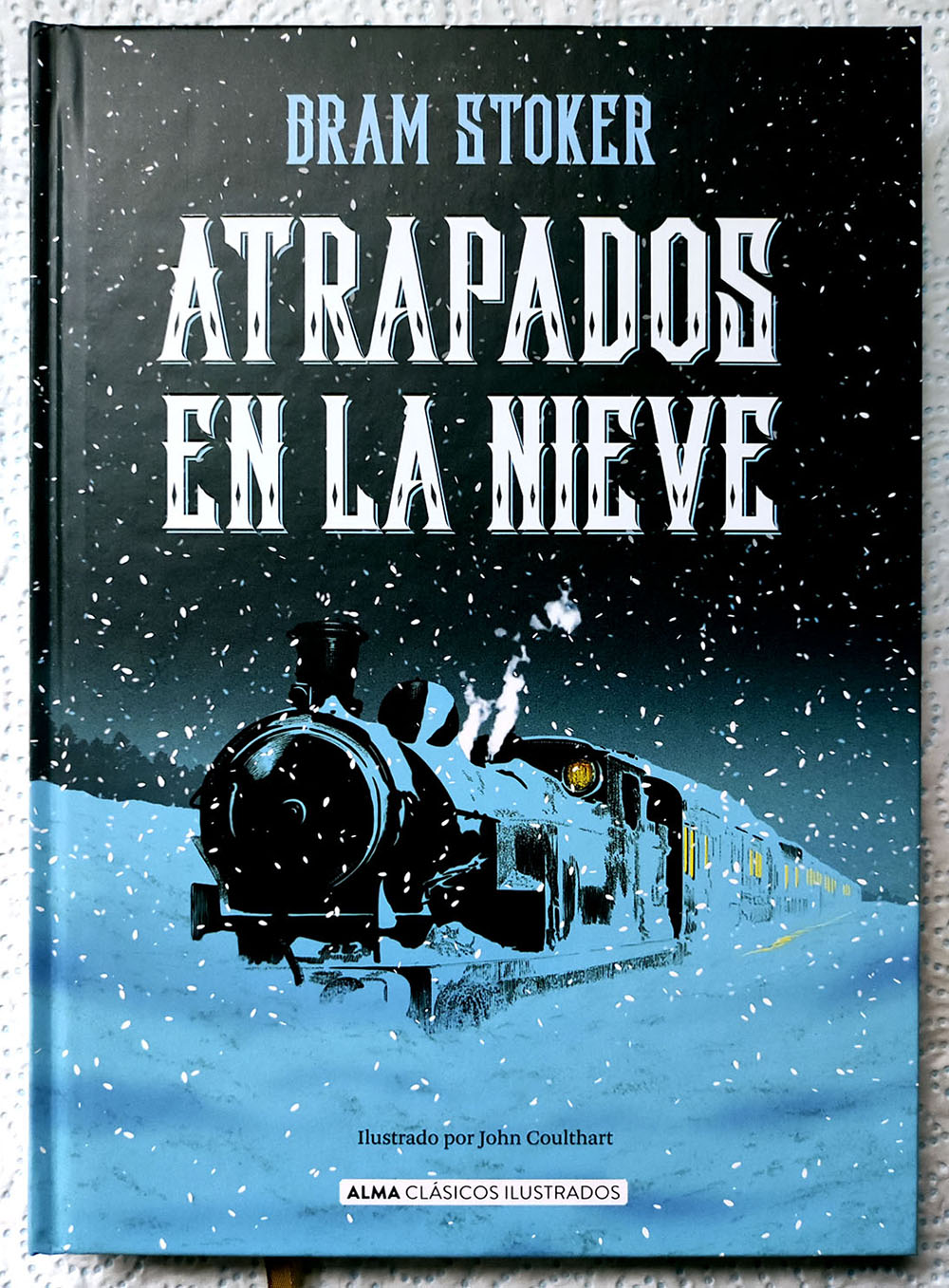
• At BBC Future: “The most desolate place in the world”: The sea of ice that inspired Frankenstein. Richard Fisher examines the history of the Mer de Glace in fact and fiction with a piece that includes one of my Frankenstein illustrations. The latter are still in print via the deluxe edition from Union Square.

• A Year In The Country looks at a rare book in which Alan Garner’s children describe the making of The Owl Service TV serial.

• The final installment of Smoky Man’s exploration of The Bumper Book of Magic has been posted (in Italian) at (quasi).

• At Public Domain Review: Perverse, Grotesque, Sensuous, Inimitable: A Selection of Works by Aubrey Beardsley.

• At Colossal: Ceramics mimic cardboard in Jacques Monneraud’s trompe-l’œil ode to Giorgio Morandi.

• At the Daily Heller: The “narrative abstraction” of Roy Kuhlman‘s cover designs for Grove Press.

• New music: Elemental Studies by Various Artists; and Gleann Ciùin by Claire M. Singer.

• Steven Heller’s font of the month is Archive Matrix.

Sensual Hallucinations (1970) by Les Baxter | The Garden Of Earthly Delights (United States Of America cover) (1982) by Snakefinger | Perversion (1992) by Stereolab

Lynd Ward’s Beowulf

ward01.jpg

A tale of fire and blood for Bonfire Night. I posted a link to Lynd Ward’s marvellous Beowulf illustrations many years ago but, as is often the case, the site that hosted them is now defunct. These copies are from a recent addition to the indispensable Internet Archive, and unlike the earlier site you get to see the entire book, complete with Ward’s many vignettes. Ward is as good a match for this dark story as he was with Frankenstein, and there’s some similarity between his rendering of Victor Frankenstein’s creation and the even more murderous Grendel. I generally prefer Ward’s black-and-white work to his colour illustrations, and I suspect Ward preferred working in a single tone when given the choice, as with his celebrated woodcut “novels”, God’s Man and Madman’s Drum. But the hot/cold palette works well here, reflecting a world of firelit halls and the icy dark beyond the fire where nightmares wait for sleeping men.

ward08.jpg

It’s also possible to read the poem itself, although I wouldn’t advise it with this translation by William Ellery Leonard, not when it begins so risibly with the words “What ho!” Beowulf famously opens with a declaration in Old English—”Hwæt!”—that bards would have shouted to gain the attention of their audience. The word doesn’t translate easily to contemporary English but it’s usually given as “Hear!” or “Listen!” Leonard’s “What ho!” is a phrase that belongs with Bertie Wooster. There are plenty of other translations available, Seamus Heaney’s, for example. I favour the David Wright translation that we read at school, a version which includes a five-page note concerning the difficulties of faithfully translating the poem.

ward02.jpg

ward03.jpg

ward04.jpg

Continue reading “Lynd Ward’s Beowulf”

Universal Horror

universal1.jpg

A couple of Halloweens ago I worked my way through a blu-ray box of the horror films made by Universal Studios in the 1930s and 40s. It was a fun and instructive experience: fun because I’d not watched many of the films properly for a long time; instructive for reaffirming my dislike of Tod Browning’s Dracula, a film so inert and lacking in cinematic drama it may as well be a series of still pictures. Browning’s film is further diminished when you have the opportunity to watch James Whale’s Frankenstein films immediately after it. The collection also allowed me to compare the BFI release of Universal’s silent version of The Phantom of the Opera, where Lon Chaney is an unforgettable Phantom, with the 1943 remake, a film I didn’t recall having seen before. The only positive things about the remake are the always worthwhile Claude Rains, even if he is wasted in the Phantom role, and seeing the massive Paris Opera House set from the silent version being reused.

universal2.jpg

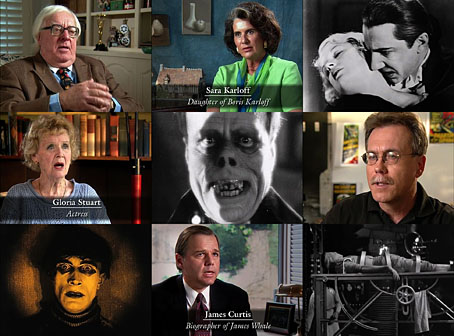
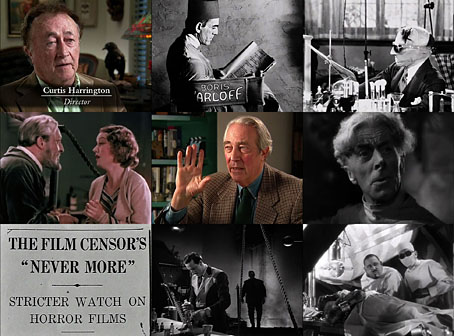
The differences between the Universal adaptations of Dracula and Frankenstein are noted in Kevin Brownlow’s 90-minute documentary which is an extra on the Frankenstein disc. Brownlow’s film, which was originally made for TV in 1998, charts the evolution of Universal’s horror films from their roots in silent cinema and German Expressionism up to the 1940s when the cycle deteriorated into sequelitis and self-mockery via Abbott and Costello. “Universal” here may be taken as referring to all of Hollywood’s early horror films. Rather than waste time on the studio’s increasingly inferior sequels, rival productions from other studios are briefly discussed: Dr Jekyll and Mr Hyde (Paramount), The Island of Lost Souls (Paramount), King Kong (RKO), and Mystery of the Wax Museum (Warner Brothers). In doing this Universal Horror follows the template that Brownlow established with fellow film historian David Gill in 1980 when they produced Hollywood for Thames TV, a 13-part series about the birth of American cinema which I rate as the best documentary series about film ever made. (Gill died in 1997 so Universal Horror is dedicated to his memory.) Hollywood interviewed as many people as possible connected with the production of the first silent films, following the format of the landmark The World at War (1973) series which related the events of the Second World War in 26 hour-long episodes. The World at War was narrated by Laurence Olivier; for Hollywood Brownlow & Gill had James Mason, not only an equivalent voice of authority but also a man with a great enthusiasm for silent cinema. Subsequent Brownlow & Gill documentaries had Lindsay Anderson as narrator, another silents enthusiast with a similar gravitas in his narrative delivery. The narrator of Universal Horror, Kenneth Branagh, isn’t bad as such but whatever his qualities as an actor, his voice alone is a poor match for these heavyweights. He does at least seem to have controlled the sporadic squeaks which mar his delivery in an earlier Brownlow & Gill series, Cinema Europe: The Other Hollywood (1995).

universal3.jpg

Universal Horror and Cinema Europe both fall short when compared to Hollywood by being made too late. By the 1990s most of the men connected with the early years of European cinema had died, and so had many of the actors who made the Universal films. It’s left to a handful of survivors, most of whom are women, to remember the days of their youth: Nina Foch (The Return of the Vampire), Gloria Stuart (The Invisible Man), Fay Wray (who must have spent most of her later years repeating stories about King Kong but here also discusses her role in Mystery of the Wax Museum), Lupita Tovar (the Spanish-language Dracula), Turhan Bey (The Mummy’s Tomb), Rose Hobart (Dr Jekyll and Mr Hyde), and Curt Siodmak (The Wolf Man). Additional commentary is provided by the daughters of significant figures: Sara Karloff, Carla Laemmle (who has a cameo in Dracula) and Arianne Ulmer whose father, Edgar G. Ulmer, directed The Black Cat for Universal, a much better film than the 1943 Phantom of the Opera, and one which should have been in the box set instead. Lastly, there’s some outsider commentary by Ray Bradbury (who also appeared in Brownlow’s next documentary, Lon Chaney: A Thousand Faces), Gavin Lambert, James Karen, Forrest J. Ackerman, Curtis Harrington, James Curtis (author of James Whale: A New World of Gods and Monsters), and David J. Skal (author of Hollywood Gothic, The Monster Show, etc). Given the breadth of the subject—two decades of film history—this should have been a series like Cinema Europe, but horror on the page or on the screen remains the most abject of the genres, continually marginalised, complained about, ignored, censored, banned. Ninety minutes of documentary time is often as good as it gets, especially with Kevin Brownlow producing.

Universal Horror at the time of writing is available for viewing at the Internet Archive, waiting for Universal’s legal goons to put a stake through its heart. Someone has also uploaded the whole of Brownlow & Gill’s Hollywood series which is gratifying to see. The latter is scattered around YouTube in varying quality so it’s good to have a range of options. It’s essential viewing wherever you see it.

Previously on { feuilleton }
Illustrating Dracula
Illustrating Frankenstein
Psychotronic Video
Dracula and I by Christopher Lee
Nightmare: The Birth of Horror
Rex Ingram’s The Magician
The Mask of Fu Manchu

Weekend links 539

earle.jpg

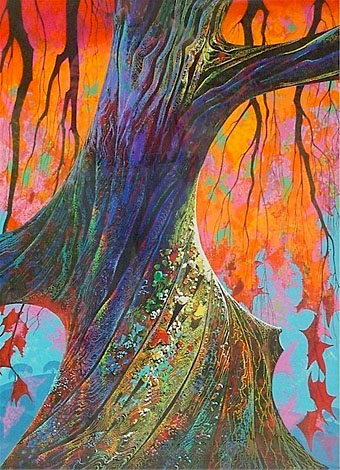
Fire, Red and Gold (1990) by Eyvind Earle.

Roger Penrose won a Nobel Prize recently for his work in physics. I read one of his books a few years ago, and was intimidated by the “simple” equations, but I always like to hear his ideas. This 2017 article by Philip Ball is an illuminating overview of Penrose’s life and work.

• At Dangerous Minds: Joe Banks on the incidents that led to Lemmy’s dismissal from Hawkwind in 1975, an extract from Hawkwind: Days of the Underground. The book is available from Strange Attractor in Europe and via MIT Press in the USA.

• “Not married but willing to be!”: men in love (with each other) from the 1850s on. It’s always advisable to take photos like these with a pinch of salt but several of the examples are unavoidably what they appear to be.

Most of all, this resolutely collaborative production stood against the vanity and careerism of individual authorship; Breton called it the first attempt to “adapt a moral attitude, and the only one possible, to a writing process.” The text itself is peppered with readymade phrases, advertising slogans, twisted proverbs, and pastiches of such admired predecessors as Rimbaud, Apollinaire, and Lautréamont, whose pluralistic credo, “Poetry must be made by all. Not by one,” anticipates the sampling aesthetic by a century. But the intensity was draining, and as the book moves toward its final pages and the writing becomes increasingly frenetic, you can almost feel the burnout taking hold. After eight days, fearing for his and Soupault’s sanity, Breton terminated the experiment.

Mark Polizzotti reviews a new translation by Charlotte Mandell of The Magnetic Fields by André Breton and Philippe Soupault

• The hide that binds: Mike Jay reviews Dark Archives: A Librarian’s Investigation into the Science and History of Books Bound in Human Skin by Megan Rosenbloom.

• “A photographer ventures deeper into Chernobyl than any before him.” Pictures from Chernobyl: A Stalker’s Guide by Darmon Richter.

John Van Stan’s reading of Frankenstein by Mary Shelley uses my illustrations (with my permission) for each of its chapters.

Susan Jamison, one of the artists in The Art of the Occult by S. Elizabeth, talks to the latter about her work.

William Hope Hodgson: The Secret Index. A collection of Hodgson-related posts at Greydogtales.

Gee Vaucher talks to Savage Pencil about her cover art for anarchist punk band, Crass.

Weird, wacky and utterly wonderful: the world’s greatest unsung museums.

Tom Cardamone chooses the best books about Oscar Wilde.

• At Dennis Cooper’s: Jean-Pierre Melville Day.

You by The Bug ft. Dis Fig.

Magnetic Dwarf Reptile (1978) by Chrome | Magnetic Fields, Part 1 (1981) by Jean-Michel Jarre | Magnetic North (1998) by Skyray

André Castaigne’s Phantom of the Opera

castaigne1.jpg

Frontispiece.

My recent film viewing has included two early adaptations of The Phantom of the Opera, the superb Lon Chaney version from 1925, directed by Rupert Julian, and the not-so-superb 1943 version with Claude Rains as the Phantom. I’d not seen the latter before but it was included in a blu-ray collection of Universal horror films; Rains is wasted in the title role but in its favour the film has Technicolor photography and huge sets, some of which were being reused from the 1925 film. The Chaney version is one of my favourite silent films so it was good to see again after a lengthy absence. It also sent me to Gaston Leroux’s novel at long last, and this in turn led me to the illustrations by André Castaigne for the first edition.

castaigne2.jpg

“She staggered swooning.”

The Phantom of the Opera was published in 1911, and while it hasn’t been subjected to the overexposure sustained by Dracula and Frankenstein it’s still one of those stories where the adaptations now dominate the popular imagination. I’d not seen Castaigne’s illustrations before so I was surprised by how closely the 1925 film followed their details, especially the depiction of the Phantom’s appearance as the Red Death at the bal masque. The same goes for the ghostly head of fire which Raoul and the Persian encounter in the cellars beneath the opera. In the film this is an inexplicable moment but one which would no doubt have been familiar to the novel’s readers. Finally, there’s Lon Chaney’s incredible makeup which turns out to be very close to the glimpses of the Phantom’s skull-like face in these pictures. I often used to wonder about this, how much of Chaney’s appearance was merely an attempt to look as horrifying as possible. (In the 1943 film, and the 1962 Hammer adaptation with Herbert Lom, both Phantoms have been disfigured by acid scarring.)

castaigne3.jpg

“They sat like that for a moment in silence.”

By coincidence, a new illustrated edition of The Phantom of the Opera was published this month by the Folio Society, with a splendid set of illustrations by Taylor Dolan. As for the Lon Chaney film, the restored blu-ray print is the one to look for, with tinted scenes, the bal masque in two-strip Technicolor, and an excellent orchestral score by Carl Davis.

(Note: With the exception of the frontispiece, all the illustrations here were printed over two pages, hence the fold across each picture.)

castaigne4.jpg

“A head of fire came toward them.”

castaigne5.jpg

“Talking of death, I must sing.”

Elsewhere on { feuilleton }
The illustrators archive

Previously on { feuilleton }
A Pictorial History of Horror Movies by Denis Gifford