Weekend links 183

doisneau.jpg

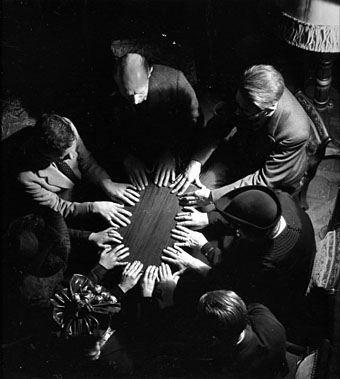
La table qui tourne (1943) by Robert Doisneau.

In [Gödel, Escher, Bach], Hofstadter was calling for an approach to AI concerned less with solving human problems intelligently than with understanding human intelligence—at precisely the moment that such an approach, having borne so little fruit, was being abandoned. His star faded quickly. He would increasingly find himself out of a mainstream that had embraced a new imperative: to make machines perform in any way possible, with little regard for psychological plausibility.

The Man Who Would Teach Machines to Think by James Somers.

Whenever the latest pronouncements about the imminent arrival of artificial intelligence are being trotted out I wonder what Douglas Hofstadter would have to say on the matter. You don’t hear much about Hofstadter despite his having been involved for decades in artificial intelligence research. One reason is that he’s always been concerned with the deep and difficult problems posed by intelligence and consciousness, subjects which don’t make for sensational, Kurzweilian headlines. Hofstadter’s essays on AI (and many other topics) in Metamagical Themas: Questing for the Essence of Mind and Pattern (1985) are essential reading. James Somers’ lengthy profile for The Atlantic is a welcome reappraisal.

• The end of October brings the spooky links: When Edward Gorey illustrated Dracula | Paula Marantz Cohen on Edgar Allan Poe | Yasmeen Khan revisits Werner Herzog’s Nosferatu | Roger Luckhurst on horror from the Gothics to the present day, and Michael Newton on Gothic cinema.

•  Magic Words: The Extraordinary Life of Alan Moore is a biography of the Northampton magus by Lance Parkin. The author talks about his book here, and also here where if you look carefully you can see my Lovecraft book on his shelf.

• A crop of Halloween mixes: Boo, Forever by Jescie | Samhain Seance 2: Hex with a Daemon by The Ephemeral Man | Wizards Tell Lies & The Temple of Doom by The Curiosity Pipe | Radio Belbury’s Programme 11.

The Book of the Lost is an album by Emily Jones & The Rowan Amber Mill presenting music from imaginary British horror films. Release is set for Halloween. More details here.

Laura Allsop on Derek Jarman’s sketchbooks. Jarman’s Black Paintings are currently showing at the Wilkinson Gallery, London.

Magick is Freedom! Existence Is Unhappiness: Barney Bubbles vs. Graham Wood.

• Soho Dives, Soho Divas: Rian Hughes on sketching London’s burlesque artists.

Jenny Diski on the perennial problem of owning too many books.

Equus through the years by Clive Hicks-Jenkins.

Virgin Records: 40 Years of Disruptions

• At BibliOdyssey: Chromatic Wood Type

Witches at Pinterest

The Witch (1964) by The Sonics | My Girlfriend Is A Witch (1968) by October Country | You Must Be A Witch (1968) by The Lollipop Shoppe

Weekend links 174

ikuma.jpg

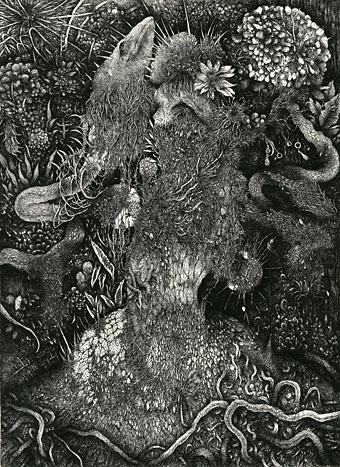
Dress (2012) by Nao Ikuma.

• Two of my Cthulhu artworks can currently be seen in the Ars Necronomica exhibition at the Cohen Gallery, Brown University, Providence, RI. The exhibition is part of NecronomiCon, and runs to September 13th. In related news, my steampunk illustration has been nominated in the Visual category of this year’s Airship Awards. Winners will be announced at Steamcon V in October.

• “…the story of how a small cabal of British jazz obsessives conducting a besotted affair with the style arcana of Europe and America somehow became an army of scooter-borne rock fans…” Ian Penman looks back at the culture of Mod for the LRB.

• “What is it about the writer in the First World that wants the Third World writer to be nakedly political, a blunt instrument bludgeoning his world’s ills?” Gina Apostol on Borges, Politics, and the Postcolonial.

If someone had designed a work regime perfectly suited to maintaining the power of finance capital, it’s hard to see how they could have done a better job. Real, productive workers are relentlessly squeezed and exploited. The remainder are divided between a terrorised stratum of the, universally reviled, unemployed and a larger stratum who are basically paid to do nothing, in positions designed to make them identify with the perspectives and sensibilities of the ruling class (managers, administrators, etc) – and particularly its financial avatars – but, at the same time, foster a simmering resentment against anyone whose work has clear and undeniable social value. Clearly, the system was never consciously designed. It emerged from almost a century of trial and error. But it is the only explanation for why, despite our technological capacities, we are not all working 3–4 hour days.

On the Phenomenon of Bullshit Jobs by David Graeber

Ron Rosenbaum talks to Al Pacino about all the usual stuff, and reveals some detail about the actor’s obsessive interest in Oscar Wilde’s Salomé.

• More queer history: The Brixton Fairies and the South London Gay Community Centre, Brixton 1974–6.

• At Dangerous Minds: Anthony Burgess and the Top Secret Code in A Clockwork Orange

• Every day for 100 days, Jessica Svendsen redesigned a Josef Müller-Brockmann poster.

LondonTypographica: Mapping the typographic landscape of London.

• Mix of the week: Secret Thirteen Mix 083 by Demdike Stare.

• At Strange Flowers: Alfred Kubin the writer.

Derek Jarman’s sketchbooks.

Rick Poynor on Collage Now.

• Thomas Leer: Private Plane (1978) | Tight As A Drum (1981) | Heartbeat (1985)

Just the ticket: Cabaret Voltaire

cv01.jpg

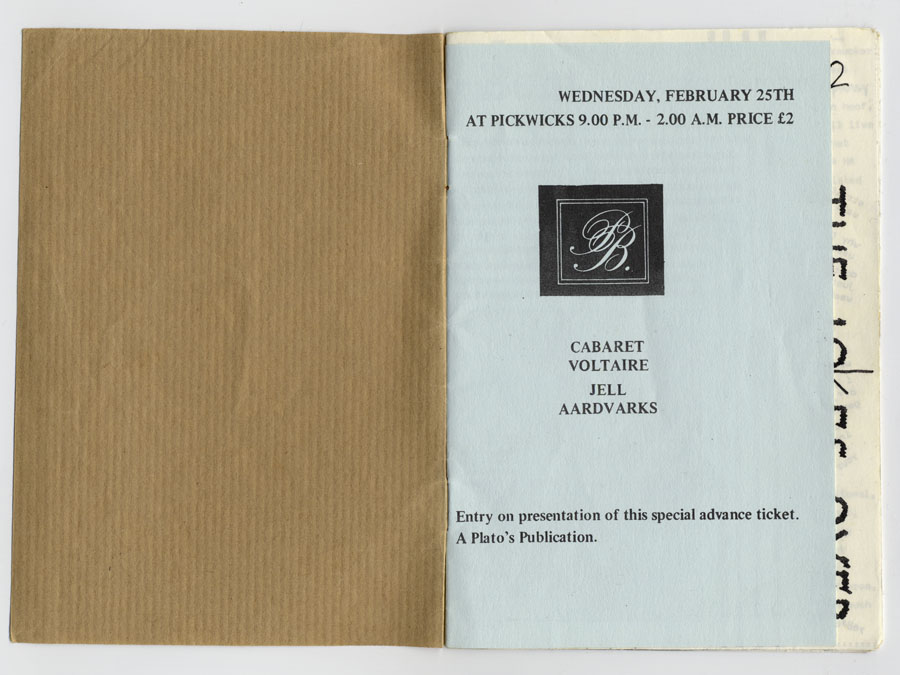
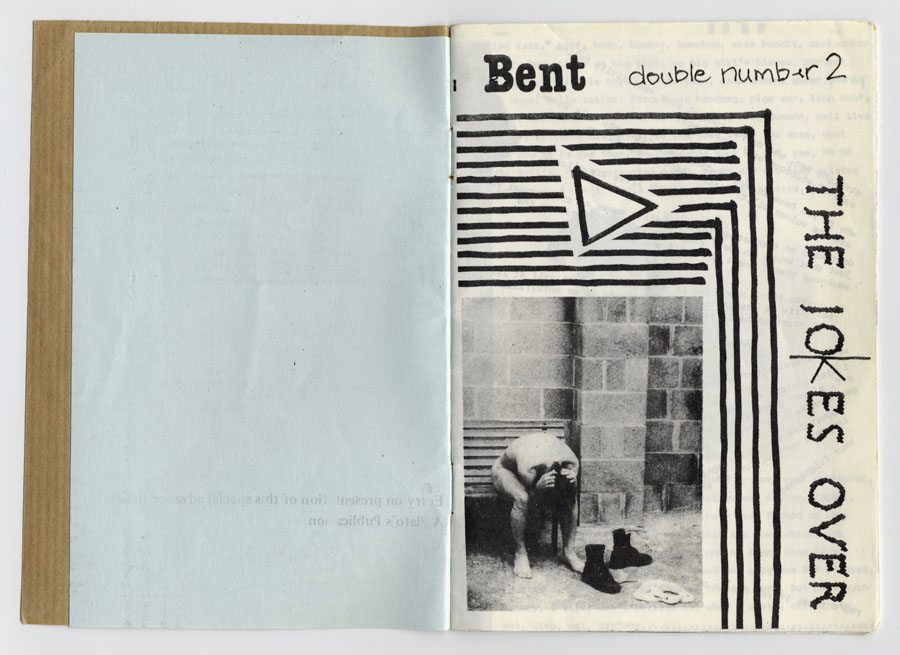
The current issue of The Wire has a great appraisal by Keith Moliné of the musical history of Cabaret Voltaire, a well-timed piece given the recent announcement of forthcoming reissues from Mute Records. Having been a Cabophile from the start I’m rather biased, but the Wire piece has had me listening to the early albums and singles this week (between bouts of Zdenek Liska), and finding the passage of time has made those early recordings seem increasingly strange. Cabaret Voltaire were one of the few groups I liked obsessively enough to collect ephemera from newspapers and magazines. Knowing this, a friend gave me this curious fanzine/ticket from a gig the group played in Liverpool in February, 1981. The venue was Plato’s Ballroom at Pickwicks, and judging by the wording inside—”A Plato’s Publication”—it seems it was the venue’s idea to make the ticket a small (10.5 x 15 cm) booklet.

cv02.jpg

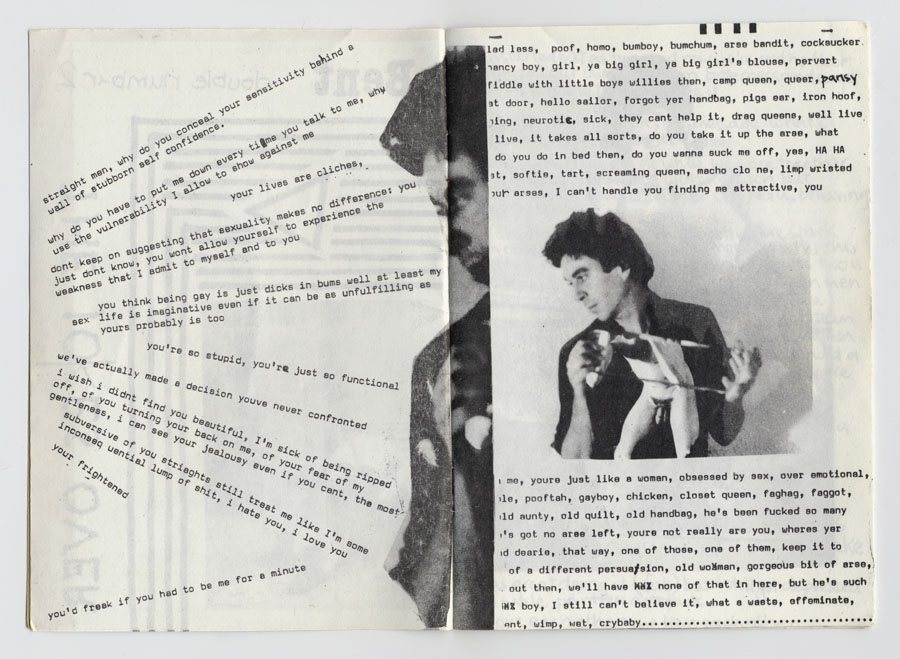
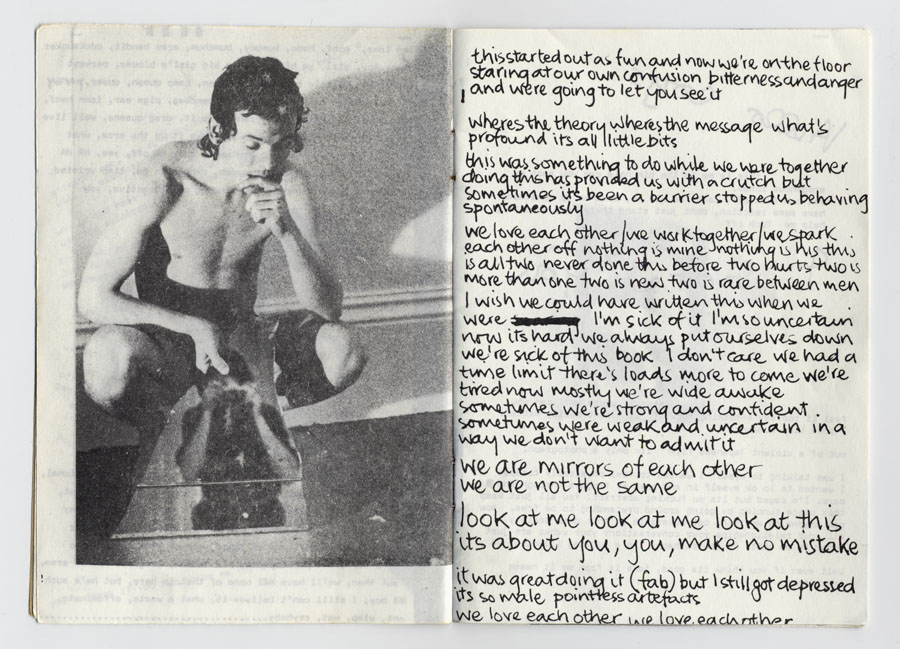
What’s surprising about this is that the fanzine the ticket is bundled with has nothing at all to do with music (or that other perennial of 80s post-punk culture, left-wing politics) but is a glimpse of life as a gay man in Liverpool. I’ve always found this fascinating for the daring it took to foist the thing on a bunch of unwitting Cabs fans, most of whom would have been straight men and not especially sympathetic to the subject matter. In the context of 1981 forcing people to look at grainy shots of naked men with accompanying text (by another man) declaring them to be a turn-on was a transgressive act. The only representations of anything gay in the popular media were a few camp (and therefore safe) comedians; Derek Jarman was still an underground figure, and as late as 1984 a BBC play about gay men was prefaced with a warning about its “contentious” subject.

cv03.jpg

I’ve no idea who was responsible for the fanzine, there are no credits, and it’s possible that the people involved didn’t want to be too easily identified. If the tone of the writing seems rather dramatic then, again, it’s important to see it in context of a country which wasn’t much more amenable to gay people than Russia is today. Saying things in public that most people didn’t want to hear was a challenging act; emotions often ran high.

cv04.jpg

Looking for information about the gig turned up this newspaper ad. (Who were Jell and Aardvarks, I wonder?) By an odd coincidence only the day before I’d found this upload from the same person of a very scarce compilation tape that happens to be from the same year, and which features contributions from Cabaret Voltaire’s Chris Watson and Richard Kirk. The Men With The Deadly Dreams was compiled by Geoff Rushton, aka John Balance of Coil, and was apparently limited to 200 copies. Among the other highlights there’s a track from Eyeless in Gaza, whose early work I like a great deal, and an electronic piece by Throbbing Gristle’s Chris Carter which I think is exclusive to this collection. Two artefacts—fanzine and tape—with brown paper covers that give a snapshot of Britain’s underground culture in 1981.

cv05.jpg

Continue reading “Just the ticket: Cabaret Voltaire”

Sebastiane by Derek Jarman

sebastiane.jpg

Sebastiane Opens
October 1976: Sebastiane opened at the Gate cinema in Notting Hill last night after a day of record attendances and good reviews. At the opening Barney James, who plays the centurion, sat next to my parents. At the end of the film he turned to Dad and said, “I don’t suppose forces life was ever like that.” To my surprise Dad replied, “I was out in the Middle East before the war and it’s really quite accurate.”

After its opening at the Gate, where it played for four months before moving into the West End, Sebastiane opened all over the world to wildly different reviews. The Germans found our Latin untuned to their ears, and the French, at least so I was told, panned it. In the States it was classed S for Sex and we were unable to advertise it – so the audiences turned up expecting hardcore and were disappointed. However in Italy and Spain it was a stunning success with lyrical reviews. In Rome, Alberto Moravia came to the first press show and praised the film in the foyer saying that it was a film that Pier Paolo would have loved.

Derek Jarman, Dancing Ledge (1991)

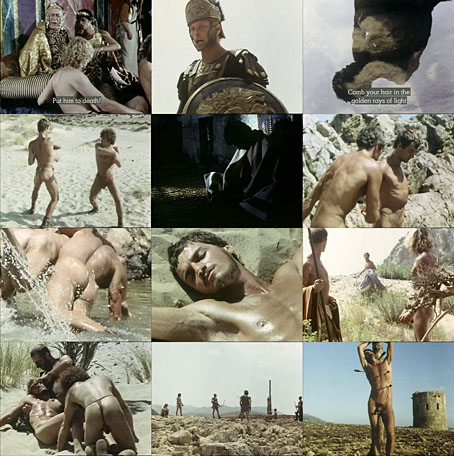
Pasolini would indeed have loved Sebastiane (1976) which owes much to the Italian director’s historical films, especially Oedipus Rex (1967) and Medea (1969). The film was Jarman’s first feature (co-directed with Paul Humfress), produced on a very small budget, and filmed on the coast of Sardinia. Brian Eno provided the music, and Lindsay Kemp has a memorable cameo appearance in the opening scene. The events which lead to the martyrdom of Saint Sebastian (Sebastianus) are dramatised from the point of view of a group of Roman soldiers who have Sebastianus among their company. The film is notable for its all-Latin dialogue, and for being the first non-porn film to feature a male erection, although that detail is often missing from prints which judiciously crop the lower portion of the screen.

The copy linked here has somehow turned up at the Internet Archive, and is the same erection-free version which has circulated for some years on DVD. The sneaky censorship would have been justified ten or more years ago but makes no sense today when far more explicit films are easily available. But if you haven’t seen Sebastiane then you have an opportunity for as long as this copy remains available…which may not be for long since I’m sure its copyright can’t have lapsed.

The late, unlamented and very reactionary British film critic Leslie Halliwell once complained that Pasolini’s “Trilogy of Life” films featured “a forest of male genitalia”. The same might be said of Sebastiane which, judging by the intemperate comments one sees on review sites, provokes a similar splenetic reaction. “It’s just gay porn!” they shriek, to which the obvious response is “No, it isn’t”, and “So what if it was?” A century of cinema has paraded the bodies of women for the gaze of the heterosexual male, the same male who chokes on his dudgeon when faced with the very thing he carries between his legs. Grow up, boys. Also at the Internet Archive (for the time being) is Derek Jarman’s The Garden (1990), the most personal of his later films until his final feature, Blue, in 1993.

Previously on { feuilleton }
A Journey to Avebury by Derek Jarman
Derek Jarman’s music videos
Derek Jarman’s Neutron
Mister Jarman, Mister Moore and Doctor Dee
The Tempest illustrated
In the Shadow of the Sun by Derek Jarman
Derek Jarman at the Serpentine
The Angelic Conversation
The life and work of Derek Jarman

A Journey to Avebury by Derek Jarman

jarman2.jpg

Among the Doublevision video releases I was writing about earlier this month there’s a notable omission from those which have been reissued on DVD: Derek Jarman’s In the Shadow of the Sun was the seventh release on the label, the 1980 version of a film which was compiled in 1974 using footage from his earlier Super-8 shorts, one of which was A Journey to Avebury (1971). Several of the short films have appeared as extras on recent DVDs but the gorgeously oneiric In the Shadow of the Sun remains stubbornly unavailable.

jarman1.jpg

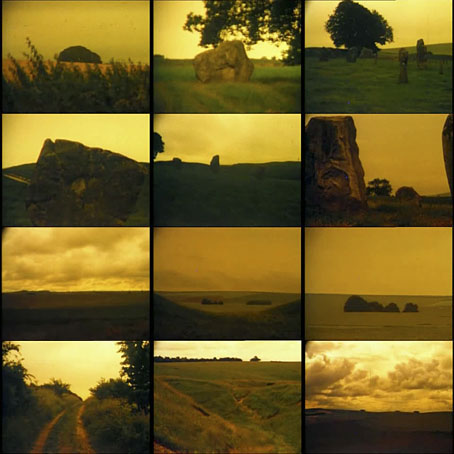
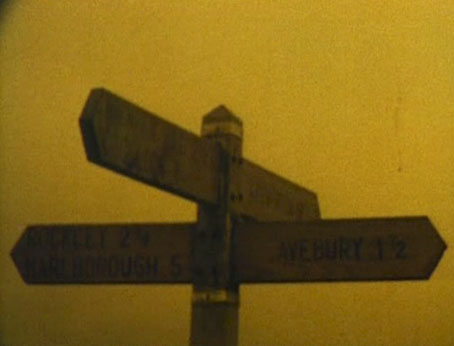
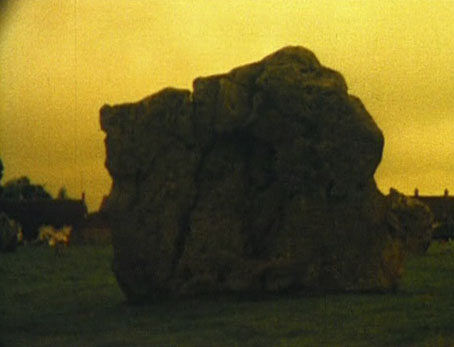
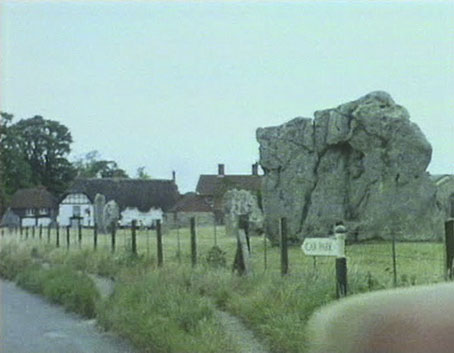
A Journey to Avebury lasts for ten minutes, and in its original state was nothing more than silent, static shots of fields, pathways (putative ley lines, perhaps), silhouetted trees, and finally the Avebury stones. I still find it one of the most fascinating of his short films. The yellow filter gives all the shots an oppressive, sulphurous cast which turns the otherwise bucolic landscape into a place of imminent (or even post-) apocalypse. I’m reminded of the yellow skies in Charles Platt’s erotic nightmare The Gas (1970), or some of the outdoor shots in Penda’s Fen (1974) which are equally suffused with menace.

jarman3.jpg

The copy of A Journey to Avebury that’s currently on YouTube is a recent version with an uncredited electronic score. I still don’t know who did the music; it doesn’t sound like Coil. Cyclobe? (It’s Coil.) The YouTube version can be found in far better quality on the Second Sight DVD of Jarman’s The Last of England.

cots6.jpg

And just to show how everything here is connected to everything else, that brooding megalith above (known locally as “The Devil’s Seat”) can be seen in at least one shot in Children of the Stones. No surprise there but the shot also reveals the place where Jarman and co. would have been standing five years earlier.

Previously on { feuilleton }
Children of the Stones
Avebury panoramas
Derek Jarman’s music videos
Derek Jarman’s Neutron
Mister Jarman, Mister Moore and Doctor Dee
The Tempest illustrated
Penda’s Fen by David Rudkin
In the Shadow of the Sun by Derek Jarman
Derek Jarman at the Serpentine
The Angelic Conversation
The life and work of Derek Jarman