42 One Dream Rush

onedream1.jpg

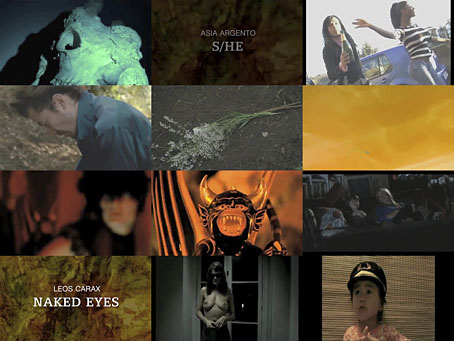
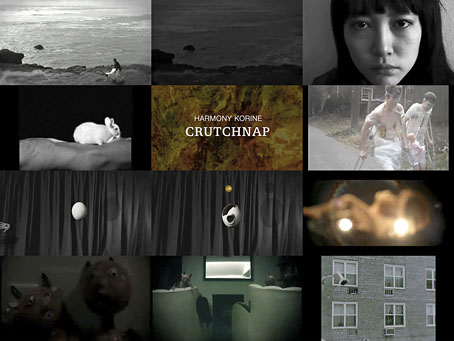
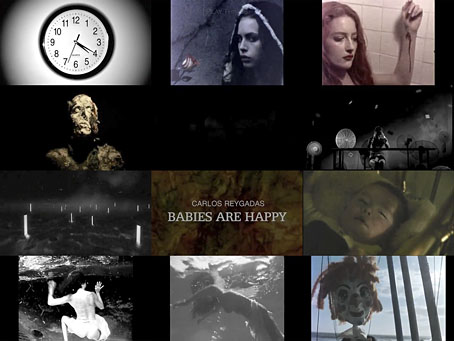
A 45-minute omnibus film from 2009 in which Abel Ferrara, Arden Wohl, Asia Argento, Brian Butler, Carlos Reygadas, Charles Burnett, Charlyn Marshall, Chris Graham, Chris Milk, David Lynch, Dee Poon, Floria Sigismondi, Florian Habicht, Gaspar Noé, Grant Morrison, Griffin Marcus, Harmony Korine, James Franco, Joe Coleman, Jonas Mekas, Jonathan Caouette, Kenneth Anger, Larry Clark, Leos Carax, Lola Schnabel, Lou Ye, Matt Pyke, Michele Civetta, Mike Figgis, Mote Sinabel, Niki Caro, Rajan Mehta, Rinko Kikuchi, Ryan McGinley, Sean Lennon, Tadanobu Asano, Taika Waititi, Terence Koh, Yung Chang, Zachary Croitoroo and Zhang Yuang each direct a 42-second film on the subject of dreams.

A couple of these have done the rounds before but this is the first time I’ve seen the complete set. The dream theme is loosely interpreted, with entries that range from real or imagined nightmares and Lynchian weirdness (Lynch’s own piece is as strange as you’d expect), to ambitions and daydreams. Given the collection of directors it’s no surprise to find sexuality and mortality as recurrent sub-themes. Not all of it works but you only have to wait 42 seconds for something new to arrive. Watch it here.

onedream2.jpg

onedream3.jpg

La femme qui se poudre

bokanowski1.jpg

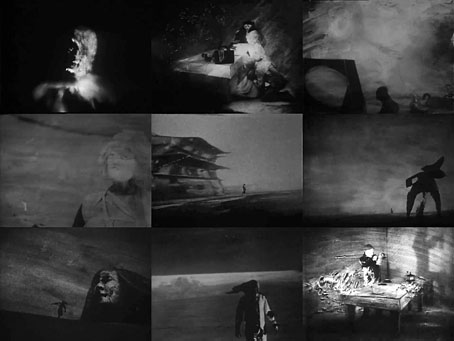
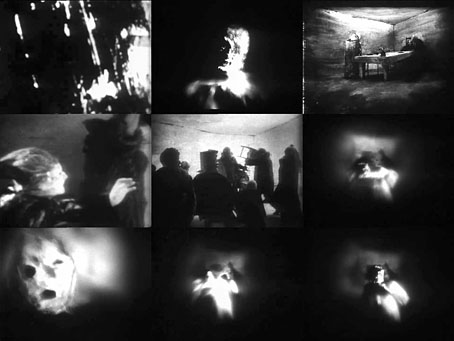
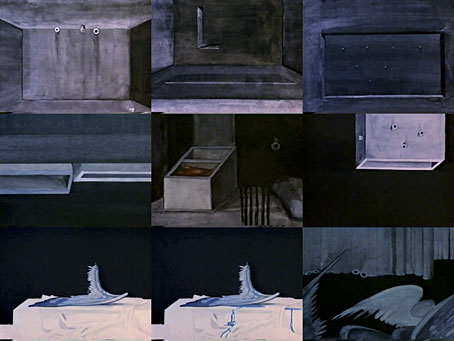
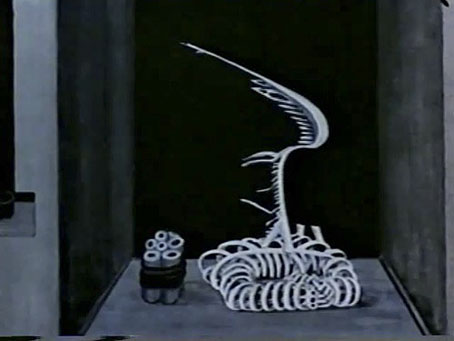
The DVD collection of films by Piotr Kamler turned up last week so I’ve been alternating viewing of that with shorts by Patrick Bokanowski. The latter is less an animator than a filmmaker who uses animation or film effects to achieve his aims, together with masks and very stylised performances. Bokanowski’s early film La femme qui se poudre (The Woman Who Powders Herself, 1972) runs for 15 minutes, and is as remarkable in its own way as his feature-length L’Ange (1982). La femme qui se poudre has the same masked figures engaged in activities which often lack easy interpretation; in both films the atmosphere can shift from absurdity to the edge of horror and back again. For me what’s most remarkable about this particular short is the way it anticipates both Eraserhead and the early films of the Brothers Quay yet still seems little known. The Quays are on record as admiring L’Ange but I’ve yet to see any sign that David Lynch knew of this film in the 1970s. I’d be wary of assuming that Lynch was imitating Bokanowski, artists are quite capable of finding themselves working in similar areas independently.

bokanowski2.jpg

Films of this nature always benefit from well-matched soundtracks: Piotr Kamler uses recordings by different electronic composers; Eraserhead had Fats Waller and the rumblings and hissings of Alan Splet; the Quays have unique compositions by Lech Jankowski. La femme qui se poudre and L’Ange have outstanding soundtracks by Michèle Bokanowski, the director’s wife and an accomplished avant-garde composer. Her work is as deserving of further attention as that of her husband. DVDs of L’Ange and a collection of Patrick Bokanowski’s short films may be purchased here.

Previously on { feuilleton }
Le labyrinthe and Coeur de secours
Chronopolis by Piotr Kamler
Brothers Quay scarcities
Patrick Bokanowski again
L’Ange by Patrick Bokanowski

Witkinesque

supervert.jpg

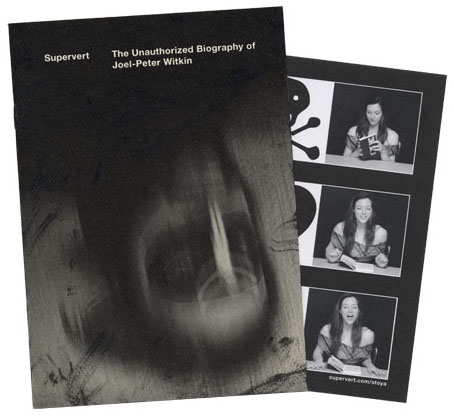
Arriving in the post this week, a Christmas gift from Supervert, a chapbook featuring a new piece of writing that purports to be the unauthorised biography of American artist/photographer Joel-Peter Witkin. The premise is that the facts of the real Witkin’s life are far too mundane to account for his extraordinary photo tableaux so Supervert supplies details such as “Mary Witkin [his mother] worked as a bookkeeper in a DDT plant, slowly saving to enrich the unfathomable reservoirs of the absurd.” A metaphysical portrait of the artist, then, with echoes of David Lynch or Bruno Schulz. Inside the chapbook was a promo postcard bearing pictures of the delightful Ms. Stoya whose reading of Necrophilia Variations has now gained over four million YouTube views.

The Witkin book isn’t for sale but copies are available to those who enter the Supervert contest which is running throughout December. All you need do is enter an email address here then keep your fingers crossed.

witkin.jpg

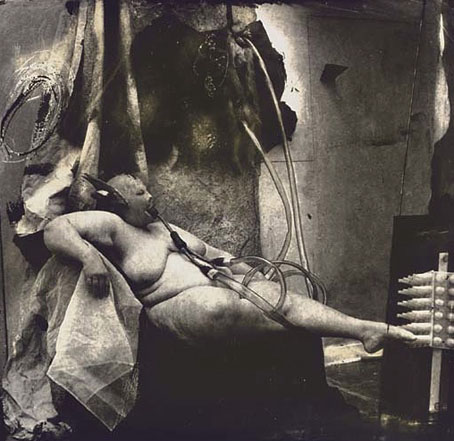
Sanitarium, New Mexico (1983) by Joel-Peter Witkin.

Witkin’s tableaux made an immediate impression circa 1993 when I bought a copy of PhotoVision, a Spanish photography journal which had devoted an entire issue to his work. This arrived at a point when I was halfway through drawing the Reverbstorm comic series, and Witkin’s parade of unorthodox humanity, crucified apes and sundry body parts seemed an ideal complement for the parade of similar grotesqueries (and sundry body parts) we were putting into the comic pages. I also liked the way Witkin worked his own variation on familiar scenes from art history, something we were doing throughout Reverbstorm (Witkin’s Vase: Study For the Base of the Crucifix just happens to combine a partly dissected human skull with Picasso’s Guernica, a recurrent motif throughout the series).

reverbstorm1.jpg

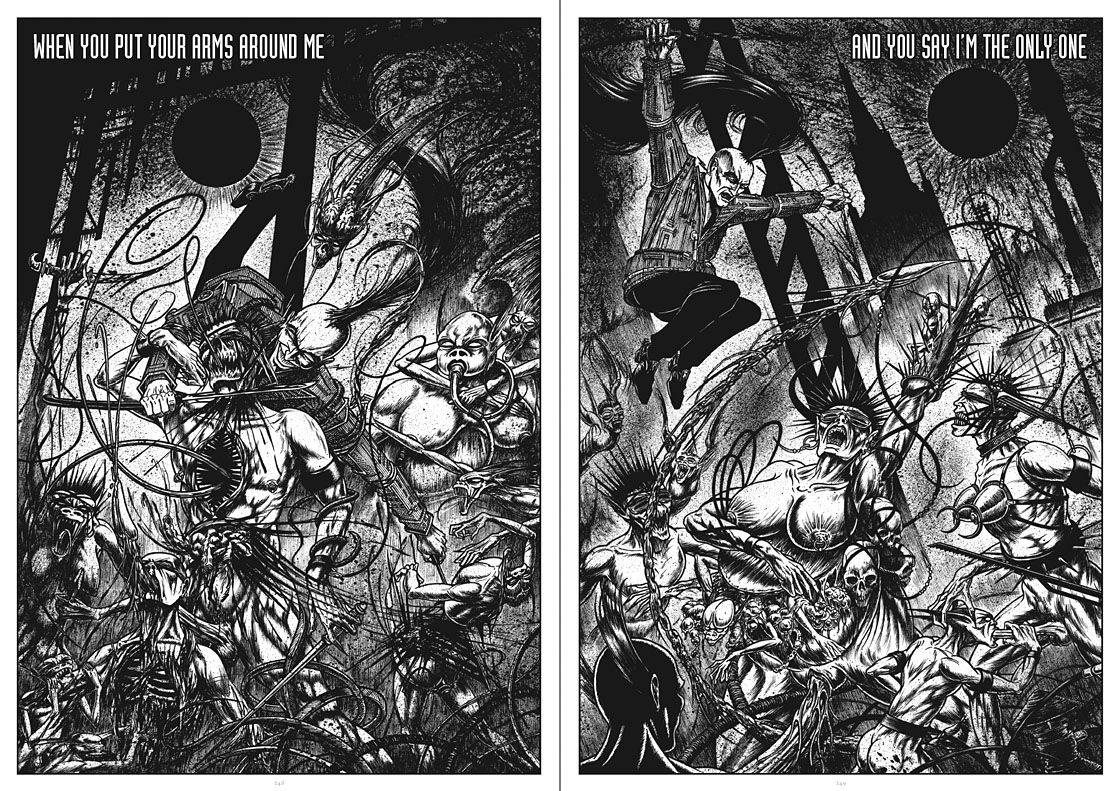
Above and below, some of the more Witkinesque details from part seven of Reverbstorm. The main figure above was a direct reference to Witkin’s Sanitarium, New Mexico. Many figures in other drawings are given Witkin-like blindfolds.

Continue reading “Witkinesque”

Les Jeux des Anges by Walerian Borowczyk

jeux1.jpg

Les Jeux des Anges.

Following yesterday’s post, we can be certain that Terry Gilliam had seen Les Jeux des Anges (1964) because in 2001 he included it in a list of ten favourite animated films. Jan Lenica co-directed Dom (1959) with Walerian Borowczyk but doesn’t work on this film which is the darkest and strangest of all Borowczyk’s works I’ve seen to date. Once again there’s some unavoidable subtext, although whether that applies to the Holocaust or to Stalinist repression is for the viewer to decide. What we see is a series of painted tableaux in which various mechanical processes are butchering angels. The atmosphere isn’t far removed from the cruelties of Roland Topor while the painted scenes are very similar to those that David Lynch would be animating a couple of years later. The soundtrack is credited to electronic composer Bernard Parmegiani. Watch it for yourself here.

jeux2.jpg

Previously on { feuilleton }
Labirynt by Jan Lenica
Les Temps Morts by René Laloux
Short films by Walerian Borowczyk

Weekend links 122

jackson.jpg

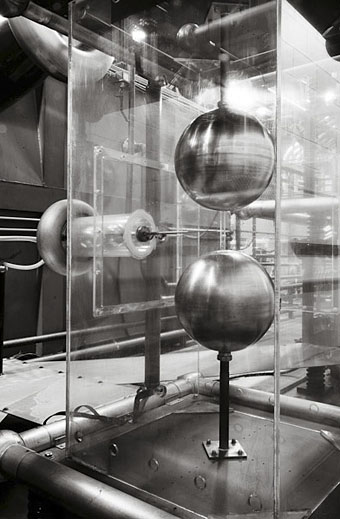
Transmitter Crowbar Discharge Unit, Bates Linear Accelerator. Photo by Daniel Jackson from his Dark Machines series.

The language we use for writing about art is oddly pornographic: We know it when we see it. No one would deny its distinctiveness. Yet efforts to define it inevitably produce squeamishness, as if describing the object too precisely might reveal one’s particular, perhaps peculiar, investments in it. Let us now break that unspoken rule and describe the linguistic features of IAE in some detail.

IAE has a distinctive lexicon: aporia, radically, space, proposition, biopolitical, tension, transversal, autonomy. An artist’s work inevitably interrogates, questions, encodes, transforms, subverts, imbricates, displaces—though often it doesn’t do these things so much as it serves to, functions to, or seems to (or might seem to) do these things. IAE rebukes English for its lack of nouns: Visual becomes visuality, global becomes globality, potential becomes potentiality, experience becomes…experiencability. […] Whatever the content, the aim is to sound to the art world like someone worth listening to, by adopting an approximation of its elite language.

International Art English by Alix Rule & David Levine

For years I’ve been calling it Artspeak: the frequently disingenuous, misleading or merely confused jargon that passes for descriptive writing in the art world. Alix Rule and David Levine apply the more neutral label of International Art English. In a lengthy essay at Triplecanopy they reveal the origins of IAE’s terminology and show why the stuff has spread like semantic kudzu.

• “What a bizarre focal point Anish Kapoor’s spiral callipers are: a Laocoönian observation platform strangled in red steel at a cost of many millions, while electricity pylons, with their austere elegance, once hymned by the poets of the 1930s, have been removed, at enormous cost, from the same site to be buried in the radioactive tilth of landfill dumps and industrial detritus.” Iain Sinclair reports on the Olympics.

Alfred Kubin in…Nottingham! The Other Side, an exhibition of “haunting drawings of death, trauma and fantastical creatures inhabiting imaginary worlds”, running to the end of September.

Francis Ford Coppola and Stewart Copeland discuss the making of Rumble Fish (1982). Over at The Rumpus there’s Coppola talking about his career and his latest film, TWIXT.

Eraserhead: The Making of a Cult Classic. In the 1980s Kenneth George Godwin interviewed everyone responsible for making David Lynch’s film. Fascinating reading.

Skin Job, the debut poetry collection by Evan J. Peterson, is twenty-one poems about monsters, horror, and science fiction. Evan made a trailer.

• Wood, brass and “the latest advances in nanotechnology”: Teka, an OLED lamp by Aldo Cibic and Tommaso Corà.

Tonite Let’s All Make Love in London (1967): Peter Whitehead’s film of the capital at its swinging height.

“Beam Us Up, Mr. Scott!”: Why Misquotations Catch On by Maria Konnikova.

Hari Kunzru‘s ten favourite books about underground London.

The Periodic Table of Heavy Metals.

Alan Garner: A life in books.

Fuck yeah, manuscripts!

• (HR) Giger Counter.

• This week was all about Vangelis in the 1970s: Creation du Monde (1973) | Spiral (1977) | Himalaya / Summit (1979).