Weekend links 811

reiniger.jpg

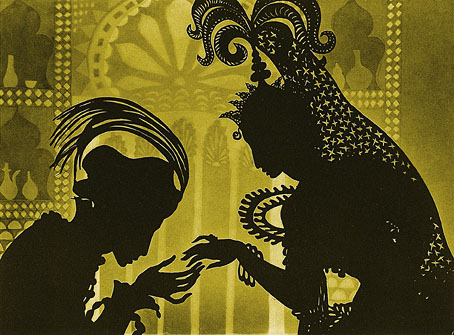
A still from The Adventures of Prince Achmed (1926), a feature-length animated film by Lotte Reiniger.

Hélice 39 is a speculative-fiction journal (in Spanish) whose current issue includes an article by Marcelo Sanchez: “What did Borges think of Lovecraft?”

• Among the new titles at Standard Ebooks, the home of free, high-quality, public-domain texts: The Maltese Falcon by Dashiell Hammett.

• Old music: Hydrophony For Dagon by Max Eastley & Michael Prime; The Adventures Of Prince Achmed by Morricone Youth.

Public Domain Review lists some of the writers whose works will enter the public domain this year.

• “Modern Japanese Printmakers celebrates vibrant mid-20th-century innovation“.

• At Nautilus: “Here’s what’s happening in the brain when you’re improvising.”

• At the BFI: Pamela Hutchinson selects 10 great films of 1926.

• New music: The Future Is Now by Pietro Zollo.

• At Dennis Cooper’s: Phil Solomon Day.

• 2026 is the Year of the Fire Horse.

Runaway Horses (“poetry written with a splash of blood”) (1985) by Philip Glass | Unicorns Were Horses (1996) by New Kingdom | Red Horse (2002) by Jack Rose

Eldritch idols


hpl22.jpg

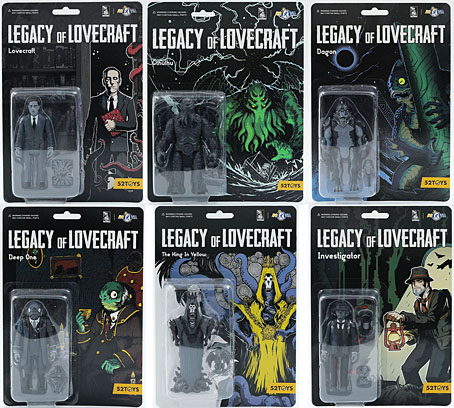
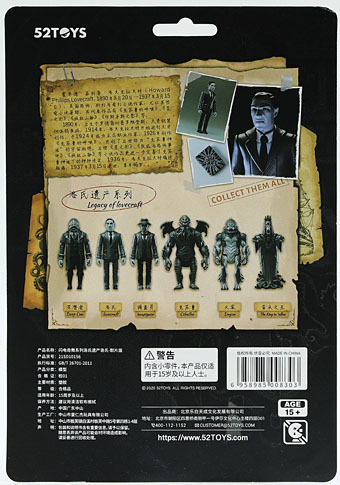
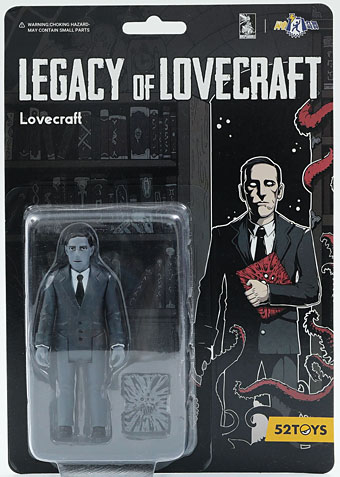
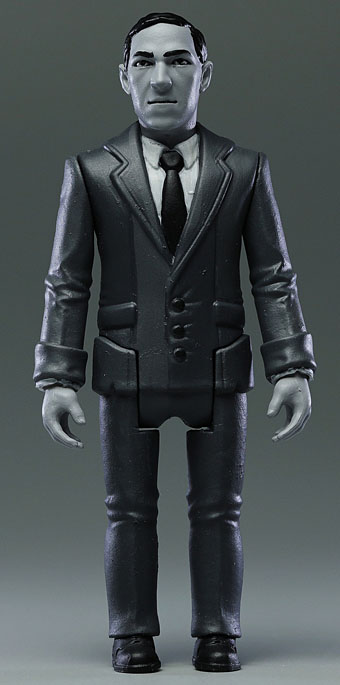
I wouldn’t usually bother writing about new additions to the growing mountain of plastic ephemera generated by 21st-century culture but these items warrant wider attention. Legacy of Lovecraft is a set of six Lovecraft-related action figures made by 52Toys in Japan which include a figure of Lovecraft himself. There was a time when this alone would have been surprising but 20 years have now elapsed since the idea of a Sigmund Freud action figure went from being an unlikely joke to something you could actually buy. Today we’re more likely to be surprised if something with a substantial cultural footprint hasn’t generated any merchandising spin-offs.

hpl21.jpg

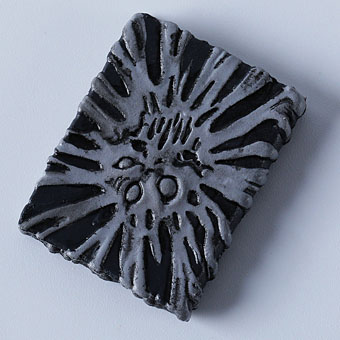
I saw the Lovecraft figure last month in a post at Tentaclii but didn’t notice at the time that it was part of a range which includes Cthulhu, a Deep One, Dagon, and The King in Yellow. The latter isn’t a Lovecraft creation, of course, but Robert Chambers’ stories are Mythos-adjacent. And despite the box art the figure isn’t clad in yellow either, but this provides an opportunity for enterprising owners to create some suitably tattered garments. All the figures come with small complementary items: Lovecraft has a forbidden tome, Cthulhu a tiny ship to torment, and so on. (The nameless “Investigator” comes with two extra items, a lamp and a Cthulhu statue.) The King in Yellow intrigues me the most for being a curious combination of Lovecraftian tentacles with an abundance of gnashing teeth that look like something out of Junji Ito’s comics. If I was going to buy any of these this is the one I’d get first. At around £25 each they’re not cheap but then I’ve spent similar amounts on Japanese CDs in the past.

hpl20.jpg

hpl18.jpg

hpl19.jpg

Continue reading “Eldritch idols”

Weekend links 387

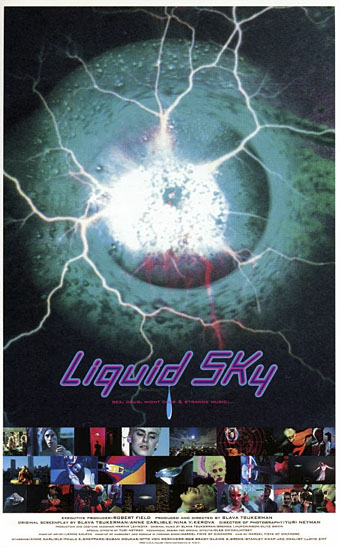
liquidsky.jpg

Japanese (?) poster for Liquid Sky (1982).

• The announcement this week of the death of Carl T. Ford, former editor of Dagon magazine, prompted a handful of memorial pieces. Dagon was notable for being a small British magazine devoted to Lovecraftian and other weird fiction (and the Call of Cthulhu games) at a time when the majority of such publications were American; it was also very well-produced, its later issues being typeset and filled with quality black-and-white illustration. Dagon interviewed many notable writers, including people such as Thomas Ligotti whose work at the time was still only known to a small group of enthusiasts. Mark Valentine posted a reminiscence at Wormwoodiana; Yog-Sothoth.com has an interview with Carl from 2010.

Michael “Dik Mik” Davies, manipulator of an audio generator and tape echo for Hawkwind, also died this week. Dik Mik’s primitive background electronics, augmented by Del Dettmar’s synthesizers, were an essential component of the early Hawkwind sound.

• Erik Davis talks to writer, photographer, and curator Joanna Ebenstein about Goth obsessions, memento mori, Santa Muerta, and her extraordinary new illustrated collection Death: A Graveside Companion.

• Slava Tsukerman’s cult film Liquid Sky (1982) finally gets a blu-ray release. From 2014: Punks, UFOs, and Heroin: Daniel Genis on how Liquid Sky became a cult movie.

Geeta Dayal explores the MOMA exhibition Thinking Machines: Art and Design in the Computer Age: 1959–1989.

You Should Come With Me Now is a collection of new fiction by M. John Harrison published this week.

VinylHub: “Our mission is to document every physical record shop and record event on the planet.”

Vladimir Nabokov‘s dream diary reveals experiments with “backwards timeflow”.

• Flawed Greatness: DB Jones on beauty and balance in John Ford’s The Searchers.

Irakli Kiziria on 9 synth artists who defined Eastern Europe’s post-Soviet sound.

• Edgar Allan Poe’s Hatchet Jobs: Mark Athitakis on Poe’s book reviews.

• Mix of the week: FACT mix 627 by Oneohtrix Point Never.

• At Creative Review: The design of Mute Records.

How generative music works.

Laraaji‘s favourite albums.

We Do It (1970) by Hawkwind | Adjust Me (1971) by Hawkwind | Electronic No. 1 (1973) by Hawkwind

Dark arts

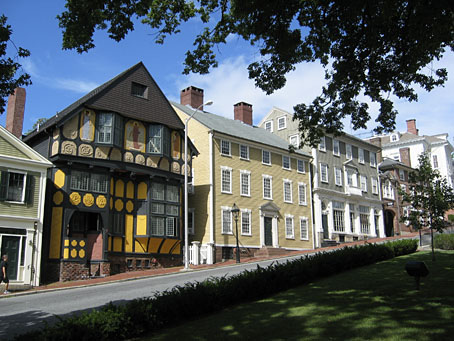
pvd05.jpg

Thomas Street, Providence: on the left is the Fleur-de-Lys Studios; two doors along is the Dodge House Gallery which housed an additional part of the art exhibition; the Providence Art Club is the red-brick building next door.

I’m back from Providence, returned early on Tuesday but took the day off to recover from jet lag. The city was hot and humid for much of the time but I didn’t mind that, it was good to be able to walk around in the evening without a jacket, something that seldom happens here. I don’t go to many conventions so although NecronomiCon was the best I’ve been to, there isn’t a great deal of competition. I always enjoy meeting and talking to creators of any stripe—writers, artists, filmmakers, editors, etc—and it’s a pleasure to meet readers face to face, but conventions in general aren’t always attractive in themselves. NecronomiCon was inviting for being relatively small and with a strong focus not just on Lovecraft but on weird fiction as a whole: there were panels on Clark Ashton Smith, Lord Dunsany, Robert Chambers, and one on the legacy of what M. John Harrison designated “the New Weird”. I’ve been told that if there’s a NecronomiCon in 2017 the intention is to develop this area of discussion.

pvd07.jpg

And then there’s Providence itself: Lovecraft’s stories will read in a very different light now I’ve visited the city that inspired so much of his work. The one walking excursion I took to College Hill was curtailed by an afternoon of 30-degree temperatures but I did get to see a small part of Angell Street where Lovecraft lived for many years, and I also walked down Benefit Street as far as house number 135, familiar to readers as The Shunned House. The architecture of Providence is a delight, not only the Colonial buildings but the also the more recent vernacular styles of the Downtown area. Even the heat seemed connected to Lovecraft and his abhorrence of cold weather; in later years he took sightseeing trips down to Florida so I’m sure he wouldn’t have complained about the hot sun or the swampy air.

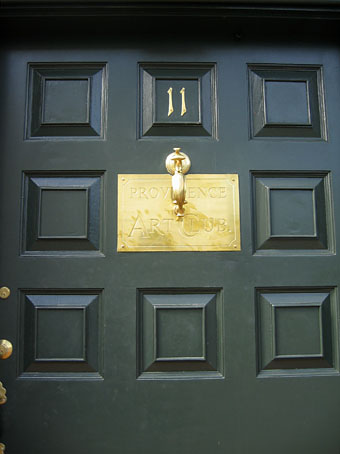
pvd06.jpg

The massive and weighty door of the Art Club.

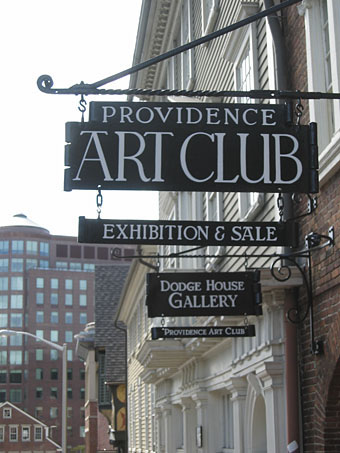
The main reason to be there was for the art exhibition, of course, and for that the venue couldn’t have been better. The Providence Art Club is mentioned in The Call of Cthulhu as a rather staid organisation that disapproves of Henry Anthony Wilcox who works down the street at the Fleur-de-Lys Studios; I spoke to a couple of current Art Club members, and was amused to hear that the establishment still maintains a somewhat conservative position. But the presence of so much bizarre and grotesque art in the gallery was evidence of a loosening of attitudes that Wilcox and Pickman couldn’t have managed in their day. A selection of my photographs follows below; I took over 250 photos but really should have taken more, especially of the buildings. The Providence Art Club has a good collection of photos from the opening night, some of which include me caught uncomfortably in front of a camera lens.

pvd18.jpg

Some acknowledgements: I’ve already thanked Niels-Viggo Hobbs and The joey Zone for inviting me there but I’ll do so again. Big thanks also to Carmen Marusich who spent most of her time behind the counter at Lovecraft Arts & Sciences in the Arcade; to print-wrangler Brian Mullen who very generously spent an afternoon ferrying me around various stores in search of a phone charger before smartly suggesting I try the USB port in the TV at the hotel (something I should have thought of); and to Michael Rose and company at the Providence Art Club for allowing us into their beautiful building. Shouts and thanks to: Sara Bardi, Michael Bukowski, Syl Disjonk, Jason C. Eckhardt, Bob Eggleton, Dave Felton, Stephen Gervais, Mike Knives, Robert H. Knox, Allen Koszowski, Henrik Möller, Mallory O’Meara, Gage Prentiss, Skinner, Jason Thompson, Frank H. Woodward (at last!), Josh Yelle, and all those who bought artwork, offered compliments or came to see the art and the panel discussions.

Finally…Earth! I’ve been listening to the band a great deal this year so I’m predisposed to enjoy any live event, but their performance in the gilded splendour of the Columbia Theatre on Federal Hill really knocked me out. An outstanding set with great sound and great support acts too, especially Elder. All this taking place a couple of streets away from the location of Lovecraft’s Starry Wisdom church; I was in seventh heaven.

And now the photos…

pvd16.jpg

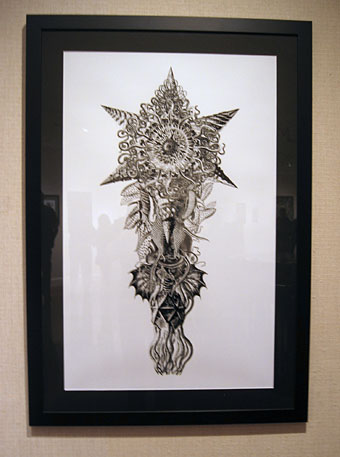
The title page entity from Lovecraft’s Monsters which was named Tentacles for the exhibition.

pvd17.jpg

My works were in a gallery room on their own, guarded by the title page thing from Lovecraft’s Monsters.

Continue reading “Dark arts”

More Esteban Maroto

maroto05.jpg

Psychedelic Kali from Vampirella 18.

Copies of the Dracula comics may be scarce these days but two of the artists who appeared in the title—Esteban Maroto and José Beá—were also appearing regularly in Vampirella around the same time. The Internet Archive has a large collection of Warren titles including an almost complete run of Vampirella. Esteban Maroto’s work stands out for me for his draughtsmanship, his page layouts, the atmosphere of heady eroticism, and the frequent touches of psychedelia of which the panel above is one of the more striking examples. The best strips are the ones he wrote himself; when he works with American writers the results tend to be more restrained. It’s a shame Vampirella was mostly a black-and-white title, so many of these pages would benefit from the same colour treatment as Wolff.

maroto01.jpg

Wolf Hunt from Vampirella 14.

And speaking of wolves, there’s a similar collection of witches and lycanthropes in these stories.

maroto02.jpg

Tomb of the Gods: Horus from Vampirella 17.

Tomb of the Gods is a short series in which mythological stories are explored Maroto-style. The exception is Gender Bender, a piece of science fiction with masculine and feminine psyches pitted against each other in a virtual arena. The story title is a surprise for anyone thinks that phrase originated in the 1980s.

maroto03.jpg

Tomb of the Gods: Kali from Vampirella 18.

Continue reading “More Esteban Maroto”