Weekend links 99

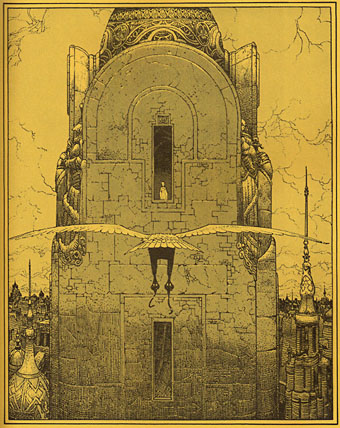
moebius.jpg

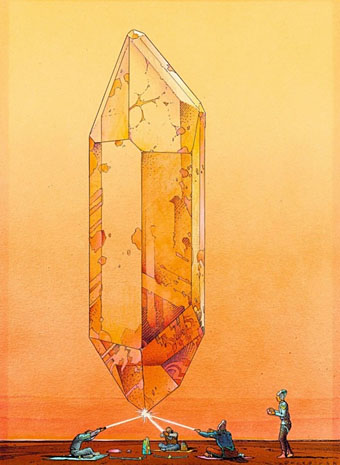
From the Crystal Saga portfolio (1986) by Moebius. Via Quenched Consciousness.

Moebius: A while ago, [science fiction] was filled with monstrous rocket ships and planets; it was a naive and materialistic vision, which confused external space with internal space, which saw the future as an extrapolation of the present. It was a victim of an illusion of a technological sort, of a progression without stopping towards a consummation of energy. But we’ve completely changed that vision. It’s been a sharp, radical change, and somewhat brutal.
HM: Why brutal?
Moebius: Because all those beautiful projects we believed in are gone. But the real sense of science fiction is the discovery that the voyage is interior, and the real energy, the rockets of the past, is what is contained in people’s spirits.
HM: One doesn’t have to read other people’s visions then, one can make the discovery oneself?
Moebius: Well, that, and also the fact that the “new planet” of old science fiction is right here: it’s the Earth.

The Moebius Interview by Diana K. Bletter, Heavy Metal, August 1980.

RIP Jean Giraud, aka Moebius, one of the great artists of the 20th century. My approach to drawing comics was almost wholly derived from the illustrational style of the French, Belgian and other artists being published in Heavy Metal magazine in the late 1970s/early 1980s. Many of the stories were appearing in English for the first time, and for me they revitalised a medium in which (undergrounds aside) I’d lost all interest. It wasn’t only the exceptional artwork that was attractive. The narratives of Moebius, Druillet, Bilal and co. presented a more sophisticated approach to science fiction and fantasy than the simple-minded fare filling the superhero titles or the pages of 2000 AD. Moebius’s work was wittier, sexier and far more imaginative than any American comics I’d seen up to that time. Some of the stories read like graphic equivalents of New Worlds-era science fiction so it came as no surprise to find Moebius drawing a strip called The Airtight Garage of Jerry Cornelius (the title was later amended at Moorcock’s request) while Druillet in his September 1980 Heavy Metal interview mentioned enjoying books by William Burroughs, Michael Moorcock and Thomas Disch, and singled-out Ballard’s Crash as a favourite novel. Without the examples of Druillet and Moebius (and the intoxicating inspiration of the October 1979 issue of Heavy Metal) I wouldn’t have spent 17 months adapting The Call of Cthulhu as a comic strip.

Hasko Baumann’s 2007 documentary, Moebius Redux: A Life in Pictures (some of which can be seen on YouTube) is a good place to start when trying to appraise Jean Giraud’s extensive career. The film is now available on DVD.

Update:
The hour-long cut of Moebius Redux has been posted to Vimeo
An obituary by Kim Thompson at The Comics Journal
The Moebius posts at But Does It Float
moebius2.jpg

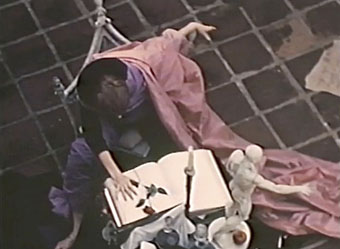
From Les Yeux du Chat (1978) by Jodorowsky & Moebius. Via Quenched Consciousness.

• “Naked Lunch,” Ballard wrote later, “was a grenade tossed into the sherry party of English fiction.” The criss-crossing careers of JG Ballard and William Burroughs are examined in detail at RealityStudio. Related: The Discipline of D.E. (1982) by Gus Van Sant and The Unlimited Dream Company (1983) by Sam Scoggins.

• Dr John’s forthcoming album, Locked Down, has been produced by The Black Keys‘ Dan Auerbach. Those of us who favour the Doctor’s voodoo-inflected early albums are hoping this might mean he gets groove back after wandering for years in an MOR swamp. One of the new recordings, Revolution, sounds promising.

I don’t think sexuality is fixed anymore. I think more from the gay male side than the lesbian side, there is often a wish for things to be fixed. I heard Lady Gaga’s Born This Way and I don’t know why they like it. Maybe, they need more certainty than girls do. For me, it’s like why do you care anyway? Maybe you were, maybe you weren’t. What’s the big deal? I can’t connect to that emotionally, so it baffles me.

Jeanette Winterson talks to Sassafras Lowrey.

• “In [Jacob’s Room], [Virginia] Woolf makes the subject matter not Jacob himself but the ways in which we know and don’t know each other – the gaps in our knowledge.” Alexandra Harris on Modernism in art and literature.

• The Northwest Film Forum in Seattle hosts Magick in Cinema on 5th April, an evening of occult-themed short films which includes a rare screening of Curtis Harrington’s Wormwood Star.

• John Bertram’s Lolita cover competition from 2009 is due to appear in June as a book-length study entitled Recovering Lolita. Bertram previews the contents here.

• “Erotic fiction is having a steamy renaissance and its hottest authors are women.”

LSD helps to treat alcoholism.

• The other Moebius (Dieter): News (1980) by Moebius & Plank | Tollkühn (1981) by Moebius & Plank | Conditionierer (1981) by Moebius & Plank.

House of Harrington

harrington1.jpg

Curtis Harrington.

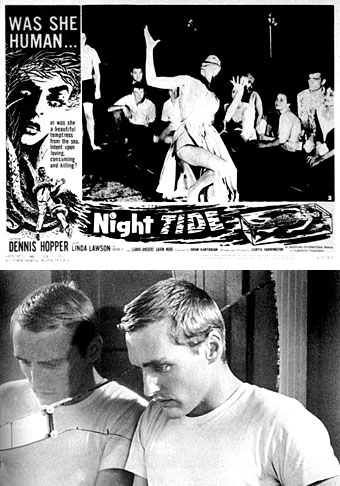
House of Harrington is a short documentary from 2008 about the late filmmaker Curtis Harrington which has just been posted to YouTube by its makers, and by a curious coincidence this appearance occurs in the week of Dennis Hopper’s death. Harrington gave Hopper the lead in his debut feature Night Tide (1961) at a time when the actor was ostracised in Hollywood after a falling out with director Henry Hathaway. Hopper’s diligent performance in Harrington’s film, a low budget horror, is a long way from the histrionics one usually finds in works of this sort and is a good reason to seek it out.

harrington2.jpg

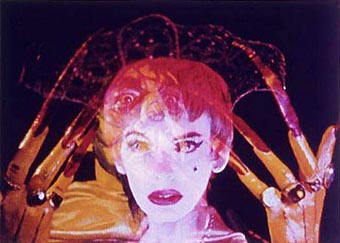
Marjorie Cameron in The Wormwood Star.

Also in Night Tide in a wordless role is the enigmatic occult artist Marjorie Cameron who drifts around looking spooky and mysterious. Cameron had earlier appeared with Harrington in Kenneth Anger’s Inauguration of the Pleasure Dome (1954), he as Cesaré the Somnambulist from Caligari, she as Aleister Crowley’s Scarlet Woman. That encounter led to Harrington making her the subject of one of his experimental shorts, The Wormwood Star in 1956. I’ve wanted to see this film for years, if only to sate a persistent curiosity, and House of Harrington contains a few tantalising glimpses. With luck it may turn up on YouTube (or even DVD) in the future.

Lastly, Automat Pictures, the makers of House of Harrington, also have a lengthy filmed lecture in their channel, Queer for Fear, which “explores gay and lesbian subtext in the horror film, and examines the intertwining of queer history and monster movies.”

• House of Harrington: Part 1 | Part 2 | Part 3 | Part 4

Previously on { feuilleton }
Curtis Harrington, 1926–2007
The art of Cameron, 1922–1995
Kenneth Anger on DVD…finally

Curtis Harrington, 1926–2007

harrington.jpg

Curtis Harrington, who died on Monday, was chiefly known as a director of low-budget horror films, the most acclaimed of which is his debut feature Night Tide (1961), a watery riff on Cat People (1942) starring a young Dennis Hopper. But Harrington should also be remembered for his associations with early American avant garde cinema, especially the productions of Kenneth Anger. Harrington was behind the camera for Anger’s Puce Moment (1949) and appeared in front of it as Cesare the Somnambulist in Inauguration of the Pleasure Dome (1954). Harrington’s early films were similarly uncommercial experimental shorts, one of which, The Wormwood Star (1956), was based around the paintings and person of Marjorie Cameron Parsons Kimmel aka Cameron. Harrington and Cameron both appeared in Anger’s Pleasure Dome and Harrington featured Cameron again when he came to make Night Tide, where she appears as a mysterious, witch-like presence.

Night Tide is well worth a look, despite the limitations of its budget. Dennis Hopper had been ostracised from Hollywood after a fall-out with director Henry Hathaway and was hanging around with various artists and experimental filmmakers (including Andy Warhol’s crowd), acting in TV shows and generally biding his time. Harrington gave him a starring role and the opportunity to pull some Method faces, and he’s very impressive as he falls for a girl who may or may not turn into a murderous sea creature with the next full moon. Good use is made of the crumbling beachfront of Venice, CA, and there’s some sly camp humour to be found in Hopper’s appearance (he’s dressed in a sailor uniform most of the time, looking like an extra from Anger’s Fireworks), and in the scene where he goes for a (chaste) massage. Night Tide isn’t as strange as Carnival of Souls (1962) but both films share enough of the same atmosphere and period detail to make a perfect double-bill.

Previously on { feuilleton }
Alla Nazimova’s Salomé
Coming soon: Sea Monsters and Cannibals!
Freddie Francis, 1917–2007
The art of Cameron, 1922–1995
Kenneth Anger on DVD…finally

The art of Cameron, 1922–1995

cameron_work01.jpg

Fairy Queen (1962), ink and dyes on parchment.

A rare exhibition of work by occult artist Cameron, aka Marjorie Cameron Parsons Kimmel, can be seen at the Nicole Klagsbrun Gallery in New York.

Nicole Klagsbrun Gallery is pleased to present an exhibition of work by Cameron (1922–1995), curated by Michael Duncan, George Herms, and Nicole Klagsbrun. The exhibition runs from January 12 until February 10, 2007. An opening reception will be held on Friday, January 12, from 6–8 pm.

This survey is the first solo gallery exhibition of artist, performer, poet, and occult practitioner, Cameron (Marjorie Cameron Parsons Kimmel). A maverick follower of the esoteric mysticism of Aleister Crowley and his philosophical group, the OTO (Ordo Templi Orientis), Cameron was also an accomplished painter and draftsman and mentor to younger artists and poets such as Wallace Berman, George Herms, and David Meltzer. While enlisted in the Navy, she was assigned the tasks of drawing maps and working in a photographic unit, which led to attendance at art classes after being discharged. In Los Angeles, she became the wife and spiritual avatar of scientist and mystical thinker Jack Parsons (1914–1952), one of the founders of the Jet Propulsion Laboratory and an influential leader of the OTO.

marjorie_cameron.jpg

The mundane Cameron during the Second World War.

In the early 1950s, Cameron met the fellow LA artist and jazz enthusiast Wallace Berman who was fascinated by her artwork, poetry, and mystical aura. In 1955 Berman used his photograph of Cameron as the cover of his literary and artistic journal Semina and included in the issue a drawing she had made the previous year. The drawing became renowned when the police cited it as ?lewd? and shut down Berman’s 1957 exhibition at Ferus Gallery. After this experience, Cameron, like Berman, refused to show her art in commercial galleries. She remained, however, a crucial figure in the Berman circle. Cameron’s romantic aesthetic and commanding persona prompted filmmaker Curtis Harrington to commemorate her output as a visual artist in The Wormwood Star (1955), a lyrical short film recording the art and atmosphere of her candlelit studio. Filmmaker Kenneth Anger cast her in a leading role opposite Anäis Nin in his film Inauguration of the Pleasure Dome (1954).

cameron.jpg

The occult Cameron, manifesting as the Scarlet Women for Kenneth Anger.

Despite the grim fatality of much of her writings, Cameron?s artworks portray a fanciful, even wistful lyricism. In the early 1960s she corresponded with Joseph Campbell, citing her interest in his book The Hero with a Thousand Faces, as well as in the fiction of Hermann Hesse and Isak Dinesen. Consumed by myth and the idea of protean growth, Cameron depicted the process of metamorphosis and transformation in hundreds of line drawings where ominous figures and landscapes emerge from uniformly striated, passionately articulated ink marks. Other gouache drawings and paintings depict mythic figures of her own creation engaged in ritualistic, symbolic acts.

For now, her work is barely visible on the web but there’s another small gallery of her pictures here. And just to show how MySpace is seemingly intent on resurrecting everyone who ever lived, Marjorie Cameron, Babalon 156 is in your extended network.

Nicole Klagsbrun Gallery
526 West 26th St, no. 213,
New York.

Via Jay.

Previously on { feuilleton }
Kenneth Anger on DVD…finally
Austin Osman Spare