Occult gestures

dunwich1.jpg

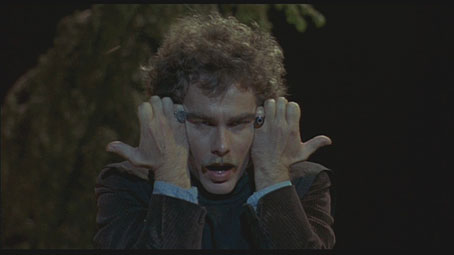
Dean Stockwell freaks out: The Dunwich Horror (1970).

I’m off to the NecronomiCon later this month so HP Lovecraft and all his works will be a predominant theme for the next couple of weeks. I’m also extremely busy right now so posts may tend to be brief.

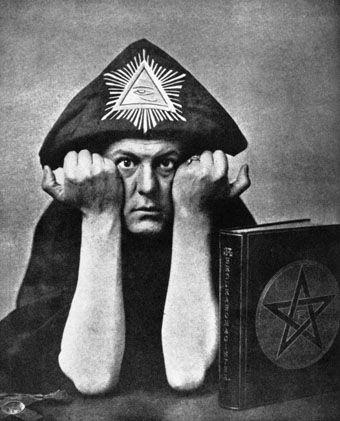
One of the films showing in Providence for the convention is Daniel Haller’s 1970 production of The Dunwich Horror. I have a low tolerance for bad horror films, and this is a bad one despite being closer to its source than other AIP quickies. Dean Stockwell plays Wilbur Whateley whose goatish qualities are here reduced to a gesture which even the filmmakers may not have known as “the Horns of Pan”, a borrowing from the famous photo of Aleister Crowley in his magician’s robes. I noted an earlier borrowing of this gesture some time ago after stumbling upon an obscure silent film serial, The Mysteries of Myra. The use in The Dunwich Horror provides another odd link between Lovecraft and Crowley, and makes me wonder whether any other films have nodded to Crowley in this way.
crowley.jpg

Aleister Crowley in 1912.

Another stray connection worth noting: Dean Stockwell was good friends with Dennis Hopper, and the pair are described in a number of sources as living for a while in a house run by Marjorie Cameron, an artist with a direct connection to Crowley via her husband, Jack Parsons. This may be rumour but Hopper and Cameron did appear together in Curtis Harrington’s beguiling Night Tide in 1961.
dunwich2.jpg

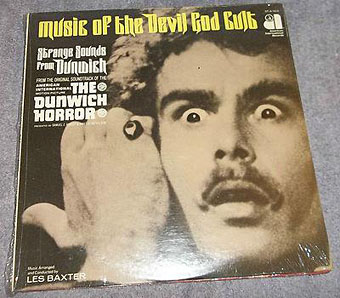
Finally, the gesture appears again on the cover of the soundtrack album which AIP smartly titled Music of the Devil God Cult: Strange Sounds from Dunwich. The title was too much for easy-listening maestro Les Baxter to live up to but he does have the distinction of being the first composer to record a piece of music entitled Necronomicon.

Previously on { feuilleton }
NecronomiCon Providence 2015
The horror
Die Farbe and The Colour Out of Space
The Mysteries of Myra

More Songs for the Witch Woman

cameron1.jpg

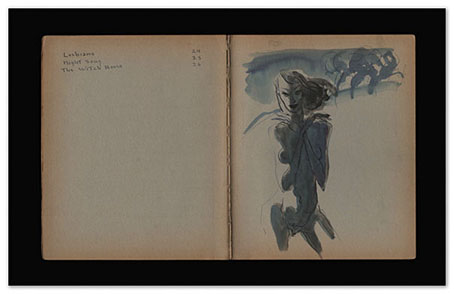
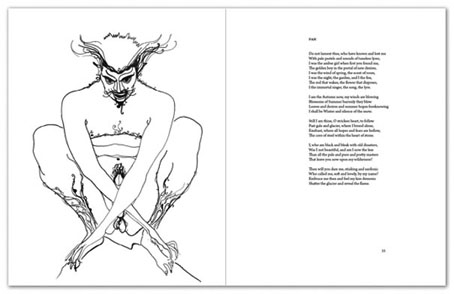
This month I’ve been enjoying the latest quality publication from Fulgur, Songs for the Witch Woman, the centrepiece of which is a cover-to-cover reproduction of the book of occult poetry and art created by Jack Parsons and Marjorie Cameron in the early 1950s. It’s been a great pleasure in recent years seeing the welling of interest in Cameron’s work. In 2001 when I was compiling notes for an abandoned study of occult cinema, Cameron as artist, witch or mere human being was a shadowy presence about whom nothing substantial seemed to have been written; her art was impossible to see anywhere, all one had were fleeting references in books, and her appearances in The Inauguration of the Pleasure Dome and Curtis Harrington’s Night Tide, a pair of films that only exaggerated her mystique. The intervening years have seen a lifting of successive veils so we’re now able to watch Curtis Harrington’s film portrait, The Wormwood Star, and see her work in books and exhibitions like this one (also titled Songs for the Witch Woman) which will be showing at the Pacific Design Center in Los Angeles from mid-October. As an early precursor to that there’s this feature by Robert Garrova at SPRC which includes comments about the exhibition from organisers Scott Hobbs and Yael Lipschutz.

cameron2.jpg

Pan: art by Cameron, poem by Parsons.

Previously on { feuilleton }
Songs for the Witch Woman
More Cameron
Inauguration of the Pleasure Dome: The Eldorado Edition
The Wormwood Star
Street Fair, 1959
House of Harrington
Curtis Harrington, 1926–2007
The art of Cameron, 1922–1995

The Wormwood Star

cameron1.jpg

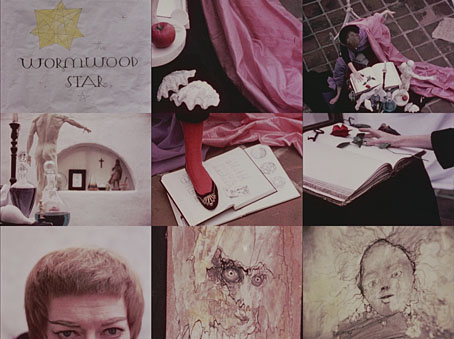
I’ve waited about 20 years to see this one, after first learning of it via a Curtis Harrington interview in Michael Weldon’s Psychotronic magazine in the 1990s. The Wormwood Star (1956) is a 10-minute study of the occult art and witchy persona of Harrington’s friend Marjorie Cameron (1922–1995), best known these days for her memorable incarnation as the Scarlet Woman in Kenneth Anger’s Inauguration of the Pleasure Dome (1954), a film in which Harrington also appeared. With her flame-red hair, green eyes and basilisk gaze, Cameron (as she preferred to be called) would have made an impression wherever she landed. Her presence in Anger’s film is so striking that stills of her face have often been used to stand for the entire Magick Lantern Cycle.

cameron2.jpg

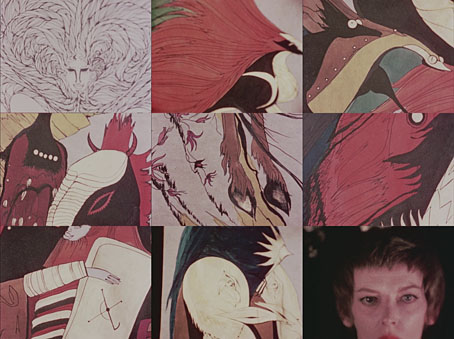
In The Wormwood Star Harrington ramps up the mystique with oblique shots and at least half the running time given to Cameron’s strange drawings and paintings. The subtitle, “Concerning the Knowledge and Conversation of the Holy Guardian Angel” harks back to the 1940s and her husband, Jack Parsons, a rocket researcher and, for a time, the American head of Aleister Crowley’s Ordo Templi Orientis. Harrington later gave Cameron a wordless role as the “Water Witch” in his low-budget horror film, Night Tide (1961), where she drifts around Venice Beach looking suitably mysterious. Night Tide is out-of-copyright so can be watched in full at YouTube. The Wormwood Star appeared on a Curtis Harrington DVD only last month which is no doubt where this copy originates. It may not stick around so watch it while you can.

Previously on { feuilleton }
Street Fair, 1959
House of Harrington
Curtis Harrington, 1926–2007
The art of Cameron, 1922–1995
Kenneth Anger on DVD…finally

Weekend links 165

smart.jpg

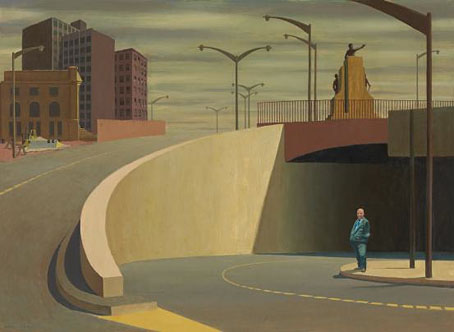
Cahill Expressway (1962) by Jeffrey Smart whose death was announced this week.

• “Russell Beale is awed by the beauty of the Roman silver Warren Cup showing men and youths making love, so startlingly erotic that the first time the British Museum was offered it in the 1950s, it turned it down flat. In 1999, when it came on the market again, the museum had to raise £1.8m to acquire it. ‘It’s just heaven, isn’t it?’ Russell Beale sighs.” Maev Kennedy on Same-Sex Desire and Gender Identity, a new exhibition at the British Museum.

• “The route to Tyburn Tree snaked through Holborn and St Giles, then went along Tyburn Road, today’s Oxford Street. It was dense with spectators.” Matthew Beaumont on the tiny memorial (Google view) for the estimated 50,000 people executed in the centre of London.

• Mixes of the Week: Bottoms Up by Staffan Lindberg for BUTT Magazine, and Electronic Ladyland, a collection of women with synths (and other instruments) from Bitch Media.

But the very thing that is valuable about diversity – the cultural and ideological clashes that it brings about – is precisely what many people fear. And that fear takes two forms. On the one hand you have the little Englander sentiment: immigration is undermining the national fabric, eroding our sense of British or Englishness, turning our cities into little Lahores or mini-Kingstons. And on the other you have the multicultural argument: that diversity is good, but it has to be policed to minimise the clashes and conflicts and frictions that diversity brings in its wake. And so we have to restrain speech, and police the giving of offence.

Kenan Malik on The Pleasures of Pluralism, The Pain of Offence.

L’Empire des Lumières is a great title for Anne Billson’s blog about Belgium. Tram-wire covered streets are one of my favourite things.

The Outer Church, 28 musical artists with an uncanny temperament collected by Joseph Stannard for Front & Follow.

His Heavy Heart, a film by Alan Moore & Mitch Jenkins, is looking for Kickstarter funding.

• In 1997 Quentin Crisp wrote about “Ten Wonderful Gangster Movies” for Neon magazine.

Raymond Chandler’s The Big Sleep redesigned for the Penguin Design Award, 2013.

• Out on DVD/Blu-Ray this month: The Curtis Harrington Short Film Collection.

A billion-pixel panoramic view of the planet Mars from the Curiosity Rover.

• In the TLS: Robert Craft on Stravinsky and The Rite of Spring.

Typophonic: Album cover typography.

The Owl Theremin is a thing.

LSD ABC

Spring Rounds From The Rite Of Spring (1975) by Alice Coltrane | Revenge Of The Black Regent (1999) by Add N To (X) | Sore Ga Afrirampo (2010) by Afrirampo

Burt Shonberg’s Poe paintings

usher1.jpg

House of Usher (1960): Vincent Price and Mark Damon.

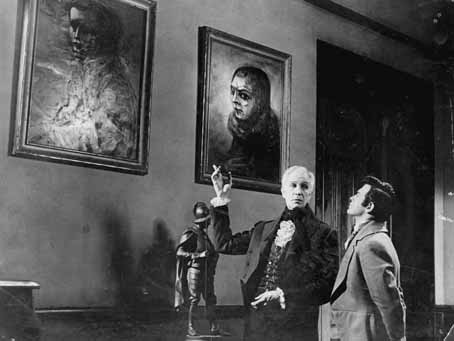
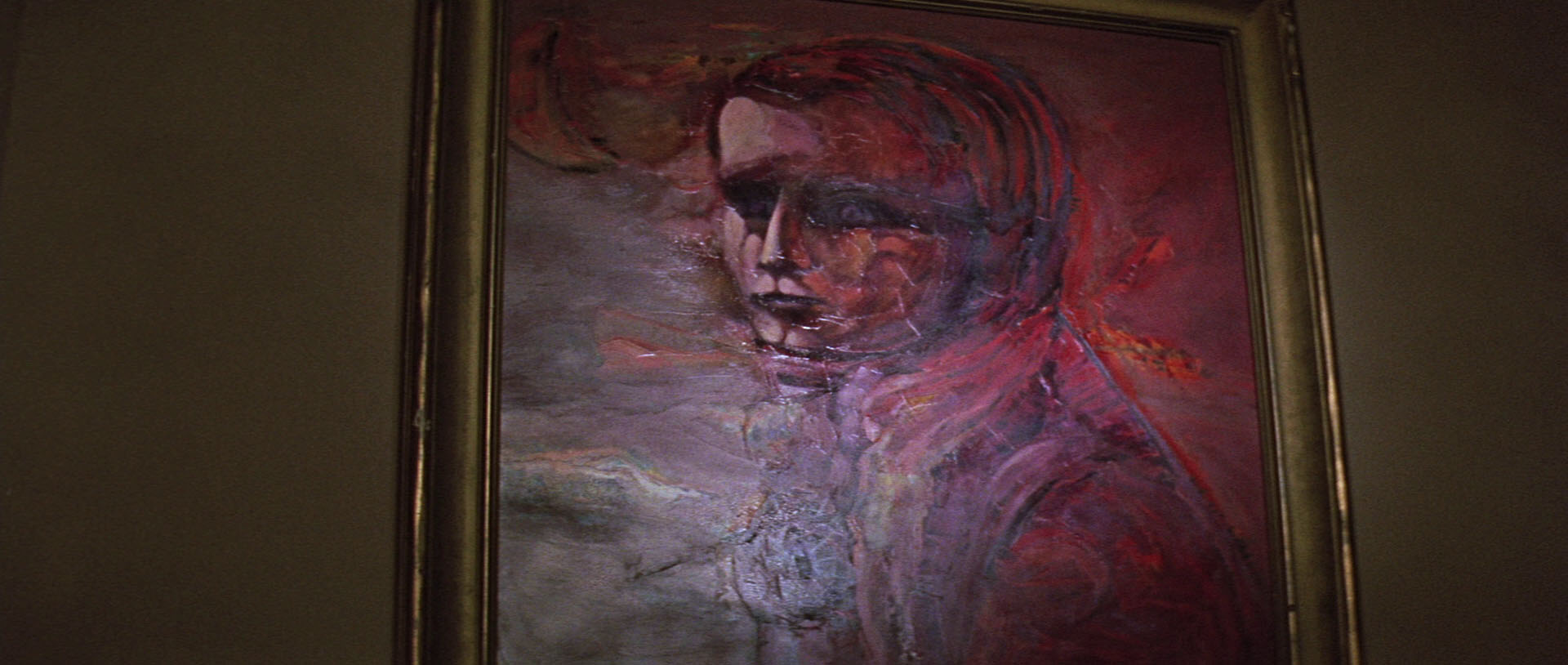
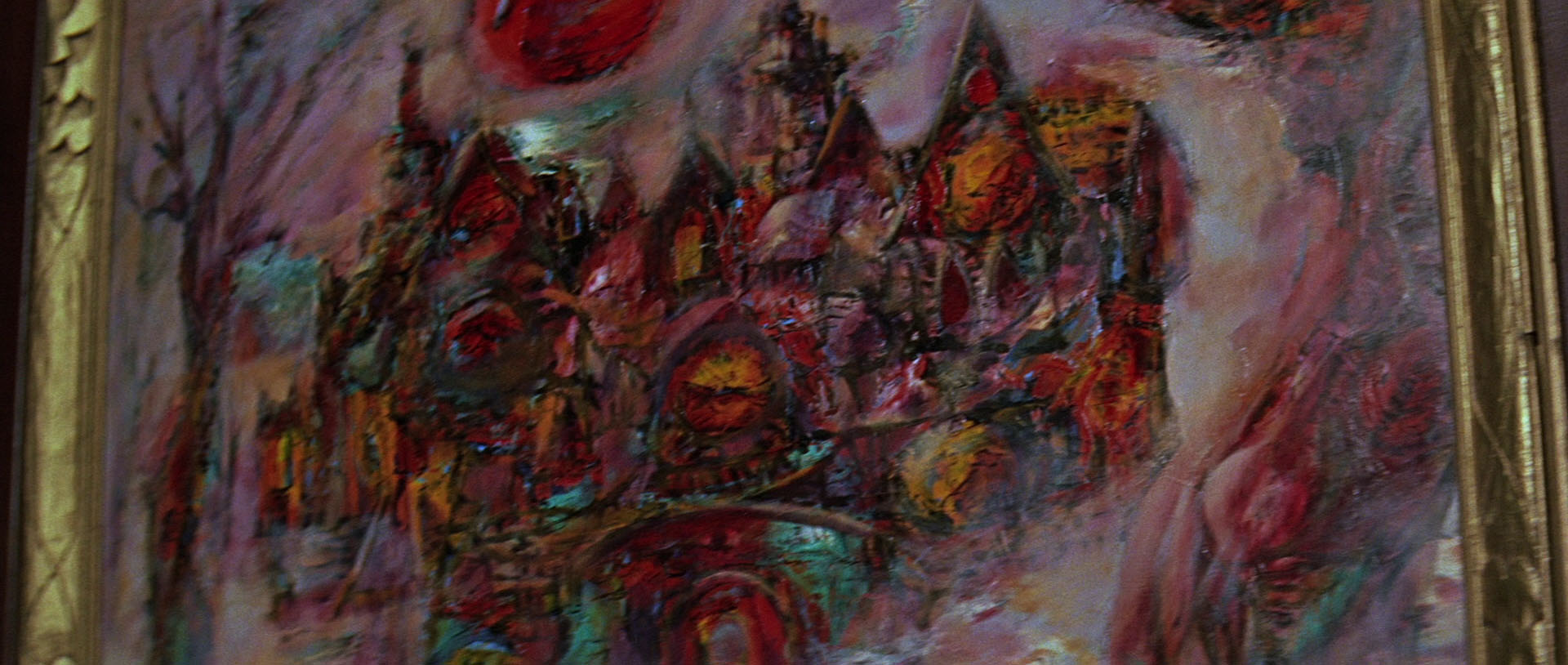
This post ought to have followed the one in January about the sinister portraits glimpsed in Roman Polanski’s Dance of the Vampires. I still don’t know who was responsible for those paintings but the artist who created the equally outré family portraits in Roger Corman’s House of Usher (1960) was credited for his work. Burt Shonberg (1933–1977) was a friend of Corman’s who had to produce the six portraits at speed (the entire film was shot in fifteen days) so the results are sketchier than they might have been in a production with a bigger budget. I always liked the anachronism of these pictures, the way they look very much of their time; the effect is a jarring one that adds a note of much-needed strangeness to Corman’s otherwise sparse interiors.

usher2.jpg

Shonberg was a curious artist, the gallery page on his website shows a progression from Picasso-style early works in the 1950s to his own brand of mystical psychedelia. Some of his paintings from around the time of House of Usher have that stained-glass fragmentation one finds in the work of Leo & Diane Dillon from the same period. Shonberg’s biography says Corman used more paintings in The Premature Burial (1962) but I don’t have a copy of that to hand and haven’t found any examples. There’s also the detail that Shonberg was involved for a while with Marjorie Cameron, herself an artist who appeared as the mysterious “Water Witch” in another AIP production, Curtis Harrington’s Night Tide, a year after House of Usher.

usher3.jpg

usher4.jpg

Continue reading “Burt Shonberg’s Poe paintings”