
Weekend links 125

cme.jpg

Coronal Mass Ejection from the surface of the Sun, August 31st, 2012.

• “Most of the main parts were recorded in a single day using Vangelis’s famous technique: try to play as many synths as possible at once.” Simon Drax on the prolific musical output of Zali Krishna. The new Krishna opus is Bremsstrahlung Sommerwind, free to download at the Internet Archive.

• The Northants International Comics Expo (N.I.C.E.) opens on September 22nd. Among the many attendees there will be Mr Alan Moore making his first convention appearance since 1987.

• “Isolated for one night in a boat overlooking the Thames, Geoff Dyer explores representations of reality through the lens of Joseph Conrad’s Heart of Darkness.”

Now seems the right time to revisit this secret archive of public broadcasting. It’s an antidote to the celebrity-led, format-driven nature of so many arts documentaries made today. It shows that it’s possible to produce TV that is both populist and experimental. And it also refutes the cliché that the 1970s was a decade only of crisis and downturn. “Feminism, political theatre, Ways of Seeing: I wasn’t thinking, ‘what a terrible time’. It was very dynamic, activist, political. Creatively it was very exciting. Yet all they show on those television retrospectives are episodes of Top of the Pops.”

Sukhdev Sandhu talks to Mike Dibb, the director of Ways of Seeing.

• From 1999: Colm Tóibín reviews A History of Gay Literature: The Male Tradition by Gregory Woods.

What We See: a song by Julia Holter & Nite Jewel with a film by Delaney Bishop & Jose Wolff.

Rick Poynor on The crash test dummy: from subcultural fringes to pop culture mainstream.

In his 1973 book on Joyce, Joysprick, Burgess made a provocative distinction between what he calls the “A” novelist and the “B” novelist: the A novelist is interested in plot, character and psychological insight, whereas the B novelist is interested, above all, in the play of words. The most famous B novel is Finnegans Wake, which Nabokov aptly described as “a cold pudding of a book, a persistent snore in the next room.” The B novel, as a genre, is now utterly defunct; and A Clockwork Orange may be its only long-term survivor.

Martin Amis on A Clockwork Orange, fifty years on. My old post about the film’s record shop scene continues to be one of the most popular pages here.

• Wild Boys: David Bowie and William Burroughs in 1974, hand-coloured by DB.

Alfred Kubin‘s illustrations for Haschisch (1902) by Oscar AH Schmitz.

• Revolution off: industrial ruins photographed by Thomas Jorion.

• Tetrahedra of Space: 22 pulp illustrations by Frank R. Paul.

The Blue Boy Studiolo: a Tumblr.

Marina Warner visits Hell.

• The art of Casey Weldon.

RainyMood.com

Third Stone From The Sun (1967) by The Jimi Hendrix Experience | Sunrise In The Third System (1971) by Tangerine Dream | 3rd From The Sun (1982) by Chrome.
Weekend links 97

conformist.jpg

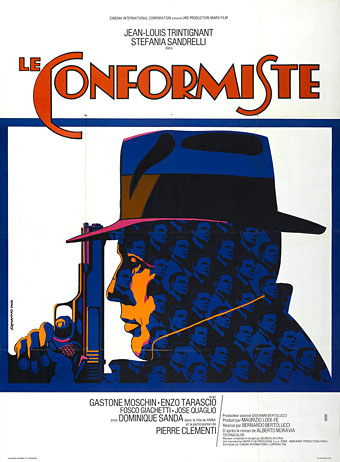
Illustration by Ermanno Iaia. Hard to believe that Bernardo Bertolucci’s The Conformist (1970) is only now appearing on DVD in the UK. Arrow Films release a dual-format edition at the end of this month.

• The week in perfume: Perfumes: The Guide by Luca Turin & Tania Sanchez is reviewed by Emily Gould (“this is a golden age of perfume criticism”) and prompts a meditation on the art and process of scent from Rishidev Chaudhuri.

Electrical Banana by Norman Hathaway & Dan Nadel is “the first definitive examination of the international language of psychedelia, focusing on the most important practitioners in their respective fields”.

Sacred Monsters is a forthcoming collection of essays and criticism by Edmund White. Related: Colm Tóibín from 1999 reviewing A History of Gay Literature: The Male Tradition by Gregory Woods.

Medium, a video by Clayton Welham and Sam Williams for Emptyset whose imminent release (also entitled Medium) I’ve designed. Related: Dave Maier on music versus noise.

• Couldn’t happen to a nicer guy: the face of US presidential contender Rick Santorum rendered as a collage of (mostly) gay porn. More provocation: All Dead Mormons Are Now Gay.

• Coilhouse discovered a rough copy of Bells of Atlantis (1952), an experimental film which features Anaïs Nin, input from Len Lye and an electronic score by Louis & Bebe Barron.

• “The idea that we should have but two options when it comes to our gender presentation, male or female, has always felt ludicrous to me,” says LaJohn Joseph.

Bely paints “a universe of strange manifestations” which drifts across Apollonovich’s consciousness every night before he falls asleep. We are even shown congeries of images that are shards of events which took place that day for the senator: “all the earlier inarticulacies, rustlings, crystallographic figures, the golden, chrysanthemum-like stars racing through the darkness on rays that resembled myriapods”

Malcom Forbes on Andrei Bely’s masterwork, Petersburg (1916).

RIP Barney Rosset, publisher of Grove Press books and the Evergreen Review.

The Brothers Quay will be at work in Leeds city centre this May. Lucky Leeds.

Warm Leatherette, a short film by Analogue Solutions.

Cormac McCarthy, Quantum Copy Editor.

The importance of being axonometric.

Always Crashing In The Same Car (1977) by David Bowie | Crash (1980) by Tuxedomoon | Crash Dance (1983) by Yello.

Beckett directs Beckett

endgame.jpg

Beckett Directs Beckett
In 1985 Samuel Beckett directed “Waiting for Godot”, “Krapp’s Last Tape” and “Endgame” as stage pieces with the San Quentin Players. All three productions were grouped together under the overall title “Beckett Directs Beckett.” As such they toured throughout Europe and in some parts of Asia to wide acclaim. Furthermore, each time a new tour was organized for these productions, after sometimes lengthy lacunae, Beckett has, with the assistance of Walter Asmus, and/or Alan Mandell, brought them back to performance level.

Though the initial productions as staged in 1985 already brought forth substantial changes in the published acting texts of the plays, each time a re-mounting of the productions occurred additional changes were made. The same was true during the production period for these television versions, with Beckett sometimes making textual changes on the telephone even as a given scene was being taped. For these productions, it was our intention and design to open them out beyond the confines of the stage in order to accommodate them to the television medium. Walter Asmus and Alan Mandell, both of whom enjoyed the author’s complete confidence, were responsible for this part of the endeavor.

The producers have a contractual obligation to Mr. Beckett that no changes be made in the original Beckett productions. However, as someone who has done a good deal of work on television (unfortunately not well known in the US), Beckett realizes the constraints and demands of that medium, and the many significant differences between television and the stage. In mounting the television versions of these productions, therefore, we worked intimately with Beckett on these questions as they arose.

Furthermore, Beckett asked that the taping take place in Paris so that, as he said, he could keep an eye on things. In short, Beckett’s was the creative vision which moved the whole enterprise. Walter Asmus and Alan Mandell, the nominal television directors for the series, were perfectly content to act as the guarantors for Beckett’s directorial vision.

Nothing here should be taken to suggest that we lay claim to the only possible interpretations of these plays, that Beckett’s is the last word on the subject. On the contrary: we sought, and believe we have succeeded, in establishing not only the last versions of the texts which Beckett revised prior to his death, but also provided bench-marks, points of departure from which present and future theater and television and film artists can explore other interpretations. The programs were aired by PBS in the US and have been seen in many other countries throughout the world.

More from the indispensable Ubuweb. Would have been nice for these productions to have been some of those mentioned by Colm Tóibín in his piece for the LRB on Jack MacGowran and Patrick Magee but these are still worth seeing for being directed by the writer. As Tóibín notes with regard to Beckett’s direction:

The journalist Clancy Segal wrote about Beckett’s style of directing as he observed him work with the two Irish actors: “His interventions are almost always not on the side of subtlety but of simplicity . . . The actors tend to want to make the play ‘abstract and existential’; gently and firmly Beckett guides them to concrete, exact and simple actions.”

Previously on { feuilleton }
Colm Tóibín on Beckett’s Irish Actors
Not I by Samuel Beckett
Film by Samuel Beckett