Weekend links 745

kronberg.jpg

Eros (1905) by Julius Kronberg.

• At the Internet Archive (for a change): All 15 episodes (with English subs) of Návštevníci (The Visitors, 1983/84), a Czech comedy TV serial about time travellers visiting the present day. Directed by Jindrich Polák, better known for the serious science fiction of Ikarie XB-1 and another time-travelling comedy, Tomorrow I’ll Wake Up and Scald Myself with Tea. The main interest for this viewer is the involvement of Jan Švankmajer who creates collage animation for the first episode while animating food and other objects in later episodes. This was the period when Švankmajer was mainly working as an effects man at the Barrandov Studios after the Communist authorities had put a stop to his film-making. Even with Švankmajer’s involvement I’m not sure I can endure 450 minutes of Czech wackiness but it’s good to keep finding these things.

• “…for the melomaniac who wasn’t in and around Bristol in the 1980s or 90s, the term [trip hop] simply opens the door to a whole universe of music that blurs the lines between so many styles in a way that is still compelling three decades on.” Vanessa Okoth-Obbo on the 30th anniversary of Protection by Massive Attack.

• Coming soon from Strange Attractor: Moon’s Milk: Images By Jhonn Balance, compiled by Peter Christopherson & Andrew Lahman.

For some in Ireland, [The Outcasts] is a dim but impressive memory, glimpsed on late-night television during its only broadcast in 1984. The Outcasts over the decades became a piece of Irish cinema legend, less seen and more peppered into conversations revolving around obscure celluloid. The Irish Film Institute describes this film as “folk horror”, a phrase I find too liberally applied these days to just about anything featuring sticks, rocks, and goats or set in the countryside. The Outcasts does not necessarily strive for the ultimate unified effect of horror. Instead, this film is of a rarer breed, more akin to Penda’s Fen (1974) in its otherworldly ruminations. I’ve come to prefer the phrase “folk revelation” as perhaps a more accommodating description for these sorts of stories. Whatever the case, I hope you get to see this remarkable film.

Brian Showers discussing the contents of The Green Book 24, newly published by Swan River Press. The Outcasts has just been released on blu-ray by the BFI

Still casting a spell: Broadcast’s 20 best songs – ranked!

• New music: Earthly Pleasures by Jill Fraser.

• At Dennis Cooper’s: John Carpenter‘s Day.

• RIP Maggie Smith.

The Visitors (1981) by ABBA | Two Different Visitors (2003) by World Standard & Wechsel Garland | We Have Visitors (2010) by Pye Corner Audio

Spell Blanket

broadcast.jpg

Design, as before, by Julian House.

The trees full of new leaves
offering green tears to the earth
to be picked and split
for the tell of green of
what’s fair and unfair
and between the twigs, cassette tape drapes
his silent songs let melody
loose in layers of heartache

The trees are indeed full of new leaves just now. The lyrics for I Want To Be Fine, one of the songs on Spell Blanket, twine into a different shape the words which had earlier appeared as half of Royal Chant on the Broadcast and Focus Group album, Witch Cults Of The Radio AgeSpell Blanket has been a delightful surprise, or a pair of surprises, the first being the CD packaging which emulates the facsimile vinyl sleeves that the Japanese love so much. If people are going to keep releasing CDs then this is the way to go. As for the music, demos are seldom very promising material, the kinds of things that appear as bonus tracks on reissued discs. I’d have bought this one anyway but didn’t expect it was going to be so good or sound so finished in comparison to the demos offered by Stereolab, for example, on their recent album reissues. James Cargill apparently took his time preparing the material for Spell Blanket and its companion collection, the yet to be released Distant Call. His care shows in the sequencing which balances very short sketches with longer compositions to create a collection that feels closer to a proper album than I expected. The general tone is light and unavoidably poignant when you know that these are among the last songs we’ll hear from Trish Keenan. Will Salmon reviewed the album for The Quietus.

Previously on { feuilleton }
Through The Gates Of Yesterday

Weekend links 718

inagaki.jpg

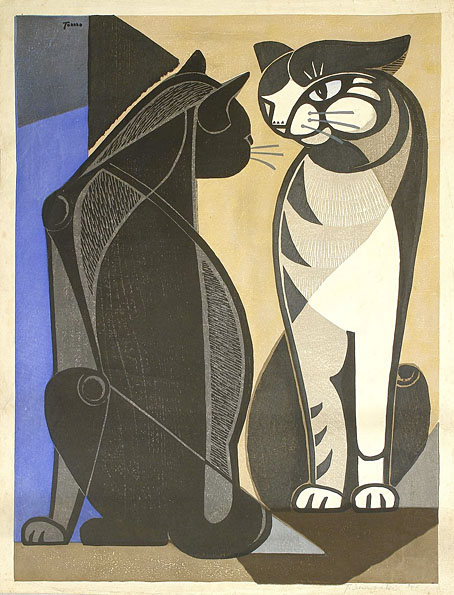
Chatting Cats (c.1960) by Tomoo Inagaki.

• New/old music: Follow The Light by Broadcast, a song which will appear on Spell Blanket—Collected Demos 2006–2009 in May. The album will be followed by another collection, Distant Call—Collected Demos 2000–2006, in September, with both releases being described as the last ever Broadcast albums. This was always going to happen eventually but I thought there might be a final collection of all the tracks the group recorded for compilations which have never been reissued.

• “Cats are all over Turkey. In Istanbul, which I visited before traveling to eastern Turkey, cats are welcome not just in cafes but in houses, restaurants, hotels, and bars.” Emily Sekine on the cats of Turkey.

• “El Shazly’s music is like a rush of new energy, a link between the past and present of Egyptian music that is fresh and vital.” Geeta Dayal on Egyptian singer and composer Nadah El Shazly.

• More werewolves: A trailer for Wulver’s Stane, a contemporary refashioning of werewolf lore. Director Joseph Cornelison is a reader of these pages. (Hi, Joseph!)

• Among the new titles at Standard Ebooks, the home of free, high-quality, public-domain texts: Ghost Stories by EF Benson.

• At Colossal: Sacred geometries and scientific diagrams merge in the metaphysical world of Daniel Martin Diaz.

• At The Quietus: What does dying sound like? Jak Hutchcraft on music and the near-death experience.

• At Unquiet Things: Languid Dreams and Unsettling Poetry: The Art of Jason Mowry.

• At Dennis Cooper’s: Spotlight on…Ronald Firbank Caprice (1917).

Ashkasha, a short animated film by Lara Maltz.

• New music: Chimet by Mining.

I’m The Wolf Man (1965) by Round Robin | The Werewolf (1972) by Barry Dransfield | Steppenwolf (1976) by Hawkwind

Weekend links 717

smith.jpg

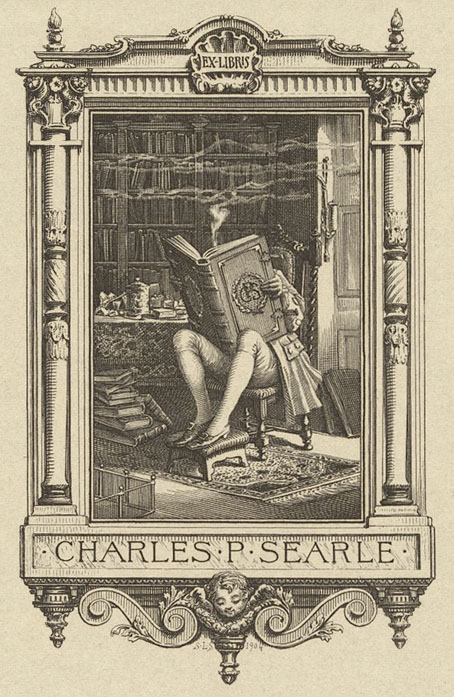
Bookplate of Charles P. Searle (1904) by Sidney Lawton Smith.

• “If Minute 9 is the first time we hear the names Deckard and Blade Runner, it’s also the first time we meet the plainclothes cop who will play a key role in LAPD surveillance of Deckard—and in the changed emphasis of four subsequent versions of Blade Runner released over the next twenty-five years.” Des Barry in the latest Minute 9 installment at 3:AM Magazine, in which a writer analyses the ninth minute of a favourite film.

• “I’ve really started to respect the journalists who are documenting what artists are doing… There’s so much reliance on social media for artists to express themselves, but maybe some don’t want to express themselves on social media all the time. Maybe they’d rather talk to a professional journalist who could parse through it for them. It can be more interesting that way.” Julia Holter talking to Skye Butchard about music-making.

• “I didn’t use any instruments that had been manufactured after 1980, but vintage analogue gear to sound like the tracks that they’re trying to evoke.” Matt Berry discussing his enthusiasm for library music, and his new album of the same for the KPM label.

• Mixes of the week: Monument Waves 002 at A Strangely Isolated Place, and DreamScenes – March 2024 at Ambientblog.

• At Public Domain Review: The Art of Sutherland Macdonald, Victorian England’s “Michelangelo of Tattooing” (ca. 1905).

• At Colossal: Unearthly characters populate Spencer Hansen’s salvaged universe.

• At Bandcamp: A Guide to Can by George Grella.

• Galerie Dennis Cooper presents…Amir Zaki.

• New music: Shoures Soote by Cerfilic.

Queens Of The Circulating Library (2000) by Coil | Library Of Solomon Book 1 (2011) by Demdike Stare | The Equestrian Library (2013) by Broadcast

Weekend links 713

hishida.jpg

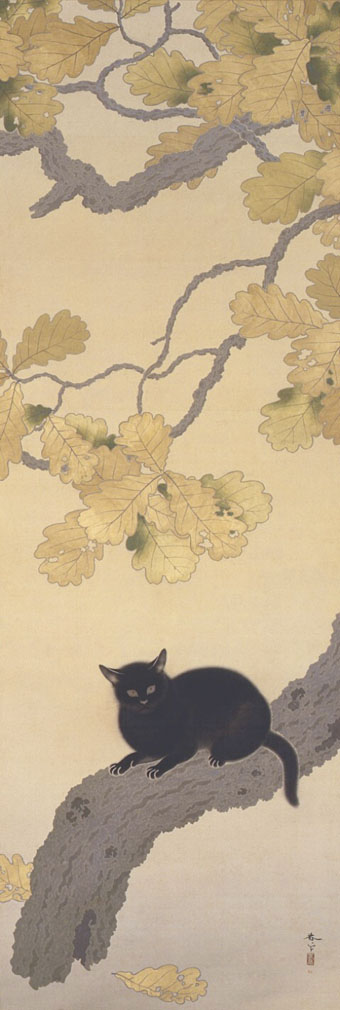
Black Cat (1910) by Shunso Hishida.

• “A duck goes quack quack in English but coin coin in French. In Spanish a dog goes guau-guau, not woof woof, while in Arabic it goes haw haw, and in Mandarin wang-wang. In Japanese cats go nyaa, and bees—having no access to the zz sound—go boon-boon.” Caspar Henderson asks “Could onomatopoeia be the origin of language?”

• Coming soon from MIT Press: Blotter: The Untold Story of an Acid Medium by Erik Davis; “the first comprehensive written account of the history, art, and design of LSD blotter paper, the iconic drug delivery device that will perhaps forever be linked to underground psychedelic culture and contemporary street art.”

• At Aquarium Drunkard: The late Damo Suzuki is remembered with a recording of Can playing at the Volkshalle Wagtzenborn-Steinberg, Giessen, October 22, 1971.

• At Unquiet Things: Another collection of Intermittent Eyeball Fodder. I was sorry to hear from that post that artist Dan Hillier had died recently. RIP.

• At Bandcamp Daily: Mouse On Mars discuss 30 years of dynamic electronic music.

• Old music: Rare Soundtracks & Lost Tapes (1973–1984) by Alain Goraguer.

• At Spoon & Tamago: The imaginary architectures of Minoru Nomata.

• Mix of the week: DreamScenes – February 2024 at Ambientblog.

• At Vinyl Factory: Julia Holter on some of her favourite records.

• At Public Domain Review: Wanda Gág’s Millions of Cats (1928).

• Steven Heller’s Font of the Month is Cuatro.

A brief history of London’s gas lamps.

• New music: Pithovirii by Aidan Baker.

Black Cat Bone (2000) by Laika | Black Cat (2005) by Broadcast | Black Cat (2008) by Ladytron