Manuel Orazi’s Salomé

orazi1.jpg

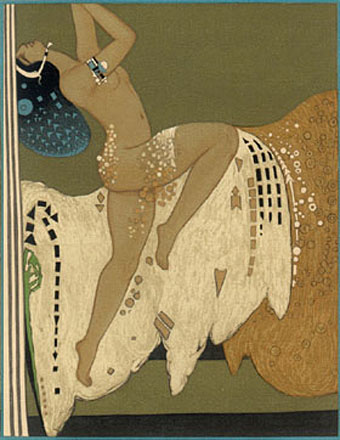
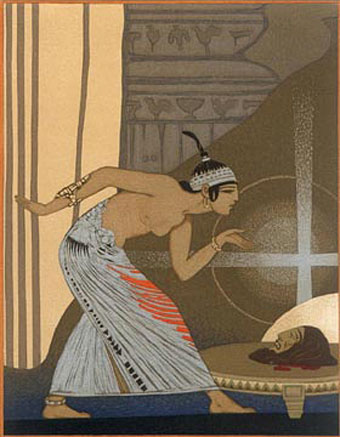
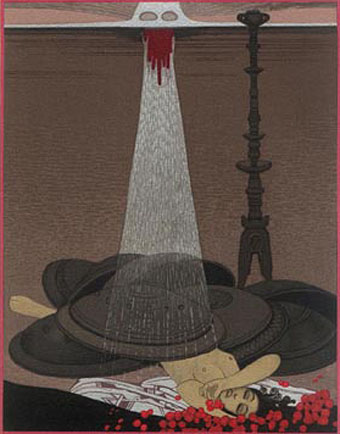
The Biblical bad girl returns in three pictures from an illustrated edition of Oscar Wilde’s play, published as a limited run in 1930. Manuel Orazi (1860–1934) was a French artist whose work has appeared here before, and no doubt will do again very soon since I’ve been finding further examples of his illustrations and designs. These drawings are closer to Gustav Klimt or George Barbier than his earlier illustrations which owed much to the stylisation of Mucha’s Art Nouveau.

orazi2.jpg

orazi3.jpg

Elsewhere on { feuilleton }
The illustrators archive
The Salomé archive

Maria Nilsdotter

nilsdotter1.jpg

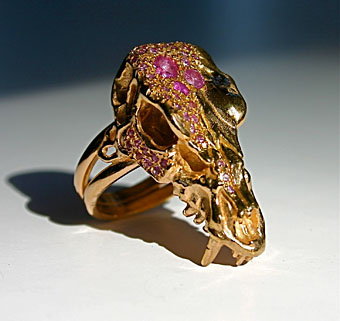
Dragon Skull Ring.

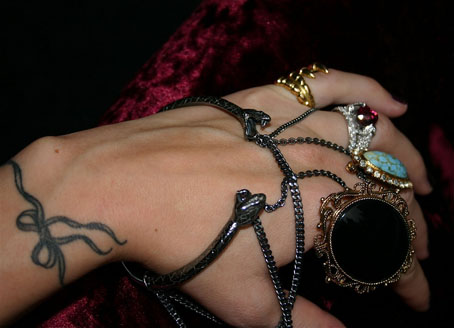
Jewellery by Swedish designer Maria Nilsdotter. Looking at her blog posts I’d guess that her snake bangle is inspired by the serpentine ring and bracelet set designed by Alphonse Mucha and Georges Fouquet for Sarah Bernhardt.

nilsdotter2.jpg

Snake bangle (blackened silver).

Previously on { feuilleton }
The Divine Sarah
Lalique’s dragonflies

The art of Henri Privat-Livemont, 1861–1936

privat3.jpg

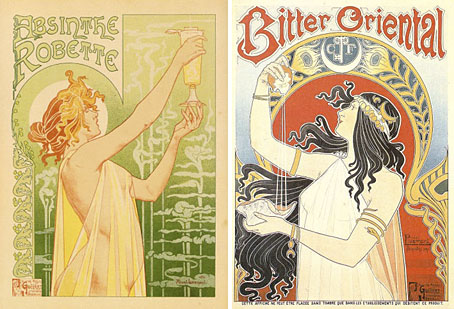
left: Absinthe Robette (1896); right: Bitter Oriental (1897).

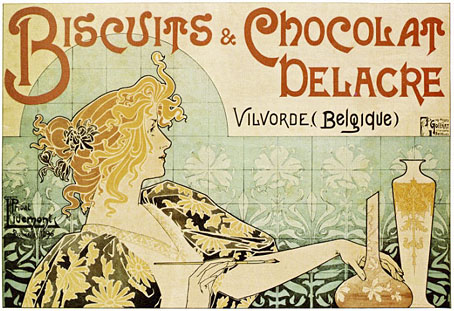
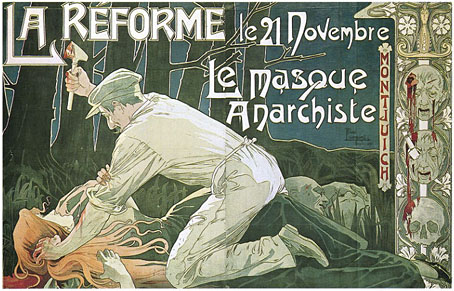
Henri Privat-Livemont, a Belgian artist and one of the best of the post-Mucha Art Nouveau stylists. I’ve featured his Absinthe Robette poster before but am including it again since it’s my favourite of the ones I’ve seen. All of these are from the Art of the Poster 1880–1918 collection at Lawrence University whose copies can be explored in extreme close-up.

privat2.jpg

Biscuits & Chocolat Delacre (1896).

privat1.jpg

Le Masque Anarchiste (1897).

Previously on { feuilleton }
Absinthe girls

The faces of Parsifal

parsifal.jpg

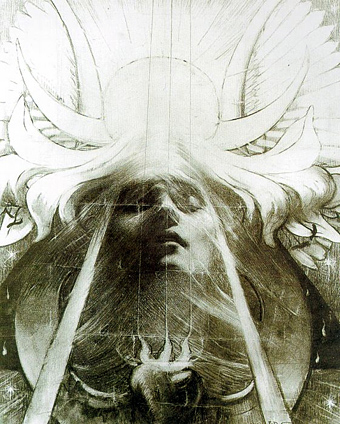
Parsifal by Jean Delville (1890).

Continuing the occasional series of posts examining the evolution of a particular design or image, this one begins with a mystical charcoal drawing by Belgian Symbolist, Jean Delville (1867–1953), our object of concern being that entranced or dreaming face.

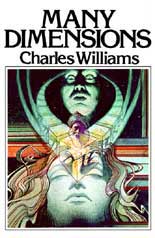
lamb.jpgMy first encounter with Delville’s image wasn’t via the original but came with this Seventies’ version produced for a Charles Williams paperback cover by illustrator Jim Lamb. (And this copy is the only one I can find, reused on a recent audiobook of Williams’ novel. If anyone has a link to a larger copy of the paperback cover then please post it in the comments.) Yes, this is tenuous but when I eventually got to see Delville’s picture it made me think immediately of Lamb’s illustration. Many Dimensions is one of my favourite books by Williams and unusually for him it deals with Islamic rather than Christian mysticism; in that case if Lamb was borrowing from Parsifal then it’s a case of the right image for the wrong book.

Jim Lamb is another illustrator from this period who now works mainly as a landscape artist.

Continue reading “The faces of Parsifal”

San Francisco angels

mouse_kelley.jpg

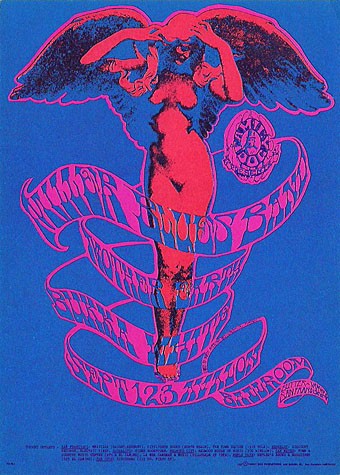
Miller Blues Band/Mother Earth/Bukka White by Alton Kelley & Stanley Mouse (1967).

I already had this piece roughed out before discovering that psychedelic artist Alton Kelley died last month, something that doesn’t seem to have been reported very widely. I posted the picture above last October then in January this year wrote something about San Francisco’s Panama-Pacific International Exposition of 1915. But it’s taken me until now to realise that these two things are connected.

The San Francsico poster artists of the Sixties, of which Mouse & Kelley were leading members, borrowed frequently from earlier sources, especially Art Nouveau stylists such as Alphonse Mucha and the Symbolist painters. A recent Thames & Hudson book, Off the Wall: Psychedelic Rock Posters from San Francisco traces some of the more obvious influences but this is one example which seems to have eluded them.
weinman.jpg

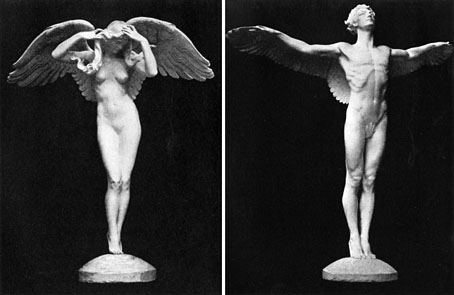
Descending Night and Rising Day by Adolph Alexander Weinman (1914).

The statue that Mouse & Kelley used was titled Descending Night and was, with Rising Day (aka The Rising Sun), one of a pair of symbolic works created by sculptor Adolph Alexander Weinman (1870–1952) for the Panama-Pacific Exposition. The photos above are from one of the books I linked to earlier, Sculpture of the Exposition Palaces and Courts by Juliet Helena Lumbard James. The identities of artists’ models are rarely preserved but in the case of Descending Night we know that one Audrey Munson was the model. And I know that thanks to a well-timed overview of Ms Munson’s career by Silent-Porn-Star.
weinman2.jpg

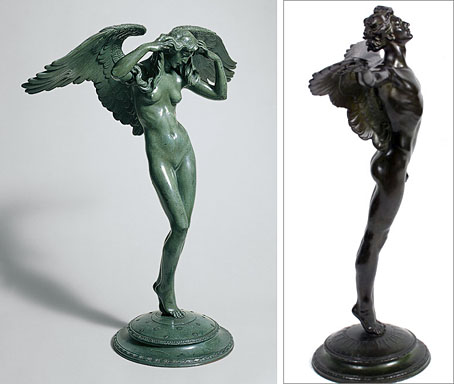
Weinman later worked his statue designs into these rather fine figurines which became his best-selling small bronzes. These pictures make visible the stars at the feet of Night and the sun at the feet of Day.
weinmann_kelley.jpg

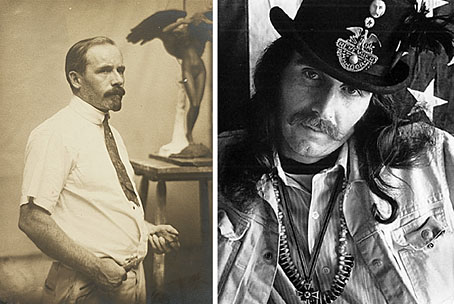
left: Adolph Alexander Weinman in his studio with a study for Descending Night in the background; right: Alton Kelley in the Sixties.

Weinman didn’t live long enough to see his work exploited on a gaudy concert poster and given his adherence to a pre-Modern, Beaux-Arts style it’s perhaps just as well. He’s most remembered today for his Liberty design for the American Silver Eagle which also used Audrey Munson as the model. Ms Munson lived to 1996 so I can’t help wonder if she ever saw her youthful figure return on Mouse and Kelley’s poster. The same year as the San Francisco Exposition she played an artist’s model in Inspiration, a film by George Foster Platt which is only notable now for being the first American non-porn film to feature a nude woman. She stripped off again a year later for Rae Berger’s Purity. Audrey was 76 in 1967 but something tells me she that her free spirit would have identified with the Summer of Love more than many others of her generation.

Elsewhere on { feuilleton }
The illustrators archive

Previously on { feuilleton }
The Evanescent City
Family Dog postcards