The White People by Arthur Machen

aklo.jpg

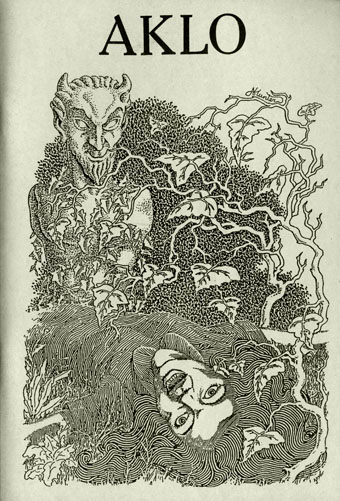
Aklo: A Journal of the Fantastic, Spring 1988 edition, edited by Mark Valentine & Roger Dobson. Illustration by Alan Hunter.

1: The White People

The White People by Arthur Machen was written in 1899 but not published until it appeared in Horlick’s Magazine, January 1904. The magazine, which ran for just over a year, was edited by Machen’s Golden Dawn colleague AE Waite which no doubt explains the unlikely venue. HP Lovecraft enthused about the story in Supernatural Horror in Literature (1927):

Less famous and less complex in plot than The Great God Pan, but definitely finer in atmosphere and general artistic value, is the curious and dimly disquieting chronicle called The White People, whose central portion purports to be the diary or notes of a little girl whose nurse has introduced her to some of the forbidden magic and soul-blasting traditions of the noxious witch-cult — the cult whose whispered lore was handed down long lines of peasantry throughout Western Europe, and whose members sometimes stole forth at night, one by one, to meet in black woods and lonely places for the revolting orgies of the Witches’ Sabbath. Mr. Machen’s narrative, a triumph of skilful selectiveness and restraint, accumulates enormous power as it flows on in a stream of innocent childish prattle, introducing allusions to strange “nymphs,” “Dols,” “voolas,” “white, green, and scarlet ceremonies,” “Aklo letters,” “Chian language,” “Mao games,” and the like. The rites learned by the nurse from her witch grandmother are taught to the child by the time she is three years old, and her artless accounts of the dangerous secret revelations possess a lurking terror generously mixed with pathos. Evil charms well known to anthropologists are described with juvenile naiveté, and finally there comes a winter afternoon journey into the old Welsh hills, performed under an imaginative spell which lends to the wild scenery an added weirdness, strangeness, and suggestion of grotesque sentience. The details of this journey are given with marvellous vividness, and form to the keen critic a masterpiece of fantastic writing, with almost unlimited power in the intimation of potent hideousness and cosmic aberration.

Lovecraft borrowed Machen’s naive narrator a year later for The Dunwich Horror: Wilbur Whateley’s diary is written “by a child of three-and-a-half who looked like a lad of twelve or thirteen”, and makes reference to “Aklo”, “the Dho formula” and “the Voorish sign”. (The journal in The White People refers to “a wicked voorish dome”.)

Lovecraft wasn’t alone in being impressed by the story, it’s long been regarded as Machen’s greatest piece of short fiction with good reason:

…it remains the purest and most powerful expression of what Jack Sullivan has called the “transcendental” or “visionary” supernatural tradition. Most other tales in that tradition, Blackwood’s The Wendigo, EF Benson’s The Man Who Went Too Far, and Machen’s own The Great God Pan, merely describe encounters with the dark primeval forces that reign beyond the edge of civilisation; The White People seems an actual product of such an encounter, an authentic pagan artefact…

TED Klein, The Penguin Encyclopedia of Horror and the Supernatural (1986)


2: The House of Souls

sime.jpg

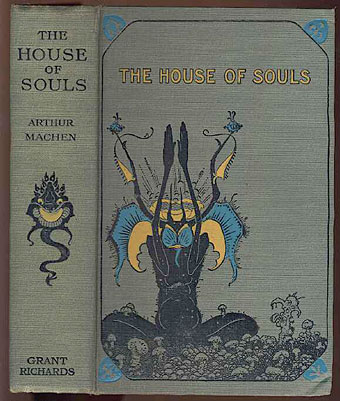
The House of Souls (1906). Cover illustrations by Sidney Sime.

The story was first collected in The House of Souls in 1906, a book that features a splendidly weird cover illustration by Sidney Sime. Inside there’s some of Machen’s finest supernatural writing including The Great God Pan, The Inmost Light and The Three Imposters. Also included is A Fragment of Life, a visionary piece that begins as a domestic drama but by the end has almost intersected with The White People.

And by coincidence (or is it?), I’ve just noticed that Tartarus Press are publishing a facsimile edition of the 1906 volume later this month.


3: The Ceremonies

ceremonies.jpg

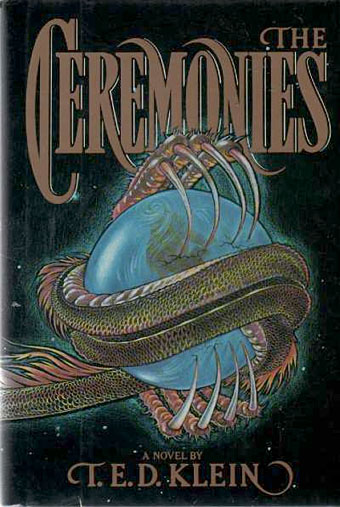
The Ceremonies (1984). Illustration by David Palladini.

TED Klein’s debut novel is also his only novel to date. Klein was editor of The Twilight Zone Magazine at this time, and he used the publication’s popularity to promote the weird fiction of the past; writers like Machen and Algernon Blackwood weren’t as visible in the mid-80s as they are today. The Ceremonies was expanded from a 1972 novella, The Events at Poroth Farm, and borrows much from The White People: the ceremonies of the title refers to those in the story, and the story itself—which a character is instructed to read by moonlight—is described as a key to occult mysteries. There’s a lot about the novel to recommend—Klein’s prose for a start—but I felt it could have been much weirder than it was. The book reads like a typical King/Straub narrative that’s aiming for more without quite getting there, and placing something as unique as Machen’s story at its heart only makes its eventual shortcomings all the more apparent.


4: A drawing

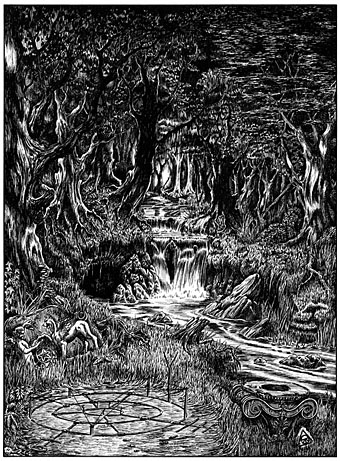
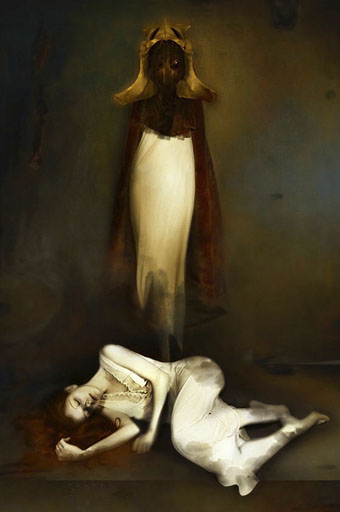
whitepeople.jpg

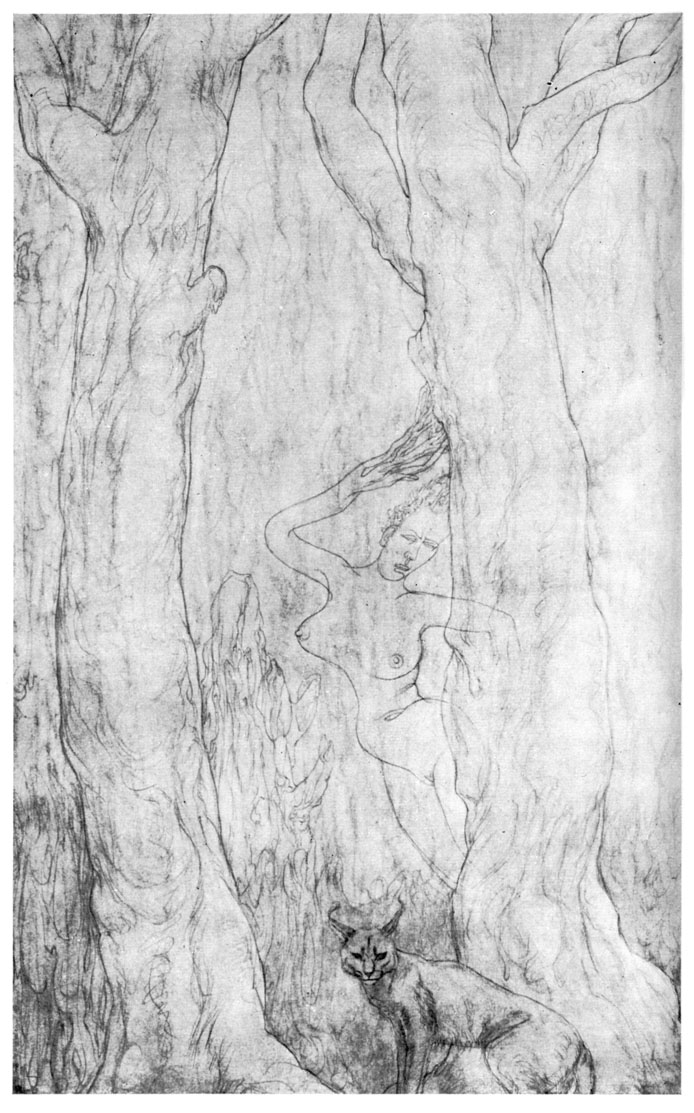
The White People (1990) by John Coulthart.

And speaking of aiming for more without quite getting there, my drawing from 1990. This was going to be one of a series based on Machen’s story but I ran out of steam, feeling that the usual approach of drawing separate scenes wasn’t going to deliver the essence of the piece. If I tried this today I’d probably go for a more surreal approach the way Sätty did with Poe.


5: Roses

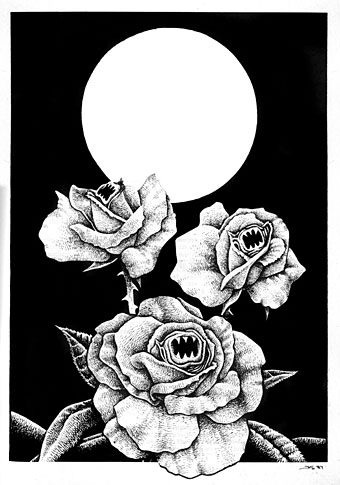
roses.jpg

The Singing Roses (1987) by Jeffrey Salmon. From Dagon magazine no. 18/19, July–October, 1987.

“And what is sin?” said Cotgrave.

“I think I must reply to your question by another. What would your feelings be, seriously, if your cat or your dog began to talk to you, and to dispute with you in human accents? You would be overwhelmed with horror. I am sure of it. And if the roses in your garden sang a weird song, you would go mad. And suppose the stones in the road began to swell and grow before your eyes, and if the pebble that you noticed at night had shot out stony blossoms in the morning?

The White People

*

Sweet tortures fly on mystery wings / Pure evil is when flowers sing / My heart / My heart is a rose

Love’s Secret Domain (1991) by Coil


6: Ghost Box

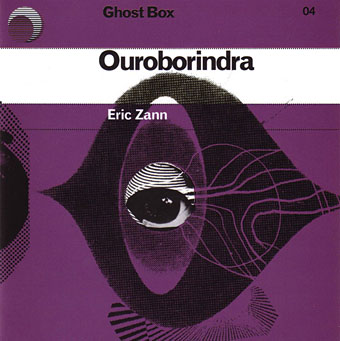
zann.jpg

Ouroborindra (2005) by Eric Zann. Design by Julian House.

Track 4: Dôls
Track 6: Voolas

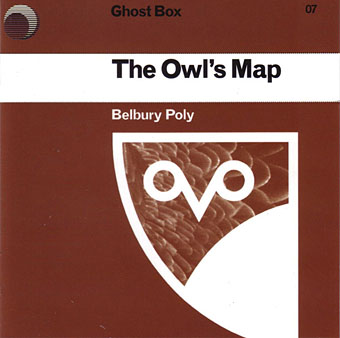
belbury.jpg

The Owl’s Map (2006) by Belbury Poly. Design by Julian House.

Track 11: Scarlet Ceremony

Among the sleeve notes there’s this:

And the noise and the singing would go on and on for a long time, and the people who were in a ring swayed a little to and fro; and the song was in an old, old language that nobody knows now, and the tune was queer.

Arthur Machen, The White People


7: The White People by Ibrahim R. Ineke

ineke1.jpg

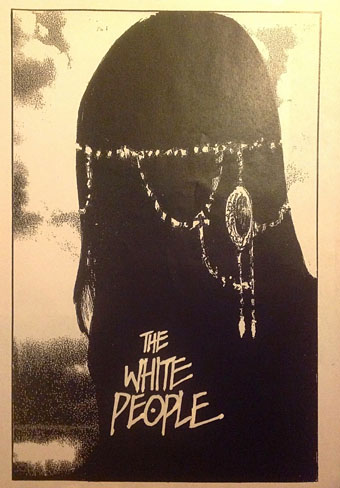
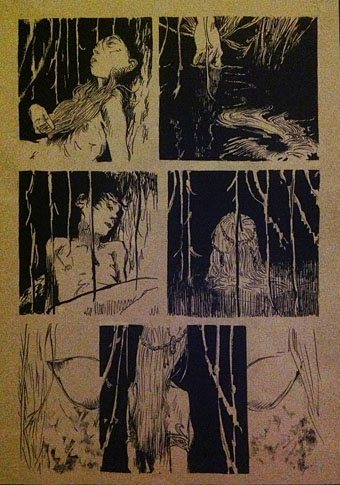
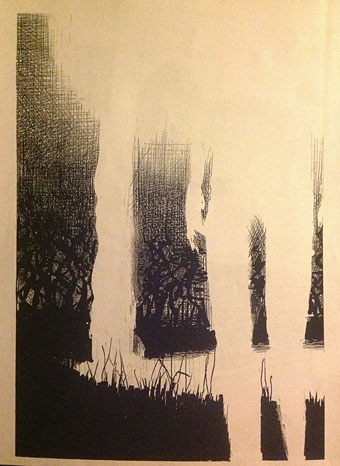
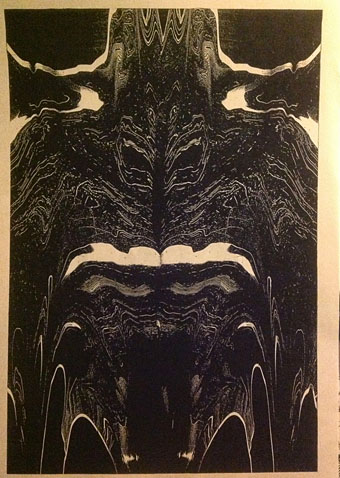
A very impressive comic-strip adaptation, the first of its kind, as far as I’m aware. See the full run of pages here. (And thanks to Ibrahim for getting in touch!)

ineke2.jpg

ineke3.jpg

ineke4.jpg

For those who can’t afford a limited edition from Tartarus Press, Machen’s story may currently be found in Penguin’s The White People and Other Weird Stories. The perfect thing now the nights are drawing in.

Update: See also The Forbidden Forest, a short animation based on the story. (Thanks, Richard!)

Elsewhere on { feuilleton }
The Lovecraft archive

Previously on { feuilleton }
The Bowmen by Arthur Machen
Rex Ingram’s The Magician
The Great God Pan

Nigel Kneale’s Woman in Black

wib1.jpg

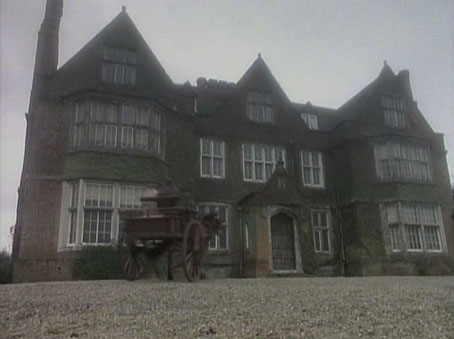
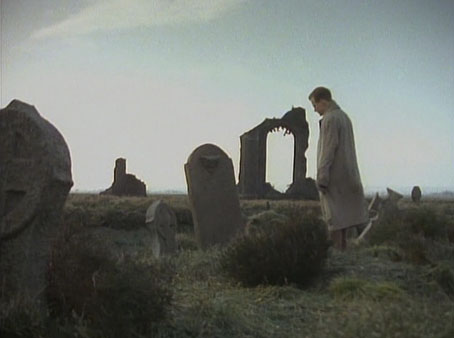
The British television tradition of screening a ghost story at Christmas was filled in 1989 with Nigel Kneale’s adaptation of Susan Hill’s novel The Woman in Black. This isn’t one of the best contributions to the annual ghost drama but at 100 minutes it’s one of the longest, and it has its supporters, some of whom value it above the recent Hammer film production. Seeing as I’d re-watched Nigel Kneale’s major film and TV works earlier this year I thought I’d give The Woman in Black another look. It was better than I remembered although it still left me feeling unsatisfied.

I’ve not read Susan Hill’s book so can’t say how it compares to the television version in any detail. (Wikipedia has a spoiler-heavy list of the differences.) I did see Stephen Mallatratt’s play in 1988, however, the first adaptation of the book which has since become one of London’s most popular theatre productions. The play conjures an effective sense of dread but relies a little too much on loud noises to shock the audience at crucial moments. This is a cheap trick in bad horror films (Wes Craven does it a lot), and it’s just as cheap a trick on a stage. Nigel Kneale may have altered Hill’s story to a degree which apparently displeased her but he didn’t resort to any Craven tricks.

wib2.jpg

The BBC’s Christmas ghost stories have tended to be MR James stories, and The Woman in Black is very much a James pastiche which no doubt helped make it attractive to ITV. All the James hallmarks are there: a man of letters (solicitor rather than a scholar) visiting an isolated part of the English countryside; a lonely house; fearful locals; mysterious deaths; documentary evidence that requires examination; a haunting.

Adrian Rawlins is the young solicitor, Arthur Kidd, given the task of putting the estate of a dead woman in order. Rawlins would have been fine in a smaller role but he wasn’t a good choice for a central character, not when Kidd is on screen every minute of the running time. Far better is the always excellent Bernard Hepton as a genial landowner, a very different role to his sinister Fisher in Robin Redbreast. There’s a lot of solid period detail—Kneale’s dialogue fixes the date at around 1925—and the writing and direction manages to avoid insulting the intelligence. In place of the usual voiceover reading of letters we have Kidd listening to a succession of recording cylinders, an unlikely thing for an elderly woman to be using but it does give the film a connection back to Van Helsing’s device in Dracula. There’s even a surreptitious reference to Kneale’s “stone tape” theory when Kidd says that the ghostly sounds he keeps hearing are like a recording of a terrible event. Director Herbert Wise does some clever hide-and-seek business with the spectral woman, only fumbling things near the end when he makes the mistake of trying to imitate Jack Clayton’s The Innocents. So why does this version still remain unsatisfying?

Continue reading “Nigel Kneale’s Woman in Black”

Weekend links 159

francov2.jpg

El Banquete Magnético (2011) by Cristina Francov.

Did Vertigo Introduce Computer Graphics to Cinema? asks Tom McCormack. He means Saul Bass’s title sequence which mostly uses still harmonographs but also features some animated moments by John Whitney.

•  Temple of the Vanities by Thomas Jorion. “Pictured here are political monuments and munitions depots, hulking concrete forms that marked the edges of empires.” Related: Paintings by Minoru Nomata.

• Musical reminiscences: Matt Domino on the Small Faces’ psychedelic magnum opus Ogden’s Nut Gone Flake, and Richard Metzger on the sombre splendours of Tuxedomoon.

Harrison is best known as one of the restless fathers of modern SF, but to my mind he is among the most brilliant novelists writing today, with regard to whom the question of genre is an irrelevance. To read his work is to encounter fiction doing what fiction must: carrying out the kinds of thinking and expression that would be possible in no other form. I pass through his novels feeling a mixture of wonder, calmness and disturbance; I end them brain-jarred and unsettled. Metaphysical echoes persist for days afterwards. It feels as if I have had a strabismus induced, causing illusions that slowly resolve into insights.

Robert Macfarlane on M. John Harrison and the reissue of Climbers.

• Divine Machinery: An Interview with Paul Jebanasam. Arvo Pärt, Cormac McCarthy and Algernon Blackwood are folded into his new album, Rites.

Autostraddle shows the evolution of twelve queer book cover designs. As is often the case in cover design, latest isn’t always best.

• “My Definition Of Hell? It’s Other People, At The Cinema!” Anne Billson on the very thing that finished me as a cinema-goer.

• “London in the 1830s was a truly weird and terrifying place.” Spring-Heeled Jack, The Terror of London.

• At Scientific American: The Reading Brain in the Digital Age: The Science of Paper versus Screens.

Van Dyke Parks: “I was victimised by Brian Wilson’s buffoonery.”

Colour film of London in 1927.

Abandonedography

Social Dead Zone

• Tuxedomoon: Tritone (Musica Diablo) (1980) | Desire (1981) | Incubus (Blue Suit) (1981)

Hodgsonian vibrations

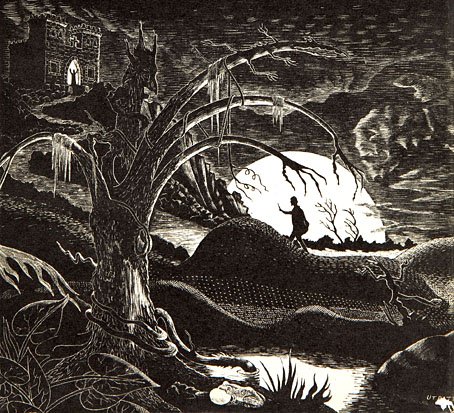
utpatel.jpg

Illustration by Frank Utpatel from the 1947 Arkham House edition of Carnacki, the Ghost-Finder.

“Presently I got hold of myself a bit, and marked out a pentacle hurriedly with chalk on the polished floor; and there I sat in it almost until dawn. And all the time, away up the corridor, the door of the Grey Room thudded at solemn and horrid intervals. It was a miserable, brutal night.”

The Gateway of the Monster (1913) by William Hope Hodgson

“Word falling – Photo falling – Time falling – Break through in Grey Room”

The Ticket That Exploded (1962) by William S. Burroughs

Among other things, 2013 is the centenary of the first book publication of William Hope Hodgson’s collection of weird tales, Carnacki, the Ghost-Finder, and while I don’t believe that William Burroughs was referring to the supernatural eruption that occurs in Hodgson’s Grey Room it would be remiss of me to ignore the connection. Listening this week to Music for Thomas Carnacki by Jon Brooks (he of The Advisory Circle) had me wondering whether there’s any other Hodgson-derived music of note. Lovecraft has inspired hours of musical endeavour while Hodgson’s weird contemporaries, Algernon Blackwood and Arthur Machen, are referenced on some of the Ghost Box releases. Hodgson is the poor relation in these celebrations, often passed over despite the sonic potential of Carnacki stories such as The Whistling Room, The Horse of the Invisible, and especially The Hog, a tale whose manifestations are almost wholly perceived through the medium of sound. Searching around turned up the following examples.

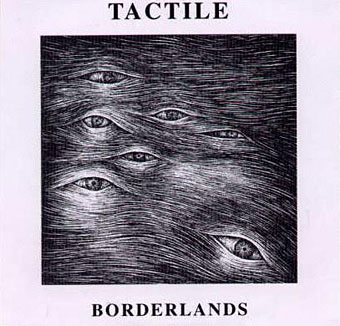
tactile.jpg

Borderlands (1999) by Tactile.

The House on the Borderland is the big favourite in this list, this album being a series of tracks by John Everall based on Hodgson’s novel. John Balance of Coil appears on the first track, Grief, reading the poem which opens the book.

Continue reading “Hodgsonian vibrations”

Weekend links 152

mackenzie.jpg

Light Moves on the Water (2010), a collage by Alexis Anne Mackenzie.

“[She] stated, emphatically and more than once, that pornography cannot and should not be linked to LGBT rights…When a gay man lives somewhere where his identity is threatened, it’s clear how sex – including pornography – and sexuality are intertwined. His sexual imagination, which is criminalized, matches the sexual images of gay pornography (which are also criminalized). Since acting out his imagination through sex would be to risk his life, the access to the images is safer. The images, created by gay men wherever it’s legal to create them, provide empowerment and diminish alienation.” An important piece by Conner Habib who asks “Why are we afraid to talk about gay porn?”

• Florida’s Parallel Universe: “The abandoned Nike Missile Site, surrounded by the Everglades, is a reminder of when humans almost destroyed the world and a warning that we could still lose everything today.” By Stefany Anne Golberg.

• In Search of Divine: A Retrospective by Katherine McLaughlin. Related: Jeffrey Schwarz, director of a new documentary, I Am Divine, talks about Divine’s career, and his film to Polari Magazine.

When Brendan Behan’s Borstal Boy was banned in 1958, it was said that a man in a pub asked him how much the book weighed, then offered to bring two thousand copies across the border instead of his usual smuggled butter. We might have called it the Black North, for being dark with Protestants, but when I was a child in the 1960s, Ulster was the place British sweets came from: Spangles, Buttons and, most notably, Opal Fruits. It was across this border that the feminists of “the condom train” staged a mass importation of illegal contraceptives in May 1971. When they arrived from Belfast into Connolly Station, the customs men “were mortified”, Mary Kenny, one of the participants, remembered, “and quickly conceded they could not arrest all of us, and let us through”.

Anne Enright on censorship in Ireland.

• Open Culture posts a copy of Nigel Finch’s 1988 Arena documentary about Robert Mapplethorpe.

The Fall of Communism Through Gay Pornography: A video by William E. Jones.

• Surrealism Made Fresh: Sanford Schwartz on the drawings of the Surrealists.

• Cult Classic: Defining Katherine Mansfield by Kirsten O’Regan.

Jonathan Barnbrook (again!) on David Bowie (again!).

Sydney Stanley illustrates Algernon Blackwood

20 Haunting Ghost Towns of the World

• At Pinterest: The Male Form

The Life Divine (1973) by Santana and McLaughlin | The Rhythm Divine (1987) by Yello feat. Shirley Bassey | Divine (2000) by Antony and the Johnsons