Weekend links 803

USA-ad.jpg

Ad for The United States Of America from Helix magazine, 1968.

• American composer Joseph Byrd died this week but I’ve yet to see a proper obituary anywhere. He may not have been a popular artist but he was significant for the one-off album produced in 1968 by his short-lived psychedelic group, The United States Of America. Their self-titled album has been a favourite of mine since it was reissued in the 1980s, one of the few American albums of the period that tried to learn from, and even go beyond, the studio experimentation of Sgt Pepper. The United States Of America didn’t have the resources of the Beatles and Abbey Road but they did have Byrd’s arrangements, together with an energetic rhythm section, an electric violin, a ring modulator, some crude synthesizer components, the voice of Dorothy Moskowitz, and a collection of songs with lyrics that ranged from druggy poetry to barbed portrayals of the nation’s sexual neuroses. The album became an important one for British groups in the 1990s who were looking for inspiration in the wilder margins of psychedelia, especially Stereolab, Portishead (Half Day Closing is a deliberate pastiche), and Broadcast. Byrd did much more than this, of course, and his follow-up release, The American Metaphysical Circus by Joe Byrd And The Field Hippies, has its moments even though it doesn’t reach the heights of its predecessor. Byrd spoke about this period of his career with It’s Psychedelic Baby Magazine in 2013.

• At BBC Future: “The most desolate place in the world”: The sea of ice that inspired Frankenstein. Richard Fisher examines the history of the Mer de Glace in fact and fiction with a piece that includes one of my Frankenstein illustrations. The latter are still in print via the deluxe edition from Union Square.

• A Year In The Country looks at a rare book in which Alan Garner’s children describe the making of The Owl Service TV serial.

• The final installment of Smoky Man’s exploration of The Bumper Book of Magic has been posted (in Italian) at (quasi).

• At Public Domain Review: Perverse, Grotesque, Sensuous, Inimitable: A Selection of Works by Aubrey Beardsley.

• At Colossal: Ceramics mimic cardboard in Jacques Monneraud’s trompe-l’œil ode to Giorgio Morandi.

• At the Daily Heller: The “narrative abstraction” of Roy Kuhlman‘s cover designs for Grove Press.

• New music: Elemental Studies by Various Artists; and Gleann Ciùin by Claire M. Singer.

• Steven Heller’s font of the month is Archive Matrix.

Sensual Hallucinations (1970) by Les Baxter | The Garden Of Earthly Delights (United States Of America cover) (1982) by Snakefinger | Perversion (1992) by Stereolab

Weekend links 748

leighton.jpg

• In Tate Britain yesterday afternoon I finally got a proper look at Frederic Leighton’s An Athlete Wrestling with a Python (1877). It’s been part of the Tate collection for years but I never used to see it there, my only sighting being a view through a glass door into a locked gallery where the exhibits were being rearranged. I put the statue into my adaptation of The Call of Cthulhu in 1988 (see this post). Virgil Finlay also borrowed the pose for a Tarzan illustration in 1941.

• At Smithsonian magazine: See the first section of the largest-ever cosmic map, revealed in stunning detail by the Euclid space telescope.

• At The Daily Heller: Your Next Stop, The Twilight Zone. An interview with Arlen Schumer about the TV series.

• At Wormwoodiana: Mark Valentine on Punch and the Surrealists.

• Mix of the week: DreamScenes – October 2024 at Ambientblog.

• New music: A House Where I Dream by Mattias De Craene.

• RIP Lillian Schwartz, pioneering computer animator.

• At Bandcamp: The Acid Mothers Temple Dossier.

• Where to start with Alan Garner.

Jim Reid’s favourite music.

The Twilight Zone (1963) by The Ventures | The Twilight Zone (1979) by The Manhattan Transfer | Twilight Zone (1998) by Helios Creed

Weekend links 593

inlandprinter.jpg

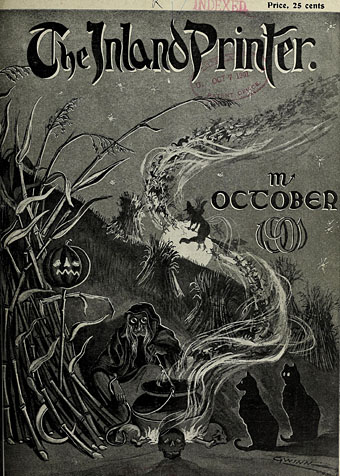
Cover art by Gwinn (?) for The Inland Printer, October 1901.

The 50 British films that inspired a young Martin Scorsese. No Michael Powell (or Hitchcock, for that matter) but I think we’re supposed to take The Archers as a given. And he’s always had a commendable taste for British horror; few directors of Scorsese’s stature would put so many Hammer films and minor chillers on a list like this.

• New music: Grey Frequency return with Essentia, an album that explores “the connections and conflicts between internal and external worlds, and our sense of place and function in an unfathomable, transcendent universe”. Ideal Halloween listening, as is much of the Grey Frequency catalogue, especially Paranormal.

• “You don’t want to have a brilliant idea for a novel at the age of 87,” says Alan Garner. Justine Jordan reviews Treacle Walker, the novel in question, here.

In his gloomy tales, predominantly written in French, journalists disappear while hunting for esoteric secrets, ships sailing to mythic islands get lost in unreal waters, protagonists track down occult artefacts such as Dr Dee’s black spirit mirror, and the living wander down alleyways that lead to the hereafter. These are all unfaithfully retold in Ray’s uniquely arcane, often kaleidoscopic prose.

Robert Davidson on Belgian author Jean Ray

• “Poe brings forth, as if out of thin air, a grotesque world fully crystallized.” Sudipto Sanyal on you-know-who.

• At Bandcamp Ed Blair compiles a list of John Carpenter-like music beginning with an album from the man himself.

• At Wormwoodiana: Mark Valentine on the current condition of second-hand bookshops in Britain.

• Mix of the week: Samhain Séance 10: There and Back Again by The Ephemeral Man.

• At Dennis Cooper’s: Terence Hannum presents…Horror Soundtracks Day.

• No One Here Knows I’m a Vampire: A Spooky Matt Berry Reading List.

• New/old music: Aqua by Ryuichi Sakamoto.

More dark arts at Unquiet Things.

Treacle Toffee World (1968) by The Fire | Treacle People (1970) by UFO | Woodsmoke & Treacle (2010) by Moon Wiring Club

Voice of the Fire by Alan Moore

votf1.jpg

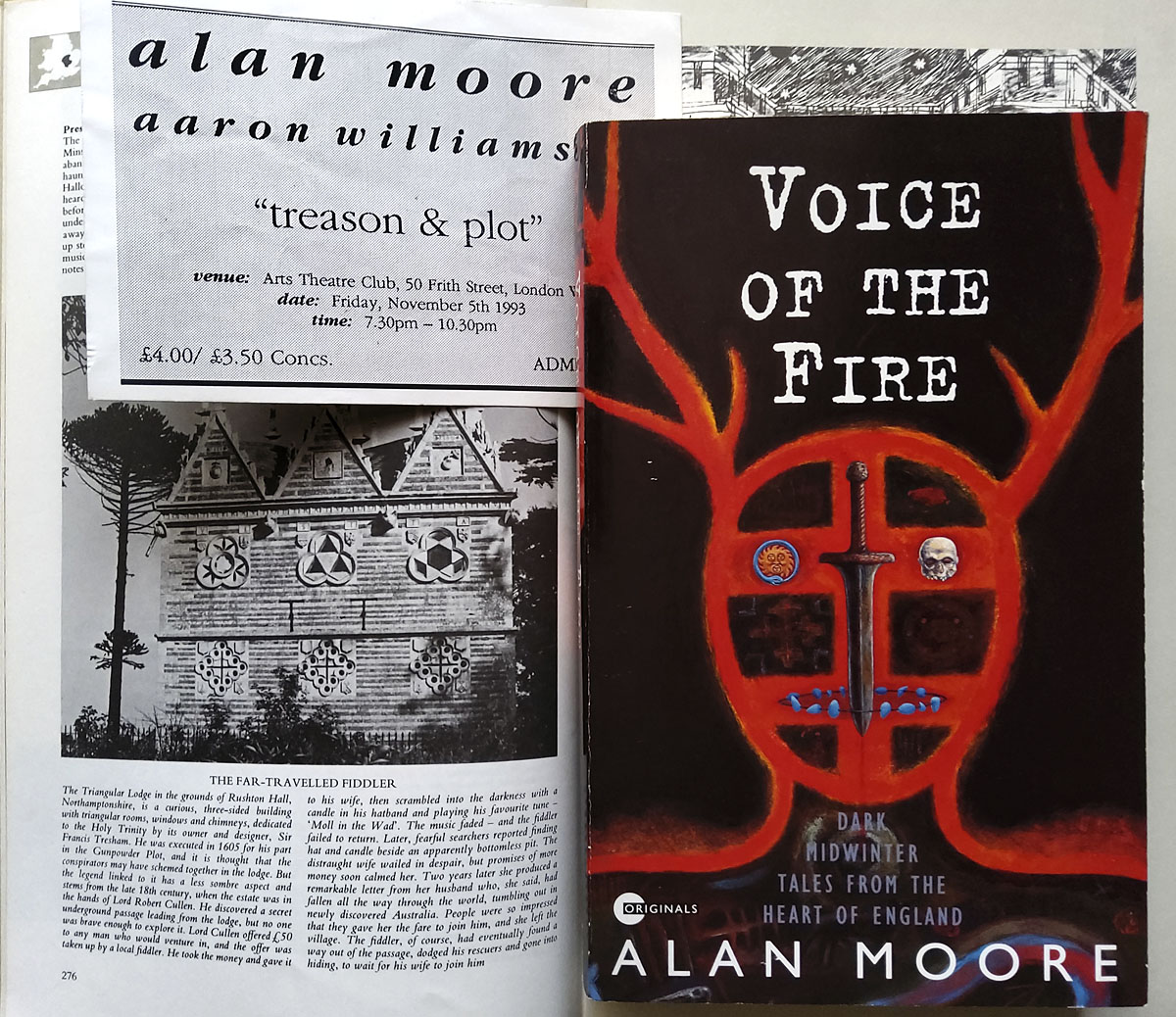
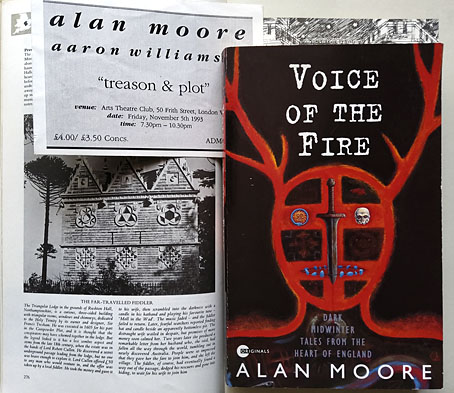
“History is a heat,” says Alan Moore at the end of his first novel, Voice of the Fire, when the author takes centre stage to add his own voice to those of his characters. History is a heat, and fire is its agent, the element that provides a connecting thread between the twelve people whose voices comprise the text of the book. Late last year I was asked to design a new cover for Voice of the Fire which will be published by Knockabout in a 25th anniversary edition later this year. I’d read the book when it was first published, and even saw Alan read some of the opening chapter in 1993 at an event at the Arts Theatre Club in Soho. That event, which took place on November 5th, was titled “Treason and Plot”, and the pages from the work-in-progress novel had been collected from the offices of Gollancz after Alan left the unfinished manuscript of Yuggoth Cultures—which he was supposed to be reading from that evening—in the back of a cab. I was in London that day to talk to Alan about illustrating Yuggoth Cultures, so to find myself illustrating Voice of the Fire many years later feels a little like being caught by one of the acausal connecting threads that he weaves through his novel.
votf3.jpg

The first edition: design by Gary Day-Ellison, illustration by Robert Mason. The photo on the left shows Thomas Tresham’s Triangular Lodge, a folly outside Northampton encoded with references to the Holy Trinity via a profusion of triangles and tripartite details. Tresham’s Lodge is described in the Gunpowder Plot chapter of Alan’s novel; the triangles on my cover may be taken as a reference to this.

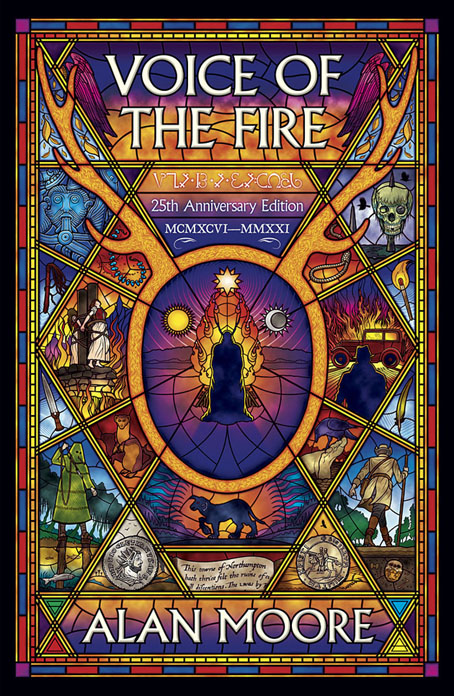
November is the dominant month in Voice of the Fire, and the ritual fires of November 5th are one of many recurrent motifs. The novel’s twelve characters live in Alan’s home town of Northampton at different periods of history, from 4000 BC to 1995, a span of time that charts the town’s foundation and growth, taking in the Viking invasions, the Roman occupation, the Crusades, the treason and plot of Guy Fawkes and his conspirators, witch trials, the poet John Clare, and Alan himself. A lot of history and a wealth of incident to try and symbolise in a cover design. Author and publisher both liked the stylised outline of a horned head that Robert Mason painted on the cover of the first edition, a reference to the opening chapter of the novel in which a Neolithic shaman performs a ritual that marks the land as the site of the future town. I liked the original cover but felt it made the novel seem too much like something by Henry Treece or Alan Garner, with no indication of more recent history. A stained-glass window seemed like a good solution to the problem of how to bring together so many disparate elements into a single design. Stained-glass windows are often things from the distant past still visible in the present day, and they have the additional convenience of being a single container for many small pictorial details.
votf2.jpg

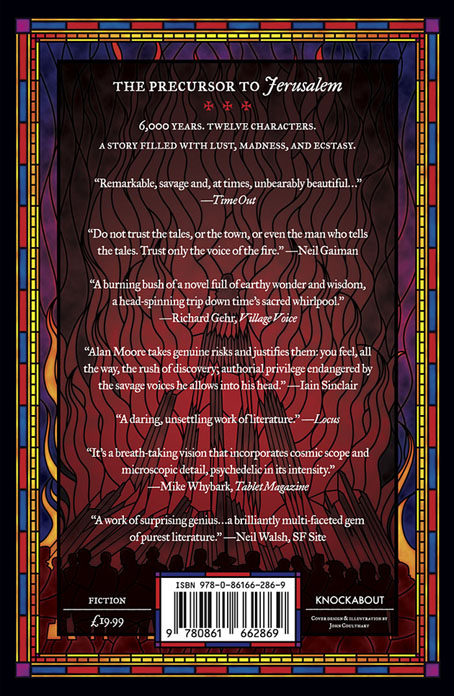
It’s Bonfire Night on the back cover.

My design doesn’t attempt to illustrate all the characters or events from the novel but shows the more salient moments together with smaller details, some of which (the noose, for example) appear in multiple chapters. The horned shaman is at the centre of the design which radiates out from his ritual fire. I avoided making the window design too much like a church window; the book contains many references to churches and Christian history but there’s also a strong pagan element in many of the chapters. Magic, in the occult sense, is a recurrent thread, and Alan’s favourite Elizabethan magus, Dr. John Dee, is present (albeit offstage) in the Angel Language chapter. To acknowledge this I placed an inscription in Enochian—Dee’s “Angel Language”—underneath the title. There’s more magic in the font used for the title and author’s name, Albertus, which was named after Albertus Magnus, a philosopher and theologian often described as an alchemist. The main reason to use Albertus is for its timeless styling and its readability, an important quality for such a busy cover design; the font is a common one on London street signs.

The creature with the floppy ears in the lower centre is another recurrent motif, the sinister “shagfoal”, or Black Dog, whose presence is a sign of the darker energies that seem to thrive in that part of the world. Black Dogs appear in folklore all over Britain but there are few pictorial examples to be found in old texts. I based my hound on the “Straunge and terrible Wunder” depicted in 1577 on the title page of Abraham Fleming’s account of the Black Dog of Bungay. Other details are more obvious for those who read the novel so I won’t spell out everything here. If you haven’t read it then I’d urge you to do so, it’s one of Alan Moore’s major works, and a book I’m hoping might receive more attention than it did in 1996 when Gollancz only saw fit to publish it in paperback. Voice of the Fire will be published by Knockabout in May in paperback and a limited edition hardback which will include a card signed by the author. Top Shelf will be doing something similar for the US but I don’t think they’ve announced any dates or other details as yet. Anyone looking for further information is advised to keep an eye on the Knockabout news page or the publisher’s social media accounts.

Previously on { feuilleton }
The Blake Video
The Cardinal and the Corpse
Mapping the Boroughs
Tresham’s Trinities
The Triangular Lodge again
Art is magic. Magic is art.
Alan Moore: Storyteller
Alan Moore: Tisser l’invisible
Dodgem Logic #4
The Triangular Lodge

Weekend links 424

calder.jpg

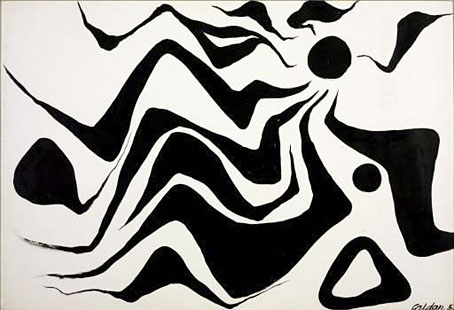
Black Sun (1953) by Alexander Calder.

• “But Berlin Alexanderplatz transcends its genre elements, largely because of Döblin’s deep lack of hope about what can be expected of human beings.” Adam Kirsch on Alfred Döblin’s Berlin.

• “I occasionally dream of finding books that do not seem to exist (yet), and sometimes remember their titles,” says Mark Valentine.

• “I don’t read fiction.” He does, however, own 11,000 books. Alan Garner on writing a memoir of his wartime childhood.

What is it that I really like? I mean that’s the question that I think every musician and artists and everybody actually, is asking themselves; what they really like. And that means the emphasis is on REALLY like, meaning how do you push aside what you’ve been told, what you’ve been taught, what your friends like, and how much you like something because your friends like it or because it’s socially popular at the moment, or your girlfriend likes it or any of those ideas.

Jon Hassell (again) in an interview at Ableton

• How Alexander Calder sparked a modern fascination with mobiles (sculptures, that is, not telephones).

• Deep in Italy, one man’s Surrealist mini-city sleeps: Francky Knapp on Tomaso Buzzi’s La Scarzuola.

• “Even before electricity, robots freaked people out”: Lisa Hix on the history of clockwork automata.

Nicolas Winding Refn’s website devoted to neglected/abandoned films was launched this week.

• Mixes of the week: FACT Mix 664 by Lucy, and XLR8R Podcast 552 by Thomas Fehlmann.

Jean-Paul Goude‘s best photograph: an androgynous Grace Jones.

Marquis de Sade: 112 pages, 100 erotic illustrations.

The world’s most beautiful libraries

Sade Masoch (1968) by Bobby Callender | I’ve Seen That Face Before (Libertango) (1981) by Grace Jones | Black Sun (2011) by Demdike Stare