The World’s Greatest Detective

sh1.jpg

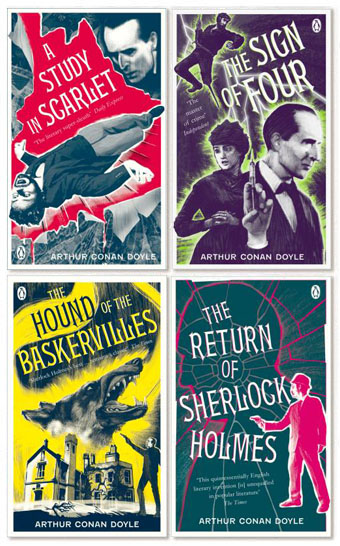
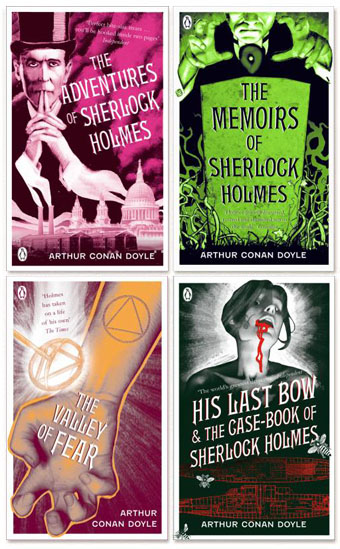
Coralie at Penguin Books sent through these cover designs today, a splendid “collect the set” republication of the Sherlock Holmes stories which should be on the shelves early next month. This follows last year’s collection of similarly repackaged Edwardian thrillers which included Conan Doyle’s dinosaur tale, The Lost World. Having recently watched the Granada TV adaptations of the Holmes stories now would be a good time to go back to the books, especially since I only recall ever having read The Sign of Four and a couple of the stories.
sh2.jpg

And on the technical side, I’ll note that my typeface mania identifies the font used for the titles of these books as Gable Antique Condensed, a contemporary design by Jim Spiece based on a Bauer typeface from around 1900. Unless it’s one of the variants mentioned by Identifont….

Elsewhere on { feuilleton }
The book covers archive

Previously on { feuilleton }
“The game is afoot!”
Boys Own Books

William Heath Robinson’s Midsummer Night’s Dream

mnd1.jpg

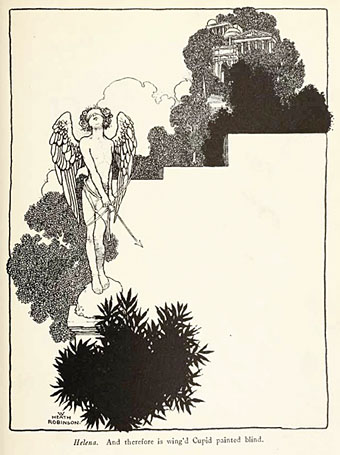
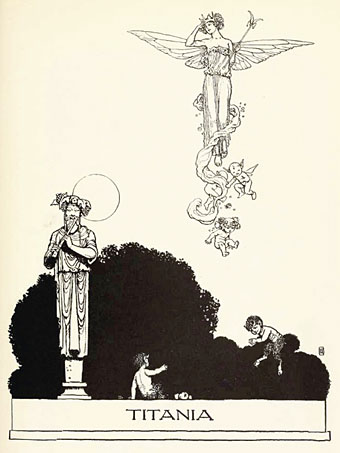
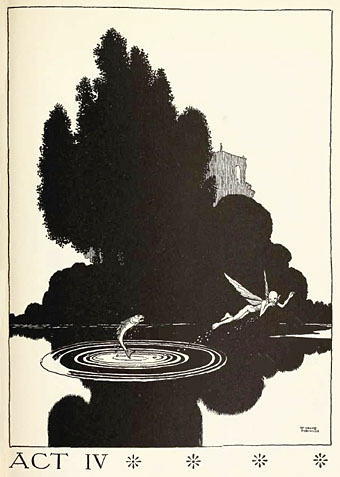
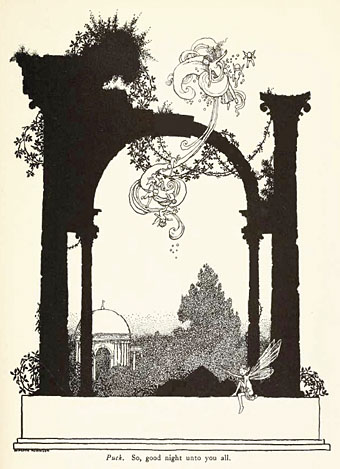
I wasn’t planning on featuring William Heath Robinson again so soon but I couldn’t resist posting some extracts from his 1914 edition of A Midsummer Night’s Dream, another great download from the scanned books at the Internet Archive. I have a few of these illustrations in a WHR monograph but I didn’t realise the book as a whole was so good. The Robinson brothers had a remarkable mastery of space in their work, no doubt derived from Beardsley but they found a way to make his expanses of black and white work for their own distinctive styles. This book, like many of those of the period, features colour plates but I much prefer Heath Robinson’s black-and-white work to his watercolours. His Poe book contains many fine drawings but his style is more suited to this Shakespeare play, especially in the depictions of clouds of fairy figures tumbling through the air.

mnd2.jpg

mnd3.jpg

mnd4.jpg

Elsewhere on { feuilleton }
The illustrators archive.

Previously on { feuilleton }
William Heath Robinson’s illustrated Poe

Yayoi Kusama

kusama.jpg

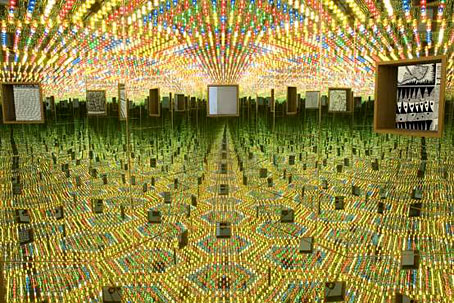
Infinity Mirrored Room—Love Forever (1994).

“It is not controversial to describe Yayoi Kusama as Japan’s greatest living artist,” says Hannah Duguid in The Independent. I made a post about Kusama’s artworks in 2006 and now her work is in exhibition at the Victoria Miro gallery, London.

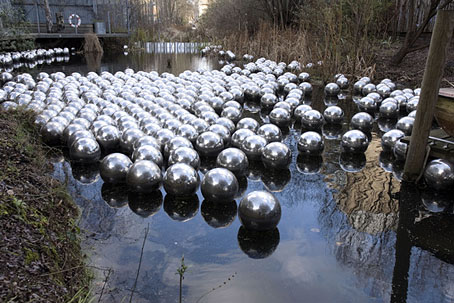
For this exhibition, revered Japanese artist Yayoi Kusama has conceived a new installation Dots Obsession—Infinity Mirrored Room (2008) especially for the upper gallery and in the lower galleries will install 50 new silkscreen works that will be shown alongside two significant sculptural pieces from the early nineties. At Victoria Miro 14 the artist will present a series of new dot paintings and an environmental installation I’m Here, but Nothing (2000-2008). The exhibition will continue outside the gallery where Kusama will install one of her most infamous works, Narcissus Garden in Regents Canal—a work which has never before been exhibited in the UK.

More pictures here. The exhibition runs until 20 March, 2008

kusama2.jpg

Narcissus Garden (1966—2008).

Previously on { feuilleton }
Maximum Silence by Giancarlo Neri
The art of Yayoi Kusama
Atomix by Nike Savvas

At the Mountains of Madness

atmom.jpg

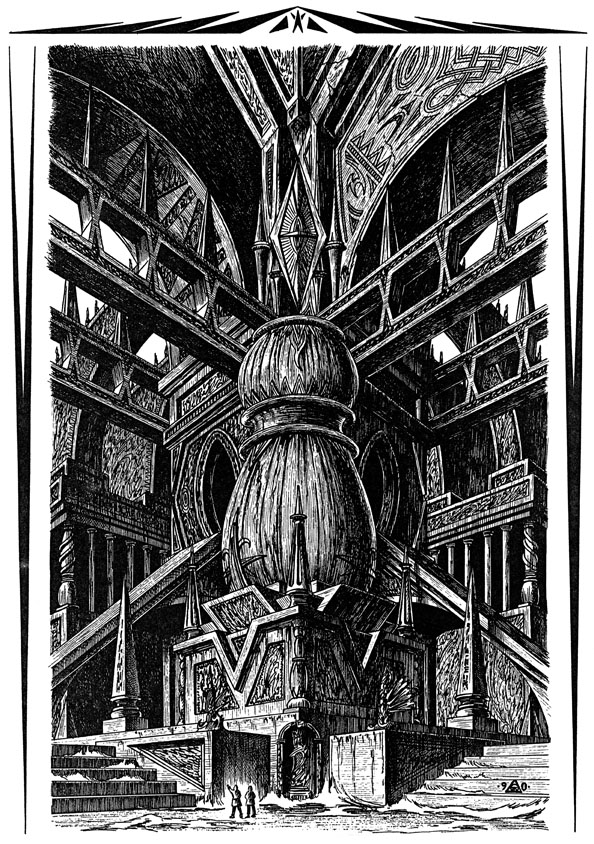
Going through stacks of old artwork today turned up a photocopy of a drawing I did in 1990, my sole attempt to illustrate HP Lovecraft’s At the Mountains of Madness. By the time I did this I was pretty exhausted by Lovecraft’s world and was already at work on the first phase of the Lord Horror comics for Savoy which explains why this is a bit half-hearted, the architecture owing more to Piranesi than anything particularly alien. I forget why I did this now, I think it was at someone’s request, and I’ve also no idea where the original drawing is. The sprawling organic cityscape/landscape I created last year for the Maison d’Ailleurs exhibition is probably closer to the kind of thing this story requires.

atmom3.jpg

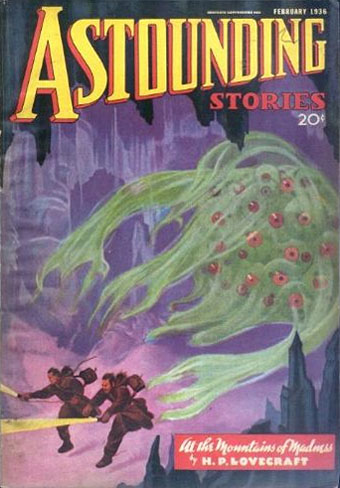
At the Mountains of Madness was rejected by Lovecraft’s usual publisher, Weird Tales, for not being enough of a horror story. This is true, the novella is more of a fictional travelogue, especially in its later half where a million-year-old alien city is discovered in the heart of Antarctica. Science fiction magazine Astounding took it instead where it made the cover of the February 1936 issue, the climactic shoggoth attack being painted by Howard V Brown. Poor old Lovecraft had nearly all his most famous stories published in Weird Tales, and helped give the magazine its lasting reputation, yet he was never given a cover feature during his lifetime. Astounding gave him the honour again in June of the same year for another novella, The Shadow Out of Time, also illustrated by Howard Brown.

Previously on { feuilleton }
Lovecraftian horror at Maison d’Ailleurs