Mishima’s Rite of Love and Death

mishima.jpg

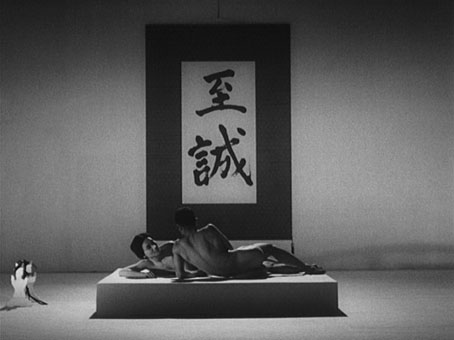
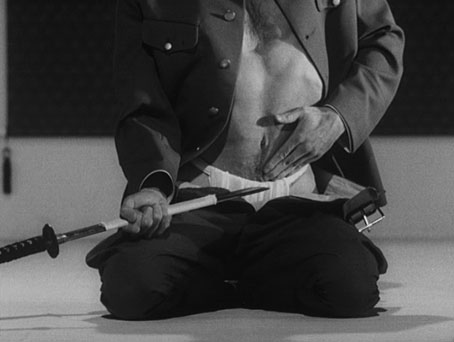
Yukio Mishima’s extraordinary, little-seen 28-minute film Yûkoku aka Patriotism aka Rite of Love & Death (1966) was released on DVD earlier this year via Criterion. You can also see it now on Ubuweb.

Playwright and novelist Yukio Mishima foreshadowed his own violent suicide with this ravishing short feature, his only foray into filmmaking, yet made with the expressiveness and confidence of a true cinema artist. All prints of Patriotism (Yûkoku), which depicts the seppuku of a army officer, were destroyed after Mishima’s death in 1970, though the negative was saved, and the film resurfaced thirty-five years later. New viewers will be stunned at the depth and clarity of Mishima’s vision, as well as his graphic depictions of sex and death.

mishima2.jpg

Previously on { feuilleton }
Secret Lives of the Samurai
Guido Reni’s Saint Sebastian
The art of Takato Yamamoto

Design as virus 7: eyes and triangles

eye0.jpg

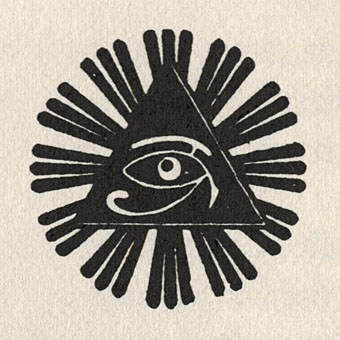
Continuing this occasional series. The above motif is the Golden Dawn’s Wedjat or Eye of Horus emblem as reproduced in the hardback edition of The Confessions of Aleister Crowley, an “autohagiography”. Crowley was under discussion here a few days ago and the eye in a triangle symbol can also be seen on the sleeve of the single featured in that posting, forming a part of the seal of the Ordo Templi Orientis, the occult order which Crowley joined in 1910. Crowley’s use of the eye in a triangle caught the attention of writer Robert Anton Wilson and the first part of his Illuminatus! trilogy (written with Robert Shea) is titled The Eye in the Pyramid. That latter symbol appears on the reverse of the American dollar bill, of course, and some of the conspiracy theories surrounding that usage are explored in the novel. Wilson went on to make the eye in a triangle something of a personal symbol and his obsessive use of the motif caught my attention in turn when I began reading his books.

All of which leads us to Hawkwind and a person whose name keeps turning up on these pages, designer Barney Bubbles.
eye1.jpg

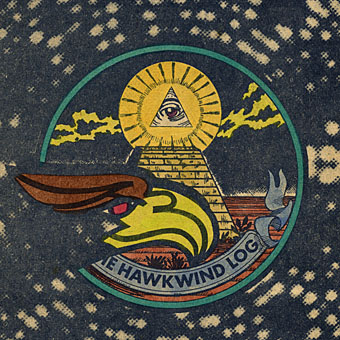
Hawklog cover (detail) by Barney Bubbles.

The booklet which BB designed for Hawkwind’s second album, In Search of Space (1971), featured a version of the dollar bill symbol on its cover. This is the only eye in a triangle design I’ve seen among Barney Bubbles’ work although he was so prolific there may well be others. When I began producing my own significantly inferior Hawkwind graphics in the late Seventies I incorporated eyes in triangles partly as a way of avoiding having to draw hawks all the time but mainly because of Robert Anton Wilson. BB had already established a precedent and it so happens that the eye in the Golden Dawn/Crowley version is the eye of a hawk-headed Egyptian god.

Continue reading “Design as virus 7: eyes and triangles”
Elizabeth Goluch’s precious metal insects

goluch1.jpg

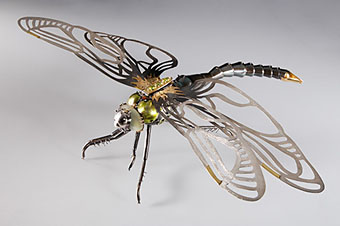
Dragonfly (Green Darner) sterling silver, 18k & 14k gold, brass, ceramit, moonstone.

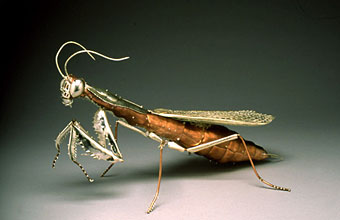
Two of Elizabeth Goluch‘s unique—and no doubt expensive—sculptures. She also does a range of jewellery.

Another fabulous find from Fabulon.

goluch2.jpg

Praying Mantis, sterling silver, copper, 14K & 18K gold.

Previously on { feuilleton }
Kelly McCallum’s insect art
The art of Jo Whaley
The art of Philippe Wolfers, 1858–1929
Lalique’s dragonflies
Lucien Gaillard
Insect Lab

Mikel Marton

sailor.jpg

Mikel by Mikel.

Delectable Canadian photographer and self-proclaimed “renowned exhibitionist” Mikel Marton (aka Toxicboy) has finally moved from LiveJournal to Blogger. Looks like postings there of himself and his models will be more regular than before which is good to see. And his Toxicboy site is still active, of course.

Previously on { feuilleton }
Tiger Lily
Toxicboy

The art of John Hurford

hurford.jpg

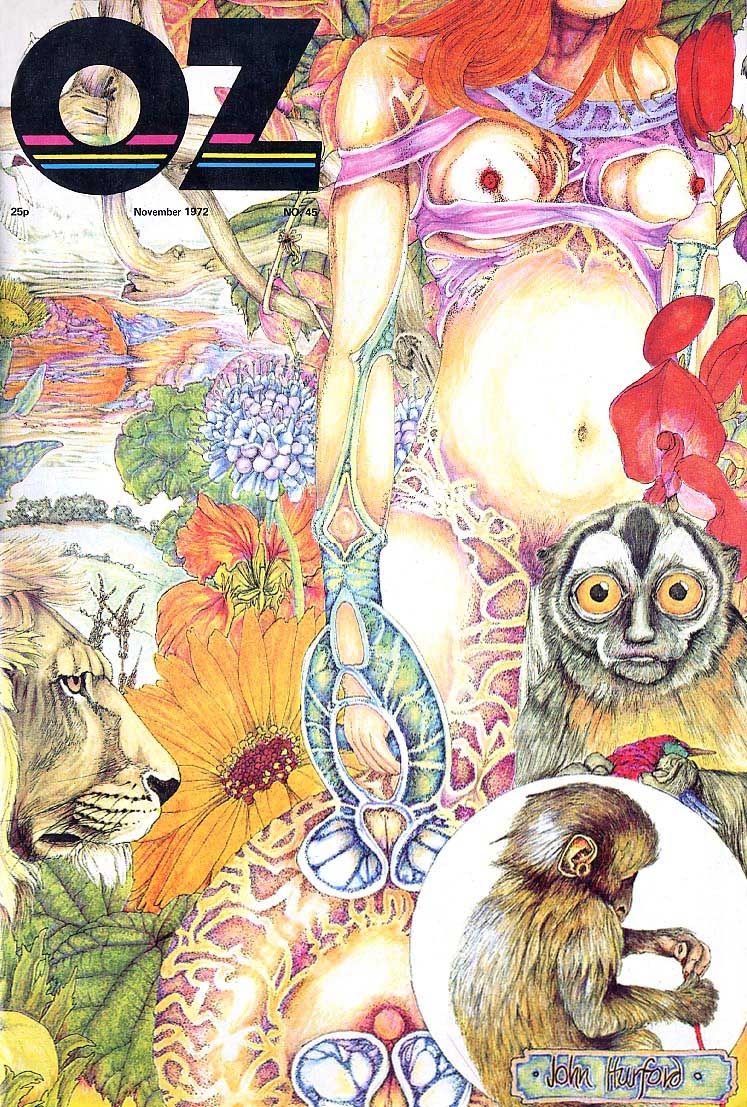
Oz #45, November 1972.

This large-format issue of Oz magazine with John Hurford’s cover was one of the last published and is also one of the few issues I own. Hurford provided many interior illustrations for Oz and other magazines, as well as producing poster art and other graphics. Unlike many artists of the period he’s still active and has his own site with examples of recent work. For more Oz covers, go here.

Elsewhere on { feuilleton }
The illustrators archive

Previously on { feuilleton }
The art of Bertrand
Barney Bubbles: artist and designer
Oz magazine, 1967–73