Sexual healing
| Simon Callow on gay roles in cinema.
Vintage swordplay #2
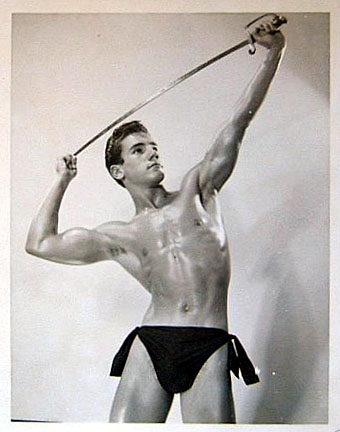
Even though I never really noticed before it’s become fairly obvious that adding a sword to a beefcake photo was a way of lending some spurious historicity to an otherwise overt piece of male nudity, the cheap version of having models pose among Greek or Roman ruins. Not that I’m complaining, of course. This example comes from Bob Anthony’s New York studio of the 1960s. Thanks to Aristan for the tip!
Elsewhere on { feuilleton }
• The men with swords archive
Dead on the Dancefloor
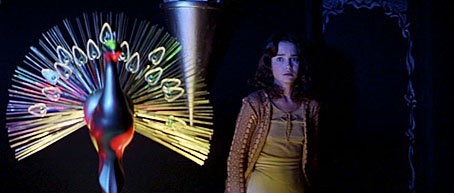
Suspiria: Jessica Harper and a bird with crystal plumage.
For this year’s Halloween playlist I’ve let Mark Pilkington from Strange Attractor make the selection. The following is from a CD-R collection of Italian horror soundtracks that Mark sent me some time ago. Not everything here is easy to find but the superbly nerve-jangling racket created by Goblin to accompany Dario Argento’s equally superb Suspiria (1977) is widely available and ideal Halloween listening.
If one hasn’t been written already, there’s probably a thesis to be found in the influence of progressive rock on Italian cinema. Many of these pieces represent a curious blending of the kind of Italian prog-rock exemplified by bands such as PFM together with the scores of (inevitably) Ennio Morricone. William Friedkin’s use of the opening of Mike Oldfield’s Tubular Bells in The Exorcist inspired legions of imitative themes in subsequent horror films, not least Suspiria. Dario Argento later brought in ELP’s Keith Emerson for the sequel, Inferno (1980), whose main theme—a kind of disco version of Jerry Goldsmith’s Latin chants from The Omen—I’ve always been rather partial to. The best of this music manages to be groovy and scary at the same time, Goblin being the masters in that department, and is often better than the films it was written for. The perfect thing for zombies in satin flares.
Cannibal Holocaust (Main theme) by Riz Ortolani
Death Dies (Profondo Rosso) by Goblin
Zombie Flesh Eaters (theme) by Fabio Frizzi
Sighs (Suspiria) by Goblin
Suoni Dissonanti (City of the Living Dead) by Fabio Frizzi
Flashing (Tenebrae) by Goblin
Adulteress’ Punishment (Cannibal Holocaust) by Riz Ortolani
Suspiria by Goblin
Voci Dal Nulla (The Beyond) by Fabio Frizzi
Deep Shadows (Profondo Rosso) by Giorgio Gaslini & Goblin
L’alba Dei Morti Viventi (Dawn of the Dead) by Goblin
Suono Aperto (The Beyond) by Fabio Frizzi
Markos (Suspiria) by Goblin
The Dead On Main St/Voodoo Rising (Zombie Flesh Eaters) by Fabio Frizzi
Escape From The Flesh Eaters (Zombie Flesh Eaters) by Fabio Frizzi
Roller (Non-soundtrack album) by Goblin
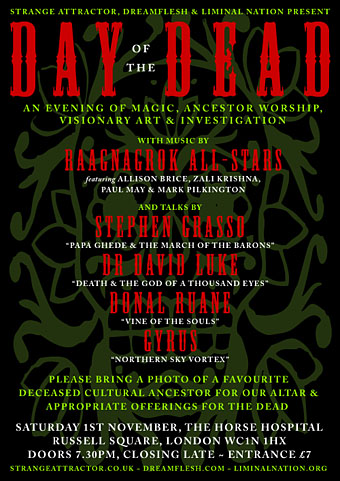
And while we’re on the subject of music and Halloween, Mark Pilkington is playing as part of the Raagnagrok All-Stars on November 1st at the Horse Hospital, London, as part of a Day of the Dead event. More about that here.
Happy Halloween!
Previously on { feuilleton }
• Another playlist for Halloween
• White Noise: Electric Storms, Radiophonics and the Delian Mode
• The Séance at Hobs Lane
• A playlist for Halloween
• Ghost Box
The Panic Broadcast
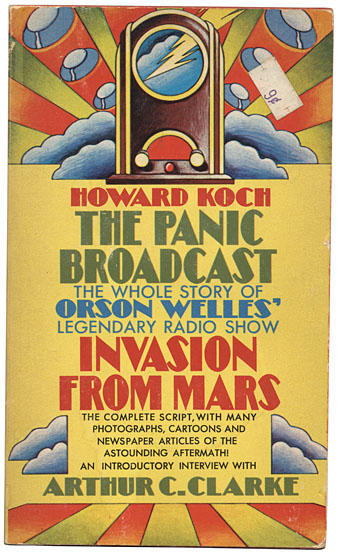
It was 70 years ago today—October 30, 1938—that Orson Welles and the Mercury Theatre traumatised American radio listeners with their brilliant adaptation of The War of the Worlds. I wrote about that recording last year so rather than repeat myself, here’s the final words from Howard Koch’s 1970 book about the play, The Panic Broadcast. (That’s the cover of my cheap paperback edition.) Koch was charged by Welles and producer John Houseman with the task of condensing and updating HG Wells’ novel and he ends his book with an examination of the lessons to be learned from the resulting hysteria. America’s current crop of demagogues on TV and radio—and the audiences prepared to take everything they say at face value—render his words as apposite now as they were forty years ago.
Meanwhile, how can we protect ourselves from politically biased information coming to us through the mass media? It isn’t as simple as dialing another station as in the case of the Martian scare. In my opinion, the only safeguard we have is the cultivation of a skeptical attitude toward all authority, to regard no person or office sacrosanct, to accept nothing that doesn’t accord with our experience and our knowledge acquired from other sources.
Most of my generation were brought up to give unquestioned obedience to authority, whether parental, religious or political. The result has been a compliant and conformist society that has tolerated a war every decade, all sorts of racial and economic inequities and a progressive spoliation of our planet. The management, shall we say, has been less than perfect.
But for the first time there are signs of a change and we have good reason to hope that the world won’t be lost by default. Today all authority is being questioned and challenged, especially by the young. The American people have become more concerned with public affairs on every level. They are taking less on faith; the individual intelligence is beginning to assert itself in self-protection and therein lies the promise of a society with the attributes for survival.
If the nonexistent Martians in the broadcast had anything important to teach us, I believe it is the virtue of doubting and testing everything that comes to us over the airwaves and on the printed pages – including those written by the author of this book.
• The Mercury Theatre on the Air | An archive of the radio shows
Previously on { feuilleton }
• The night that panicked America
• War of the Worlds book covers
Return to Las Pozas

Las Pozas is the unique fantasy/folly/Surrealist paradise which Edward James spent years building (and never quite finished) in the Mexican jungle of Xilitla. When I wrote about the place a couple of years ago decent photos were hard to find. Flickr has now filled the gap with this extensive set of views by Lucy Nieto. Lots of great details and some remarkable shots which show the scale of the structures, as does the picture above (note the people).
Previously on { feuilleton }
• The magic kingdom
• Las Pozas and Edward James