Weekend links 66

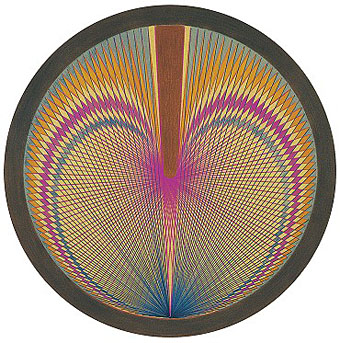
kunz.jpg

A design by Emma Kunz (1892–1963).

• Following the news this week it’s worth reminding people of a great post put together by Adam Curtis back in January, Rupert Murdoch—A portrait of Satan. One detail there concerns the death of chat show host Russell Harty in 1988. This week the London Review of Books posted an extract from Alan Bennett’s diaries referring to the Harty episode where he notes how the tabloid practice of getting private phone numbers from the police was common and widespread, not simply the actions of a single newspaper. For more about the deathbed hounding of Russell Harty (and Bennett’s loathing of Murdoch) see Writing Home. Related: Dennis Potter shortly before his death discussing his desire to kill Rupert Murdoch.

• Don’t get mad, get even: Hakim Bey’s Black Djinn Curse: “How to invoke a terrible curse on a malign institution.” See also: Black magic as revolutionary action.

Village Voice talks to Linda Manz about her experience as a young actor in Days of Heaven, The Wanderers and Out of the Blue.

Truth Wins Out infiltrates the “ex-gay” clinic run by Michelle Bachmann’s husband.

Free Situationist booklets by Larry Law. Related: films by Guy Debord at Ubuweb.

• Have tea with Doctor Dee in Mortlake, London, next Wednesday.

Publisher Peter Owen: Sixty years of innovation.

Wilhelm Reich: the man who invented free love.

A conversation with Brian Eno by Ben Sisario.

The mysterious minaret of Jam, Afghanistan.

Stereolab cover designs at Hardformat.

Orgone Accumulator (1973) by Hawkwind | Cloudbusting (1985) by Kate Bush | Orgasmatron (1986) by Motörhead | Orgasmatron (1993) by Sandoz | Orgone Donor (2004) by Deathprod.
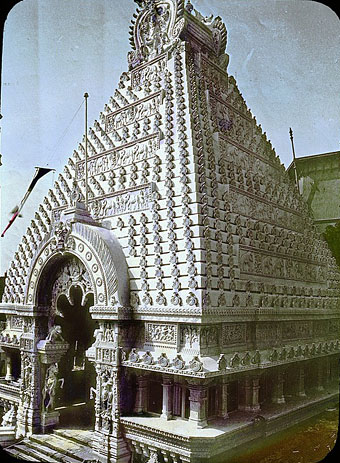
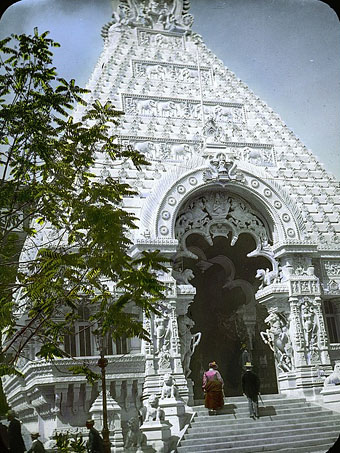
The Cambodian Pavilion, Paris, 1900

exposition1.jpg

Despite being one of the most striking and beautiful national pavilions in the Exposition Universelle of 1900, the Cambodian building seldom features isn’t featured in any of the exposition guides I’ve seen. These photos are from the excellent set of William Henry Goodyear views presented by the Brooklyn Museum at Flickr. If it wasn’t for the people visible in the picture below (and the Parisian lamp-post) you wouldn’t know these were from the exposition at all.

exposition2.jpg

exposition3.jpg

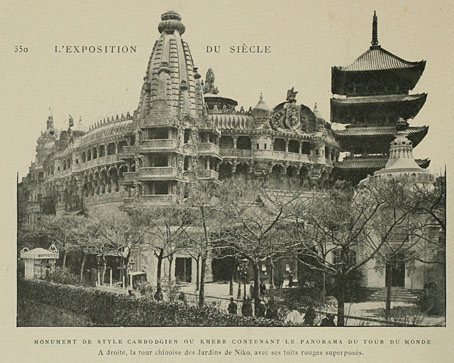
Another trace of Cambodia appeared via the Tour of the World exhibition where a variety of “exotic” buildings were forced to occupy the same plot of ground. This group does appear in the guides, the view here being from L’Exposition du Siècle by Albert Quantin. The multi-story confection dominating this scene may superficially resemble some of the Angkor temples, but for me it’s more reminiscent of buildings like the Casa Milà which Antoni Gaudí was constructing in Barcelona a few years later.

Previously on { feuilleton }
Le Manoir a l’Envers
Suchard at the Exposition Universelle
Esquisses Décoratives by René Binet
Le Palais de l’Optique, 1900
Exposition Universelle films
Exposition jewellery
Exposition Universelle catalogue
Exposition Universelle publications
Exposition cornucopia
Return to the Exposition Universelle
The Palais Lumineux
Louis Bonnier’s exposition dreams
Exposition Universelle, 1900

Angkor panoramas

angkor3.jpg

Ta Phrom by Rob van Gils.

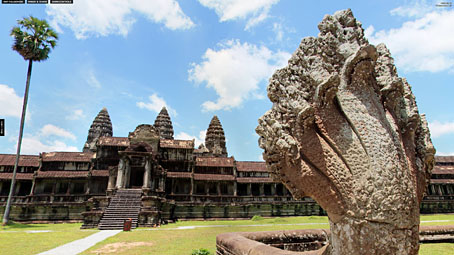
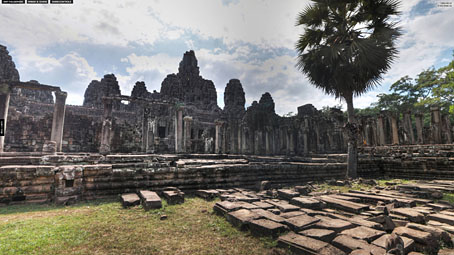
A Cambodian architecture post by Will from 50 Watts sent me to 360 Cities for some panoramic views of the temples of Angkor and environs. I always prefer the sight of these places in their weed-infested state even though all those weeds and tree roots were slowly destroying the stonework. For more recent photos, John McDermott’s site has many beautiful infra-red views of the temples and their statuary. (Click on the Fine Art section.)

angkor1.jpg

Naga at Angkor Wat – Siem Riap, Cambodia by Tetsuyayoshi.jp.

angkor2.jpg

Angkor by Vasiliy Nikitenko.

Elsewhere on { feuilleton }
The panoramas archive

Previously on { feuilleton }
The Temples of Bagan
The temples of Angkor

The Thackery T. Lambshead Cabinet of Curiosities

lambshead-cover.jpg

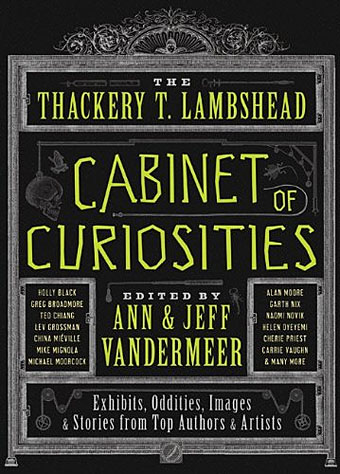
Cover design by James Iacobelli.

The sequel to The Thackery T. Lambshead Pocket Guide to Eccentric & Discredited Diseases is published next week in the US but we have permission to write about it before the official release. The Thackery T. Lambshead Cabinet of Curiosities is a chunky hardback of 320 pages with a host of contributors including Holly Black, Greg Broadmore, Ted Chiang, Rikki Ducornet, Amal El-Mohtar, Minister Faust, Jeffrey Ford, Lev Grossman, N.K. Jemisin, Caitlín R. Kiernan, China Miéville, Mike Mignola, Michael Moorcock, Alan Moore, Garth Nix, Naomi Novik, James A. Owen, Helen Oyeyemi, J.K. Potter, Cherie Priest, Ekaterina Sedia, Jan Švankmajer, Rachel Swirsky, Carrie Vaughn, Jake von Slatt, Tad Williams, Charles Yu and others. I provided title pages for the various sections of the book, as well as a variety of found and bespoke illustrations. And seeing as how I seldom miss an opportunity to take a dig at Rupert Murdoch (especially this week), it would be remiss of me if I didn’t mention that it’s published by an imprint of HarperCollins which means I’m currently feeling somewhat tainted by the Evil Empire. Mea culpa. When you sup with the devil, use a long spoon.

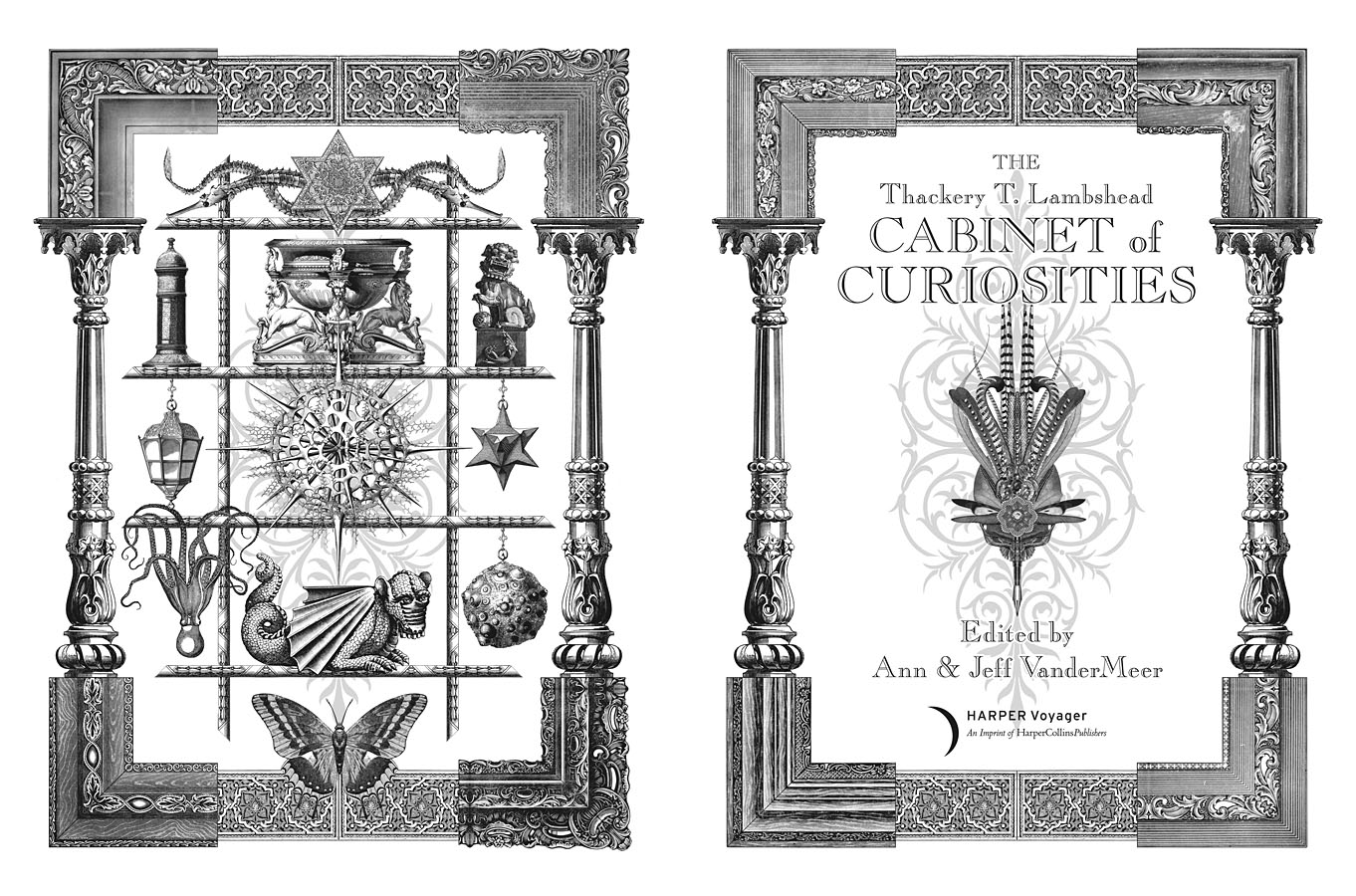
lambshead-title.jpg

My title spread.

That aside, this is a treat for anyone who enjoys the more experimental, eccentric and surreal end of the fantasy spectrum:

After the death of Dr. Thackery T. Lambshead at his house in Wimpering-on-the-Brook, England, a remarkable discovery was unearthed: the remains of an astonishing cabinet of curiosities. Many of these artifacts, curios, and wonders related to anecdotes and stories in the doctor’s personal journals. Others, when shown to the doctor’s friends, elicited further tales from a life like no other. Thus, in keeping with the bold spirit exemplified by Dr. Lambs­head and his exploits, we now proudly present highlights from the doctor’s cabinet, reconstructed not only through visual representations but also through exciting stories of intrigue and adventure. A carefully selected group of popular artists and acclaimed, bestselling authors has been assembled to bring this cabinet of curiosities to life.

From what I’ve read so far the general tone is a lot less overtly wacky than the first book, and if set beside some of the more clichéd and pedestrian fantasy works being jobbed out at the moment will probably seem downright avant garde. Editors Ann and Jeff VanderMeer have been at pains to emphasise that this isn’t another steampunk collection although seeing as how many people now equate steampunk with any kind of antique graphics that’s the way some may take it. Alan Moore aficionados should know that Alan’s piece, Objects Discovered in a Novel Under Construction, is a riff on some of the contents of his forthcoming novel Jerusalem. My illustration for that entry is below.

Jeff had some blog posts this week related to the book, one looking back at the Disease Guide, the other with details of the US tour he and Ann will shortly be undertaking. A couple of my other contributions follow.

Continue reading “The Thackery T. Lambshead Cabinet of Curiosities”

The Worlds of Mervyn Peake

peake-sphinx.jpg

Illustration by Mervyn Peake for The Sphinx by Oscar Wilde (1949).

The centenary of writer, artist and poet Mervyn Peake is being celebrated this year with a number of events in the UK. Mervyn Peake: A Centenary Celebration is a small exhibition of Peake’s drawings which has been running since April at the Pallant House Gallery, Chichester. That show ends on July 17th so if you want to be glared at by Fuchsia Groan you’re advised to get your skates on.

The Worlds of Mervyn Peake is a more substantial affair opening this week at the British Library, London, which promises to have materials from the British Library collection and the Peake archive on display. Two evenings of talks are also scheduled although the first of these, Mervyn Peake’s Gormenghast, is now sold out. The Guardian ran a feature at the weekend with pieces by some of the people who’ll be involved in the discussions, including Michael Moorcock, who’s been championing Peake’s work since the early 1960s, and China Miéville. For those who can’t make it to the exhibitions, there are also books: The Gormenghast Trilogy has been republished in a new illustrated edition, and the British Library is selling an American edition of Maeve Gilmore’s Peake’s Progress, a 592-page selection of writings, drawings and poetry which has been out-of-print in the UK for years. Essential purchases for any Peake enthusiast.

Update: There’s also an exhibition of artwork by Mervyn Peake and Maeve Gilmore at Viktor Wynd, London. Thanks to Vadim for the tip.

Elsewhere on { feuilleton }
The illustrators archive

Previously on { feuilleton }
A profusion of Peake
Joseph Cavalieri’s stained glass
Mervyn Peake at Maison d’Ailleurs
Peake’s Pan
Buccaneers #1
Mervyn Peake in Lilliput
The Illustrators of Alice