Seminal art and design

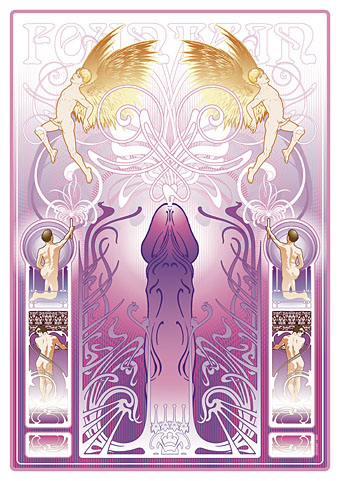
fountain.jpg

Fountain (2011) by John Coulthart.

seminal, a. and n.

A. adj. Of or pertaining to seed; of the nature of seed.

1. a. Of or pertaining to the seed or semen of men and animals (applied Phys. and Anat. to structures adapted to contain or convey semen); of the nature of semen.

Oxford English Dictionary

The Dirty Comics exhibition curated by Jon Macy opens today in San Francisco so here at last is my non-comics contribution to Jon’s erotic art show. This is something I’d had in mind for a while so it was good to have the opportunity to actually tackle the thing, and also have an outlet for it outside this website. Below I explore some of the intent and inspiration which led to the piece.

Creating some sort of gay erotica was an idea I’d had in mind for a while but it suffered from the usual syndrome whereby work with no immediate outlet gets shunted aside by the pressure of paid commissions and ongoing personal projects. It’s also the case that pieces of work I create for myself I tend to want to sell or see reproduced via a service such as CafePress. The trouble is that most of those services are based in the US which means they’re subject to that tiresome puritan attitude towards sexual content: anything other than “artistic” nudity is forbidden at CafePress, and the same applies to many other self-publishing services. There are outlets for gay erotica but I’ve not had chance to explore the best options. If anyone has any tips then please leave a comment.
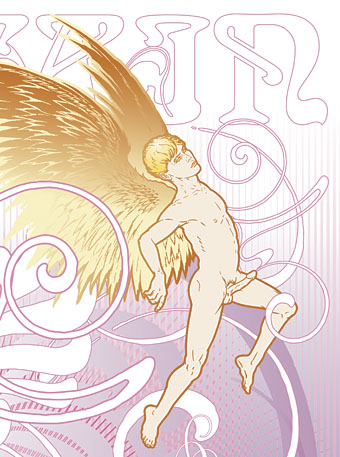
closeup.jpg

This angel figure was something I’d drawn back to 2008 when I’d made a start on a similar work which fell by the wayside. One of the great things about computer graphics is being able to work on part of something which can then be picked up later and dropped into a new composition.

figures.jpg

So the intention was to produce a follow-up to the Dodgem Logic cover I created last year which presented a same-sex take on various Art Nouveau stylisations. The figures above are from one of the early drafts which takes a border design from Alphonse Mucha’s Documents Decoratifs (below), a series of sample borders and frames Mucha produced for the use of artists and designers.

Continue reading “Seminal art and design”

Crafting steampunk illustrations

steampunk.jpg

Today’s post is another guest piece at Tor.com where I talk a little about using collage to create steampunk illustrations and designs. The post is part of their Steampunk Week, and I take the opportunity to acknowledge the influence of some artists who have become familiar points of reference here, namely Max Ernst and Wilfried Sätty.

Meanwhile, in light of this news, I should say that I don’t own an iPod, iPad or iPhone but there are four Apple computers of various vintage in this place, all of which have been used to create the art and design work I’ve been producing since the late 1990s. Apple machines and Adobe software literally changed my life by allowing me to get involved in graphic design and create artwork that would have been impossible to produce using pencil, ink and paint. Many thanks, then, to Steve Jobs. And RIP.

Previously on { feuilleton }
Initiations in the Abyss: A Surrealist Apocalypse
SteamPunk Magazine
Morlocks, airships and curious cabinets
The Steampunk Bible
Vultures Await
Steampunk Reloaded
Wilfried Sätty: Artist of the occult
Illustrating Poe #4: Wilfried Sätty
Steampunk overloaded!
More Steampunk and the Crawling Chaos
Steampunk Redux
Steampunk framed
Steampunk Horror Shortcuts

Abysmal creatures

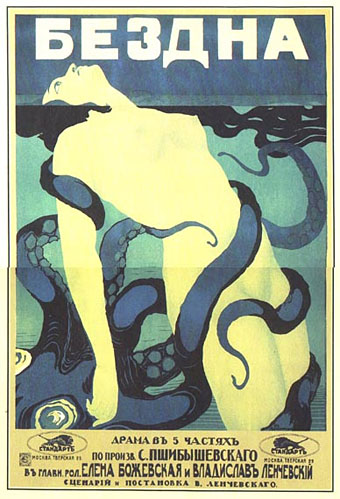
kalmanson1.jpg

Bezdna (Abyss).

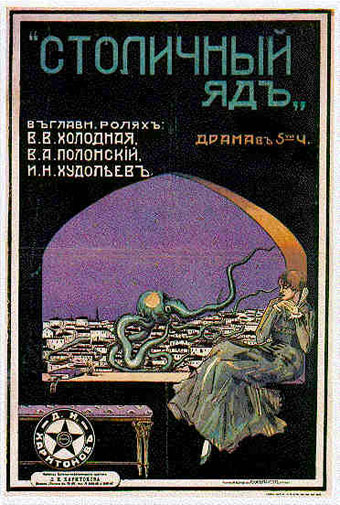
A couple of film posters from a time when poster artists weren’t prevented from treating their subject in a symbolic manner. Both these designs are the work of one M. Kalmanson (and I’m assuming here that the scant information is accurate), and both are for Russian films produced in 1917. Beautiful Century alerted me to the work above which Japonisme had spotted a couple of years ago when gathering the more familiar images of women menaced by those pesky cephalopods. Searching around produced the poster below which confirms that the artist had tentacles on the brain that year, creating a picture that looks like a collaboration between Edmund Dulac and HG Wells. There’s little information anywhere about the films themselves but that’s not too surprising when so much of the silent era has been lost forever. As with The Isle of Lost Ships, it’s a good bet that the cinematic reality was a lot less interesting than the promise of the poster design.

kalmanson2.jpg

Poison of the Big City. (Maybe… I can’t find this title confirmed in separate sources.)

Previously on { feuilleton }
Fascinating tentacula
Jewelled butterflies and cephalopods
The art of Rune Olsen
Octopulps
The art of NoBeast
Coming soon: Sea Monsters and Cannibals!

Murmur Become Ceaseless and Myriad

spare.jpg

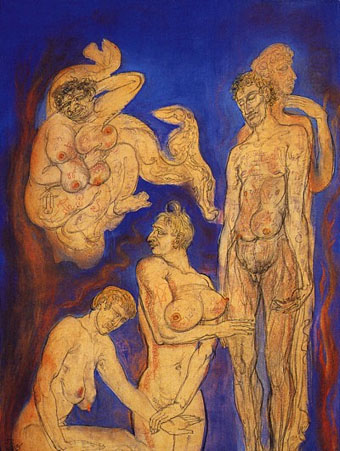
Efflaration (1952) by Austin Osman Spare.

The Austin Spare revival continues with another exhibition, Murmur Become Ceaseless and Myriad at Flat Time House, London, curated by Mark Titchner. Unless I’ve missed something this is a significant moment since it’s the first time Spare’s work has been paired with that of a more contemporary artist, the late John Latham (1921–2006) whose former home provides the exhibition space.

Biographically, the artists have a lot in common: a reticence to engage with the art establishment or the commercial art market; superficial correspondences with the work of their contemporaries but isolation by force of their ideas. The artistic genius of both these artists was, in the main, recognised by their peers, even if the subject of their work was not entirely understood.

In spite of this, discussion of Spare’s practice has largely related to arcana and magic, despite his training in fine art and early mainstream successes. Conversely, Latham’s work has been understood primarily in relation to the conceptual art practices of the 1960s and 70s. This exhibition broadens these perspectives, presenting their work in the context of two parallel experimental practices. (more)

There’s also a somewhat tenuous connection between the pair in the figure of Alan Moore, a Spare enthusiast who in 1992 appeared with John Latham and a number of other literary and artistic types in The Cardinal and the Corpse, a TV film by Iain Sinclair and Chris Petit which really ought to be on YouTube but isn’t. It’s worth a watch if you can find a copy. Murmur Become Ceaseless and Myriad runs until 30th October.

Previously on { feuilleton }
Kenneth Grant, 1924–2011
New Austin Spare grimoires
Austin Spare absinthe
Austin Spare’s Behind the Veil
Austin Osman Spare

Main aesthetics

main01.jpg

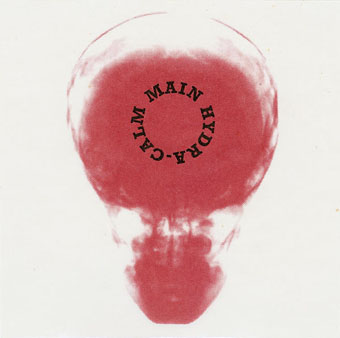
Hydra-Calm (1992).

It’s always good to find a group of musicians who not only make the kind of sounds you like but also package their work effectively. Having read the Quietus interview with Robert Hampson last week I was going back through the catalogue of Hampson’s 90s group Main and thinking again how well the design of their digipak singles and albums complemented their music. Main evolved out of an earlier rock outfit, Loop, and the earliest Main productions still bear some trace of the trancey Loop approach to rock structures. The first Main album, Hydra-Calm, was released on Situation Two, and comes packaged like the first album from Faust, with an X-ray of a skull on a transparent sheet replacing the X-ray fist of the German group.

main02.jpg

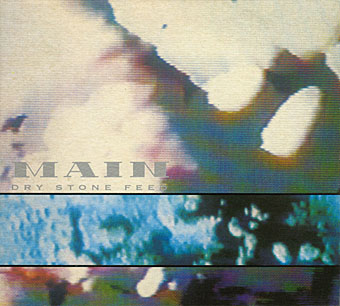
Dry Stone Feed (1993).

With a move to the Beggars Banquet label a year later, a different design approach was adopted which set the template for nearly all the Main releases during the 1990s. An outfit (or person) named Avida is credited with Main’s design, with the name being adjusted on various releases to Avida Design, Avida Formations, Avida Hydroforms and Avida Iceforms. The decision to dwell on varieties of texture matches the evolution of the group’s music from arrangements of guitar, bass and drums to abstract and increasingly minimal fields of sound; in this respect, Deliquescence was a perfect title. Hampson and co. created their sound fields by subjecting guitar noise to unspecified sampling and effects processes. When Simon Reynolds invented the term “Post-rock” to describe some of the musical developments happening in the 1990s, Main always seemed to be exemplars of the term, they really did go from being a bona fide rock band to a group pushing sound far beyond anything to do with rock music at all.

main03.jpg

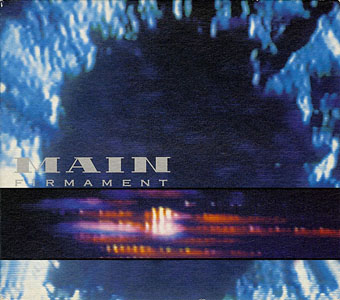
Firmament (1993).

The photos used by Avida Design start out as shots of TV screens or computer monitors then range through the natural world with close-ups of rock formations, lichen, wood grain and underwater ice. The typography is nearly always Copperplate Gothic (or a sans serif variation) printed in metallic silver ink. The most satisfying release for me was the Hz set of six CD-singles released from mid-1995 to 1996, the last of which came with a box to place the singles in and a booklet containing symbols which relate to each disc. Hz is the peak of their output, and although it was later released as a double-disc set I prefer the box.

Anyone looking for these releases today can find copies for sale at Discogs.com. Robert Hampson is still active, his site is here. A few more Main covers follow.

Continue reading “Main aesthetics”